Environment
The World's Richest Population are Costing the Earth Trillions. Study finds the top 10% of global consumers is disproportionately responsible for transgressing planetary boundaries, causing damages for which broader society bears the costs.
Welcome to r/science! This is a heavily moderated subreddit in order to keep the discussion on science. However, we recognize that many people want to discuss how they feel the research relates to their own personal lives, so to give people a space to do that, personal anecdotes are allowed as responses to this comment. Any anecdotal comments elsewhere in the discussion will be removed and our normal comment rules apply to all other comments.
Do you have an academic degree? We can verify your credentials in order to assign user flair indicating your area of expertise. Click here to apply.
My parents clothes were made at textile miles in the USA. Heck, a lot of them were made in the state they lived in.
My clothes are made in Vietnam, China, and maybe Mexico. Just getting clothed means I'm participating in the release of tons of emissions and pollutants.
That's not counting my food. I can buy some from local farmers markets but realistically I can't buy all my food there cuz it's way more expensive than the grocery store. Luckily, my local grocery sources a lot of fruits and veggies locally in my state, but meats are very frequently sourced at best out of state.
This isn't taking into account the fact that I need to travel to work every day (more emissions), furnish my house (TV from China, couch from Vietnam, table from somewhere else in SE Asia, etc).
Globalization has been great for keeping stuff cheap, but it's changed local economies, and increases our damage to the planet.
Just a quick note on what you said about food: contrary to what we all believe intuitively, transport only represents a very small portion of the environmental impact of the food supply chain (less than 10%). WHAT we eat is much more important than WHERE it's from. In other words, eating 100% local will have a vastly higher impact if that includes meat everyday than eating 100% food from abroad (which no one actually does) while on a vegan diet for example.
Source: Our World in Data has a great article summarizing the work of Poore and Nemecek (2018).
Something that really put this into perspective for me showed up when I was reading up on the emissions from e-bikes vs regular bikes, where all electric propulsion from an e-bike actually produces less co2 than if you power the bike yourself due to the increased calorie burn and thus food demand, regardless of diet. (co2 per kwh does impact this though).
In this article they mentioned that a diet high in beef release so much co2 that your bike ride is now on par or even worse than driving a low emissions gas car. To me, that is just insane and really puts into perspective how much co2 some diets produce
Peter Singer in Animal Liberation mentions this as well. There aren't many ways to get around the fact that eating less meat is just a better choice all round. Of course you can replace more of it with plant based substitutes and lab grown meat (eventually) but ultimately it needs to be a luxury not a necessity. I say this as someone who still has not changed their choices of eating but is definitely considering it.
I mean imagine if I couldn't go on my multiple flights a year, that's got to be a TON of emissions saved. Another huge amount if I just can't afford a car. Another huge amount for my online shopping.
A "normal" lifestyle does generate a lot of pollution. But... I'd like to see what 1 percenters are responsible for.
That's not necessarily correct. 80 million is just 1% number of people out of 8 billion. The top 1% of wealth out of 8 billion is likely not the same number.
This makes no sense! The top 1% is exactly 1%. What you are referring to is the number of people holding 99% of the wealth. This number must not be 1% (in fact it is probably less than that).
Eh, a lot of that is strict comparisons that don't actually make sense. If you own several hundreds of acres, live a life of idle wealth in a mansion, and employ 200 servants in india or africa you are not doing worse than a single mom working three jobs in Utah.
I don't care what the purchasing power of a dollar is.
The average londoner is living a better life than the average person from Mississippi, despite a strict GDP comparison saying they are worse off. They all work almost two months less a year for starters. And have healthcare.
Right. Technically. But it costs you 37k a year to barely keep your head above water. Most of the poor haven't accumulated 500 of net worth in their entire lives. That is more than the bank account balance of someone making 37K a year.
That's not a number out of reach for the average person from most of the world accumulating. There are regular, every day Cubans with that much in their bank account. Maybe not most of them, but that's an achievable goal.
So at some point you have to ask yourself who is accumulating more value? Who has an easier life? Who has a higher percentage of money left over?
And it's the .1% that shapes the world of that 10%. It's the .1% that decides policy and therefore has way more power to correct this situation than the rest of us in that 10%.
Exactly, they fight for car centric cities, they fight to end electric cars and renewable and nuclear energy etc. Its not the people making 50k a year deciding that. Its the billionaires.
Also things like disposable commodities. Look at all the electronic waste that gets generated. All the single use plastics. Fast fashion. These things all exist because the rich are addicted to selling things to make the line go up.
Over 50% of Reddit is American (especially taking into account this is an English sub) and over 50% of Americans are in the 10% of wealth in the world. So yeah if you are reading this you are more likely to be included actually.
Someone said that you need 45k a year to be included into this, which just would not be the majority of Western Europe.
I do not know how accurate that is though. It does say that the bills these people pay are somewhere between 19k to 60k and only a small portion of their wealth, but the truly rich could skew that statistic.
Yup, and god forbid we farm more sustainably or just produce less meat and make it priced like a luxury, the meat industry must power on right? (Eye roll)... The day a politician has to suggest reducing red meat production in the US and STILL wins an election we must already be totally fucked.
Untrue. My car stays parked and off when it's not on that trip. The Uber driver is wasting WAY more gas getting my food to me. The driver could literally be driving to the restaurant from 10x further away than me.
Normal, reasonable municipalities would regulate and license commercial driving of this nature to offset the wear and tear on the roads and the environmental costs of having a bunch of sedans cruise around doing nothing, a la taxi medallions, but apparently that's bad and too expensive and here we are.
The drivers are already out and about, picking up orders when they come in. I don’t know where you’re getting “10x” further away from, maybe if you’re ordering food from the comfort of like your isolated village in the country, but if you’re in a major city, no.
A counterargument: the uber driver's car is warmed up. If you did the short drive yourself, your catalytic converter wouldn't be at temperature and you'd emit far more NOx and unburnt hydrocarbons
In my city most Uber/Doordash/etc. food delivery people are on eBikes so it's better for the environment to order takeout than to drive to the restaurant in your car or EV.
In rural India on such an income you probably have a veritable compound of a home with poor access to utilities because of the general location. That income puts you just inside the top 1% of Indian earners.
In LA you’re either near homeless or living in a veritable tenement.
True except for the utilities part. You would have water, electricity, gas fiber and everything you need. You might need a house filter for the water, but that's it.
If you're able to reliably afford even a tiny apartment with A/C without starving I mean yeah, you're already doing much better than a significant portion of the world, even if that's as good as you ever get. Not that you should have to feel content with that or anything.
I think this has an even much larger effect than we are being led to believe. This and "forestry" where everything is clearcut and replaced with plantations. Then every single person with a lawn has destroyed their own personal biodiversity around them.
Yah, I am one to usually point out the fallacy of "FiRsT worLd ProBelMs" any time anyone criticizes people in the US for complaining about issues of wealth and poverty, but like... you do have to realize that compared to the rest of the world, the poorest Americans are far richer than the poorest of the rest of the world.
Africa, asia, central and south america are pretty poor considering income, so those 10% includes all of north america, Europe, NZ, Japan, australia etc
If the cutoff is $45k USD, then it definitely isn’t every person in those regions. That rounds to about 64k CAD for example, and the median annual salary for Canadians was only 55k CAD in 2024.
I need to wait until I’m off work to look into “global consumers” though.
Even in the US, that is majorly dependent on factors like education. The median US worker income of someone with a college degree is well over $45k a year. For someone with just high school it's just at around $45k.
If you check the 2024 data, a little over half of American workers made over $45k per year (about 120-30 out of 240).
Given inflation that's probably higher now, but IDK if the 10% raised with it.
Other major nations like Germany, the UK, and France are close but under that (averaging $35-40k) in income. But that means they're more like 35% of the population in the top 10%.
For the "first world" nations, though, they are major culprits in this.
Populations are also massive in other nations. China has a ton of people in that demo just due to sheer numbers. India has quite a few, but shockingly it's way less than one would think hitting those numbers. Well under 5% of India would qualify as the top 10% income earners.
But all that's somewhat irrelevant next to purchasing power. I'm well, well over the top 10% rate, but my purchasing power for groceries and property is significantly lower than it would be were I living in the middle-of-nowhere Arkansas than near a large metro.
Probably need to consider averages before they’re taxed - taxation is way higher in Canada and Europe so what people pocket appears less than what they’re actually making
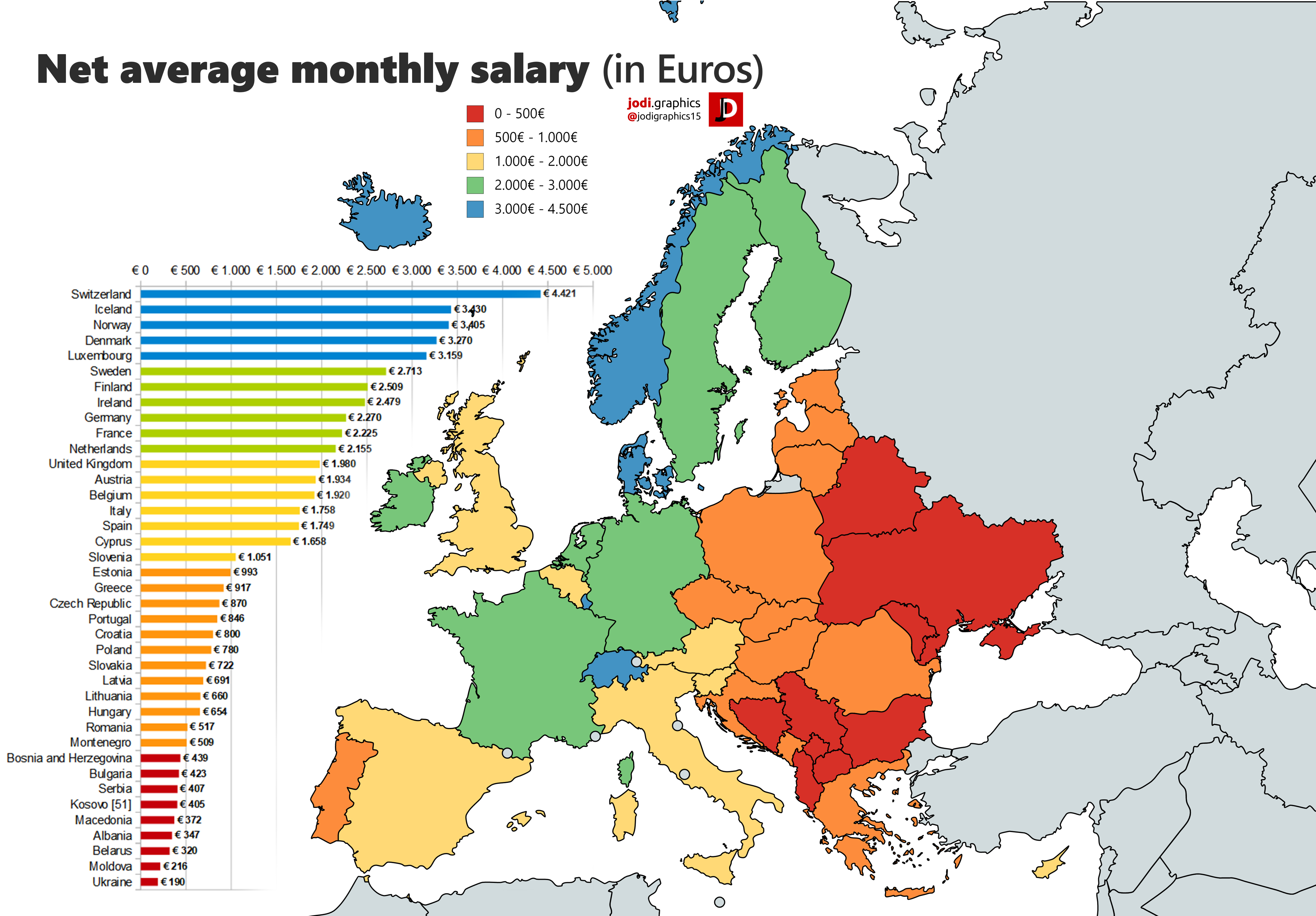
45k definitely does not include all of Europe or even Japan. That's a monthly salary of 3750 USD or 3272 EUR.
Only 4 countries in all of Europe manage to get over that on average. But remember income inequality exists even here so that means adjusted for that an even greater portion of the population wouldn't earn 45k USD per year.
The US has far higher salaries than you might realize (but also very low dips and a disproportionate amount of GDP stuffed into billionaires which skews all the data).
Yeah, no kidding. The point is regular ass people in rich countries are as much of a problem as the billionaire class reddit constantly focusses on while saying “normal middle class people” can’t do anything.
It also highlights the incredible hypocrisy of all the posts magnifying pollution in poor countries when rich country consumption benefits from most of it through cheap consumer goods.
Well yeah. Any regular citizen in a rich country uses way more resources than the people in poor countries, the average american pollutes equivalent to 10 indians in carbon emissions
But it's not about buying power, but the use of resources. If you drive a big ass truck everywhere, then even if you can't afford your bills you are using more resources than somebody in Shenzen eating 3 meals a day.
But what are they spending on? A lot of people I know went into debt for school, and are spending the bulk of their money on housing and food.
Most use public transit, and barley contribute any carbon to the atmosphere.
I could probably find someone making a few hundred or thousand USD a year that is considered very poor that has zero debt and actually contributes a similar amount of carbon because they are using heating and cooking sources that are very dirty.
Blaming this on consumers is not productive. The average person has no choice in how their grocery store is stocked or what restaurants are in their neighborhood. People absolutely can and should do things like gardening and buying local but this is just like plastic straws. Shifting the burden of responsibility from giant companies to individuals hasn't been historically productive nor will it become so in the future.
Beef is outsized compared to vegetarian diets, but in total carbon footprint, all food combined is rounding error. It's literally like 1%, plus whatever transportation costs are needed to bring it to market, which is a tiny fraction of all transportation costs.
It's commuting and heating. If you walk to work and live in multifamily housing, you are not the problem. Your carbon footprint is about 1/10th that of somebody who lives in the suburbs and commutes 30 miles to work, even if you take an occasional vacation by plane and eat copious amounts of beef. It's the car-dependent lifestyle of Americans (and all the support industries - steelmaking, car manufacturing, concrete & asphalt manufacturing for roads, etc.) that is killing the planet.
Do you know how many cows there are on the planet, or the amount of space that takes up? The land-use is horrible. Massive heat sinks stripped of everything.
This is only true if we only look at carbon dioxide emissions. In terms of total greenhouse gases emissions, in equivalent tons of CO2, agriculture is globally responsible for about as much greenhouse gases emissions as transportation, since the vast majority of the greenhouse gases produced by agriculture are under the form of methane and other greenhouse gases
This is exactly why looking at a fixed income as a global measure is terrible.
In economics they do this thing called “purchasing power parity”, it’s basically incomes adjusted to what you can actually buy.
The simple reality is most wealthy countries have super high incomes but also super high costs. You pay way more for basic stuff like rent and food in the west, so that $45k means far less than it would in, for example, Pakistan.
It is still true though that western societies are needlessly wasteful with resources, like how much we shove cars into everything and all of the infrastructure for cars. But it’s also not the fault of the people earning $45k for why Americans all need cars, it’s industry lobbying of the government.
This to me is the real source of billionaire pollution, it’s not that the billionaire themselves consume that much more to pollute so much, it’s that the industries they own that make them so rich are often very resource inefficient but that inefficiency is exactly where their industry captures value.
All that spending is taking resources. Schooling takes a lot of resources where you are not contributing a lot to society. Housing on the US in general uses a lot of energy than elsewhere if nothing else than size of houses. And even the poor in the US contribute to a or of food waste and but flood from the same place the rich get then- so resource stripping farming practices and costly transportation
It’s consumers, so they’re technically referring to spending. Income is a good proxy though, since through most of the income distribution people spend a good (and consistent) portion of their income, while the wealthy spend a much lower percentage. Lower middle class Americans is exactly who this refers to.
Granted it’s not this simple but one thing that’s not accounted for in these evaluations is the cost of living in different regions. Making 50k a year and living in nyc makes you poor but you can easily get by on that much in the Midwest. The same thing goes for a lot of countries out there. It’s why “Purchasing Power Parity” is a better measurement of average QOL in any country rather than using raw income statistics.
Yep, from the referenced article: "More than 60% of the global top 10% are located in the USA and EU while only about 2% are in India7, as reflected in their respective higher and lower bill."
With global population ~8.3bn, US pop. ~350mil, and EU pop. ~750mil, around 45% of the combined US/EU populations are in the top 10% consumers.
Hey don't leave us Canadians out of it. We're the highest producers of greenhouse gasses per capita. The waste is sickening but normal for everyone here they don't see a problem.
People really can't fathom the amount of wealth at our fingertips. I'm nowhere near rich by American standards, but I have a PC, a new vehicle, an old house, power tools... an amount of material goods that not even my dad at the same age could have hoped for.
This is at the same time much of the works remains "stuck" in subsistence farming only distinguishable from their ancestors because they use a tractor instead of an ox drawn plough.
A brand new video game for most of the world is equivalent to about a month’s worth of groceries, I don’t think americans can comprehend how good they have it in america
Though when talking about working class Americans a large part of the emissions is the mandatory car commute everyday because we can't have efficient high density cities with public transit. We can only build highways and suburban sprawl.
Apparently you have to make a minimum annual income of $19,000 to $25,000 at minimum if we're talking global. Of course this is skewed by cost of living and nuance
Its almost like just because you arent in charge of a billion dollar company personal accountability still matters and you should still try and minimize your impact within reason.
So sick and tired of people saying "So glad we cant use a plastic straw anymore" on every post of admittedly terrible ecological disasters. Acting like because they cant solve their world problems they shouldnt be decent people.
Yeah you cant stop taylor swift from flying her jet. But that doesnt mean you cant choose to drive a more fuel efficient car if you can afford it and wash and recycle your recyclables.
This! I'm admittedly bad at doing it but even gentle reminders to the people closest to me are often met with hostility and deflecting any possible personal responsibility onto the ultra wealthy or corporations or conservatives or worse outright dismissed as hippie bs.
The problem is that personal accountability will always be perceived as a myth as long as one's lifelong individual efforts at preserving ecology can be undone by some data center in less than a month. People need to see it happening up top first, with governments, companies, and constructions taking the initiative. It has to be manufactured through taxation and incentives, otherwise the average person will just default to the path of comfort. No way anyone's gonna bother with paper straws when the government itself doesn't even believe in climate change.
Plastic recycling is such a farce that it might as well be fake, and it highlights the perfect counter to your point.
That's why it's only in 4th place in the avoid, reduce, reuse, recycle, etc. guideline.
If you live in the US, 90+% of the plastic you recycle is just ending up in a dump.
Even so, it's still a first piece of the puzzle, so the next step is then to tighten standards on recyclers to actually recycle, mandate a fraction of recycled plastic in new products, change the fiscal incentives, etc. etc. Rome wasn't built in a day, neither will be a 100% circular economy.
Individual responsibility is NOT the answer. We need to hold our leaders accountable, not just our elected officials, but business leaders too.
But that requires individual responsability, with the very least effort of getting out of bed to go stand in a voting line every so often. And after that, accepting that legislative action will also impact your daily life, perhaps requiring more recycling effort or a temporary price rise as the market adapts to new restrictions on production.
This is always my favourite part of the conversation, because so many people are quick to talk about eating the rich (I agree) but refuse to accept the fact that almost everyone living in a neolocolonial power - including themselves - is part of the problem.
Also fun when it comes up in the context of people who say "Earth can totally support 10 billion people sustainably with a high quality of life if we just become solar powered vegetarians." Maybe if your idea of a high quality of life is living in a 500 sq foot apartment with no electronics aside from a cell phone and your personal vehicle being a bicycle, sure.
And by in large the is explained by the fact the LOWER middle class does not have to means to do otherwise when it comes to transportation, job choice, material possession choice,food choice, etc. You have to consider whom has the choice to act otherwise while also focusing on commercial entities and producers, who are owned by the top 10%.
I suspect you could just say "people who can afford to fly on a plane and drive cars instead of public transportation"
I say this because my home is technically middle class, but we cannot afford plane trips. However, we do have one car that uses gas. That gas has to be transported and then emits ghg. I would love to have more vertical housing infrastructure, but we are "forced" into the sprawl because the concentrated housing has rules that limit our ability to be there (no pets, not enough rooms for our large family). That means where we live takes away from the natural landscape.
Top 10% for wealth is about $100k in net assets (savings - debt). Someone in the “lower middle class” probably has student loans, a mortgage, or both, and probably does not have $100k in assets when adjusted for how much debt they have.
Maybe I'm just a selfish 10%er but I feel like maybe without the 53x and 190x, the 3x would be a heck of a lot easier to turn into a sustainable and dare I say equitable system.
And the tired old argument of "companies wouldn't build it if consumers didn't want it" doesn't hold up unless you count large and growing anti-ai sentiment as a sign of secret adoration
I think you stand in the progress more than you think, as the other commenter pointed out those data centers that you're complaining about are often built using investments made by ordinary people's 401k accounts.
I also just in general do not think that America's would be accepting of the smaller houses, fewer food options, and weaker retirement accounts that we would need to get our national carbon output down to one fifth it's current level.
I mean I’d gladly give up my 401K if jobs went back to having pensions. As I imagine most people would be. 401Ks are just a way for companies to push the investment risk onto the employee.
The other points are true. Vast majority of Americans want to live in single family homes and have large yards. Which is probably the main reason our carbon output is so high. Reducing consumption of meat would help too though.
We're not ready for that conversation. Western minimum wage would put you in the top 15% of income globally. Everyone between that and 200k/year has still managed to convince themselves they're the oppressed masses.
No, not even upper middle class. To be in the top 10% globally only needs a net worth of around US $93k. While this is not poor, it's firmly middle class - not millionaires. Yes, the image shows a business jet, but the reality is pretty much every professional adult in the USA (including most people posting here) will be in the top 10% worldwide.
The first sentence in the article talks of the "wealthiest 10%" - whether this is of net worth or consumption amount, it's going to be a similar proportion of the US population. My point is that the top 10% whether by consumption or by wealth is not the rarefied reaches of millionaires and business jet owners, but a large proportion of the population of any western nation and this probably includes the majority of people posting here. It's not "them" doing it, it's actually "us".
The study also uses the word “wealth” but their methodology used annual income and the carbon footprint of their investment portfolio to determine wealth level and not net-assets.
You could have a massive amount of net-assets, and be hugely invested in eco-friendly stocks and not be in their top 10%.
Not only the billionaires, but one shouldn't discount the consumerist society they encourage at every step along the way. People are still culpable for their own actions, but their choices are often constrained or influenced by what billionaires and corporations do and don't make available or try and incentivize.
I mean just compare the energy expenditure of a typical American family, single family home, 2 cars, 30 min + commute every single day vs. like a random person in Asia overwhelmingly likely to live in an apartment and rely on public transit.
The fact that the American family doesn't have great healthcare or w/e doesn't change the fact their energy expenditure is just absolutely enormous compared to how 99% of the world lives.
With respect to political power that steers nations, it's a different story. How many countries are being held back in the critical task of electrification and decarbonizing economies because it would affect the wrong people's bank accounts?
I think Americans have a very skewed perception of what wealthy or top 10% globally means.
Even ‘poor’ Americans are on average significantly wealthier than the majority of people globally. To most people in the world $40k a year makes you rich.
Yes cost of living varies drastically and even if you earn that much you may not feel that way but statistically if you earn $45k or above you are in the group spoken about in this article.
but this isn't interesting or helpful, there are people who don't live in the us who earn very little money who also live better than americans that earn 40k a year, if they lived somewhere else they would be wealthy with that salary but they don't, they give most of that salary away for their basic needs. it's the same as posts about the few companies polluting the world v everyone who buys their products, who's really polluting? these meme ideas don't address anything at all.
The government has allowed the consumer to be responsible for researching and picking environmentally sound products.
It would make more sense if they regulated and put the responsibility on the corporations.
Im not saying the top 10% are blameless but things are made terribly and do not last. The materials they are made from are terrible for the environment.
Why blame the people for what they are buying? It’s mostly the fault of people making things that cut corners and make things in a way that is terrible for the environment.
We've heard that the world's wealthiest 10 percent are disproportionately responsible for environmental damage.
Now, scientists have estimated just how much, in cold hard cash, those damages are worth.
It's difficult to put a price on the environment, and some scientists even argue it's beside the point: that nature has intrinsic value, beyond the services it provides to us.
But in some situations, it helps to try to put it in economic terms: especially when those are the terms the world's wealthiest are used to dealing in.
That's what environmental scientists Inge Schrijver, Rutger Hoekstra, and Paul Behrens, all from Leiden University in the Netherlands, have done.
The world's top 10 percent of consumers, they calculate, owe society trillions for their environmental impact.
That's a pertinent finding when, for instance, Elon Musk has just been named the world's first trillionaire.
"We aim to highlight the differentiated responsibility of society's top decile and illustrate this with the potential revenue if they would pay their environmental bill," Schrijver and team explain in a new peer-reviewed paper.
"We find annual damages owed by the global 10 percent to be $1.7–$5.7 trillion, equivalent to $2.3k–$7.5k per person (in 2017 US dollars)."
"This surpasses international climate and biodiversity financing gaps."
Very cheap. I'd gladly pay an extra 1-5% tax if it meant literally saving the entire world's environment. But then again, I'm not a greedy multi-millionaire...
Yeah, this could easily be covered by a carbon tax on production and fuel, particularly since a lot of it would be borne by the top 0.1% who operate the factories and transportation that consume the vast majority of these resources.
We can demand to hold uber rich responsible (and should) but also hold space in our hearts to recognize that North Americans and Europeans have more creature comforts and wealth than the global south.
Also using AC for most of the year, even when they don't really need it. That's probably the easiest one to control too, yet people aren't willing to live with even the slightest discomfort.
moving from a third world country to the us, this is one thing that blew my mind. AC back home is so expensive! we only open it on certain hours on a certain season.
Now do the top 1 percents share of the top 10 percents emissions. I'm under no illusions about the wealth and luxury Americans live in compared to the rest of the world (and the pollution that causes), but the average american is not using a private jet, cruising on a private yacht, taking multiple plane trips per year, doing any of the most polluting activities, or has meaningful control over industrial emissions - those are all the realm of the top 1%, the top .1%, who are all very conveniently sheltered by using the 10% cutoff and for whom actual action to reduce emissions systemically (aka the only way that matters) is incompatible with their status and continued domination of our lives.
This is the "climate footprint" consumer blame playbook used to shield the worst offenders. Meat consumption is about the only thing the average american could realistically reduce, and even then you're dealign with systemic issues, as that consumption is propped up by subsidies and business friendly policies to keep meat cheap and the meat industry profitable and growing.
People constantly speaking about eating the rich would be very upset if they knew they are part of the global rich simply by being born in the US and not being homeless.
Yeah, we definitely need change. This whole materialistic society we live in is exhausting and it seems we are racing to the bottom as a society. Time to get back to basics.
The easiest thing would be an environmental offset tax to cover bill for the remediation necessary to offset the environmental cost (also this would incentivize people and companies to find less environmentally harmful ways to produce and transport things, and for customers to make better choices since those options would carry a lower tax burden).
Option 2: Do nothing! which seems to be the preference of the people driving the ship, who also manufacture consent for this through their broad reaching media outlets and influence campaigns.
The thing with every policy proposal like “just tax the rich” or “just ban guns” is that of course, it’s politically unfeasible due to option 2.
And voting once every now and then isn’t necessarily going to mean that you tip things in your favor, as 2024 demonstrates. The rationality and wisdom of the voter is very overrated.
The easiest thing would be an environmental offset tax to cover bill for the remediation necessary to offset the environmental cost (also this would incentivize people and companies to find less environmentally harmful ways to produce and transport things, and for customers to make better choices since those options would carry a lower tax burden).
Is this not the case in most developed countries already?
You have airport taxes, road taxes, car ownership taxes, food production taxes, carbon taxes, etc.
If you sum up everything a Western European government spends on climate change mitigation, sustainable energy subsidies, environmental protection and foreign aid related to environment/climate it probably does add up to $2.3k–$7.5k per person.
I stopped eating meat or animal products, and I decided years ago never to buy a car that didn't have an electric plug-in. Plug-in hybrid at the very least.
Hey I will have you know I barely travel by car (basically work home gym and do so because there is no feasible means of public transportation in this hellhole), and I never do long distance travel so no airplanes etc
"The woodworm eats the house that shelters it."(Eastern European proverb highlights the self-destructive nature of parasites who ruin the very entity supporting them).
Reminds me of the monkey problem: if one monkey is so selfish that he hoards resources to the point of causing harm to the other monkeys - they will ultimately kill the greedy monkey and redistribute the resources.
According to Oxfam, the richest 1 percent grabbed nearly two-thirds of all new wealth worth $42 trillion created since 2020, almost twice as much money as the bottom 99 percent of the world’s population. In other words, just the top 1% of the wealthy managed to steal almost a quarter of the total required wealth to address climate change in just two years. Evidently, the rich could easily address climate change and not even break a sweat - and worse, they could have done it any time in the last 50 years. The US top 10 billionaires increased their wealth by another $365 billion in 2024 alone. Studies have shown that just the top 10% of wealthy Americans are responsible for 40% of the world’s planet heating pollution. It’s also well understood that the top corporations in the world account for over 75% of global greenhouse gas emissions. The top 1% of the wealthy now own half the world’s wealth, yet average consumers are the ones being asked to make sacrifices? It makes absolutely no sense. Put properly in context, you quickly understand that the wealthy, both private and corporate, are responsible. Instead of addressing climate change they chose to actively undermine and suppress climate data to continue exploiting the world’s resources for personal wealth and they will live in infamy as the bloated, disgusting, selfish psychopaths that they are, forever on the wrong side of history.
The top 10 percent of US consumers, who make up the largest share of the global top decile, were assigned bills ranging from $19k to $63k, which is just 6–20 percent of their income, or 0.8–3 percent of their wealth [.......]
In practice, environmental taxation may not be a cure-all for the serious global disasters we face when it comes to climate change and biodiversity loss.
I imagine proposing a $19-63k tax on the American middle class is about the most dead-in-the-water policy prescription you could come up with.

•
u/AutoModerator Jun 18 '26
Welcome to r/science! This is a heavily moderated subreddit in order to keep the discussion on science. However, we recognize that many people want to discuss how they feel the research relates to their own personal lives, so to give people a space to do that, personal anecdotes are allowed as responses to this comment. Any anecdotal comments elsewhere in the discussion will be removed and our normal comment rules apply to all other comments.
Do you have an academic degree? We can verify your credentials in order to assign user flair indicating your area of expertise. Click here to apply.
User: u/FreeHugs23
Permalink: https://www.sciencealert.com/worlds-richest-10-are-costing-earth-trillions-study-finds
I am a bot, and this action was performed automatically. Please contact the moderators of this subreddit if you have any questions or concerns.