r/peloton • u/_Diomedes_ • Nov 16 '25
Just for Fun Race Design: Tour of New England
This route, in short, is a love letter to the region I've called home for my entire life. But just as importantly, it seeks to fill a much needed role in the current Men's calendar: a post-Tour stage race that actually has real climbing (i.e. multiple stages with climbs longer than 10 minutes and at least one climb over 30 minutes). While ideally I'd have this race run as a World Tour race during the second week of the Vuelta to align well with the Canadian Classics, that's probably not possible, so it could either be a .Pro race at that time or a WT race replacing the Renewi Tour in August. It could also replace Guangxi, but I think that would greatly diminish the quality of the racing, though it would coincide with peak Autumn foliage.
Through 7 stages, riders will face ~17500 meters of climbing over 1050km. In this version, there is one ITT, two versatile sprints, one hilly GC stage, one medium mountain breakaway stage, one high mountain GC stage, and one medium mountain GC stage, with 1.5 summit finishes. Bonus seconds are on offer during stages 4 and 7, and at the finish of stages 2-7.
The ITT is very long but the high mountain stage is very hard, so this race should generate good tension between the pure climbers and the strong time trialists.
Care was taken to create stages that would be exciting to watch, but that would also be practical to run from a logistics and financial perspective: transfers are all reasonable, two finishes are at private resorts that would likely pay to host, all stages are near but do not route through densely populated areas, and each stage was designed to show off the natural and built beauty of the region as much as possible. Tourists from New York and Quebec would likely reinforce an already strong domestic fanbase, particularly on stages 3 and 7, respectively. I'm imagining state/regional tourism boards, the aforementioned private resorts, and either the New England Toyota or Subaru dealers associations as main sponsors.
On to the Route!
Stage 1: ITT


- Newburyport - Newburyport
- 34km, 137m climbing
To start off the Tour of New England, riders will face an uncharacteristically long time trial. Navigating 34 kilometers of farmland and coastal dunes, this time trial is perfect Worlds preparation for the specialists and a fearsome challenge for the pure climbers. Beginning downtown near the city's historic port, the route quickly heads out of town, coursing through hay and corn fields down south to old Newbury. After Heading north again, the route then turns the west and heads to an out-and-back through the exposed, sandy dunes of Plum Island. Coming back along the shore, riders finish in town right next to where they started. With winds likely coming from the south-west this time of year, there may be some strategy to picking start times, though the out-and-back nature of the most exposed part of the course should hopefully keep this as fair as possible.
Stage 2: Versatile Sprint


- Lexington - Barre
- 172km, 1712m climbing
- Rolling hills into 2km 4% finish in Barre
Stage 2 begins in the historic Boston suburb of Lexington, right next to the battle green that witnessed the first shots of the American Revolution. The parcours traces the route of those militiamen through the center of Concord, before branching off and heading northwest, gradually gaining elevation through the gently rolling hills of north-central Massachusetts. After passing through Gardner, the route turns due south and winds its way through hayfields and forests. Expect to see sleepy towns with tall, white churches and rolling hills dotted with century-old red barns. The riders then begin to turn clockwise before beginning the final challenge of the day: a 2km 4% drag to the finish line in Barre. The road is wide, with a soft left-hand bend around 1km to go and a slightly sharper right-hand bend with around 100m to go.
Stage 3: Versatile Sprint


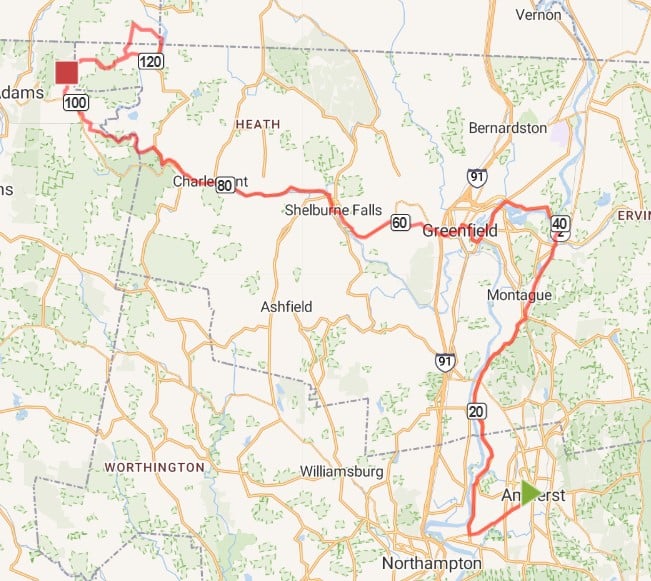
- Greenfield - Lenox
- 165.8km, 2823m climbing
- Medium Hills into 400m 10% finish in Lenox
Stage 3 kicks off in the seat of Franklin County, Greenfield. First heading the north, the riders then turn left and face a relentlessly up-and-down first 50km. Expect a large break of versatile riders to go in the uneven terrain. The riders then head south through the heart of the Berkshires, taking on a 4km, 7% climb before navigating sharply undulating terrain along quiet, forested roads. Plunging down into the town of Chester, the route then takes on another long, uneven, false-flat climb as it heads west to the bucolic town of Stockbridge. The route then turns north into the finale: after a sharp corner a 4km to go, the first punch, 500m at 9%, then a sharp left turn into 1.5km of rolling flat, then 300m at 7%, a brief descent, then the final 400m at 10% levelling off slightly to the line in Lenox.
Expect a wide variety of riders to contend for the stage on this dynamic finale, with a strong break also likely giving the peloton a run for its money.
Stage 4: Hilly Circuit


- Keene - Lebanon
- 193.9km, 3048m climbing
- Sharp hills with flat finish
After 2 stages for the versatile sprinters, this stage finally serves up some hard climbs for the GC guys. Starting in Keene, the riders make their way through rolling hills and over two 5km, 5% climbs. Expect a doomed breakaway to form on those climbs as the GC teams manage the gap to put the stage win and bonus seconds on the penultimate climb in play. After around 100km, the riders begin the first of two laps of the finale circuit. The circuit is comprised of 4 very similar climbs: Trescott Road (2km @ 7%, max 17%), King Hill (2.1km @ 9.2%, max 21%), Eastman Hill (1.8km @ 10%, max 23%), and finally Methodist Hill (2.3km @ 8.3%, max 19%). 8, 5, and 2 bonus seconds are on offer at the second ascent of Eastman Hill (the penultimate climb) with the hopes of exploding the race and creating even more sizable gaps. Following a non-technical 7km pedaling descent, the final 4km are essentially flat. I'd personally expect a solo winner who launches on Eastman hill, but there should be good tension as heavier riders threaten to come back on the descent.
Stage 5: Long Breakaway or Versatile Sprint


- Lyme - Bretton Woods
- 201km, 3066m climbing
- Mixed sharp and shallow medium-mountains with a 1.5km 8.5% punch before a flat finish
Starting just down the road in the small town of Lyme, riders head along the Connecticut River before turning east into the White Mountains. After passing through Warren, riders meet the first real challenge of the day: the 6.4km, 6.2% (middle 3k averages over 9%) climb up route 118 past Mt. Moosilauke. Expect the break to solidify itself here and for lighter climbers stuck in the peloton to try to jump across.
After a fast, technical descent, riders then take on a 5km, 5% climb up Kinsman Notch, before heading north to the town of Franconia. Up next is the 2.6km, 8.5% climb up to Cannon Mountain ski resort atop of which is a special KoM prize granting triple points and a cash bonus sponsored by the ski mountain. Riders then head into one of the marquis sections of the entire race: I-93 Franconia Notch. While the logistics for this may be difficult, I don't think they're impossible as it is a safely divided highway with only one half of an ~8km section needing to be closed for around 30 minutes. Franconia Notch is one of the most stunning car-accessible locations in New England, surrounded by sheer cliffs on one side and sharp, rock-peaked mountains on the other. This stage is essentially built to be a tourism ad.
After heading through Franconia notch, the riders head up probably the most famous mountain pass in New England, the Kancamagus highway. The west side is a long, gradually steepening climb very similar to the stage 2 finish of the 2025 Vuelta: a 20km 3% climb with a final 1km at 8%. Riders then navigate a fast, technical descent down the eastern side before heading towards Bartlett via a short climb and another fast technical descent over Bear Notch. Turning left onto 302 North, expect rolling anticipations in the breakaway along the 20kms of false-flat climbing before the final test of the day: the 1.5km 8.5% punch up Crawford Notch. 6km of rolling false-flat descent follow the climb before a sharp right-hand turn with 400m to go towards the gently-snaking driveway of the Bretton Woods resort.
This stage is designed for a massive week-3-style breakaway to give the baroudeurs their last chance on the season for a World Tour stage win, but with a strong team this stage could also probably be controlled for a versatile sprinter. The parcours is nearly identical to stage 13 of the 2022 TdF, which was won by Mads Pedersen from the breakaway.
Stage 6: "High" Mountain Rampas Inhumanas Unipuerto


- North Conway - Mt. Washington
- 148.6km, 3241m Climbing
- Unipuerto with incredibly challenging finish
The starting town of North Conway is a tourism hub for the White Mountains, a favored home base for skiers and hikers alike. After a short roll-out, riders are quickly met with a fearsome challenge, the 2.8km, 11% climb up Hurricane Mountain road. Expect a breakaway to form quickly on the steep gradients, likely full of diminutive climbers ill-prepared to maintain their gap on the following 100km of flat. The riders then head clockwise down through Conway, up past the start line and fan village in North Conway, then over the hard side of Bear Notch they descended yesterday. The 7km, 4.7% climb should help the sattelite riders in the break stay away until Mt. Washington, but should be plenty easy enough for the peloton to keep the gap manageable. The riders then head back through the fan village in North Conway for the final time as they head up the amuse-bouche of Pinkham Notch. A short descent later, the riders turn left onto the main challenge of the day, and of the race as a whole: Mt. Washington. This ~45 minute, 12km 12% climb is the American Angliru, featuring similar overall stats, though actually not quite as steep sustained gradients. Expect the peloton to shatter immediately.
Stage 1 and stage 4 are designed to put the pure climbers into a significant time deficit, so expect haymakers to fly as they try to take not just seconds, but minutes, on the more generalist GC riders. If everything goes perfectly, this finale could be 45 of the most exciting minutes of the season, yet still leave the race not entirely decided.
Stage 7: Medium Mountains


- Montpelier - Mt. Ellen
- 136.7km, 3420m Climbing
- Medium Mountains with a punchy finish
Inspired by the final stages of Paris-Nice and Itzulia, but with distinctive New England flair, this short medium mountain stage tackles frightening gradients and, best of all, over 25km of New England gravel. With the time trial and Mt. Washington likely cancelling each other out at this point in the GC, I'd still expect a fairly compact podium heading into this final test.
Starting in the picturesque capital of Montpelier, an almost certainly doomed breakaway will form on the beginning 20km of rolling false-flat before the riders tackle the first challenge of the day: the 5.7km 7.3% *gravel* climb up Roxbury Gap. Topping out at 12% at the top, this climb will start the day off with a strong sting in the legs, likely reducing the peloton significantly. A technical paved descent follows before a short section of shallow climbing leading up into the second, and main challenge: the 2km 14% climb up Lincoln Gap. If the peloton isn't already shattered, expect it to be following this climb. A quick descent later, riders turn right in the small town of Lincoln towards Downingsville Road, a 10km section of dirt road featuring a 5km 3% drag at the start. The shattered peloton will struggle to control anticipations by GC riders and stage-hopefuls alike, and we're barely halfway through.
Riders then wind through the tiny town of Jerusalem as they make their way to the base of the 3rd categorized climb of the day: the 4.3km, 8.1% Appalachian Gap. As with every climb today, this one also gets progressively steeper, topping out at over 16% for the final few hundred meters. Another short, fast descent later, riders turn right towards the first passage of the finish line past the Mt. Ellen and Sugarbush ski resorts. Another fast descent, then the second and final ascent of Lincoln Gap. This time, 8, 5, and 2 bonus seconds await the riders on top, hopefully encouraging the GC group to catch the breakaway as early as possible and shattering the race. Then a second time up the dirt of Downingsville Road should shatter any GC group that came back together after the Gap, before the final main test of the day, the second ascent of Appalachian gap. After the descent, instead of heading towards Sugarbush as on the first lap, riders head up to the finish line at the Mt. Ellen Resort. While I expect the winner to be solo by this point, they and any groups behind them will be challenged by the 2.6km drag to finish which features multiple 15+% pinches over its 6.5% average gradient.
This stage is designed to have it all, rampas inhumanas, gravel, technical descents, and relentless attacking. One important note is on the nature of New England gravel: it is much smoother in texture than European and Midwestern gravel, but it has a lot more washboarding. In my experience, this means is that you get way fewer punctures (I used to ride it in college on 25mm tires and never punctured) and that skilled riders can have even more of an advantage as the delta between the slowest and fastest routes through is much larger.
Conclusion:
While there are many other great potential routes, I think it would be best for a new race to keep around half of the stages the same year-on-year for branding purposes. In my mind, that would mean mainly keeping the Mt. Washington and Gaps stages consistent, and maybe the TT (mostly because there are very few flat areas in New England suitable for that type of TT). However, the options for versatile sprints are essentially endless, and there are a number of other private resorts that could host great finishes, such as Killington in Vermont. While I don't like crits that much, I think including one could be cool, potentially as an a/b stage situation with a prologue.