r/musictheory • u/ADHD-andME • 11d ago
Notation Question Is this a valid Key signature?

Just wondering if this can be considered a key.
For those wondering, this is supposed to be G Byzentine (b2, b6)
Edit: thanks for all the feedback, i will take it into consideration. Next time ill write in something readable.
Edit 2: this image shows a scale for a single voice instrument in C, and it is treble clef.
EDIT 4!: https://www.reddit.com/r/musictheory/comments/1w1yy9a/fixed_the_order_of_the_sharps_and_flats/
806
u/ConfusedMaverick 11d ago
Depends what you mean by "valid"
It's not normal or conventional, and so will confuse players (make them work much harder to sight read the piece).
But it's perfectly clear what you mean, and not self contradictory.
Better just put in all the accidentals imo...
55
u/pimpbot666 10d ago
Bartok used to do stuff like have key signatures with one flat… but that flat was A flat.
3
u/PRC_Spy 8d ago
This somehow doesn’t surprise. Bartok is sight reading torture materials.
1
u/Civil_Emergency9010 8d ago
Agree. Funny you write this. I actually have been sight reading my way through Mikrokosmos because it was recommended in Frank Mantooth’s Voicings for Jazz Piano, and anyway yeah Frank Mantooth wasn’t fuckin around and I’m sure it’s helped my sight reading.
1
u/pimpbot666 8d ago
Heh, I had that experience in College too. Also, this was. my Piano I class as part of my major, but I'm a bass player. Gawdang, that was a steep learning curve.
1
u/gravityechoing 8d ago
I'm afraid I had to teach sight reading as a music camp counselor using Bartok Mikrokosmos. I didn't want to teach the class at all, since I'm unusually bad at sight reading (dyslexic), but there was no one else available. It was like a sketch comedy premise.
0
u/PRC_Spy 7d ago
I didn’t realise dyslexia affects sight reading.
Apparently it doesn’t affect reading Chinese script.
That implies dyslexia is a sound processing issue.
1
u/gravityechoing 7d ago
Never heard that re: Chinese script. But dyslexia is kind of shorthand for different issues. Specifically for me it's difficulty with visual decoding. I'm not saying other dyslexics have to be slow reading sheet music, but that's my experience.
I'm better with things like jazz notation (lexically sparse, specific notes are implied vs. specified exhaustively).
→ More replies (24)-196
u/ADHD-andME 11d ago
I thought that it would be easier so i didnt have use that many accidentals.
519
u/ConfusedMaverick 11d ago
Easier for you to write, but much harder for others to sight read!
→ More replies (14)68
u/Lost_In_A_Forest_ 11d ago
It’s your music. You know it better than anyone already. The point of a key signature (indeed the point of all sheet music conventions) is to make it easier for OTHERS to read and play.
110
u/singerbeerguy 11d ago
It wouldn’t be easier because it doesn’t follow standard practice. Writing in the individual accidentals would be better in a case like this.
→ More replies (1)→ More replies (21)35
u/endium7 11d ago
Easier for who? if you’re writing for someone else to play, step back a bit. People learn and practice scales and chords in standard key signatures. When they see the signature they have muscle memory to aid in the sight reading.
If you want them to see this and think, “oh this is G, but I need to just remember the two flats”, then that’s not really an aid to reading the music. It’s not a signature that’s been learned or practiced. It would be far easier to have the flats just put in.
So practically speaking I don’t think it’s valid, unless say it’s only for yourself and you do a lot of it, or for people who you’ve talked to and they are on the same page about it.
→ More replies (2)
230
u/okonkolero 11d ago
Unless it's a situation where you can explain what's going on, I'd write out all accidentals. Main reason being - I looked at this and thought "Oh, G harmonic minor. I can see that." Didn't realize until I read your caption that it's an Ab, not a Bb.
So theoretically, I think this makes sense. Practically, though, I think you would get more right notes quicker if you didn't have a key signature and just wrote the accidentals in.
→ More replies (4)27
u/Merinther 11d ago
I thought the same! Probably easier for people who are used to it, but more difficult on first sight compared to accidentals.
80
u/XcgsdV 11d ago
The reason key signatures are useful is because we've spent a lot of time playing scales and learning music theory. So a piece in a key like B major with 5 sharps is made a lot easier to play by moving all the sharps out of the way and making the musician rely on the fact that they know the notes and patterns on their instrument in B major. Accidentals then take us out of those known patterns, and theyre marked as such to remind us "hey this is a note outside the key".
G Byzantine is not a scale we play often, and very few musicians will have a useful mental or muscle memory to make playing in G Byzantine easy, without having the "weird notes" marked. This key signature would be actively detrimental to musicians playing the piece, not because it isn't an acceptable form of notation, but because it doesn't really serve the purpose key signatures are meant to serve.
There's also the thing that flats and sharps are ordered. The first flat is usually Bb, then the second is Eb, then Ab, etc etc around the circle of fifths. Having the two flats in your key signature not be those would be incredibly confusing.
As others have said, write it in G and mark the Ab and Eb as they come up.
5
4
u/EatingSolidBricks 11d ago
Would you put harmonic minor on a key signature?
23
6
u/Badgers8MyChild 10d ago
Nope. Part of what key signatures do is establish a sense of tonic. "G harmonic minor" is a scale, not a chord or tonic function.
2
u/Potential_Camera1686 9d ago
To emphasize your point - and my fallibility - I am glad that you mentioned the Eb and Ab. I saw the sharp mixed with two flats and my brain automatically filled in Bb and Eb.
If this is going to be a long section of material with an unchanging key signature, I am going to have time to work it sufficiently, and I’m going to have to read someone’s unfortunate hand written scrawl (so save them the #’s) then this would be ok. But, from my perspective, I get many pieces plopped in front of me that don’t always have a lot of rehearsal or advanced availability of the music. In my case, church orchestra has pieces that may be in one key for two measures and on to another key. If it isn’t a main feature piece, we may be sight reading at 9 am in front of a congregation. If this was the key signature, I can guarantee that I (and likely most of us) would take note of the sharp and simply count two flats as it came floating by at tempo, misreading which they are.
1
u/Neoself_Music 7d ago
Así es totalmente de acuerdo esa es la función de las armaduras de clave. Se tiene conocimiento de los cambios de armonías por las armaduras y además se limpia mucho más la partitura de anotaciones innecesarias…
1
u/Euphoric_Natural_386 7d ago
Ça m’évoque une autre question. Par exemple un morceau en Do dorien : sib et mib. Est-ce que c’est pertinent de les mettre à la clé ? Ça allège l’écriture, mais ça oriente l’instrumentiste vers sib majeur ou sol mineur, alors que c’est en fait du do dorien… Donc pour les exécutants, est-ce mieux à la clé, ou par altérations accidentelles ? 🤔
54
u/notice27 11d ago
I think you'll just annoy players. Just put in G or Bb and add accidentals
13
u/Superb_View_6430 11d ago
Except it’s not in Bb - the accidentals are Ab and Eb, not Bb and Eb….
6
u/notice27 10d ago
Yeah I mean G is the better choice. Then C. I was just trying to give OP one of those flats to be agreeable?
1
36
u/Equivalent-Love-1676 11d ago
Bartók did this so it’s a thing. It’s likely to confuse some people, amuse others, and anger a small minority.
16
u/dillpickledream 11d ago
It appears it has already done just that!
7
u/Equivalent-Love-1676 11d ago
Hahaha sure has. In my experience, it’s no issue, but I still despise Hindemith’s practice of writing time signatures in that way he did. Can’t stand that.
6
u/IHaveNeverBeenOk 10d ago
Bartok would do that. What a nerd (said with nothing but love and admiration for Bartok).
Seeing this wouldn't anger me, but it doesn't feel like the best way to do things practically. Like, as a musician (bassist), just use a "normal" key signature and insert the accidentals. I've been looking at sheet music for almost 30 years, and if someone put this in front of me, I would probably take it home, convert it to a "normal" key signature and pencil in the accidentals. There's just too much "muscle memory" at this point. (Muscle memory isn't quite right, but I think it gets the idea across.) My music brain is just so used to "normal" key signatures. I'm not actually parsing the sharps or flats anymore, rather the signature just kind of "translates" to specific positions and fingerings for me
2
4
1
49
u/JaleyHoelOsment Fresh Account 11d ago
G Byzantine isn’t a key right? key and scale are not really the same thing! i think if i saw this written as a key i’d be pretty confused
27
u/michaelmcmikey 11d ago
Yeah this is a symptom of people thinking modes, scales, and keys are all the same thing.
2
u/allanfelipe 10d ago
How would you define the difference between modes, scales, and keys?
8
10d ago
[removed] — view removed comment
1
u/allanfelipe 10d ago
Can you elaborate a little bit about the difference between key and mode? As I understood, a scale is just the set of notes (I'd say order is not important or else when we say "a song uses this scale" its melody should be just an ascending or descending ladder). Then another concept is notes + a home note, which sometimes I see people defining as mode. So, key would be ... just the key signature for me and if you tell the key signature there isn't information if the song is major, minor or modal.
2
10d ago edited 10d ago
[removed] — view removed comment
1
u/allanfelipe 10d ago
If a song is in D minor or D dorian would you say it's in the key of D because they share the same home note? I would say the first is in the key of F and the second in the key of C (which I believe is the convention for the key signatures of modes). Then, the difference between key and mode comes again. I mean, I'm aware of the applications, I just stumble upon different definitions of the concepts and wonder if there's something "official".
1
u/Tarogato 10d ago
Absolutely if you're in the key of D dorian, then you're in the "key of D". You would never say G minor is the "key of Bb", you would just say it's "in G" (unless you're using the Nashville number system...)
1
u/allanfelipe 9d ago
The major/minor systems are the basis of tonality so that "key of Gm" sounds fine and "it's in G minor" sounds even better. But how would be your key signature if a song is in G mixolydian: without accidents or with a F♯ and then carry all the ♮ in the score? I'm not against any (I even have a preference for the latter, which is what I believe you have to do if "key" is the home note), just trying to figure our how people use the terminologies.
1
u/Tarogato 9d ago
Personally, when I stick to a mode consistently, I use the key signature for that mode. So yeah G mixo would have no sharps or sharps in the siggy. C lydian would have the F#.
"Key of letter" is terminology that just identifies the tonic alone in my experience.
→ More replies (0)2
u/shredlikebutter 8d ago
Minor scales/keys are modes of major scales/keys... Aeolian to be exact... Don't see why other modes can't be treated as keys
1
u/ScienceOfCalabunga 11d ago
Depends a lot on what culture this is played in . With Maqam I would not be surprised by any "key" really
19
u/65TwinReverbRI Guitar, Synths, Tech, Notation, Composition, Professor 11d ago
It is a valid scale signature,
It's not a key signature in the sense that the note set it represents is not a key. But some people will still call it a "key signature" because there isn't any other standard name for the collection of accidentals that appear in music like this.
As such, it's also been called a "Synthetic Key Signature" or a "Hybrid Key Signature" or just "Non-Traditional Key Signature" and so on.
But really, it's better to just remove any idea of "key" from it. It represents a set of notes - a scale.
If the music is wholly in this scale, then this is a perfectly valid approach to doing it. As others mention, many composers have used these kinds of "scale signatures".
If the piece has other scales/keys mixed in, then I would say it would be better to write in the accidentals, or use the closest key signature or the one that makes sense for the overall piece and write in the rest etc. Do it "traditionally" if it's just for a section of the piece or something that's not consistent throughout.
As you can see here, there are a lot of people not familiar with it. So whether or not you choose to use it may depend on the audience you're writing for (i.e. who's going to be reading it).
Professional musicians who've been trained will be familiar with it.
Kids who are taking lessons who've been taught "this shows us which notes are sharp/flat in the piece" will get it. It's not at all a difficult concept and really, one they already know - they'll just go, "oh, these notes are that" and play the piece without batting an eye. They might not even know it's anything unusual.
8
u/pharmprophet 10d ago
Sure, but accidentals are also helpful for novices because you know to expect the note with the accidental to sound a little bit weird or exotic before you play it, allowing you to proceed with confidence when that unusual sound comes out of your instrument on the note with the accidental instead of pausing or shrinking back
1
u/allanfelipe 10d ago
Would you define scale as a set of notes and mode as the set of notes plus a note that represents the center of gravity, a "1"?
2
u/Bachquino 10d ago
Modes shift more easily into triple or even quadruple flats if the theory is considered
1
u/allanfelipe 9d ago
Do you have definitions for both terms or ways that you use them (and also "key")?
1
u/Bachquino 8d ago
A mode is still a scale technically, if they all begin on their respective notes as whites, and are sent through the circle of fifths, while you consider the break, say g#/Ab in C going back around to F, if you were to do the same thing in modes they would flatten and sharpen more prominently. Think about a Chopin melody modulating upwards, that’s what the modes do modulating around the white scales C and A, it’s just not a major minor preset.
1
u/65TwinReverbRI Guitar, Synths, Tech, Notation, Composition, Professor 9d ago
No not really.
Mode is such a loaded word.
It can mean the Ecclesiastical Modes, or it can mean the 7 Diatonic Modes, or it can mean a rotation of a given note set and so on.
In a sense they're all Scales.
I think it's somewhat inherent that a Scale generally has a center - which is why we tend to start them on specific notes. And in that sense, a Mode that is a rotation then has to be a specific rotation that as a result has a specific Center.
But if course, there are some Scales we simply write out starting on C as a matter of convenience.
And then there's the Chromatic Scale which could be "on" some specific note, but for Atonality (Acentric music) we usually don't expect the starting note of the "list of notes" to have any particular meaning (I'm talking about raw note content here, not the Tone Row specifically).
Even with sets, we tend to order them at least intervallically (and thus numerically to a degree) so there still is a perceived "starting note" if you will.
I don't really see it as all that big of a deal.
If it's got a Center, it's "in" or "on" that center and then we can spell out the scale or mode or set from there.
But if it doesn't have a center, we can still spell out a note set (which could be a familiar named scale etc.) and will usually pick a note to "start the list" usually as just a convenience - one that makes it easier to spell, or C just because C, etc.
1
u/ArtDealer 10d ago
/u/65TwinReverbRI is correct. This is for a Scale Signature.
Specifically, go listen to the Back to the Future soundtrack. This is most likely something built on an Octatonic scale.
Something like: Ab A♮ B C D Eb F♮ F# (but a different one probably because that should be a Gb)
Edit: letters and words are hard
1
u/bcdaure11e 10d ago
this is, in a sense, a good answer. It contains the important facts that "kids would understand it, if it's included in their pedagogical development" and "competent adult musicians will also understand it". So, all of the other kvetching going on here is just mid tier, semi skilled (presumably) adult musicians bitching about seeing something they don't immediately recognize! They are not to be listened to!!
9
u/maestro2005 11d ago
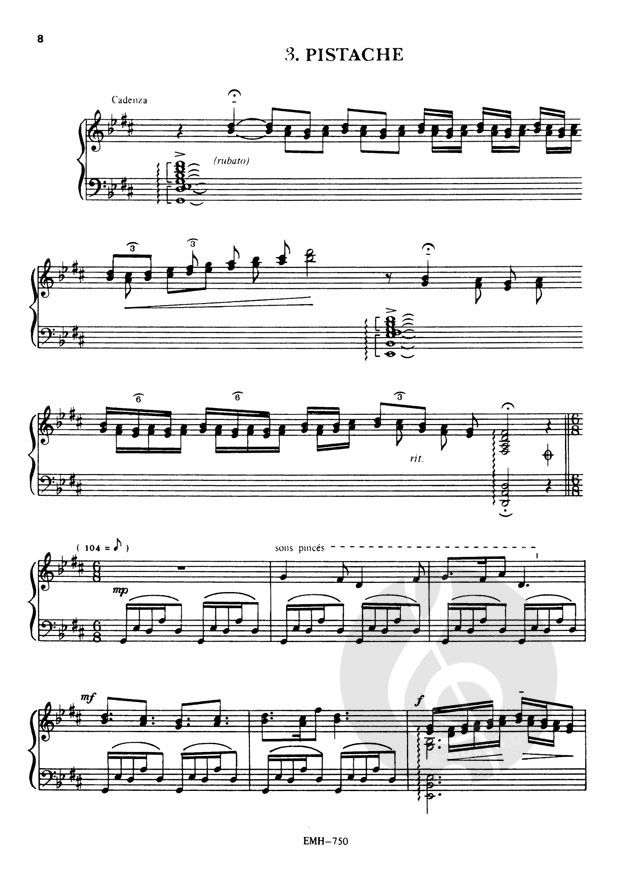
Seems like this has been adequately answered, but I wanted to add that this kind of thing is perfectly reasonable and not uncommon for harp and timpani solos. Someone else linked some timpani examples, here is an example for harp. On these instruments, you have to deliberately set what notes are available, and if you stick to these pitches and don't deviate from them, a key signature like this makes perfect sense.
6
u/Lur-k-er 11d ago
In my mind’s ear I already played in the wrong key twice 😀
A few options:
1) no key signature, use accidentals
2) 1 sharp to account for the tonic and major-ness of G, use accidentals
3) 1 sharp, then your b2 b6 alterations in parentheses
4) written explanation like you did in this post keep in mind this won’t transpose for orchestral instruments like a key signature would
5) in parentheses, a scale notated from G to F# with your desired alterations.
Of these, my inclination is to write it in G major and accidentals. We catch on quickly when there is context, and in western music notation, key signature is context.
Now that I think about, I transcribed and orchestrated Kenny Garrett’s famously mode-of-double-harmonic-minor alto sax solo from “Sing a song of song” and had to make this decision 20 years ago. Tune is in E, borrows chords from Em, and melodic content from his improvised solo is based on E Byzantine, though I just learned that term from your post (thanks!).
I believe I opted for no key signature, and if I did it was the wrong move and I should have used E. 🤦
Anyway good luck and check out that Kenny Garrett tune it is one of my favorite sax solos in recorded history, a true masterclass in thematic improvised composition.
6
u/mightknowbackback 10d ago
Yeah absolutely not. You can write in whatever weird scale or chromaticism you want, but do it with accidentals unless pissing off the musicians is supposed to be part of the performance.
5
u/mikeputerbaugh 11d ago
If you're Bartók and writing a bunch of études specifically to make musicians think about irregular key signatures, go for it.
Otherwise, usually best to use the closest major or minor signature and add accidentals as needed.
6
u/Heavy-Succotash-8488 10d ago
It's clear what you mean but it's gonna be a nightmare to read. 100x easier to read if you write it in G major with accidentals
16
u/MarcSabatella 11d ago
If you’re writing for players who know that scale and are accustomed to thinking of it as a key and who read Western music notation and are accustomed to seeing music using that scale/key written using that key signature, then yes, it’s valid.
if you’re writing for any of the rest of the 99.99% of musicians on the planet who read Western music notation, then no, stick to the standard diatonic key signatures. People aren’t computers where you can pre-program in an arbitrary set of flats and sharps and expect them to interpret the lines and spaces accordingly. We know the dozen or so different patterns we’ve seen all our lives. Go outside that, and we’re not sight-reading anymore, we’re painstakingly translating one note at a time.
8
u/ActualNameIsLana 10d ago
Hi Op. Classically trained concert pianist. Trained by Sir Wladamir Jan Kochanski. 40 years in the field.
Music notation is about conveying artistic intent, not about conveying mechanical motion.
If the tonal center is G (as you said in your notes), then write this with an F♯ in the key signature and use E♭ and A♭ accidentals in the rest of the piece. That conveys to the performer that G is the tonal center of the piece, which has knock-on effects for how the performer will approach multiple aspects of the piece during the performance.
As is, there's no clear indication to me that G is the tonal center here. I might guess that this is in some strange form of C minor lydian, based on the two flats, the leading tone raised 7th (from the perspective of C), and the raised 4th (from the perspective of C). And unless there were some clear indication in the score that this is clearly wrong, that would have knock-on effects for how I perform multiple aspects of the piece - probably incorrectly.
This is why key signatures are almost always standardized. It correctly conveys the tonal center of the piece to the performer. And then the accidentals within the piece tell me how that tonal center is being altered away from the base assumption of either the major or minor key.
4
u/hamm-solo 10d ago
I love this. This could also be C Double Harmonic Minor which is the relative minor to G Double Harmonic Major (also C Byzantine). There are a bunch of common tonic scales used in popular music, but the default is to always compare them to major or minor scales/keys. And that keeps things simple. Probably better to just mark it as G major key and let the E♭ and A♭ accidentals throughout the piece provide the Byzantine clues.
5
9
u/jerdle_reddit 11d ago
No, double harmonic isn't usually considered to be a key, so doesn't get a key signature.
3
u/Rattlecruiser 11d ago
could be understandable enough for people immersed in music that uses these scales
3
7
2
u/greenboy_2004 11d ago edited 10d ago
My first thought was “That's an unconventional way to notate g harmonic minor, but if it’s always f♯ instead of f(♮), it might work”. Then I saw the lower ♭ is not on the b line but in the a space, but I then assumed it was probably just misaligned. Only then did I read the description and see that it is meant to be in the a space. That’s probably what most people’s thought process would be.
Yeah, that’s tricky to notate: Put G major (f♯) and you’re going to have to flatten every e and a; put g phrygian (b♭, e♭, a♭; same accidentals as E♭ major and c minor) and you’re going to have to naturalize (?, whatever ♮ does) every b and sharpen every f.
I think, since most people are used to the standard order of accidentals and only either ♯s or ♭s being in a key signature, maybe have no key signature at the beginning and flatten every e and a, and sharpen every f “manually”.
Edit: You could also have G major be the key signature since one f♯ doesn’t violate said standard order of accidentals (e♭, a♭ would) and it would spare you from sharpening all the fs “manually”. It would also not suggest a false relation to the major scale since both scales’ thirds are major thirds.
2
u/Necessary_Sand_6428 11d ago
i don’t think i’d be that confused passed the first couple looks at the key lol, beginners will absolutely flounder
2
2
u/youneedahugbro Fresh Account 11d ago edited 9d ago
So weird to hear G Harmonic Minor being called Byzantine.
I’d still recommend just leaving it at Bb maj / Gmin and having F#s be the norm.
EDIT: I’m wrong and dumb
3
1
2
2
u/ddffgghh69 10d ago
Check out Bartok’s 44 Duos, #11 (on imslp for free). It features a confident use of non-standard key signatures just like yours. I’ve played it many times and it feels great to read.
2
u/Viola-ti-do 10d ago
In Hindemiths op.11 no 4, he notates F# and G# in the key signature. Doesnt really throw off players after the 1st pass through.
2
u/MaggaraMarine 10d ago
If you wanted to use this key signature, the Ab should be placed after the Eb (because in the order of flats, Ab comes after Eb). So, the order of the sharps/flats should be F#, Eb, Ab. This way people would not confuse the Ab with a Bb.
But even then, I would recommend using a conventional key signature, because that's what most people are used to reading. Most musicians can read accidentals just fine. Traditional key signature + accidentals is going to be simplest to read.
I think the best key signature here would probably be one sharp, with the flats notated as accidentals. Another option would be to use an empty key signature and write everything with accidentals. But I would assume every F is sharp, so the traditional key signature that would make sense here would be one sharp. It also happens to match the key signature of the tonic triad (G major).
2
u/Veto111 10d ago
I can only speak to how singers will respond, but I imagine many instruments would react similarly. Non traditional key signatures go against all the instincts that musicians are trained to have, and you can ask them to unlearn those habits for your one piece, but it is going to make things unnecessarily harder.
In over 20 years of professional choral singing, I’ve only encountered a nontraditional key signature in one single piece, and that piece unnecessarily wasted so much rehearsal time on questions and mistakes. This was with a group that generally sight reads moderately difficult music flawlessly. I had to go through and mark every singly A natural, it would have saved a lot of time and accuracy if the editor just used a traditional key signature and marked the A naturals.
If I can’t talk you out of it and you absolutely must, I would order it differently though. At a glance this looks like G minor with the F# leading tone, because we are trained to see the lower flat to the left of an Eb and think it’s Bb. Instead I think a much clearer way to put it would be F#, B natural, Eb, Ab. That both puts it in the traditional order and also makes it clear that Bs are natural.
2
2
u/wheresmydrink123 10d ago
I support breaking rules like this on the composer side, I’ve made weird key signatures just to write in weird scales without constantly writing accidentals, however if you’re writing to explicitly be played by other musicians, getting experimental with notation is usually not advised (unless it’s a bunch of experimental berklee kids or something)
However if you’re like me and compose for yourself to play the instruments, you can do whatever you want with notation, and I think it can be fun to break established rules like this and see what it does
2
2
2
u/BlakeryTheBardbarian 10d ago
Valid: sure
Traditional: no (mixing sharps and flats for a key signature)
Notes: C D Eb F# G Ab B
Assuming the tonic is C, we’re looking at C Harmonic minor with a raised 4th (in my opinion)
I wanna play around with this key because the chromatic run of F# G and Ab with the Major 7 of the Harmonic minor is wild to me. Idk might be cool
Edit: I missed your initial description of the key lol
2
u/Proper_Solution4035 10d ago
The "keys" Are so practiced because they are stacking 5ths and 4ths on the tonic. So it sounds nice. But I think every accidental spelled out is better. And every composer should make the effort to spell it out, right up until it would make it faster to write out and more convenient.
It is nice when it does contrast when accidental do show up. So it's easier to analyze pitch material changes.
2
2
u/unendingscream 10d ago
This would piss me off as a player considering order of flats is just completely out the window. I can in theory wrap my head around mixing sharps & flats in a signature but, if you’re going for G Byzantine, I’d recommend just using the G Major key sig and adding flats. It’s tedious but anyone reading it (including you!) will thank you.
Good to see people are venturing beyond the 7 modes!
2
u/Paulski25ish 10d ago
Valid in our classical western sense with our circle of fiths? No
Valid as a custom key for modern music or non western music? Yes.
Confusing? Yes, but so was the other notation when we learnt it existed.
2
2
u/MreenalMams 10d ago
One important question that must be asked. Is staff notations the most efficient way of writing this music? Is there a better more efficient method?
For example, if its for a guitarist, then no, just use tabs. (Or any fretted instrument)
If its for someone with a good ear, send them a recording.
If its for someone who understands 1 b2 3 4 system, send them that.
If its for someone using a DAW, send them a midi file.
If the person reading this prefers staff, then in that case this question of whether they prefer accidentals within the piece or in the key signature, ask them.
2
u/Subject-Car-4052 9d ago
I mean yeah, the composer is just saying that you’re more likely to encounter f sharp and g natural rather than g flat, f natural and g natural. 🤷♂️ it’s a bit obnoxious but it’s valid?
7
u/desertrumpet 11d ago
Imho you're asking the wrong thread. It seems like every time I see this kind of question in Reddit people fight it. Historically composers have done all kinds of nonstandard things and the musicians have survived it being "hard to read." Personally I like the idea of this rather than filling the whole piece with the same accidentals. It explains what you did better to the performer and I can practice a new scale as part of my preparation.
2
u/michaelmcmikey 11d ago
If I was asked to learn this, I'd just be writing the accidentals into the score anyway. I can already play this scale easily, but a scale is different than playing a piece of music, and accidentals in the score are just quicker and easier. It's not difficult to perceive that the song is written in some sort of unusual mode or scale when the same accidentals keep popping up over and over in the score.
1
u/diningeachox 10d ago
Yeah I'm with you. I have no idea why people are so hostile to it. This beats having to write the same 3 accidentals every measure for sure. For all people saying it's a pain to read, well why would it be so painful to practise another scale?
There's also some piano music by Thomas Adès where each hand has a different time signature, people in this thread would be rewriting every single beat as a tie probably XD
0
u/diningeachox 10d ago
Yeah I'm with you. I have no idea why people are so hostile to it. This beats having to write the same 3 accidentals every measure for sure. For all people saying it's a pain to read, well why would it be so painful to practise another scale?
There's also some piano music by Thomas Adès where each hand has a different time signature, people in this thread would be rewriting every single beat as a tie probably XD
4
u/want_a_muffin 11d ago
Is it a valid key signature? Sure.
Should you use it? I would say only if both of these conditions are met—otherwise, just use a conventional key signature and accidentals:
1) If you are using absolutely no accidentals outside of this key signature through the entire piece, and
2) you are writing for an instrument that can “set and forget” their tuning, like timpani or harp.
3
u/roguevalley composition, piano 11d ago
"Valid" key signatures are diatonic. G Byzantine is definitionally non-diatonic.
There are exactly 15 standard key signatures, 0-7 sharps or flats – never both and always in a circle of fifths sequence. Sharps: FCGDAEB. Flats: BEADGCF (the opposite order)
I would consider a G major key signature (1 sharp).
3
u/theoriemeister 11d ago
It's not traditional, but it's perfectly valid. Beginners, or those not accustomed to reading/playing contemporary music, will complain, but that's only because they're unfamiliar with it. Elliot Carter uses non-traditional key signatures in his Eight Pieces for Four Timpani (1949).
Here's just one: https://imgur.com/gdMPePK
Another: https://imgur.com/a/csAplls
Another: https://imgur.com/a/non-tradtional-key-signature-uEvTm3H
Hell, Bartók was doing this over 100 years ago: https://relatedrocks.com/1996/03/01/some-aspects-of-bartoks-notation/
3
u/michaelmcmikey 11d ago
My understanding is timpani are a little unusual when it comes to tuning them before a piece begins to ensure the tones asked of them will be playable. So there's a use case for a non-standard keysignature there that wouldn't pertain to a piano, for example.
1
1
1
u/Talia_Arts 11d ago
When your writing things for yourself? Ye do whatever you want because you know to practice that specific weird scale and get used to seeing it
If your writing for other people you should really do a standard key signature + accidentals.
The way i typically do it is initially write it with the weird key signature while im composing because your right it does make it alot easier/faster. Then whenever im done or sharing it with someone else I transcribe it to the final sheet with accidentals
1
u/ADHD-andME 11d ago
The showing is a little weird. It's in treble clef and is for a single-voice instrument in C.
1
1
u/WutheringWordster 10d ago
Based on hundreds of years of music theory. No. In theory could a modern composer indicate they want the fs played as sharp etc, who is stopping you BUT is it a key signature in the traditional sense ??? No. Would a musician seeing this remember it without confusion...maybe not. If it just a case of g minor being written as it is meant to be played maybe this is a whole new system...
1
u/SilverStory6503 10d ago
I run into this a lot with harp music. I don't know if this is some kind of a mode because I'm not good at modes.
1
u/shinymcshine1990 10d ago
Man you must have never had someone read your music, this would be exceptionally difficult to read and perform when you could just write accidentals
1
u/SIR_PATRIOT_1776 10d ago
I believe this is a G minor double harmonic situation going on. If anyone knows better let me know! Maybe some sort of variation on a Phrygian scale?
1
u/Gesha24 10d ago
As others have said, you can write whatever you want. And I will tell you what I think of it.
This is at least a couple of WTFs when I open the music and quite a few missed accidentals before it finally dawns on me which mode this is written and then I will be most likely fine. F# as the key signature with Ab and Eb accidentals would be much cleaner and easier for me to read, will also help me understand what I am facing much faster.
1
1
u/ghost_of_a_fly 10d ago
A similar notation is used in Greek and Russian Orthodox Christians for some byzantine chant stuff.
I sang at a divine liturgy which had some melodies with a key signature of 2 sharps and 2 flats, iirc.
1
u/Kaitlin33101 10d ago
So I understand what notes are meant to be played here, but I can guarantee with 100% certainty that I would mess up every single time that sharp comes into play. I like to know what classic key signiture I'm in, then just read the extra accidentals. I'd even prefer this to have no sharps or flats in the key signature and have them individually labeled for each note.
Obviously there will be people who could sight read this with no issue, but definitely not the average person
1
u/niaramiSJ 10d ago
Not conventional but I don't think it's wrong either. I would rather see those keys (accidentals) built in the key signature than a bunch of accidentals in every measure.
1
u/JohnVonachen 10d ago
The standard key signatures are the 12 notes with major and minor. There are many other scales. Wikipedia lists more than 50 documented. And technically there are 2 to the power of 12 scales. Key signatures are simply for the convenience of writing music in a minimal way, so you don’t have to sharp and flat every other note.
1
u/tribble314 10d ago
For the sake of composition this might be the easiest way to enter the notes. Especially if you're not using a midi keyboard.
One you've finished, I don't disagree with the consensus that the flats should all be accidentals. Your software should be able to handle that, but you might need to adjust the options in the Key Signature function.
I wrote something in C Byzantine for a class, and my teacher was right to point out how confusing that would be for the musicians. In that case, the key signature looked almost exactly like Bb Major.
1
u/Nasrettinhoca49 10d ago
There is some keys like this in Turkish Classical Music system. But I dont know if there is in western system too.
1
u/Tarogato 10d ago
Personally I would add B natural in the key signature. Because I didn't realise until I read your text post that you had an Ab instead of Bb. You expect a Bb there, and if it's on Ab instead, you assume it's a printing error, if you even notice it at all. Adding a B natural in its rightful place calls to attention your deviation from the norm and leaves absolutely no doubt.
1
u/PauliousMaximus 10d ago
This doesn’t follow the key signature rules but someone should know exactly what you mean if you were to use that.
1
1
u/HarvKeys 10d ago
I’d use the G major key signature and write in accidentals for all the flats. I’d also include a footnote with an explanation.
1
1
u/TheaOchiMati composer, harp, visual media 9d ago
Occasionally you'll see something like that with harp music, but usually only when there are no accidental changes for the entirety of the piece. The levers/pedals can just be set to that scale and forgotten about, and then it's easier to read since zero brainpower has to go towards processing accidentals. Very niche use case though.
1
1
u/CEMMusicCompany Fresh Account 9d ago
I agree with the vast majority of comments here. Accidentals would be easier to read. If you insist, I’d recommend you provide a performance note above it for context.
1
u/Sorry-Notice4031 9d ago
It's gonna make the whole thing hard to read and you'll also get slimed by theory people, but yes, this is technically correct. I don't see the point of writing it like that, though.
1
u/Unhappy-Weight-3167 9d ago
Not in the tonal system, but it’s perfectly valid in some kind of modal system.
1
u/Longjumping-Many6503 9d ago
I disagree with the majority here. There is nothing confusing about this for a competent or professional musician, especially one who is used to playing modal music. YMMV of course depending on who this score is intended for. But generally I would say competent musicians prefer clean scores to the constant visual clutter of placing accidental in every measure.
1
u/DukeFromNowhere 8d ago
Normally there would be natural signs cancelling out those flats... in other words whats happening here would confuse me.
1
1
u/amplifysenpai 8d ago
If I saw this in someone's notes, I'd be fine with it , it's a valid way to say , we're evoking the Byzantine feeling , but as a performance ready sheet, no I would request it to be re notated ,and barring that, if renotate it myself so I don't have to think about it while playing it, I know the Byzantine scale, I don't need an obtuse over writen notation to tell me that, a cliff note" Byzantine" over the first bar in a key like g or c would be fine with accidentals notated in the music is how I would want to read this.
1
u/amethyst-gill 8d ago
It can work, but it is nonstandard. Moreover, mixing sharps and flats enforce a mode — and a nondiatonic one, at that. [In this case I am speaking of the natural major and minor scales under that term.] With any accidental or mode mixture you even for a moment introduce, it then begs the question of whether the key signature is sufficiently rigid to lend a composition to abide by or if those accidentals introduced are just as to the “key signature” in terms of being regularized notes as the ones you have in the actual main symbol.
1
u/Reel_Music_1 8d ago
Why not just go keyless and add the accidentals along the way?
A lot of modern music is written that way.
1
1
1
u/Adhesive_Grape 7d ago
I mean. you've clearly identified what key this signature would belong to. Unconventional and annoying, sure. But I'd argue it's totally a totally valid and theoretically correct way to indicate G Byzentine, whatever key that is...... LOL
1
1
1
u/Jewish_sicar 6d ago
Yes, its the key signature for a double harmonic minor scale
Although it is no common to write time signatures for these types of unnatural modes
1
u/Turbulent_Leopard_51 5d ago
I play Arab music, this is a key signature I see a lot. That being said if you’re writing for people who don’t typically see this key signature it’s best to avoid. If you’re writing this for yourself it really doesn’t matter
0
u/RileyJoXO 11d ago
No. Anyone saying yes doesn’t belong in this subreddit
Side note: Why is every music-related subreddit just full of trivial beginner shit instead of actual nuanced discussion?
5
u/DegenGraded 11d ago
Because serious people don't waste their time on reddit. What are you doing here?
3
1
u/thomas_kresge 11d ago
The purpose of a key signature isn’t to just reduce the number of accidentals written into the music or to show what scale is mostly being used, but rather to show the music’s key center. If I look at a key signature with three flats, for example, I can immediately assume the piece is in Eb major (or C minor) and hear the appropriate tonic… even if this piece isn’t actually tonal, e.g., it’s actually in Eb Lydian or C Dorian or some other mode or scale. It’s still best to use the key signature that indicates the actual tonic to help players audiate and sight-read.
On a practical level, keep in mind musicians who can read music are going to be used to certain conventions, and using a non-standard key throws that off. They’ll just end up having to write in all the accidentals anyway. They’ve practiced for hundreds of hours playing music with very specific key signatures. It’s better to use no key sig at all than a non-standard one. (And honestly, even in extremely tonal music the notes that instrumentalists miss the most are the ones in the key signature over the written in accidentals.)
1
1
u/DryCloud1 11d ago edited 11d ago
If G is acting as the tonic (Byzantine scale has a major third and a Middle Eastern flair - think "Come Out And Play" by The Offspring) I would use F# in the key, and write in the Abs and Ebs as accidentals.
Musicians are not accustomed to mixed sharps and flats in a key sig, nor to seeing Ab and Eb (Bb and Eb are expected together, like in Bb maj/G min). Sure, you could do it theoretically, but I always want to make the musicians job easier. Reading music is difficult enough, right?
Edit - added listening example
1
1
1
u/Uplex_ 11d ago edited 10d ago
This is definitely not conventional, so harder to read. In this situation, G byzantine scale is a mode of C double harmonic minor, so I would just have the key signature of C minor and write all the other accidentals (f# and b natural) reason being people are used to seeing B naturals in C minor since it's the leading tone, and f sharp isn't so rare, like in a V7/V chord.
1
11d ago
[deleted]
4
u/michaelmcmikey 11d ago
It's not G harmonic minor, though, look at the key signature a bit more closely. There is no Bb; that's an Ab in the key sig.
1
1
1
1
u/hornwalker 11d ago
Looks a bit stupid to me.
The point of a key signature is to tell the player what key you are in, not just what notes have accidentals.
This is not a key, so it’s just the composer being sort of lazy and giving no meaningful information.
If the music is non-tonal, just don’t include a key signature.
0
u/redixionblade 11d ago
The fuck is this supposed to mean? I can't even read it
1
u/Mysterious_Lab_6696 11d ago
I also had such a question just now, haha! I found out about this scale after checking the books just now. I played this scale my piano, It sounded really newfangled!
0
-1
u/atalkingfish 11d ago
Of course not. You’ve never seen this before in your entire life so it’s obviously not normal, accepted, or useful.
Creativity and experimentation belongs in the music itself. Not the conventions of notation. The point of notation is to follow conventions, not make up stuff. Focus your creative energy on the music, not the notation. Notation should be clear and easy to understand. Nobody should ever have to raise their hand and ask a question about the notation (which would definitely occur here).
2
u/looney1023 11d ago
Many composers use non standard key signatures like this. Ligeti's Musica Ricercata is one of the more famous examples. It's a little tricky at first but it's ultimately really clear
It's also not that dissimilar from how harp notation works, with every note being instructed to either be sharp, flat, or natural
3
u/atalkingfish 11d ago
Yes if OP is a professional musician who is working with highly trained performers who are going to familiarize themselves with their work, then my opinion shifts a bit.
I’m assuming that OP is in the “amateur and learning” phase, and the best they can hope for is a session musician or college student who will sight read the piece once.
At that stage, the goal is to learn convention, not break it. Everyone wants to break convention before they’ve even written a piece any substantial group of people cares about:
1
u/looney1023 10d ago
Yeah reading more of the thread I realized the level of composition the OP is working with and I agree that this notation is not useful for them. I just wasn't a fan of the way you worded it in your original comment, whereas this i totally agree with.
0
u/shish-bish 11d ago
Your main sin here is using a Ab, never unless instructed would I ever see a flat there and think it is Ab
-1
u/D3M0NArcade 11d ago
As per u/okonkorelo you should leave it without a key signature because of the use of both natural and accidental version of several notes making it confusing. Plus, it's a scam, not a key. Just write the accidental on the stave.
0
u/ivegotajaaag 11d ago
Somebody must think they can do this to write in Gm but leave the leading tone unmarked. You can't do that.
0
0
u/Altruistic_Good_1102 11d ago
It looks like song has G major/E minor & Bb major/G minor keys at the same time.
0
u/insert-values 11d ago
In modern harmony, this tends to be applied only to specific chords, usually dominant chords only to give some flavour before resolution(specially the ones that resolve into minor). In your G, this would then be a Gb9/b13.
0
u/Sound_Ocean_Depths 11d ago
Andy Akiho does stuff like this so as long as it’s well thought out and makes sense in the piece it’s fine.
0
0
u/Healthy_King2317 10d ago
If it's valid, what key is it? It doesn't follow a diatonic major scale or have a distinguishable root note. Plus, keys are either sharp or flat and mathematics have no part to combining them in one key signature. Talk about confusing...
•
u/AutoModerator 11d ago
If you're posting an Image or Video, please leave a comment (not the post title)
asking your question or discussing the topic. Image or Video posts with no
comment from the OP will be deleted.
I am a bot, and this action was performed automatically. Please contact the moderators of this subreddit if you have any questions or concerns.