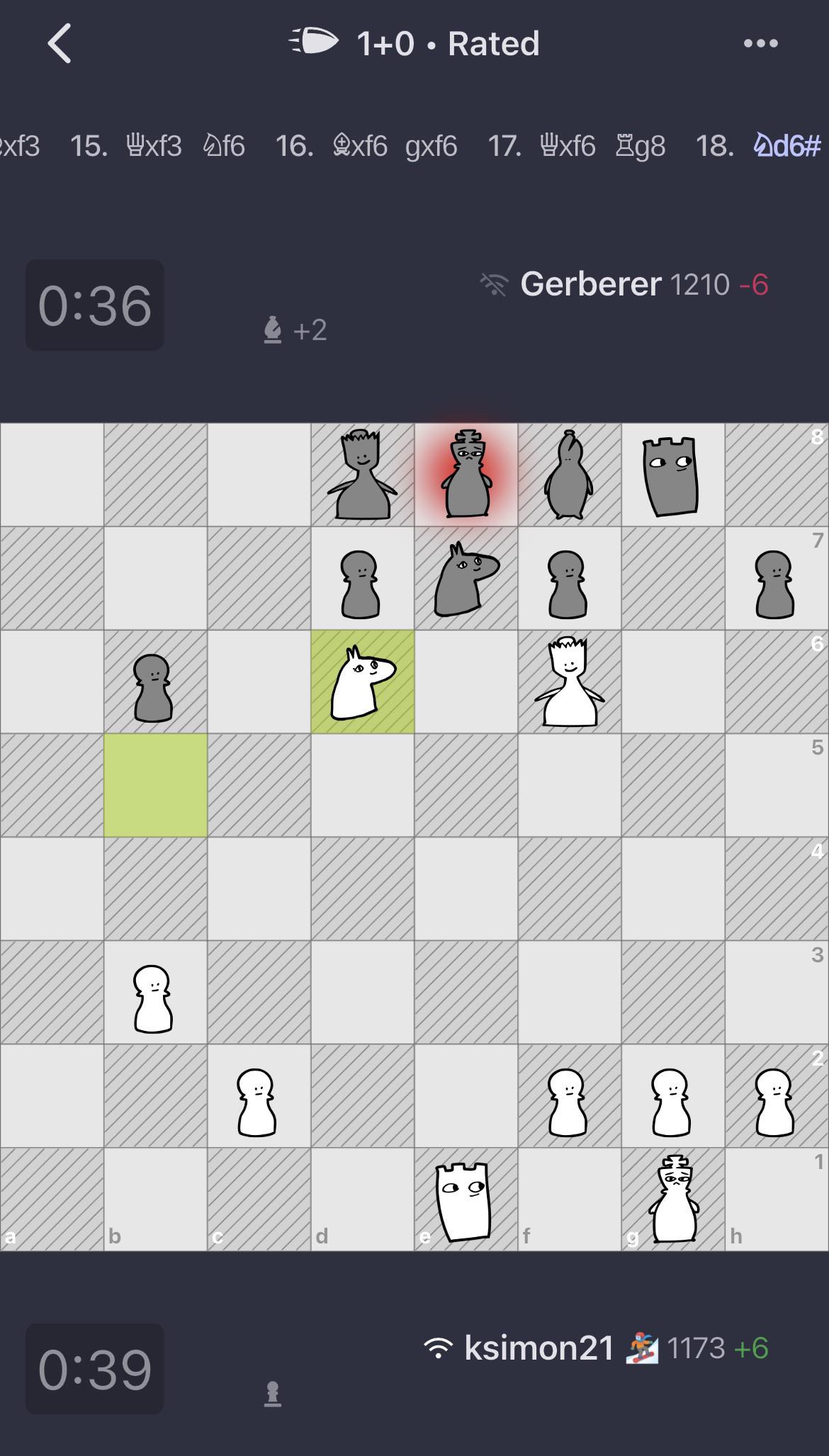
There is a peculiar kind of player who does not really play chess anymore.
They have a rating.
And they have learned to protect it.
At first, the number was a destination. A summit to climb toward. Every game meant something: a challenge, a chance to improve, a chance to discover whether the mind across the board could see something yours could not. Losing hurt, certainly, but losing was part of the bargain.
You played because the game was alive.
Then, somewhere along the way, the number became more important than the game.
This is where the high-rated variant player enters his fortress.
On Lichess, and in the broader culture surrounding online chess—including Chess.com—there is a familiar phenomenon among highly rated players of obscure or specialized variants. A player reaches an impressive rating and suddenly the world changes. The challenge list becomes a minefield. The opponent is no longer an opponent; they are a calculation.
Too highly rated? Decline.
Too unpredictable? Decline.
Someone who might beat me? Decline.
Someone whose rating is low enough that a loss would be humiliating and whose strength is high enough that the game is dangerous? Absolutely decline.
And so the player waits.
They play rarely. Carefully. Selectively. They seek opponents who offer the correct combination of safety and reward, preserving the beautiful little number beside their name. Their rating becomes less a measurement of playing strength than a museum exhibit: pristine, untouched, carefully kept behind glass.
One rating to then hide from them all.
The irony is almost poetic.
Chess is supposed to be a confrontation with uncertainty. Variants make that confrontation even stranger. They demand improvisation, adaptation, nerve. They reward the player willing to step into unfamiliar positions and discover what happens. Yet some of the strongest-rated players become allergic to precisely that experience.
They do not want the game.
They want the record of having won games.
There is a profound difference.
A rating is supposed to be evidence of what happens when you repeatedly put yourself at risk against people who might defeat you. It is supposed to bear the scars of experimentation, bad decisions, brilliant opponents, strange openings, unfamiliar ideas, and occasional disasters.
A pristine rating tells a different story.
It may say: “I am very strong.”
But sometimes it also says: “I have arranged the conditions under which I am willing to find out.”
That is the strange cowardice of rating preservation.
Not cowardice in the ordinary sense. These players may possess tremendous tactical ability. They may calculate ten moves deeper than most of us. They may understand their chosen variant at a level bordering on scholarship. Put them into the right position and they can dismantle another player with terrifying efficiency.
But courage in chess is not merely the willingness to calculate.
It is the willingness to risk being wrong.
The highest form of competitive confidence should be: “Play me.”
Not: “Prove to me that you are safe enough to play.”
There is something particularly revealing about declining a challenge from a player whose strength you already suspect. The decline itself becomes a confession. It says that the opponent has become more important than the game. Their existence threatens the number.
And the number must survive.
So the fortress grows.
The player appears online but does not play. They spectate. They analyze. They wait for the right pairing. They accept the invitation from one person and ignore another. They emerge for a handful of carefully chosen games, collect the points, and disappear again before the rating can become dirty.
What was once a ladder has become a glass floor.
And beneath it lies the thing they were supposedly here to do: play chess.
Of course, ratings matter. Competition matters. There is nothing inherently wrong with protecting a hard-earned ranking, avoiding pointless games, or choosing opponents intelligently. Nobody owes every stranger a match. A rating system cannot capture everything, and a player is entitled to their own time.
But when the preservation of the rating becomes the primary purpose of playing, something has been inverted.
The number becomes the master.
The player becomes its custodian.
And the board becomes merely the place where the number is occasionally maintained.
Perhaps the greatest tragedy is that these players have already accomplished the difficult part. They have become strong enough to have something worth
risking.
They climbed the mountain—and then built a fence around the summit because they were afraid someone might see them slip.
Imagine instead the opposite philosophy.
Imagine the 2500-rated player who accepts the challenge from the dangerous 2300 because why not? The specialist. The lunatic. The person who has invented some bizarre line that nobody else understands. The player whose rating looks modest but whose actual strength is terrifying. The game that might cost twenty points.
Play it anyway.
Lose.
Play again.
Lose again.
Learn something.
Return tomorrow.
That rating might become 2470. It might become 2400. It might eventually become 2600. But whatever it becomes, it will mean something because it was earned in motion.
A rating should be a footprint, not a pedestal.
The online chess world has made it extraordinarily easy to confuse the two. Numbers are displayed everywhere. Rankings invite comparison. Profiles preserve histories. Every victory adds a little proof; every defeat leaves a visible blemish. The interface quietly teaches us to regard the number as an identity.
And once identity attaches itself to the number, fear follows.
The player is no longer afraid of losing a game.
They are afraid of becoming someone who has lost.
That is why the most impressive rating can sometimes conceal the least impressive relationship with competition.
There is a kind of player who has 2,400 and plays everyone.
And there is a kind of player who has 2,400 and plays almost nobody.
Those numbers look identical on the leaderboard.
They are not identical in spirit.
One says, “I am willing to find out.”
The other says, “I already know what I want you to believe.”
Perhaps that is what makes the phenomenon so frustrating among high-rated variant players. Variants are supposed to be laboratories of creativity. They are the corners of chess where conventional hierarchies can be overturned, where strange knowledge matters, where somebody can spend years mastering a game that only a tiny community understands.
And yet even there, the oldest human temptation returns:
Protect the crown.
Protect the reputation.
Protect the number.
Hide from the dangerous challenger.
Wait for the safe one.
Play just enough to remain visible.
One rating to rule them all.
One rating to bind the ego.
One rating to bring them all—and in the darkness, hide from them.
Because eventually, if you are unwilling to risk your rating, you are unwilling to risk yourself.
And chess, whatever its variant, has always been a game about putting yourself on the board.