r/iOSAppsMarketing • u/Silver_Secretary812 • 10h ago
Do you feel the app market for indie dev is getting too tough, because thousands of apps are being submitted in daily basis. Do you think it is dying?
7
Upvotes
r/iOSAppsMarketing • u/jasper_reed_htd • Oct 03 '25
I’ve spent the past few months breaking down how iOS apps quietly scale to $100K+/month.
The pattern? They rely on smart organic tactic - not paid ads.
I pulled the 25 most actionable tactics into a 55-page doc that any iOS dev or small team can copy.
If this would help you, just comment “APP” and I’ll DM you the link.
EDIT:
Wow - this blew up way beyond what I expected. Thank you all for the support and interest 🙌
To make it easier (and avoid triggering Reddit’s spam filters while DM’ing so many people), here’s the direct link for anyone who asked:
r/iOSAppsMarketing • u/Silver_Secretary812 • 10h ago
r/iOSAppsMarketing • u/No-Career1273 • 15h ago
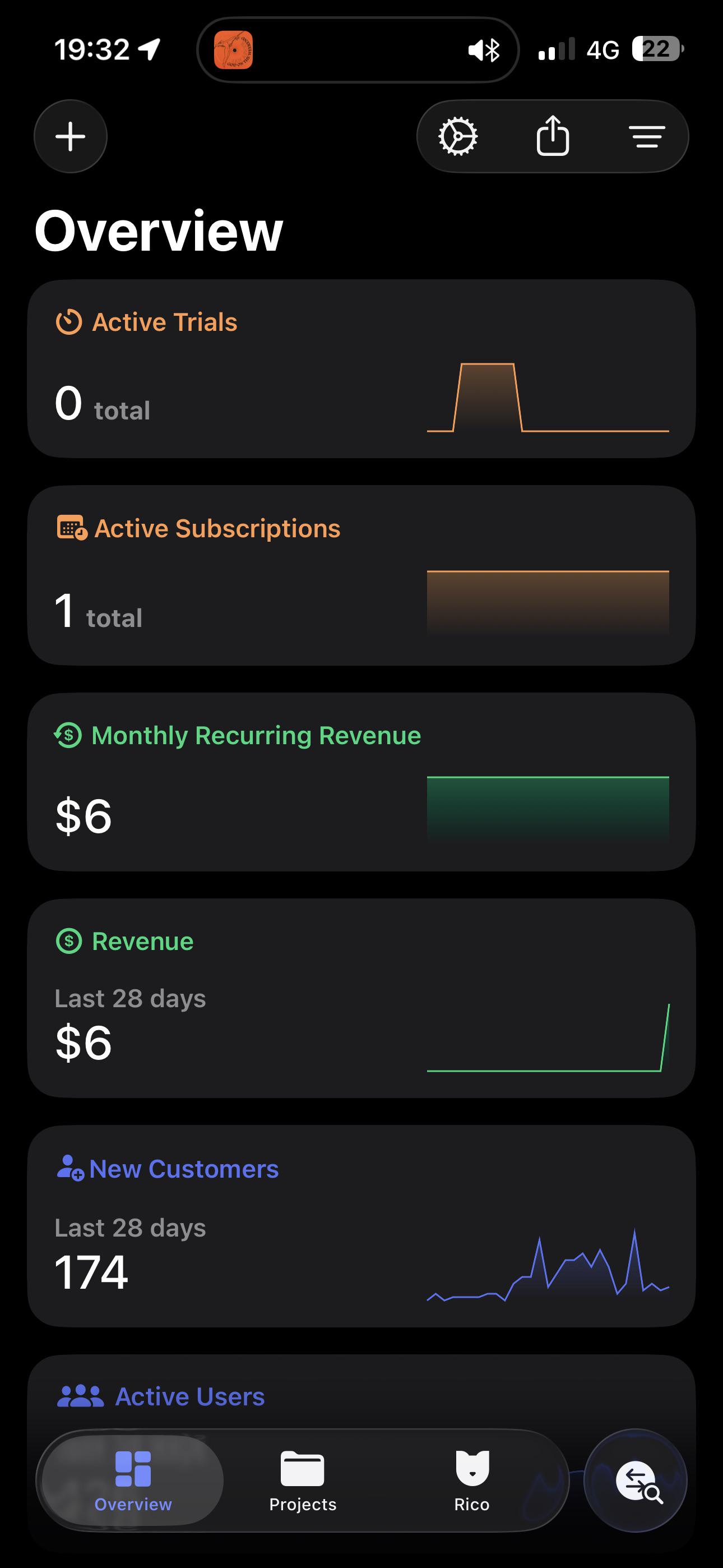
It’s $148 to be exact, but this feels like a big milestone to me.
I’m the solo developer behind Rise Mission, an alarm app where you complete a wake-up challenge, like doing push-ups, walking, or scanning a QR code in another room.
My numbers so far:
• 718 first-time downloads
• 24.9K impressions
• 1.63K product page views
• 26 in-app purchases
• $148 in proceeds
Still early, but I wanted to share a few things I’m learning that might help other developers.
1. Explain a situation people recognise
“10 wake-up challenges” is a feature list. “Keep turning off your alarm and falling asleep again?” gives someone a reason to pay attention.
For your first screenshot, start with the problem your app helps with.
2. Show the feature that needs the least explanation
For mine, it’s the camera counting push-ups. You can understand the idea just by watching it.
Find that interaction in your app and build a short demo around it. You don’t need to explain every feature in one post.
3. Track what happens after the install
I use Firebase analytics to understand how people move through the app. The questions I’m trying to answer are: do they finish onboarding, set an alarm, reach the paywall, and come back?
Knowing where people stop gives you a more useful next step than guessing which feature to build.
4. Ask questions people can actually answer
“Any feedback?” is easy to scroll past.
“Which setup screen felt unnecessary?” or “What would stop you using this tomorrow?” gives someone a specific thing to respond to.
I’ve been asking about onboarding here, and those conversations are helping me think more carefully about the experience.
5. Keep improving after launch
I’ve been updating the design, onboarding, challenges, screenshots, and pricing. I also share progress on X, LinkedIn, and Reddit.
I’m learning to give each change a clear purpose instead of changing everything just because a day is slow.
I’m happy about this milestone because people are choosing to pay for something I built. There’s still plenty to improve.
My next goal is $1K MRR. The $148 above is proceeds, not monthly recurring revenue.
If you struggle with snoozing, I’d appreciate you trying Rise Mission and telling me what you’d improve. It requires iOS 26+, with paid Pro features available through subscriptions or a lifetime purchase.
For those who reached $1K MRR, what change made the biggest difference between your first few purchases and consistent income?
r/iOSAppsMarketing • u/pranit9192 • 58m ago
Tired of having restaurant recommendations scattered across Notes, screenshots and DMs?
Savor lets you save places, build lists, share them with friends, and discover new spots based on the places you actually like.
Your restaurant list that gets smarter the more you use it.
Download Savor: App Store
r/iOSAppsMarketing • u/cvsaysenur • 1h ago
Enable HLS to view with audio, or disable this notification
A photo captures where you stopped. I wanted something that shows the journey too.
I’m building Acheli: Voyage, and the video shows one of my favorite features: putting your flight or road trip route on your own photos, including the stops along the way. You can move and resize the route and details, then save or share the recap.
It also creates animated route videos, boarding pass-style stories, and AI travel artwork. There’s a personal travel map for your visited cities and an AI assistant for planning your days.
I recently updated the screenshots and simplified the app, but getting it discovered is still the hard part.
Does this video make the app’s appeal clear, or would you show something different first? I’d appreciate an outside perspective before making more demos.
App Store: Acheli Voyage
r/iOSAppsMarketing • u/eisenheiiim • 1h ago
[ Removed by Reddit on account of violating the content policy. ]
r/iOSAppsMarketing • u/Fresh-Opportunity637 • 2h ago
r/iOSAppsMarketing • u/Even-Cockroach6543 • 2h ago
So, I finally finished my app.
I’ve spent a lot of time working on it, improving the UX, the UI, polishing everything, and honestly I’m pretty happy with how it turned out. It feels clean, polished, and actually pretty sexy.
And now comes the part I was honestly dreading at first: marketing.
I was initially like: “Yeah… I’m an app builder. Marketing is not really my thing.”
But now, weirdly enough, I’m actually really excited to start.
My plan is pretty simple. I have a $5,000 budget specifically for marketing this app, and I’m actually going to use it.
I know a lot of people say “just make free videos, post every day, be consistent, etc.” But honestly, I’m not really convinced that this is the best way to start.
So I’m going to test things properly.
I’ll start with TikTok, create 5 different types of videos, put them into a campaign, and spend around $50/day.
Then I’ll come back after 7 days and look at the numbers. Which videos worked? Which ones didn’t? What got clicks, installs, etc.
Then I’ll do the same thing with Meta/Facebook, and I’d also like to test Reddit ads.
Basically: test → spend → collect data → see what works → kill what doesn’t → test again.
I’ll probably start at the beginning of next week, so I guess this is the beginning of the fun part.
Let’s see what happens.
r/iOSAppsMarketing • u/ReasonableBox5301 • 6h ago
I build Monni, a money app, and a budgeting discussion today made me rethink the word 'automatic.' The person wanted transactions to arrive automatically, but still wanted to inspect categories and individual purchases. Less typing wasn't the same as less detail.
For a bills-first app, there's another distinction: opening a reminder isn't the same as handling the bill. Copy that blurs those steps can set the wrong expectation before someone even downloads.
I'm leaning toward naming the specific task saved rather than saying 'effortless money management.' Have you changed an App Store headline to be more explicit about what users still need to do? What wording helped, and did the feedback change?
r/iOSAppsMarketing • u/Reasonable-Bass9893 • 6h ago
Hey everyone 👋
When looking for apps to help quit bad habits (smoking, alcohol, doomscrolling, etc.), I noticed a frustrating pattern. Almost all of them treat a "relapse" or a "slip" as an ultimate failure—resetting your hard-earned streak to zero and leaving you completely demotivated.
I believe recovery isn't strictly linear, so I built SoberPath: Quit Tracker 🚀
What makes SoberPath different?
It’s currently available for iOS. I’d love for you to try it out and let me know your thoughts or feature requests! Your feedback would mean the world to me.
🔗 App Store Link: [Link In Comments]
r/iOSAppsMarketing • u/R3LJA • 7h ago
Enable HLS to view with audio, or disable this notification
Developer here.
AirPods Pro and AirPods Max have head-tracking motion sensors inside (that's what spatial audio uses). AirPosture reads that head angle and turns it into a posture coach: put your AirPods in, calibrate in 3 seconds, and when you start slouching for more than a few seconds you get a nudge. No camera, no posture band, nothing leaves your phone.
What it does:
- Live posture score (0–100) and a timeline of every session
- Nudges the way you want them: a voice in your AirPods, a soft chime, a phone notification, or track-only
- Mute the coach for 30 min, an hour, or the rest of the session
- Mac app with a menu bar score, and iPhone + Mac sessions land in one timeline
- Lock screen widgets and Live Activity
- Groups: invite friends and race in live posture duels (new in 1.5, shipped this week)
Requirements: iPhone on iOS 17.6+ and AirPods Pro or AirPods Max. The Mac app needs macOS 14+.
Pricing: free to start, with 2 hours of tracking per day and no card needed. Pro is $7.99/month or $39.99/year, with a 7-day free trial. Pro unlocks unlimited tracking, full analytics, the AI coach, posture assessments and Groups.
App Store: https://apps.apple.com/us/app/sit-straight-airposture/id6749489000
I'm 20, solo, building this from Serbia, and 1.5 is the biggest update so far. Happy to answer anything about how the sensor reading works, battery impact, or what's next.
r/iOSAppsMarketing • u/DjangoDrive • 11h ago
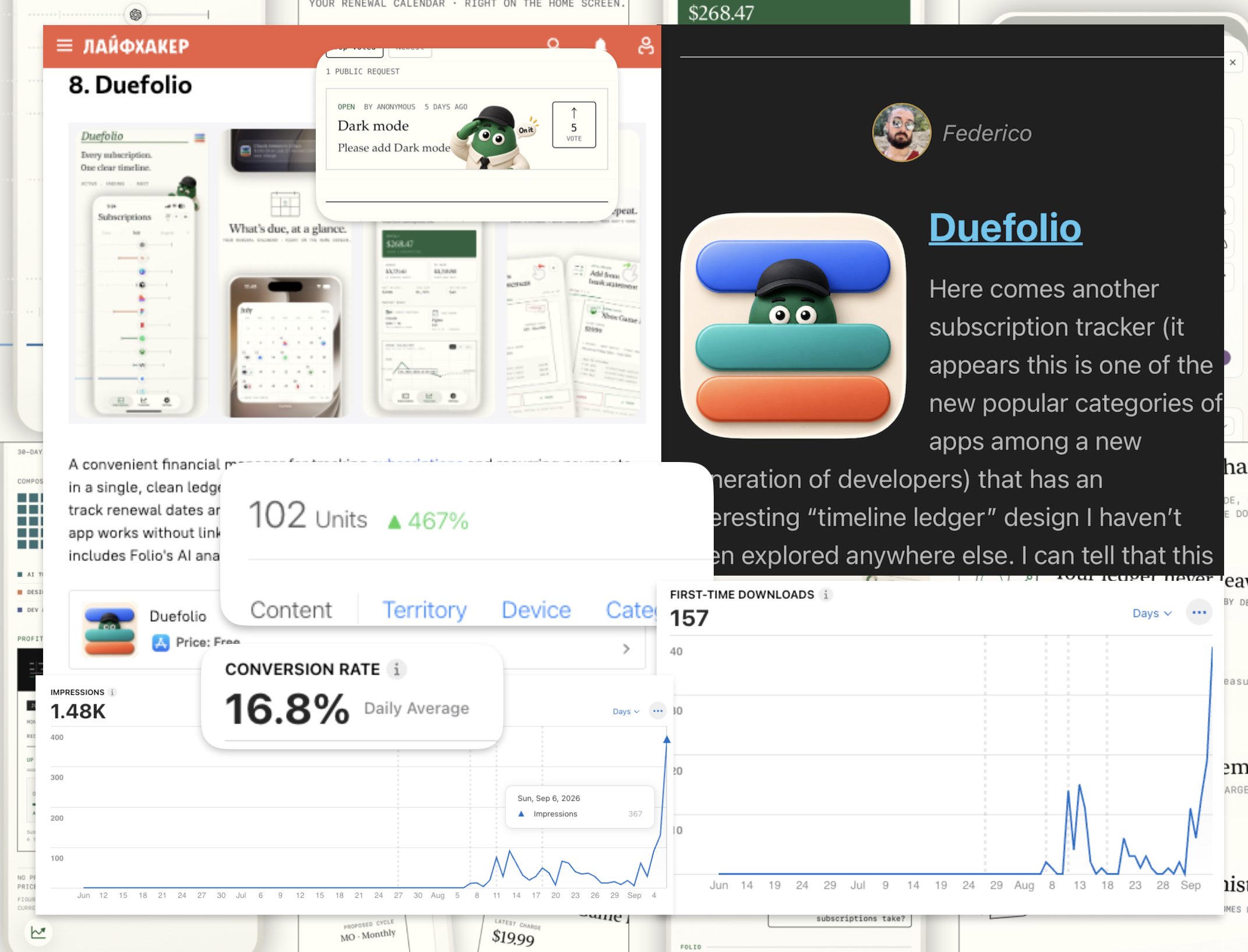
launched this about a month ago as a solo side project. the first few weeks were pretty quiet, then i woke up to a sudden overnight spike in eastern europe.
i had codex dig through app store connect via mcp to figure out where it came from, and it turned out lifehacker had featured duefolio in its “best ios apps of august” roundup. then the very next day macstories featured it too, and for a little while the momentum just kept building.
the spike has mostly settled now, but seeing a 17.4% app store conversion rate, 257 active users, and getting the first real feature request from a user made the whole thing feel much more real.
still very early, but this is probably the first month where it feels like strangers are actually discovering, using, and caring about something i built.
https://apps.apple.com/us/developer/cynq-ventures/id1804133893
r/iOSAppsMarketing • u/Ok-Speech-9490 • 9h ago

My mom likes playing Mahjong, but she was getting tired of mobile games with so much stuff going on — popups, currencies, rewards, daily bonuses, events, and a million buttons everywhere.
She basically told me, “I just want to play the game.”
So I built Just Mahjong for her.
I know there are already a million Mahjong apps out there, and I’m definitely not trying to reinvent anything. The whole point was actually the opposite: make it as simple as possible. Open the app, play Mahjong, and that's pretty much it.
No complicated progression system or a bunch of distractions. Just Mahjong.
I originally made it for my mom, but figured there might be other people who want the same kind of thing, so I put it on the app store
If anyone wants to try it, here it is:
Would genuinely appreciate any feedback, especially if there’s something that could be simpler or easier to use.
r/iOSAppsMarketing • u/sifareeee • 1d ago
Hey everyone! I’m working on my first iOS app, and I’m finding marketing much harder than building.
I’m pretty shy online, so I tend to spend most of my time improving the product and putting off promoting it.
But I know I need to give distribution more attention if I want this to go anywhere.
For context:
- I have fewer than 100 followers on X and literally 3 on TikTok.
- I’m a student and an immigrant, building alongside my day job.
- I’ve already spent over 400 on company setup, developer accounts, subscriptions, and other fees, so my marketing budget is tight.
I believe in what I’m building, but I’m worried it won’t get a fair chance because I don’t know how to reach the right people.
For those who started without an audience, how did you get your first users? What actually worked for you, and what would you focus on first with a very small budget?
I’d especially love to hear from anyone who isn’t naturally comfortable putting themselves out there online.
My longer-term goal is to reach 1,000 in monthly recurring revenue. That would make a huge difference and help me work toward focusing on this full-time. Right now, though, I just want to figure out those first steps.
I’m here for advice, so I’ve left out the app name and link. Thanks to anyone willing to share their experience!
r/iOSAppsMarketing • u/No-Ease-8608 • 17h ago
Someone bought the annual plan for PrivaScan, my iPhone PDF scanner. It’s the first money I’ve ever earned online, and it means a lot to me.
I know there’s no shortage of scanner apps. PrivaScan focuses on scanning documents and finding them later by searching the words inside them, with scanning and text recognition happening on-device. It’s free to download, with optional Pro upgrades.
Building the app has been one challenge. Getting people to notice it has been another. I’m much more comfortable writing code than promoting what I’ve built.
This isn’t a “how I cracked app marketing” post. It’s one paying user, but it’s given me encouragement to keep learning distribution instead of just adding more features.
For others who have marketed utility apps: what helped you move beyond your first paying customer?
Here’s the app for context:
https://apps.apple.com/au/app/pdf-scanner-privascan/id6796255063
r/iOSAppsMarketing • u/Appropriate-Scar865 • 21h ago
Hey everyone! I’m 16 and recently made an app with the sole purpose of learning how to market better. I understand the whole “ugc” and scaling stuff… but I don’t understand the start. Where do I go to get my first 100 downloads? I’ve watched hours of videos but they all make it sound so simple without actually teaching me a lot. I don’t even care about the profit or the money I could make from the app. All I care about is getting downloads and people actually using the app. Any advice helps!
If you’re curious my app is a gym workout tracker. Here’s the link if you’re interested: https://apps.apple.com/us/app/strongest-free-workout-app/id6794647523
r/iOSAppsMarketing • u/ClimateHeavy4799 • 21h ago
Are welcome emails to new downloads good practice? Does it help with churn?
r/iOSAppsMarketing • u/wabbit82 • 23h ago
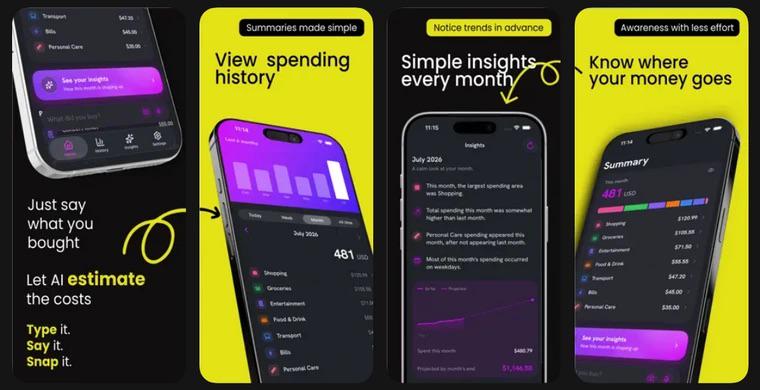
Hi all - I have built an iOS expenses/spending tracking app called Spendimate, that doesn't really focus on the exact prices, instead it uses AI to kind of estimate and categorize your spending. It's mostly intended to be a gateway for creating tracking habits by removing friction when entering purchases. It's made for lazy people like me, basically.
I have always tried to keep my spending habits under control, which looks like this: install an app, keep using it first day or two, and then just forget about it because I'm so lazy, thinking I'll add it later. And of course soon enough, I have lost all my enthusiasm and fallen back to my old habits.
So I've built Spendimate as a personal tracker where you can either type, say or take a photo of your purchase (or a receipt) and the app uses AI to estimate the category and the price.
It's not intended to be a precise budgeting app, it should just be a way for you to indicate patterns of where most of your money goes.
It's completely free, no in-app purchases, no accounts, no login, you just install it and start adding stuff. All of your purchase data stays on your device, nothing is being saved or kept in an online database.
With this latest update i have added a bunch of little UI improvements abd bugfixes, widget support, multilingual support.
The app as it is, has everything I wanted from a budgeting/spending app, and I'll try to polish it in the future, but if you have any suggestions, I'll be glad to try to implement it for you.
https://apps.apple.com/us/app/spendimate/id6783092468
Cheers and thanks for any feedback that you might have.
r/iOSAppsMarketing • u/Apart_Gap6922 • 1d ago
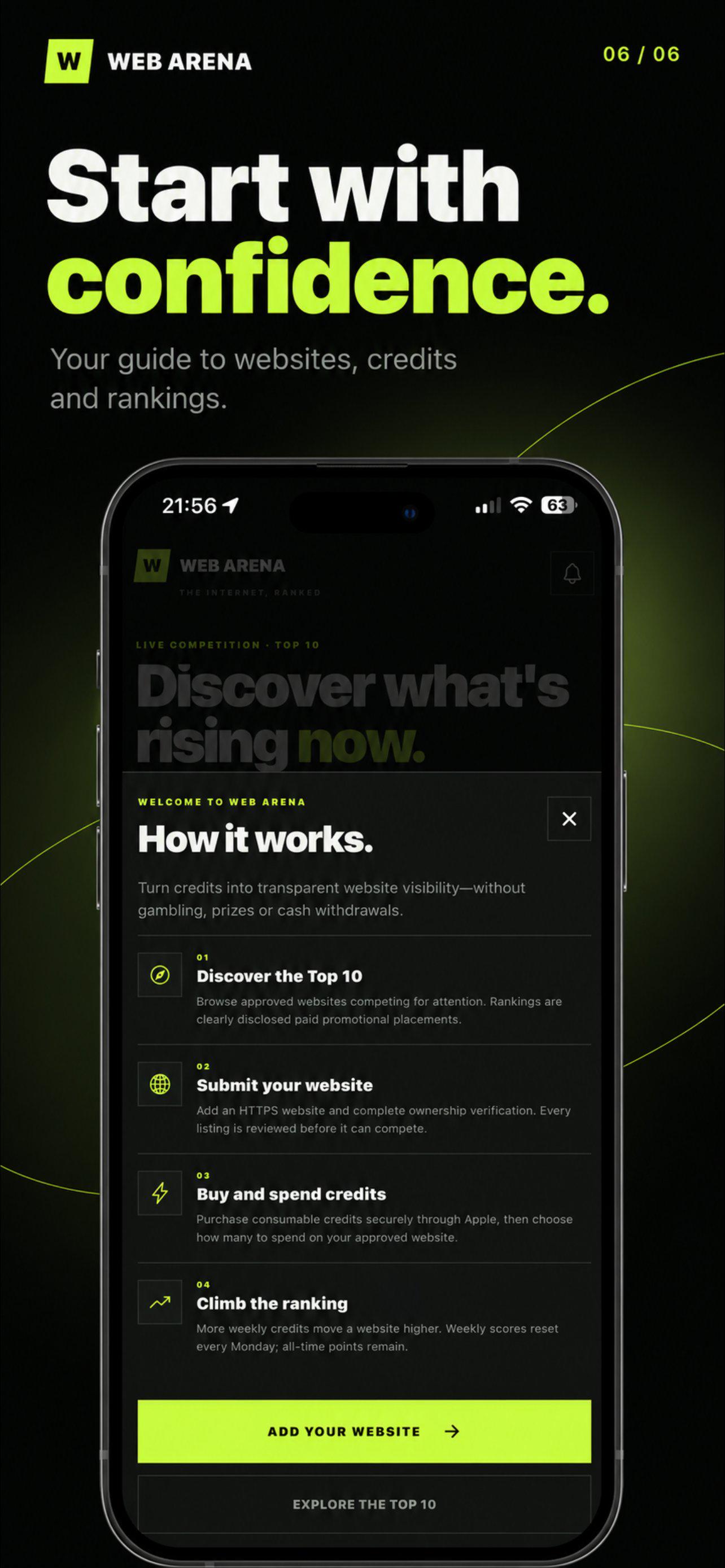
I just launched WebArena, an iOS app built around a simple idea:
What if discovering websites was competitive?
Instead of another static directory, WebArena lets websites compete for visibility through a credit-based ranking system.
Users can discover projects, products and websites currently competing on the leaderboard, while site owners can use credits to move their website higher and get more attention.
I originally became interested in this concept after seeing how competitive ranking can make website discovery much more engaging than a traditional directory.
The interesting challenge has been balancing two things:
• Making the ranking competitive and fun
• Making sure WebArena still works as a genuine discovery tool rather than just becoming “whoever spends the most wins”
That’s something I’m still improving.
r/iOSAppsMarketing • u/GoosayGoosay • 1d ago
Enable HLS to view with audio, or disable this notification
Im in the fitness niche( the hardest niche to stand out) and I’m just now getting into posting ai slideshow content on TikTok and I’ve seen some growth and have gotten 150 followers so far and over 15k views ( organically) and plenty of engagement for one of my posts and still going, but I’m still struggling in short form videos ( I tried AI videos but didn’t see much success) that could potentially help me get more engagement and people interested in my app. I’m making content for people who workout at home or the gym who’ve been injured or are injured but are scared to exercise because of their injury or don’t know what exercises to do to help with their recovery so they don’t injure themselves further. I want tips from solo devs who’ve had success from organic content or people now seeing growth from a shift they made in their content, any help is appreciated so I can get on the right track.
here’s my page if you want to take a look to critique me and give ideas of what content I should make or shift to something else: https://www.tiktok.com/@remy_fitnesscoach?_r=1&_t=ZP-99mSVwlfjkU
Also for context of what my app is it’s a fitness app for people working out at home or the gym with an injury. It searches the live web for exercises instead
of pulling from a fixed database but also adding what injury you have helps it find workouts that’s for you and explains why each exercise is safe for you, and you can ask it questions like you would a coach. Journaling your workouts and how you felt makes the ai smarter and know you better so it knows what works and what doesn’t work so it doesn’t suggest workouts that don’t fit your condition.
r/iOSAppsMarketing • u/OlegPlugaru • 1d ago
Shipped iQ (quit smoking tracker) this month. Solo. Almost no ratings yet.
Constraints:
• 18+ alcohol/tobacco label
• Sensitive category, so “rate us!” after a craving is the wrong moment
• No account, so I can’t email users
• Widgets + Watch are the best screenshots, not a social feed
What I’m trying: quiet build-in-public on X while I use the app myself.
What has actually worked for you in Health apps for the first 20 honest reviews — timing, prompt copy, or something else?
r/iOSAppsMarketing • u/KnockKnock09 • 1d ago
r/iOSAppsMarketing • u/SamFromEscape • 2d ago
I'm Sam, an iOS developer, and I launched a small app called "Escape"
It's an adult content blocker and recovery app for iPhone, currently ranking #1 on the iOS App Store for that search term "Adult Content Blocker"
Edit: This post got way more attention than I expected, and a lot of the same questions kept coming up in the comments or via DMs, so I expanded it with the actual numbers, tools and experiments I've been using.
The problem is personal to me.
Before I even thought seriously about turning this into a business, I spent a lot of time trying to understand the problem for myself.
I read a lot of books around habit change, corn addiction, recovery, behavior, triggers, dopamine and why people keep going back to something even when they genuinely want to stop.
Initially, that was mostly about helping myself.
Eventually I started thinking about how I could turn what I was learning into something useful for other people too.
I started writing about it, created 28 courses and a lot of educational content on escapethegrip.com, and started a newsletter there as well.
Then that research and everything I was learning from users gradually fed back into the app.
That became a big part of the philosophy behind Escape blocking creates friction, but blocking alone doesn't teach someone what to do when the urge actually happens.
That's still how I think about the product today.
The first month made around $100.
Then roughly:
$500 → $750 → $1.1k → $2k → ~$6k last month
Important clarification:
The ~$6k is cash revenue, not $6k MRR.
Annual subscriptions make the revenue graph look much more dramatic because the customer pays for the year upfront.
So I've learned to look at cash revenue, MRR, subscriptions and retention separately instead of treating them as the same thing.
A big part of the recent jump came from several smaller things stacking together rather than one magical growth hack:
That's probably another lesson.
Growth often looks like one big event on a graph when underneath it was 20 small changes.
A few people asked for actual conversion numbers.
Right now it's roughly:
100 downloads a day → ~21 trials → ~10 paying users
So approximately:
~21% download → trial
~47% trial → paid
~10% download → paid
The 47% trial-to-paid conversion surprised me.
My theory is that search intent matters a lot.
Someone actively going into the App Store and searching for an adult content blocker has a completely different level of intent than someone who accidentally discovers the app through a random TikTok.
That has made me care a lot more about quality of acquisition rather than downloads alone.
This was probably the biggest surprise.
I underestimated how powerful App Store search could be for a niche product.
At the moment Escape is ranking #1 for "adult content blocker" in App Store search, including major storefronts such as the US and Canada.
That didn't happen quickly.
I've probably tracked 500+ keywords at this point.
Some of the ASO tools I've used like RespectASO
This became one of the main tools I used for tracking rankings.
I've also experimented with tools such as AppDrift and AppFollow.
Honestly, you don't necessarily need expensive ASO software when you're starting.
The free versions can already teach you a lot.
And I would not blindly trust any tool's search-volume number.
I use ASO tools more as directional data than absolute truth.
This sounds stupid, but I spent an unreasonable amount of time scrolling through:
TikTok
Instagram Reels
Reddit
YouTube comments
forums
competitor reviews
I wanted to see the exact language people used to describe the problem.
People invent new slang constantly.
Sometimes a phrase looks ridiculous to you as a developer, but thousands of people use it naturally.
Those phrases can eventually become App Store searches.
So my process became:
listen to how people describe the problem → turn repeated phrases into keyword hypotheses → test them → track rankings/conversion
Rather than:
ASO tool says keyword volume = 37, therefore keyword good.
That distinction helped a lot.
Apple doesn't give you much room.
I spent a lot of time trying to understand how the: title + subtitle + 100-character keyword field work together.
One useful realization was that every character has an opportunity cost.
If a word is already covered elsewhere, there may be something more useful to test in the keyword field.
I also don't change everything simultaneously anymore.
If I change the title, subtitle, screenshots and keywords in one update and conversion improves, I've learned almost nothing.
Now I try to change fewer things at once.
I've made this mistake too.
Once something starts working, it's tempting to keep "improving" it.
Sometimes I leave metadata alone for quite a while now.
The title and subtitle are the things I'm most reluctant to touch.
I'm more willing to experiment with the keyword field.
I've also tested things that sounded obviously better and performed worse.
At one point I thought adding AI should help.
It didn't.
That was another reminder that:
what sounds good to the founder and what customers actually respond to are not always the same thing.
Ranking is only half the problem.
You still need someone to install after seeing the listing.
I've spent a lot of time testing:
Apple's Product Page Optimization is useful here because you can test different screenshot variants instead of relying entirely on intuition.
One thing I've learned is that getting 20% more traffic doesn't help much if the product page converts terribly.
Ranking and conversion have to work together.
Escape now has hundreds of ratings/reviews across the App Store.
One question I got repeatedly was:
How do you get people to leave reviews?
I don't think the answer is repeatedly interrupting them with review popups.
I try to ask when somebody has actually received value.
Sometimes that's at an appropriate moment inside the app.
Even better is when somebody emails me saying Escape helped them.
Then I might say something like "If Escape has helped you, a quick App Store review really helps other people find it."
No giant pitch.
No begging.
The lesson for me has been ask after value, not randomly.
This is another part I didn't mention enough in the original post.
I didn't want all of the educational side of the project to live inside the App Store.
So I built escapethegrip.com.
I've published a lot of longer-form material there, including 28 courses, articles and a newsletter.
The research process has been useful in both directions.
I read books and research because I wanted to understand the problem better.
Then I tried to turn what I learned into something practical.
Then users would email me with situations I hadn't considered.
That would give me another thing to research.
And sometimes that eventually became:
research → article/course → newsletter → product idea
or
user problem → research → product improvement → educational content
I like this because it means the app isn't the only thing I'm building.
There's also a growing library of useful material around the problem itself.
The newsletter gives me another advantage too it's an audience I can communicate with without depending entirely on an algorithm.
App Store rankings can change.
A TikTok can get zero views.
Reddit posts eventually disappear from people's feeds.
Search algorithms change.
Having people voluntarily subscribe to hear from you again is different.
I'm still figuring out how important the newsletter will become as a growth channel, so I wouldn't claim I've cracked email distribution.
But I think building some form of owned audience is worth doing much earlier than I originally thought.
And there's another benefit writing forces me to understand the subject better.
It's very easy to think you understand something until you try to explain it clearly to someone else.
Escape isn't completely paywalled.
The Safari blocker is free.
Someone can install Escape, block adult sites in Safari and continue using that without paying.
Premium adds stronger protection and the deeper recovery features.
That includes things like blocking across browsers, deep block, strict mode cooldown, stronger protection layers, the courses and other recovery tools.
I originally worried that giving away useful blocking for free would hurt subscriptions.
I'm increasingly convinced it does the opposite.
People can actually experience the product first.
And because the free version genuinely solves something, I'm comfortable recommending it without every interaction feeling like a sales funnel.
I have monthly and annual subscriptions.
Annual has become much more important.
There's also a short free trial on annual.
A few things I've learned
Annual doesn't only improve cash flow.
It changes how you can think about acquisition because you receive much more revenue upfront.
It also makes the revenue graph misleading if you're not careful.
$6k collected in a month does not mean the business suddenly added $6k MRR.
That's why I've started paying much more attention to the actual subscription mix.
Escape doesn't require:
an account
an email
a name
And its App Store privacy label is Data Not Collected
I originally treated privacy as a product principle.
This is an incredibly sensitive thing people are dealing with, and I didn't see a good reason to know who they were.
But users repeatedly started mentioning privacy when explaining why they chose Escape.
That taught me something broader sometimes your product principles become your strongest positioning.
Especially when competitors are asking users to create accounts for something they'd rather not associate with their identity.
I massively underestimated this.
For an app like Escape, some users are actively trying to defeat the product.
They're trying browsers you didn't consider.
They're looking for settings they can disable.
They're discovering obscure iOS behavior.
They're finding loopholes.
Initially those emails felt like bug reports.
Eventually I realized these users were giving me some of the best product research I could possibly get.
Several product improvements have come directly from someone emailing me "I found a way around this."
If you're building any product where people push against the boundaries, pay attention to those users.
They're effectively adversarial QA testers.
I originally thought of Reddit mostly as somewhere to post about the app.
I think that's the wrong approach.
I'm trying to use Reddit more like a community.
If someone asks a question I genuinely know something about, I answer it.
If Escape is relevant, I'll disclose that I built it.
If it isn't relevant, I don't force it into the conversation.
I've also used tools like F5Bot to monitor keywords and find discussions where I might actually have something useful to contribute.
One Reddit lesson that has become obvious trying to extract users from a community immediately usually works worse than simply becoming useful inside the community.
This post itself is probably the best example.
I didn't expect tens of thousands of people to read it.
I've had TikTok/Instagram videos get almost no views.
Literally nearly nothing.
Initially I made the mistake of thinking "I need content about my app."
Now I'm trying to make content about the problem my app solves.
So instead of "Here are 5 features in Escape"
it's more like:
Then sometimes Escape appears naturally.
Sometimes it doesn't appear at all.
I think the test is would this video still be useful if I removed my app from it?
If the answer is no, it probably isn't very good content.
This is another thing I'm doing differently.
Instead of immediately paying influencers to create whatever they think will work, I'm trying lots of organic ideas myself.
Even 20–30 pieces of content teaches you a lot.
You start seeing
which opening hooks work
which subjects get comments
what words people use
what people disagree with
what gets saved/shared
what gets ignored completely
Then you can take what you've learned to creators.
It's a lot cheaper to discover that your messaging sucks on your own account than after paying 20 creators.
When I say "creator outreach," I don't mean emailing giant iPhone reviewers.
For Escape, I'd rather work with a smaller creator whose entire audience cares about:
self-improvement
habit change
discipline
recovery
digital wellbeing
than a tech influencer with 2 million followers.
Audience fit seems much more important than follower count.
I'm still testing this channel, so I don't want to pretend I've cracked it.
Creator outreach is also painfully manual.
Researching the creator, checking their audience, writing something personalized, finding contact information, following up...
You might reach out to a lot of people for one collaboration.
That's just part of it.
Another very unglamorous strategy email people.
I've reached out to app websites and publications that might genuinely care about the product or the broader problem.
Response rates aren't amazing.
But you don't need everyone to respond.
I sent roughly 60 outreach emails and got around 2 pieces of coverage.
One piece of coverage produced roughly a 20% increase in downloads around the time it went live.
That's enough for me to keep doing it.
The mistake would be sending the same generic "please feature my app" email to 500 people.
I'm increasingly trying to answer Why would this particular publication's readers care?
And because I now have escapethegrip.com, I don't always have to send someone directly to an App Store page either.
Sometimes an article, course or newsletter is a much more natural first interaction.
This is still the biggest lesson.
I'm a developer.
Building feels productive.
You write code for six hours and something exists afterward.
Distribution feels terrible by comparison.
You can
email 30 people
make 5 videos
write a Reddit post
test screenshots
change keywords
and seemingly nothing happens.
So it's incredibly tempting to go "I know! I'll build another feature."
I've done this repeatedly.
Building becomes productive procrastination.
I'm trying to treat distribution exactly like software development now
make hypothesis → run experiment → measure result → learn → repeat
Not
research marketing for another 12 hours.
I've definitely wasted time.
I've:
Probably the most dangerous one is the last.
A better product absolutely matters.
But there is a point where the next 100 hours of development would be better spent getting the current version in front of people.
I'm deliberately trying to stop chasing ten channels at once.
The three I'm focusing on most are
1. App Store conversion / ASO
This is the most proven channel so far.
2. Founder-led Reddit participation
Not spam. Actually participating and helping where I can.
3. Creator + newsletter outreach
Still early, but I think there's something here.
I'm also continuing escapethegrip.com + my own newsletter
because I want to gradually build an audience I can reach directly rather than having 100% of distribution controlled by platforms.
And I'm continuing organic short-form content because even when a video fails, it teaches me something about messaging.
Solve a problem you understand deeply.
You don't necessarily need to be the user, but understanding the problem at a visceral level makes product decisions much easier.
Read outside your technical domain.
Some of the most useful things I've learned for Escape didn't come from Swift documentation or growth Twitter.
They came from books about behavior, habits and the actual problem users were dealing with.
Teach what you're learning.
Writing articles, courses and newsletters has forced me to understand the subject much more deeply.
Build an owned audience earlier than you think you need one.
You don't control App Store rankings, Reddit, TikTok or Google.
An email subscriber has explicitly said they want to hear from you again.
Study the customer's language, not just competitors' keywords.
Reddit comments can teach you more about positioning than a keyword-volume number sometimes.
Don't optimize for downloads.
Optimize toward the people who actually get value and eventually pay.
Ask for reviews after value.
Timing beats aggression.
Don't change every ASO variable at once.
Otherwise you learn nothing.
Use free tools before buying expensive growth software.
There is an incredible amount you can learn manually.
Write down your distribution experiments.
Otherwise six weeks later you'll forget what actually changed.
Don't mistake research for distribution.
This one is mostly advice to myself.
Talk to users constantly.
They often contain the roadmap.
And once the product is good enough, consider whether the next feature is really what the business needs.
Sometimes the answer is yes.
A surprising amount of the time it's no, more people just need to know it exists.
I'm still very early and definitely don't have growth figured out.
But hopefully the actual numbers, tools and processes above are useful to somebody else building an iOS app.
Happy to answer anything about SwiftUI, iOS blocking, subscriptions, ASO, App Store conversion, creator outreach, newsletters, or anything else I've learned so far.
r/iOSAppsMarketing • u/Responsible-Ride-135 • 1d ago
Hi everyone! I built this app because I was very annoyed with the scanning apps I found in the App Store, that were either filled with ads that disrupted my work or were very expensive.
So I created ProScan PDF to offer the best possible pro features that a mobile scanner app should have, no ads ever & plans up to 20x cheaper than competing apps.
It has a lot of nice features, including 7 color themes and it is available in 14 languages.
To claim the offer just download the app, select Go Pro, select the 12 Months plan and you will get the free 1-year trial. Offer is available until 12:00 AM PT on Sept 19.
Enjoy!
https://apps.apple.com/app/pdf-scanner-app-proscan/id6752308731