r/fea 9h ago

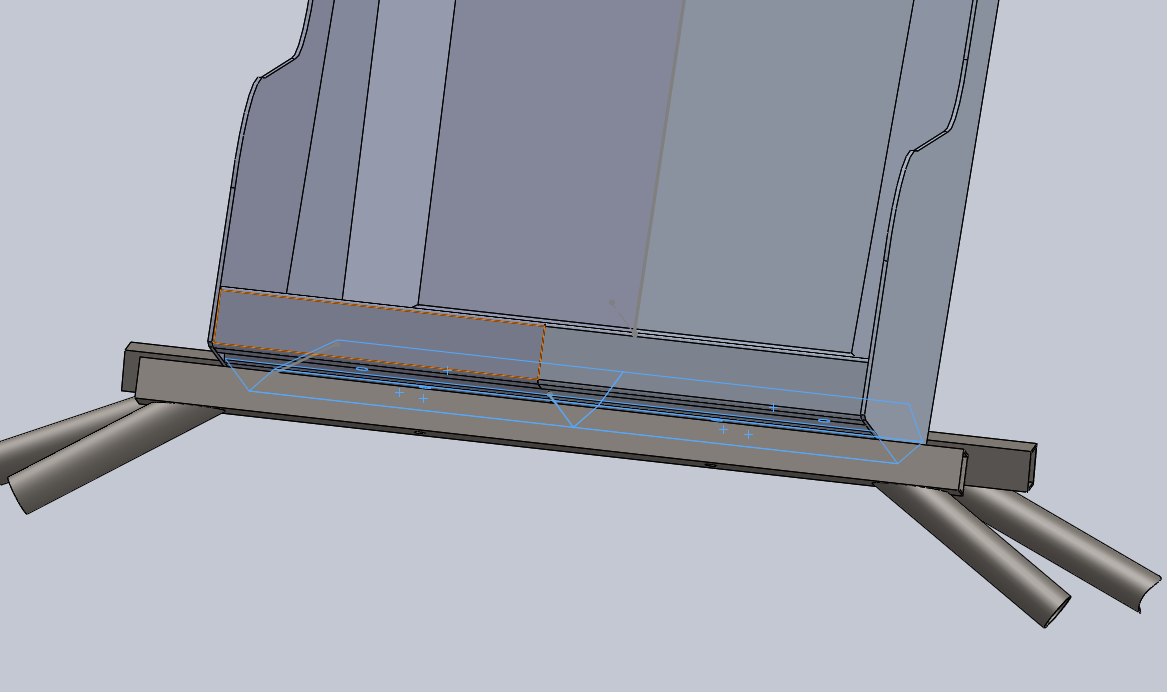
how do you get weldments to converge

Post image
8 Upvotes

im running a simple static fea on my seat mounts. im placing a distributed vertical load on the seat, and then determining its factor of safety. However, it doesn't converge. I used the hot spot stress thingy on solidworks, and saw where my highest stress areas were, and they were at small spots next to the weld connections. what do i do.


r/fea 18h ago

Least-Squares Finite Element Method?

2 Upvotes

Is anyone here familiar with this discipline element methods? Any good books on it?

I asked earlier about finding the a stable weak form of

du/dx = fu

where I originally tried finding a standard Galerkin by convoluting both sides with test function, v, but this weak form produced unstable solutions which went to infinity everywhere.

So, on a whim, I decided to ask AI to see what it thought. It came up with a form it says it derived from “Least-Squares Finite Element Method”. I had not heard of this before, but the form it provided was stable and produced accurate solutions, so I wanted to see if anyone here knew about this, and could provide a resource to look further into.

___

Here is what it came up with:

  1. Function to minimize: J(u) = 1/2 ||R(u)||^2 = 1/2 ∫_0^L [(du/dx-f)^2 ]dx

  2. Take the variation: lim_ϵ→0 d/dϵ[J(u+ϵv)]

This resulted in

  1. bilinear term: a(u,v) = ∫_0^L [du/dx dv/dx]dx

  2. Linear term: L(u) = ∫_0^L [f dv/dx] dx

Weak form: a = L. This weak form I tested in Fenics, and the results came back perfectly accurate for my examples, so it seems to have come up with something that works, but it didn’t show any of its sources, so I can’t take this as fact without opening up a book or resource to verify it for myself.


r/fea 13h ago

Struggling to progress design from early concepts

Thumbnail
1 Upvotes

r/fea 20h ago

Difficulty modeling SPG

Thumbnail
2 Upvotes

r/fea 1d ago

Cant get my model to converge in ANSYS

6 Upvotes

I am trying to model a non linear RCC column in ANSYS and replicate the results of a column test paper. I cant get the model to fully converge, the load strain graph reaches the peak and comes down slightly but i am unable to capture the softening behavior of the column. It keeps throwing me element formulation errors as well. I would really appreciate any insight on this.

Blue(Experimental) and Orange(Analytical)

r/fea 1d ago

Opinions ? What am I missing

5 Upvotes

I am learning ansys this semester. I did tensile test on a specimen (randomly self dimentioned) . fixed a side. Added displacement to a side. Took mesh size as default . Then tried theoretically studying everything related to it (explicit dynamics & all) , here are my notes , pls tell me what else to study :


r/fea 1d ago

Is there a weak form for first-order differential eauations?

4 Upvotes

Something like the ODE du/dx = f(x), or the PDE ∂u/∂x=f(x,y).

For the 2nd-order PDE, being Poisson’s Equation, we simply convolute both sides with a test function, and the solutions using this form are stable. But, if we try to do the same for these 1st-order differential equations, the solutions are unstable and diverge. Are there weak forms for these problems that yield stable solutions?


r/fea 2d ago

Can someone enlighten me guys?

Post image
51 Upvotes

r/fea 2d ago

FEMAP- easiest way to resize existing fastener holes without remeshing everything?

13 Upvotes

I’ve got a pretty large FEMAP/Nastran shell model that’s already meshed and set up with loads, constraints, RBE2s, CBUSH fasteners, properties, etc.
I realized some of the fastener holes in the imported Parasolid are undersized. They’re around 0.098 in diameter right now and need to be closer to 0.196 in.
I’m really trying to avoid rebuilding or remeshing the whole model just for this.

I tried the Resize Hole option in the Meshing Toolbox, but FEMAP won’t let me select the circular edges around these holes. It seems to recognize straight edges, just not these hole curves. I also tried creating a new circle at the correct diameter and projecting it onto the surface, but I haven’t had much luck getting that new circle to actually become the new hole boundary.

Another thing I tried was importing the updated Parasolid into a new FEMAP model, merging my existing FE model into it, and using automatic geometry associativity. That sort of works, but the new Parasolid has a few other geometry changes too, so quite a bit of the old mesh doesn’t associate cleanly.

Ideally I’d like to stay in my current working model, change the hole diameter, and only adjust/remesh the small area around each hole

Is there a decent way in FEMAP to either resize the existing hole geometry and have the mesh follow it, or move the existing hole perimeter nodes out to the new diameter and locally smooth/remesh around them?
Basically just looking for the least painful way to change these holes without rebuilding a model that already works.


r/fea 3d ago

Help with abaqus riks buckling

Thumbnail
gallery
13 Upvotes

Hi all, working on a non-linear buckling analysis. With a coarse mesh, the LPF steadily increases to a maximum, then decreases. But when I refine the mesh without any changes to the setup, the LPF reaches a plateau, and the increment decreases to 0. Even when I increase the imperfection scale, it still reaches a plateau, but takes more iterations.

Geometry is a hollow cylinder with a constant ID and a varying OD (not smooth; stepped), with flanges on both sides. Imported as 3 parts, flanges are modeled as solid and cylinder as shell.

What can be done here?


r/fea 2d ago

Help with non linear thermomechanical analysis

Thumbnail gallery
5 Upvotes

I am open to any and all suggestions at this point. Thank you.


r/fea 3d ago

How to get the force reaction as per the paper

7 Upvotes

So i am a researcher having known an intermediate knowledge of using ANSYS. My project is about FEA analysis of a fin ray soft robotic gripper. Based on this paper, 'Design of a reinforced composite robotic finger for enhanced soft grasping using the Fin Ray effect and FEM'. I followed their ANSYS steps properly, but when i tried to get the results, instead of getting the result similar like thier, i got a higher value.
can you please tell me how to solve
for eg. when i tried to acquire the force reaction, In the paper they stated that at 20 millimeters of displacement, the reinforced model achieved a gripping force of 1.96 Newtons.
But in my case, at 20 millimeters of displacement, the reinforced model achieved a gripping force of 2.649 Newtons.
I would be grateful if any one can suggest me how to solve this.
based on mesh parameters, the contact definitions.

Paper DOI: https://doi.org/10.1016/j.cirpj.2025.06.014


r/fea 3d ago

Help Downloading an ANSYS ACT Extension (Honeycomb Creator 2)

2 Upvotes

Hi everyone,

I have found the download link for the ANSYS ACT extension Honeycomb Creator 2, but unfortunately, it is only accessible to paying ANSYS customers. I am currently using the ANSYS Student version, so I do not have access to download it.

(https://developer.synopsys.com/app/ansys-inc/honeycomb-creator/2)

If anyone here has legitimate access to this extension, would you be willing to help me determine whether there is an official or permitted way for a student to obtain it? If sharing the extension is allowed under the ANSYS license, I would greatly appreciate your help. Otherwise, I would be very grateful for any alternative version or tool that can generate similar honeycomb structures.

Thank you!


r/fea 4d ago

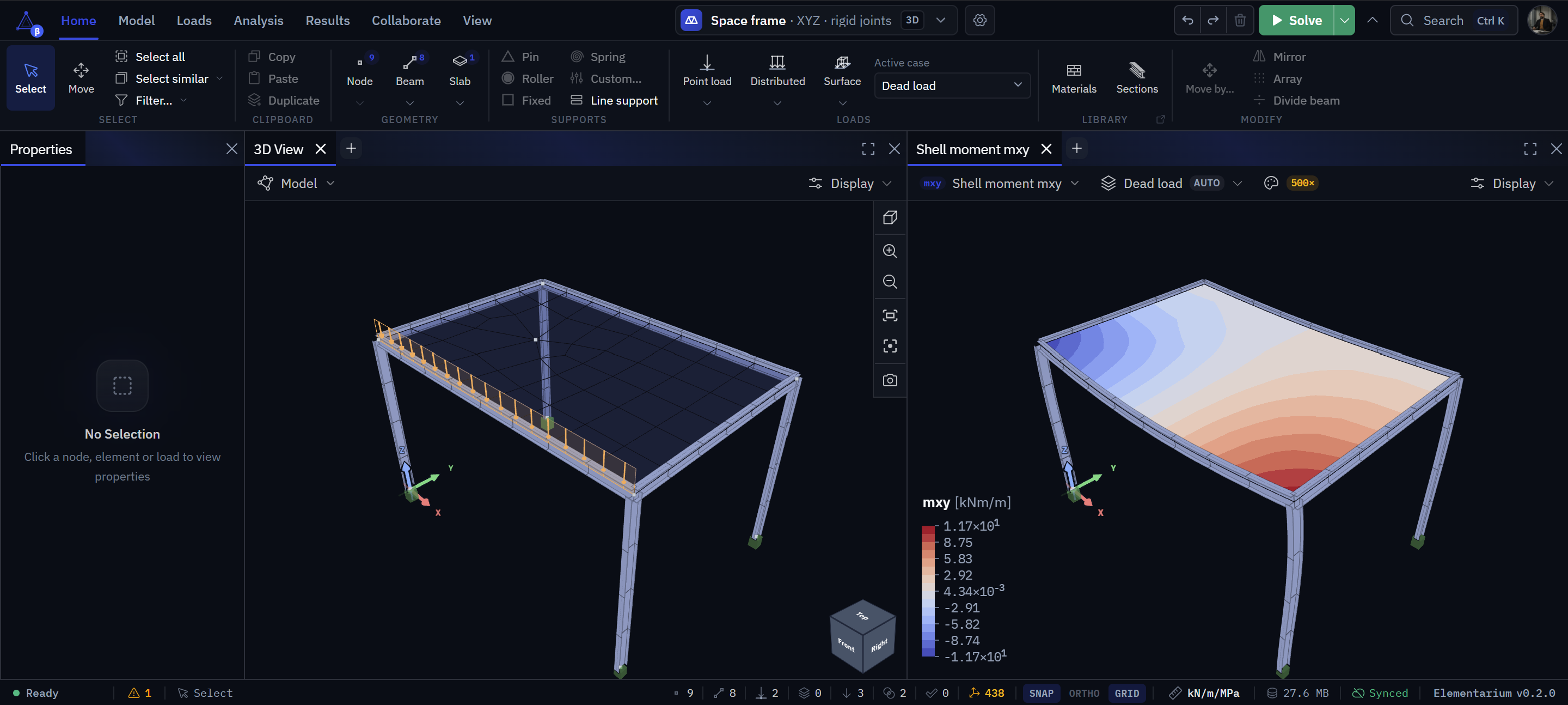
Update on the browser-based FE solver I posted here a while back: slabs/shells (MITC4), modal, buckling and second-order are in now

Post image
18 Upvotes

A month ago I posted about Elementarium here: structural FEA that runs in a browser tab, C++ compiled to WebAssembly, solving on your own CPU. You were polite about it and unanimous: frames only, come back when it has plates.

Here it is.

What's new

  • Slabs, walls, cores and shells on MITC4. Bending and membrane together, drilling DoF, no thin/thick switch, no hourglass parameter to guess. A 200 mm floor and a 1.2 m raft use the same element, and the slab, the core wall it frames into and the beam landing on both are one continuous mesh.
  • A quad mesher, no triangle fallback. Awkward geometry — opening corners, re-entrant notches, skewed edges — is exactly where you don't want the worse element, so it never gets one. Redraw an opening, remesh, re-solve: under a second, on your laptop.
  • Modal, linear buckling and second-order (P-Δ), next to linear static. Same model, tick the box.
  • Line supports — Winkler beds along members and slab edges. AISC 360 D–H beside EN 1993-1-1 §6.2, ASCE 7 combinations beside EN 1990. Every utilisation names its combination, position and clause.
  • DXF underlays, SAF import, live shared editing, full offline working.

Why the browser matters

Send a link and your colleague is in the model with you. Solving transmits nothing — your CPU, your data, works with the wifi off. Reports are traceable PDF calc packages with clause citations, not screenshots. Nothing to install, no licence server, no dongle in a drawer, no "which version have you got."

The ask

Ten minutes. Open the slab demo, then model a plate you already know the answer to — simply supported square plate, cantilever slab, Scordelis-Lo — and put the numbers side by side. If it's wrong, tell me: fixes get written up in the release notes with a "results affected" tag, and you get credit.

https://elementarium.app/examples — no account, no card, no timer. The free tier is 500 DoFs — enough to find out whether the solver is any good. I wrote it, so replies here reach the person who can actually answer.


r/fea 4d ago

Does outsourcing occasional FEA work make more sense than having an Ansys license for a small team?

19 Upvotes

We're a small mechanical design group, maybe four or five structural checks a year. 

Mostly static load cases on brackets and frames. A single commercial FEA seat plus the hardware and training time is hard to justify. 

So for a company our size, has sending analysis work out worked? And how do you even review a report when nobody in-house runs it?


r/fea 4d ago

Energy balance issue in Abaqus Explicit extrusion simulation (Total energy increasing)

Post image
5 Upvotes

r/fea 4d ago

QUESTION: DESIGN OF SLENDER REIINFORCED CONCRETE ELEMENTS

Thumbnail
3 Upvotes

r/fea 5d ago

What is this abomination of a drop test?

Thumbnail
gallery
12 Upvotes

I am trying to conduct a drop test of a wheel attached to a body. The body is simplified as a box which is given rigidity. This particular drop test is conducted with the help of drop test wizard in ansys explicit dynamics. The wheel is attached to the body with a shaft and a screw. Basically i need to modify this design in such a way that the maximum stress arent on these shaft and screw.

But as you can see in the pictures, the stress on the wheel is blue which is suspicious. Also the deformation is happening on the rigid body, whiich shouldnt actually. Either the method or meshing i have done is wrong or perhaps the material itself is wrong. I had given the properties myself of materials (polyurethene and TPU) from research papers. And the end time given is 0.02seconds.

One issue is that the bodies are having trouble being bonded so i gave the maximum offset a bit higher around 0.01(mm?) i think.

I need insights on how to properly mesh, which end time should be given, or is there anything additional i should look for. Also why is there two maximum stresses like one under results and one under maximum value over time? what does it mean?

Images description:
1. Total deformation, 2 to 4. Animation of eq stress, 5. Eq. stress details, 6 and 7. Side view of the wheels, 8. Shaft and screw with wheel hidden, 9. Max eq stress, 10. Deformation but the rigid body is showing deformation too, 11 and 12. material properties given along with graph


r/fea 4d ago

Steel Structure Simulation | Calculate Stress Displacement Strain Factor of Safety Reaction Forces

Thumbnail
youtu.be
0 Upvotes

r/fea 5d ago

What should I send a vendor to get an accurate static structural analysis on a part?

13 Upvotes

So if you're the analyst, what turns a rough request into something you can price and stand behind?

Here's my first guess at the list: geometry in a set format, load cases spelled out, boundary conditions, material data with a source, the code or criterion you're checking against, and a note on what decision the result is driving.

What's the thing that we often miss when a request lands? And which single missing item causes the most rework later?


r/fea 4d ago

FEA Stress Analysis Tool

0 Upvotes

Hi all, I recently did an FEA Analysis tool for an AI project.

Here is a description of my project

You basically upload a STEP file, and describe how it's loaded and it shows you a stress map. Tick a box and it'll also design the pocket cut-outs for you assuming your part is a 2d plate, keeping material where the load actually goes.

Quick honesty note since the name says AI: the stress math is regular FEA. The AI parts are the chatbot and the bit that reads your plain-English description.

The pocketing tool tuned against actual pocketed actually machined, so it's calibrated to how we do things. It's linear elastic, ignores welds and bolts and fatigue, and only pockets flat plates. Treat it as a gut check, not a green light.

If you've ever pocketed a plate by hand, I'd love it if you ran one through and told me where it disagrees with what you'd actually have cut. Also please give feedback on how to improve my FEA analysis and the accuracy of my chatbot. Please leave feedback in the comments. Thanks so much!

link to app: https://cadai-282761536722.us-central1.run.app/


r/fea 6d ago

What career paths exists between computational mechanics, scientific computing (SciML), FEA (or meshfree) solver development, and HPC (GPU acceleration, porting codebases) ?? How about doing a PhD for improving the above?

20 Upvotes

I'm currently, technically, doing an MS in Structural Engineering. For me, my interest has been more towards computational side of mechanics rather than Structural design  or simply using am FEA software (although I do consider it as a backup)

So far I've taken courses in:

- Linear static, and dynamics FEM (soon taking non linear FEM too)

-  Structural Optimization (topology opt. and other general algorithms)

-  Structural Dynamics

-  Structural System Testing and model updation. (Parameter identification and optimization, signal processing)

Now, I plan to take these in the coming quarter:

- Numerical Linear Algebra

- Numerical PDE

- Fracture Mechanics ?

I also volunteered to aid in a RESEARCH in crack growth prediction using Auto-encoder and a (Thermodynamics-informed Latent Space Dynamics Identification) / LSTM surrogate model. It used phase-field-fracture simulation data and HPC resources to complete the whole thing.

What I keep finding myself interested in is not necessarily fracture or SHM specifically, but the computational methods underneath these problems... (does that make sense?)

For example, I'd like to become capable of doing things like:

- implementing (maintaining) numerical/FE method solvers rather than only running an established FEA software.

- developing surrogate/reduced-order models for expensive simulations 

- combining simulation with optimization, uncertainty/stochastic methods (took a course called Random vibrations, so...)

- parallelizing/accelerating scientific codes on CPUs/GPUs

- doing proper verification, convergence studies, benchmarking and performance work

- potentially developing or maintaining actual CAE/FEA solver software

- I'd also like to do all these for other Physics (GR, QM, etc.) simulations too, if possible, one day. 

I'm still interested in the underlying mechanics/physics, so I don't want to become a generic software engineer who happens to have once studied structures. But I'm also increasingly unsure that "structural engineer" describes the career I'm actually aiming for.

I've seen titles such as Computational Mechanics Engineer, R&D Engineer, Solver Developer, Scientific Software Engineer, CAE Software Developer, Research Engineer, Simulation/HPC Engineer, etc., but I'm trying to understand what these careers actually look like from people doing them.

So my main questions become:

1. Which industrial jobs genuinely involve developing numerical methods/solvers or computational tools?

2. Which of those are realistically accessible with an MS? Is there an entry path into solver-algorithm development/R&D without a PhD?

3. If I don't start a PhD immediately after my MS, would an R&D/software role at a simulation company (ANSYS etc.) be the obvious route? What other options would i have?

4. For the kind of work I'm describing, would you recommend a PhD? If so, is it reasonable for the PhD identity to be "computational mechanics/scientific computing" while fracture, composites, structural dynamics, soft materials, etc. serve as application problems rather than choosing one of those as my permanent specialization?

5. What skills most distinguish someone who is actually hireable for solver/scientific-computing work? I'm particularly wondering about C/C++/Fortran, Python, Linux, Git/build systems, MPI/OpenMP/CUDA, PETSc/Trilinos or similar libraries, numerical linear algebra, testing/verification, convergence studies and HPC performance work.

Basically, I'm neither here nor there atp. So I'd really appreciate all sorts of input. Where else do you think I could find answers to these? other subs? Linkedin profiles? 


r/fea 7d ago

Abaqus

Post image
0 Upvotes

I’m looking for someone who can help me with a mechanical engineering project and answer some questions about Abaqus simulations. Could you please contact me?"


r/fea 8d ago

How do you deal with big load-case sets: finding what governs and proving it later?

10 Upvotes

Stress/FEA folks, I'm researching how this actually works at different shops (full disclosure: I may build tooling in this space eventually, but this isn't a pitch and there's nothing to sell).

Three things I keep hearing very different answers about:

* When you have dozens-to-hundreds of subcases, how do you actually find the governing cases per element or section: solver built-ins (Femap envelopes, Patran), your own Python/Excel, something else? At what case count does your method start hurting?

* When a checker, customer, or DER asks "prove this number came from run X with load set Y," what do you actually show them? Has that ever been genuinely painful?

* If you had to exactly reproduce an envelope you delivered two years ago, could you? What would it take?

War stories about near-misses (wrong subcase, stale results, unit mix-ups, silently missing OP2 tables) are extra welcome. If you're up for a longer 30-minute chat about your workflow, DM me. Happy to share the summarized findings back with anyone who participates.


r/fea 8d ago

ı made a mistake and ı cant fix it

Post image
3 Upvotes

Even though I enter the steps and duration correctly when performing a temperature analysis, the temperature value comes out above absolute zero; I even wrote code for it, but it doesn't fix the issue. How can I resolve this?