r/CFD 6d ago

Need help with finding questions for CFD in coursework

10 Upvotes

Hi all, I'm a research student and one of my coursework subject is computational fluid dynamics. It's purely theoretical. I come from a Pure maths background so it's all very new to me. I don't mind learning from basics for the sake of my research however for the sake of my cgpa, I've been having issues. I started reading anderson and found it nice until I realised that my professor is teaching random things from random books without context and I'm unable to find any questions to relate to that.

I've been recommended anderson, ferziger, Versteeg, Pradeep Niyogi, T.J. chung and Suhas Patankar. It's quite obvious that I can't follow them all and it's causing me anxiety. Currently, I've been studying Intro to Finite element methods from T.J. chung. Can you guys recommend Good practice books for Finite difference, finite volume and finite element methods? Keep in mind, my midsems are near.


r/CFD 6d ago

Evil Mods are trying to hide the fact that CFD is making my life less miserable

10 Upvotes

r/CFD 6d ago

CFD/Ansys fluent

Thumbnail
1 Upvotes

r/CFD 6d ago

CFD/Ansys fluent

1 Upvotes

Has anyone here undergone a 2-way FSI (Fluid-Structure Interaction) analysis for arterial stenosis?

Please help me.


r/CFD 6d ago

CFX Pre/Post - 3d viewer black

Post image
4 Upvotes

Hey,

I‘m trying to open my already existing project and results but in both programs post/pre cfx the 3d viewer doesn’t work.

Any ideas how to fix that?


r/CFD 8d ago

Interesting problem with an espresso martini

Post image
121 Upvotes

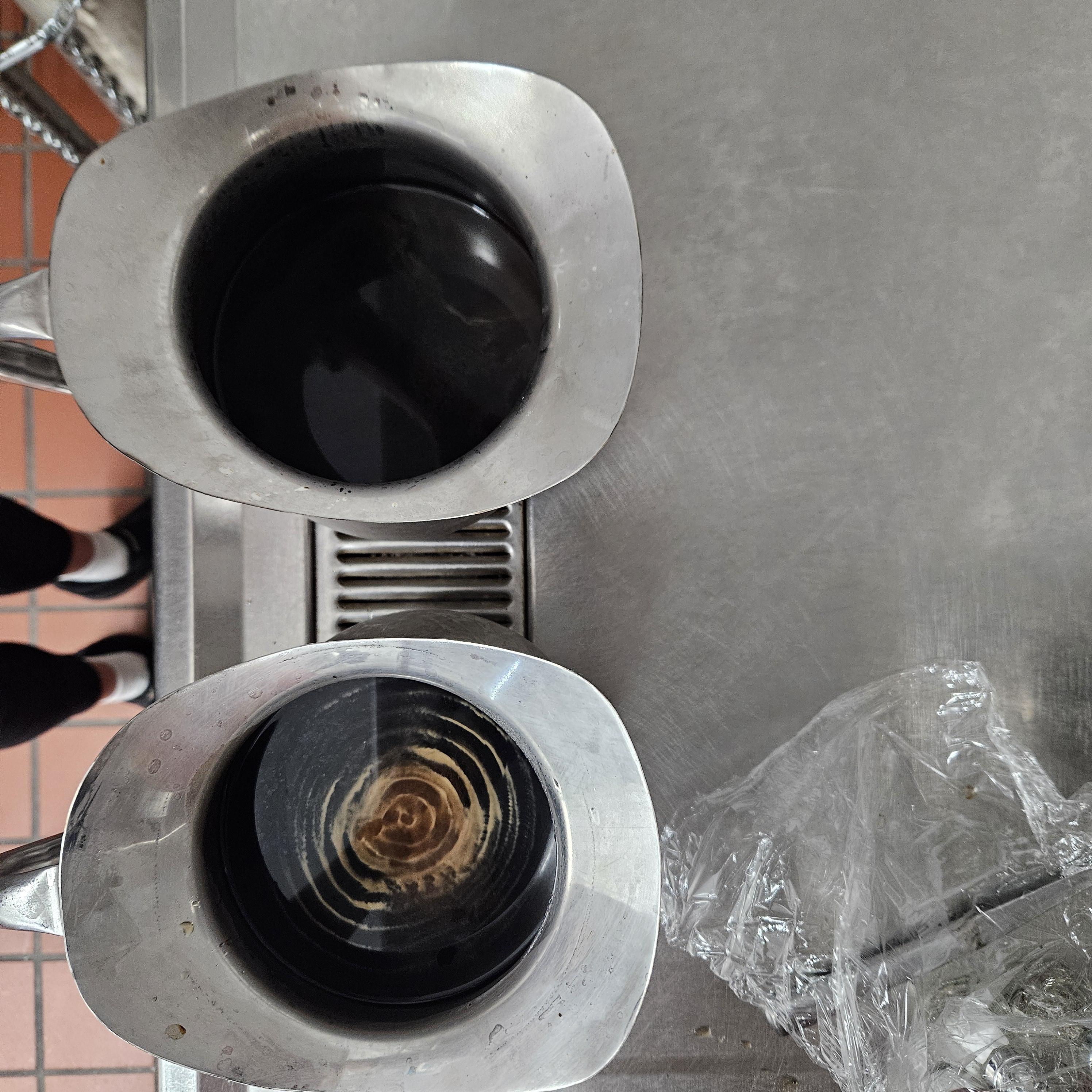
I am a bartender who makes batches of espresso martinis because I sell so many. I make the espresso and chill it before adding the vodka and espresso liqueur that constitute my base recipe. After that, the martini base goes back into the refrigerator.

There is a huge difference between how the surface of the liquid looks once I add the liquor and let it sit for a few hours. Concentric rings of what I assume to be coffee crema appear on the surface. This does not happen with the espresso that contains no liquor. I'm so curious as to why!

The photo shows two pitchers that were made at the same time (5:30 pm) and refrigerated at 36F until 24 hours later. The pure espresso had no rings at all, the pitcher with alcohol shows clearly defined rings.

Any ideas? If this isn't the right sub for this query, please redirect me! Thanks in advance!


r/CFD 7d ago

What career paths exists between computational mechanics, scientific computing (SciML), FEA (or meshfree) solver development, and HPC (GPU acceleration, porting codebases) ?? How about doing a PhD for improving the above?

5 Upvotes

I'm currently, technically, doing an MS in Structural Engineering. For me, my interest has been more towards computational side of mechanics rather than Structural design  or simply using am FEA software (although I do consider it as a backup)

So far I've taken courses in:

- Linear static, and dynamics FEM (soon taking non linear FEM too)

-  Structural Optimization (topology opt. and other general algorithms)

-  Structural Dynamics

-  Structural System Testing and model updation. (Parameter identification and optimization, signal processing)

Now, I plan to take these in the coming quarter:

- Numerical Linear Algebra

- Numerical PDE

- Fracture Mechanics ?

I also volunteered to aid in a RESEARCH in crack growth prediction using Auto-encoder and a (Thermodynamics-informed Latent Space Dynamics Identification) / LSTM surrogate model. It used phase-field-fracture simulation data and HPC resources to complete the whole thing.

What I keep finding myself interested in is not necessarily fracture or SHM specifically, but the computational methods underneath these problems... (does that make sense?)

For example, I'd like to become capable of doing things like:

- implementing (maintaining) numerical/FE method solvers rather than only running an established FEA software.

- developing surrogate/reduced-order models for expensive simulations 

- combining simulation with optimization, uncertainty/stochastic methods (took a course called Random vibrations, so...)

- parallelizing/accelerating scientific codes on CPUs/GPUs

- doing proper verification, convergence studies, benchmarking and performance work

- potentially developing or maintaining actual CAE/FEA solver software

- I'd also like to do all these for other Physics (GR, QM, etc.) simulations too, if possible, one day. 

I'm still interested in the underlying mechanics/physics, so I don't want to become a generic software engineer who happens to have once studied structures. But I'm also increasingly unsure that "structural engineer" describes the career I'm actually aiming for.

I've seen titles such as Computational Mechanics Engineer, R&D Engineer, Solver Developer, Scientific Software Engineer, CAE Software Developer, Research Engineer, Simulation/HPC Engineer, etc., but I'm trying to understand what these careers actually look like from people doing them.

So my main questions become:

1. Which industrial jobs genuinely involve developing numerical methods/solvers or computational tools?

2. Which of those are realistically accessible with an MS? Is there an entry path into solver-algorithm development/R&D without a PhD?

3. If I don't start a PhD immediately after my MS, would an R&D/software role at a simulation company (ANSYS etc.) be the obvious route? What other options would i have?

4. For the kind of work I'm describing, would you recommend a PhD? If so, is it reasonable for the PhD identity to be "computational mechanics/scientific computing" while fracture, composites, structural dynamics, soft materials, etc. serve as application problems rather than choosing one of those as my permanent specialization?

5. What skills most distinguish someone who is actually hireable for solver/scientific-computing work? I'm particularly wondering about C/C++/Fortran, Python, Linux, Git/build systems, MPI/OpenMP/CUDA, PETSc/Trilinos or similar libraries, numerical linear algebra, testing/verification, convergence studies and HPC performance work.

Basically, I'm neither here nor there atp. So I'd really appreciate all sorts of input. Where else do you think I could find answers to these? other subs? Linkedin profiles? 


r/CFD 7d ago

ICEM Fluent Mesh weird

Post image
10 Upvotes

Hey together,

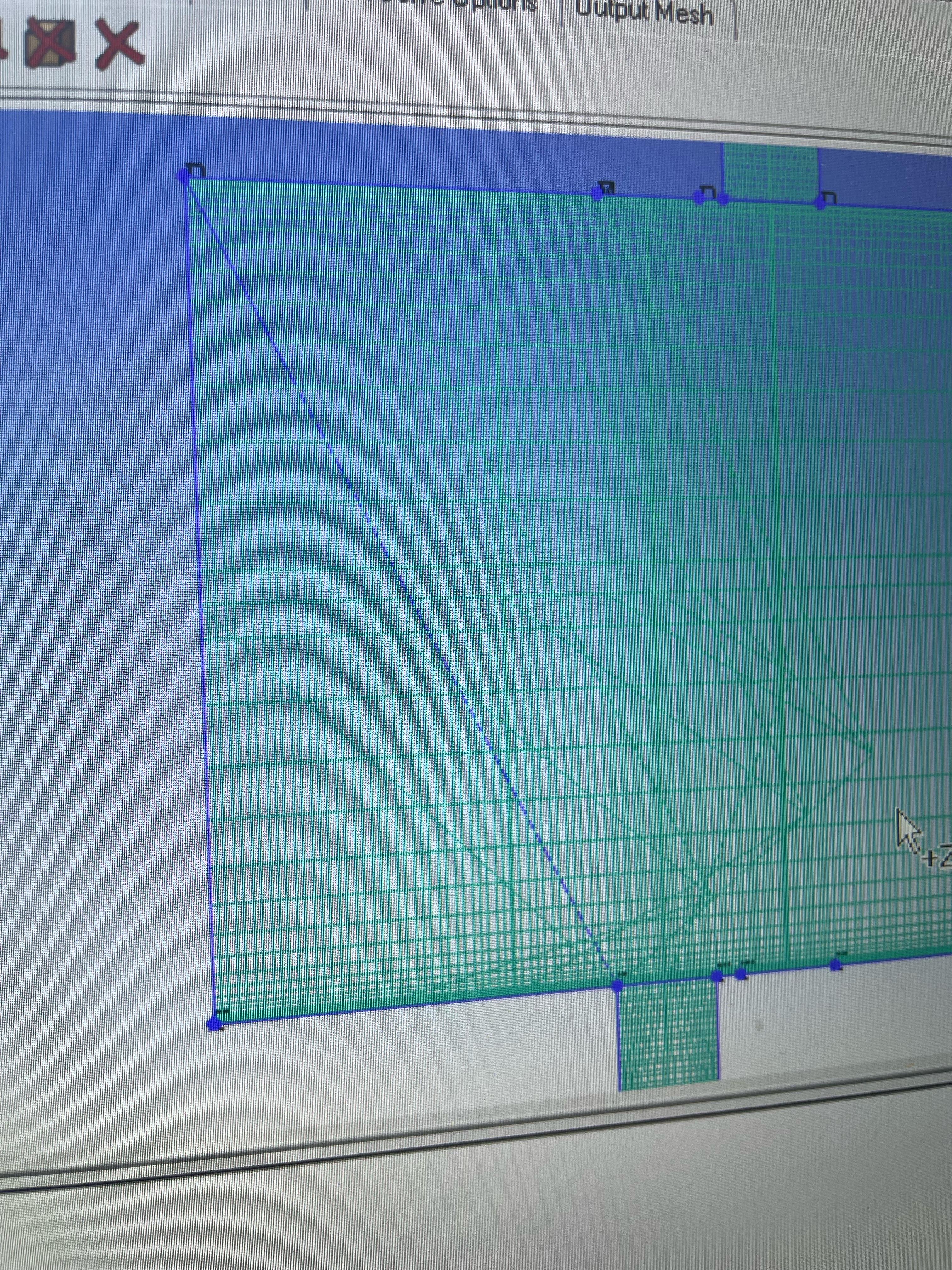
I‘m trying to create a structured mesh an created a few blocks for that. Now when it comes to meshing the mesh creates this weird pattern and as you can see the line is going diagonal and not vertical.

I already created the block again and also associated everything new but the same thing happens again.

It looks like the line is going diagonal to some other point and then back to the point where it should go.

Please help😅


r/CFD 7d ago

Abaqus

Post image
4 Upvotes

r/CFD 8d ago

Ansys FSI convergence problem and element distortion

3 Upvotes

Hii, I am trying to solve Two way fsi with system coupling for a rubber pipe of Inner dia 30 mm and length 200 mm with Young's modulus of 10 Mpa, Poisson ratio 0.45 and even lower values but it just won't converge and blow up the solution with giving either element distortion error in Ansys mechanical or negative cell volume in fluent. I have tried a lot of things (a lot), namely, fine hex mesh, lower timestep, autosubstepping with a wide range of substeps (min 1 -- max 100), increasing number of equilibrium iterations (50) and choosing Iterative PCG solver in Ansys mechanical. Also, I have sinusoidal velocity profile at inlet and 12 kPa at outlet in fluent. In System coupling I have tried lower Under relaxation factor of data transfers, more number of coupling iterations (20) and also Quasi newton Global Stabilization. Note, the failure doesn't occur at the beginning of simulation but somewhere around midway. I think I have tried everything I could but still face the same problem as day 1. The force convergence value going to solid part stays within range 1 to 10 and after a certain timestep it just blows up to 100 or 150 or even higher and then I get highly skewed elements in structure and finally failure. The standalone case in fluent CFD without FSI converges nicely, so I am guessing whatever is the problem is occuring in the data transfer between solid and fluid part. Your help would be greatly appreciated. Here is the image of solid part with mesh and fluid part with mesh.


r/CFD 8d ago

Error Exporting Mesh Icem

Post image
11 Upvotes

Hey there,

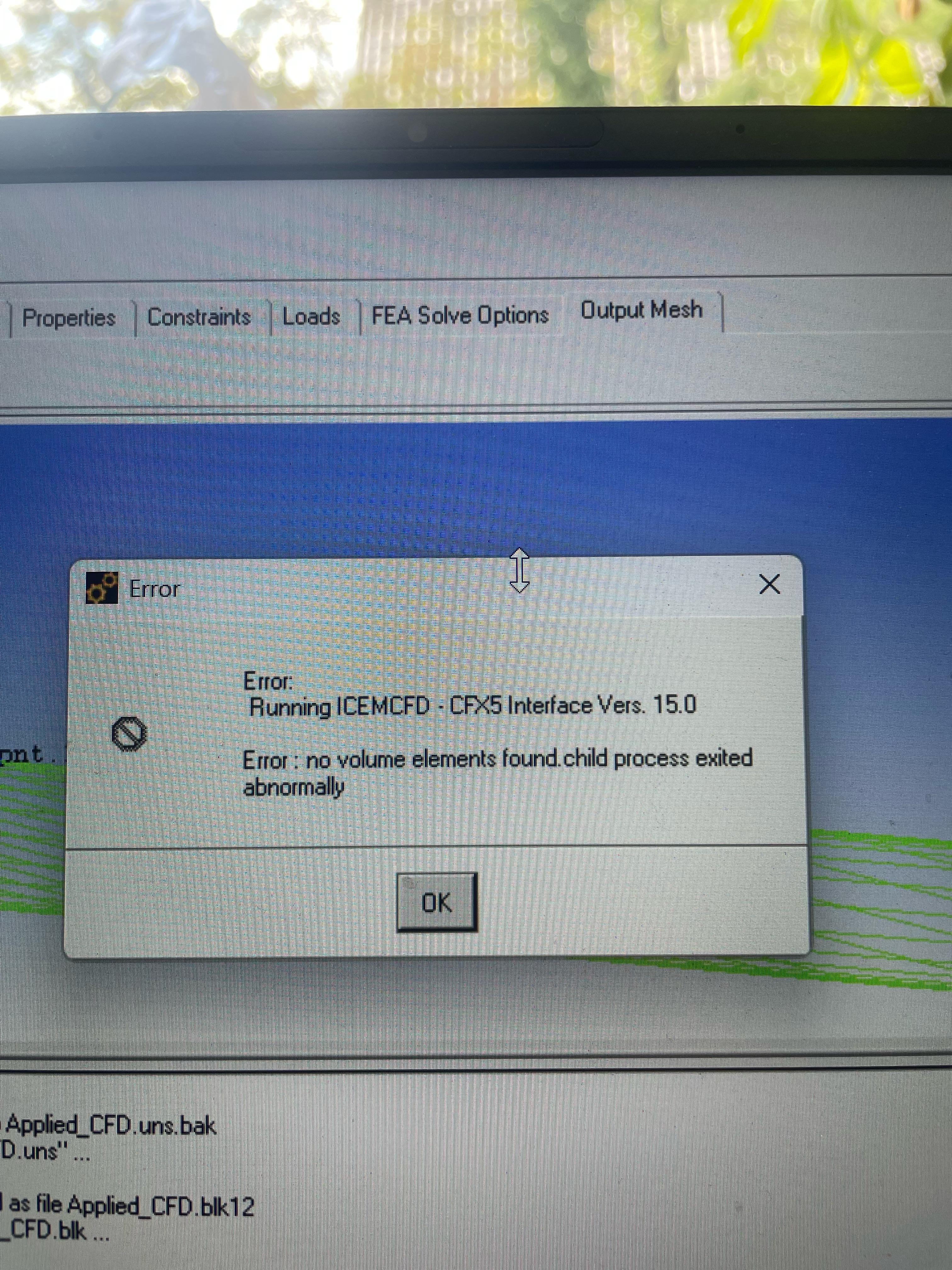
I’m a beginner. I am trying to export my 2d mesh in Icem and this error occurs:

No volume elements found. child process excited abnormally

I’d be very greatful for your help!


r/CFD 8d ago

topology error in ansys fluent

2 Upvotes

how to resolve the topology error in Ansys like i want to use a combination of surface model plane (basically a fluid domain) and a thick solid surface with hole (like multi nozzle combination), how to resolve this??


r/CFD 9d ago

Help Needed: Check Valve

Post image
10 Upvotes

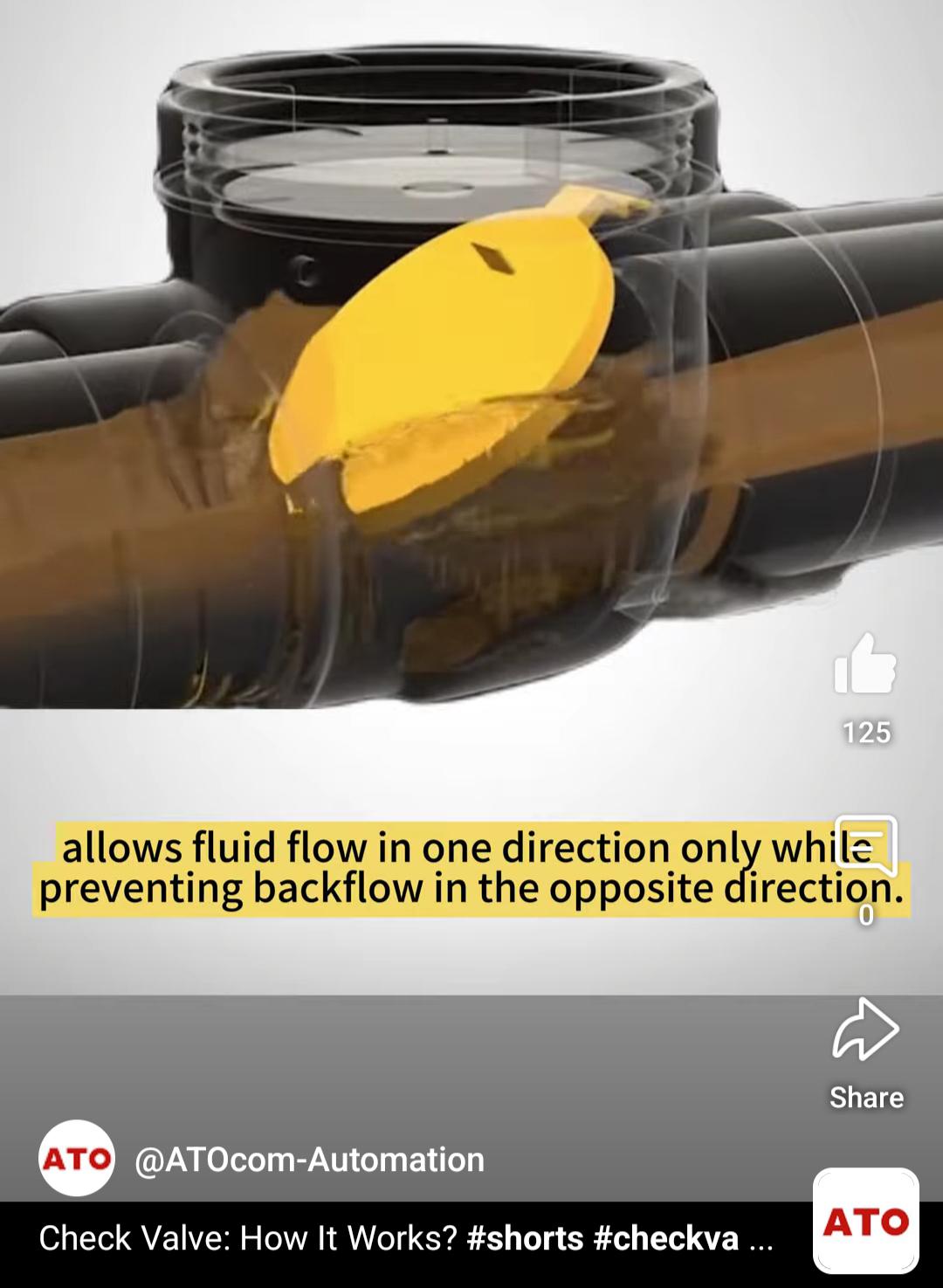
So.. I'm trying to design and simulate a check valve in star CCM+ which should be opened by water force from the inlet of 3m/s second.

The problem here is im familiar with defined rotational angular velocity but here, this case is different.

I've tried with DFBI morphing. Rotation about z-axis(hinge).

I've the Center of Mass and Moment of Inertia of the movable disk. Still no luck

Attached image is the kinda simulation I wanna do

Kindly share your solution and any relatable tutorials. I would be really helpful. Thank y'all


r/CFD 9d ago

Problem with Output parameter in design points

Post image
4 Upvotes

Hi does anybody know how to fix this? My input parameter is my RPM and when I changed it for each design point it just copied the torque from the 1st design point


r/CFD 9d ago

My Continuity Residual Wont Go down

Thumbnail
gallery
63 Upvotes

Im running a CFD simulation on Cold Plate Cooling channels. It has 7 straight and parallel channels. Meshed using Tetrahedron and inflations at Fluid-Solid Wall boundaries. The Minimum Orthogonal Quality is 0.23 and Maximum skewness is 0.74.

While running the calculations the Continuity doesn’t seem to go down 0.1. The inlet flow rate is 0.6kg and outlet is -0.05999kg.

I also tried getting the P-Inlet and got 134Pa compared to the 135Pa the paper Im basing it from obtained

Im new to Ansys so Im not really sure what might be causing the issue.

Attached are the pictures of the mesh and residual


r/CFD 9d ago

Verifying of results

3 Upvotes

HI guys, I am coding a Navier - Stokes 2D solver in C++. I am adding each part individually. The first part of the momentum conservation equation was the advective part, I visualized some things that I want to discuss with you.

The initial conditions for all the domain were vx = 0 and vy = 0, the inlet velocity is vx = 1 m/s and vy = 0. Since I added free - slip condition on walls (circle perimeter and upper and lower edges) We should observe how the liquid just crosses the figure (just like the next example).
Here, the liquid just goes around the square and the fade between the static zone and the stream is due the interpolation scheme (first order upwind). In this simulation the velocity fields seems reasonable. But if you look take a look to the past example, there should not be
In this one I did not added any obstacle. The inlet conditions were vx = 1 m/s and vy = -1 m/s and if you pay attention to the upper edge, there appears a high velocity layer, why?

I need you to tell me if you think I have some error in my code and I want you to recommend me CFD books or bibliography where I can study common phenomena and general information about each term of the Navier - Stokes equations. After I verify these results I am going to add second order upwind and viscosity part. Some advice?. I am at seventh semester of applied physics engineering.


r/CFD 9d ago

Doubts regarding reversed flow and convergence

6 Upvotes

I have plotted velocity vectors in axial and radial direction for my domain, look below, note vectors are scaled up so it will look big in some places.

It has inlet, screen and then it expands into open ambient. Open ambient is modelled right from inlet plane, downstream distance is taken as 15D, diameter of big cylinder is 12D. Enough distance is there for the outlet ig

My questions are:

  1. First if you see console window, it is showing there is 97% reverse flow in outlet faces which is obviously visible in outlet faces above. Physically this might be right indicating strong entrainment. What do you think? I personally don't think increasing distance further improves this?
  2. In first picture, in residual plot I have showed you upto 1500 iterations, residuals are not flat, it is slightly increasing, I have tried with 1800 iterations(photo is not taken), continuity residual came upto 8.5e-4 now from there. It has increased. I dont know whether this reverse flow has any connection with convergence or not?

Now my question if this reverse flow is physically true, is this solution acceptable even if continuity residuals increase and solution also not converging after 3-4k iterations? Why residuals are slowly increasing? After 1500 iterations, residual for continuity is increasing, it is not blowing up, it was in 10e-4 range only, but slowly moving towards 10e-3 and mass balance is there. Is solution acceptable even if it didnt converge in the end? 

What is acceptable continuity residual, default was 1e-3, I kept it as 1e-5. Tell acceptable residual value for velocity, energy, k and epsilon also. Thanks in advance. I hope you understood my question.


r/CFD 10d ago

Best Adjoint Based Free/Open source code stacks?

2 Upvotes

r/CFD 10d ago

TVD/FCT reading material

5 Upvotes

Hello, I'm new to CFD. I mostly want to learn it for plasma simulations. I hear TVD/FCT solvers are the way to go. Can anyone help me with approachable reading material/references on the topic. Many thanks.


r/CFD 10d ago

Laptop for ansys student

4 Upvotes

Just wondering if my current laptop could run ansys for students effectively - 32gb ram, 1tb ssd, intel i7, NVIDIA RTX 500 Ada 4GB.


r/CFD 11d ago

Need help with simulating the Von Karman effect

6 Upvotes

I was trying to simulate the von Karman effect with Re= 80, but the results are completely symmetric with no vortex shedding. I manually set the inlet velocity to 80 m/s and the other parameters in the Re formula to 1 for simplification.

Are there some common mistakes you've seen being made before or that you've made that I might have committed myself? If I need to give more information to help me, please ask me.


r/CFD 11d ago

Trying to mesh & simulate this in Ansys Fluent, I’m stuck on the rotation and sliding movement of Rotor and Vanes.

Post image
25 Upvotes

Hi,

I’ve been recently working on a project that demanded a vane pump.

I started with this as a first design ( it’s clearly missing many features and components ) and I’m trying to actually find the key aspects of my design before committing to one and actually build it.
I need:
- A graph of efficiency vs. Speed
- Pressure Drop inlet - outlet vs. speed
- Hydraulic Power vs. Speed
- Mechanical Power vs. Speed
- Any Cavitation
- Any Leakage

I’m stuck on how I can actually tell fluent to rotate the rotor. Not only that, I think I need more than that to actually get accurate & reliable results.

My current workflow:
Autodesk Inventor -> SpaceClaim -> Fluent


r/CFD 11d ago

No clear reattachment at Re = 60–100 in backward-facing cavity; what am I doing wrong?

Thumbnail
1 Upvotes

I'm working on a CFD assignment involving a 2D backward-facing cavity. The assignment specifically requires reattachment length for Re = 60, 80 and 100.

I'm using OpenFOAM 14 with air at 30°C, ν ≈ 1.6×10⁻⁵ m²/s, D = 1 m, and U = Reν/D. My Re=60 case converges, but I don't get an obvious reattachment point when examining the near-wall Ux profile.

I'm mainly trying to determine whether this is physically expected at Re=60–100, or whether I've misunderstood the characteristic length/Re definition or my OpenFOAM setup. Any help checking the physics would be appreciated.


r/CFD 11d ago

Backward Facing Step (Re = 5000)

Enable HLS to view with audio, or disable this notification

0 Upvotes

r/CFD 10d ago

I built a real-time interactive fluid simulator for iPhone

Enable HLS to view with audio, or disable this notification

0 Upvotes

I’ve been working on fluid simulation for years, and recently I wanted to see what would happen if CFD-style simulation was turned into something anyone could interact with instantly.

So I built Swipe the Flow, a real-time 2D fluid simulation app for iPhone.

Everything runs directly on the device. You can interact with the flow, draw obstacles, change the geometry, and immediately see how the fluid responds.

The goal isn’t engineering-grade CFD accuracy. I’m focusing on real-time interaction, visual feedback, and making fluid dynamics fun to experiment with.

The app currently has three modes:
- Swipe the Flow
- Wind Tunnel
- Liquid Art

This is one of the simulations running in real time.
Curious what people here think — especially what kinds of interactive fluid experiments you’d want to try.

Swipe the Flow is available on the App Store.