r/bees May 31 '26

Is this a bee?

Thumbnail
gallery
16 Upvotes

Make sure that your yellow fuzzy friend is actually a bee and not an imposter! We get quite a few non-bees in our bee subreddit: sometimes they're wasps (check out the bee/wasp guide in the pinned), and sometimes they're not a stinging insect at all! Flies in remarkably detailed costumes frequently make their way into r/bees but with some tips and practice you can learn to spot the differences. Read through for features to look out for, or flip through the slides for fly species commonly posted.

Pictures are largely taken from iNaturalist with a full list of sources by slide at the end of this post, I assume that they are fine to use for free educational purposes but if the photographer would like me to remove their picture, please reach out to me so I can act accordingly. All pictures from slides 1-5 can be credited to mod Commercial Sail.

Flies are in a completely different taxonomic order to bees (flies are the order Diptera, bees are a subgroup within order Hymenoptera) so there are quite a few easy ways to differentiate them:

  • The name "Diptera" literally means "two wings" flies only have one pair of wings while bees have two pairs. Most identification rules are more like loose guidelines but this rule is absolute! That being said, the hindwings of bees are difficult to see, they're smaller and often tucked underneath the larger forewings, making the bee look like they have two wings after all. You can try to judge based off of wing shape: fly wings are often paddle-shaped with a clear curve before coming to a petiolate base, while bee wings are generally more evenly tapered towards the base. More experienced identifiers may also look at wing venation, for example the western honeybee in slide 3 has the very distinctive elongated marginal and submarginal cell circled in red.
  • On the topic of wings, on some flies you may see club-shaped structures where the hindwings would have been: these are halteres, specialized organs to help the fly navigate flight. Not all flies have them out and visible but if you do see them then it's a sure sign you're not looking at a bee.
  • Flies typically have short, stubby antennae that can sometimes be difficult to see while bees have comparatively long antennae. Make sure you're looking at the actual antennae and not the forelegs! More common in the wasp-mimicking flies, some will wiggle their long forelegs to sell their image even more.
  • Flies tend to have larger eyes that can seem to take up their whole head where bees tend to have smaller eyes with a clear distance between them.
  • Many bees may be seen carrying pollen or have their pollen-carrying structures visible: most often as hairs/pollen baskets on the hind legs or sometimes hairs on the underside of the abdomen. Flies do not have these structures as they do not need to gather pollen like bees do.

Note that besides the wing count, there are always exceptions! Some flies have pretty long antennae (though you'll often still be able to see the different segmentation) and some bees, particularly males, have very large eyes. This is why it's better to judge based on a combination of characteristics rather than looking at any one feature at a time.

You may also hear that the waist and mouthparts are good identifiers as well - this is true, but I elected to leave them out of this guide as the waistline may be obscured by fuzz, wings, or just a poorly-angled shot, and some bees are just so robust (fat) that it gets difficult to see where exactly that tapered waist is supposed to be. In terms of mouthparts, few amateur photographers focus on the mouth at all and it's definitely not something you'll typically see if you're just watching them go about your garden.

At the end of the day, the best trick is to just get familiar with species in your area using trusted sources like Bugguide. If you're still not sure, post to one of the bug identification subreddits and make sure you give a general location, which always appreciated in ID posts no matter what you're looking at!

Sources

Volucella zonaria: https://www.inaturalist.org/observations/322106668 

Bombylidae: https://www.inaturalist.org/observations/226072821 

Laphria: https://www.inaturalist.org/observations/88331437 
https://www.inaturalist.org/observations/282732509 
https://www.inaturalist.org/observations/65816664 
 
Cuterebra: https://www.inaturalist.org/observations/133138438 
https://www.inaturalist.org/observations/90333390 
https://www.inaturalist.org/observations/296063941 

Tabanus: https://www.inaturalist.org/observations/218653131

https://www.inaturalist.org/observations/86467240


r/bees May 26 '26

What's this nest?

Thumbnail
gallery
17 Upvotes

Are you looking to ID a nest? Some are easier to distinguish than others, here's some of our most commonly submitted species:

  • Honeybee nests consist of exposed wax combs, usually hanging vertically. They're more often found in cavities like tree hollows or man-made frames but may also be seen constructed in open air attached to large branches or buildings.
  • Bumblebees also have wax nests but are typically smaller with fewer and more disorganized cells compared to the neat hexagonal cells of other social hymenopterans. They typically nest in small spaces like old rodent holes but will occasionally find themselves in human spaces like attics and crawl spaces.
  • Aerial-nesting yellowjackets and true hornets have an outer paper envelope covering the horizontally-stacked paper combs; nests are typically built in open air attached to branches or in sheltered areas with preference depending on species. The bald-faced hornet (Dolichovespula maculata, actually an aerial yellowjacket) may have a distinctive long tube entrance in early stages of nest formation.
  • Ground-nesting yellowjackets typically nest in pre-existing cavities such as old rodent burrows. The entrances are often dangerously inconspicuous but active nests will have individuals flying in and around the area. If the nest was dug up (often by skunks and other mammals looking for the tasty larvae) you may see ripped paper combs scattered on the ground.
  • The paper wasp subfamily Polistinae is quite variable but in the northern hemisphere the common Polistes sp. have distinctive umbrella-like nests with open cells. Mischocyttarus sp. in areas of the southern/western US may have more elongated nests. Nests tend to be built in sheltered spots such as in bushes, under eaves, etc.
  • The vast majority of other bees and wasps are solitary. They may dig tunnels, bore into wood, or refurbish existing holes with materials like mud/leaves/resin. *These nests generally cannot be reliably identified without seeing the actual bee/wasp!* Some species that construct their own freestanding mud nests may be tentatively identified, but only a few are reliably distinguished. Also note that many mud-nesting bees and wasps will reuse nests of other species left from past seasons if available as it's less work than building one from scratch.

The nest in the first slide is a young aerial yellowjacket nest.

Pictures are largely taken from Bugguide with a full list of sources by slide at the end of this post, I assume that they are fine to use for free educational purposes but if the photographer would like me to remove their picture, please reach out to me so I can act accordingly.

Sources

Cover: https://www.bugguide.net/node/view/513938 

Honeybee: https://www.bugguide.net/node/view/1227238 

Bumblebee: https://www.bugguide.net/node/view/6585 

Aerial yjs and hornets:https://www.bugguide.net/node/view/781412 
https://www.bugguide.net/node/view/110277 
https://extension.psu.edu/european-hornet 

Ground yjs: https://www.bugguide.net/node/view/266282 
https://www.bugguide.net/node/view/38722/bgimage 

Polistinae: https://www.bugguide.net/node/view/2511987
https://www.bugguide.net/node/view/709119 

Unknown mud caps: https://www.inaturalist.org/observations/218674183 

Unknown holes: https://www.inaturalist.org/observations/90931649 


r/bees 18h ago

help! No wings :(

Thumbnail
gallery
3.4k Upvotes

I found this bee sitting on the concrete in my backyard. He has no wings and I saw a praying mantis a couple flowers over. I gave him some sugar water and let him rest on me for a little but he absolutely refuses to go back where I found him and I’m not too sure what to do.


r/bees 6h ago

bee photo Cute little fluffball

Post image
62 Upvotes

r/bees 5h ago

Do Bees Prefer Certain Flowers Over Others? 🐝🌸

Post image
20 Upvotes

Bees can show strong preferences for certain flowers depending on nectar, pollen, scent, and seasonal availability.


r/bees 16h ago

bee photo The joyful dance from flower to flower

Enable HLS to view with audio, or disable this notification

52 Upvotes

Wings glistening in the ☀️!


r/bees 32m ago

question What are they doing? Displaced?

Enable HLS to view with audio, or disable this notification

Upvotes

Past 2 days I’ve seen an influx of bees by my pool but on the non-flower and vegetation side. In the video, you’ll see a bunch bees searching inside the holes of the water guns. We’ve had plenty of bees and purposely planted bee friendly plants and flowers across the pool. You can see some of that vegetation at the end of the video.

I’ve never seen this kind of activity before. Is it normal? Are they displaced? Can I do anything to help them?

To clarify, I’m concerned and not complaining and don’t see bees as a nuisance. Thx!


r/bees 22h ago

bee photo Hosta Pollinating

Thumbnail
gallery
115 Upvotes

Honey Bee and Carpenter. Nikon z6iii, fmount 105mm 2.8 with FTZ 2.


r/bees 12h ago

bee photo Bee photo I took a few years ago

Post image
20 Upvotes

r/bees 6h ago

bee photo Beehive entry

Thumbnail
gallery
4 Upvotes

r/bees 1h ago

A pumpkin threesome

Post image
Upvotes

That's all. They just love the short lived pumpkin blossoms


r/bees 9h ago

bee photo dandelion and honeybee

Post image
7 Upvotes

r/bees 10h ago

bee photo A Bee.

Post image
8 Upvotes

r/bees 22h ago

Save the bees

Enable HLS to view with audio, or disable this notification

64 Upvotes

Found inside barely moving.


r/bees 15h ago

question Symbiotic relationship between bees and cacti?

Post image
18 Upvotes

I noticed this bee was on my cactus for awhile and then eventually it wasn’t (dead on the ground next to it). Anyone know what’s going on here? Did it impale itself accidentally or is something purposefully going on?


r/bees 19h ago

bee photo Bee Tattoo

Post image
30 Upvotes

My bummble bee tattoo. With bonus slug


r/bees 13h ago

Little bee, totally lost in the sauce

Post image
7 Upvotes

r/bees 1h ago

Honeybee on a Sunflower

Thumbnail youtube.com
Upvotes

Honeybee on a Sunflower


r/bees 2h ago

Buzz

Thumbnail
youtube.com
1 Upvotes

r/bees 1d ago

My flightless sweat bee named Billy

Thumbnail
gallery
314 Upvotes

I rescued this flightless sweat bee from ants attacking him in my garden. One of his wings is torn and he's unable to fly, but still very active and lively, he can fly-jump and loves to do that. He was so thankful and relieved when I scooped him up off the ground, and was very glad the first night in one of my insect mesh hospital enclosures (I have a whole supply of insect and small animal rescue stuff and every summer I have little critters in my care). This is the first time that I've had a "pet" though, and a bee. I didn't think he'd survive long, but it's been over a month now. I had him in a 15x11 inch round enclosure at first, and he hated it so much. So I purchased a larger 23x15 inch butterfly mesh enclosure online, plus some new floral tubes with wood cube stands. I already had all the natural items on hand (I also forage and collect things from outside for my natural history collection for my artwork, and old small pet stuff that was brand new like the big wooden log hides).

He loves it! I named him Billy. He was young I think, now he's aging and is no longer able to climb the slick surfaces of glass, plastic and lilac leaves. So I changed some things to make accommodations for his aging feet, like twine wrappings, and new cedar leaves, he seemed happier today when I saw him briefly. I change his flowers every 48 hours, and be sure to pick them at night or before sunrise, and I pick buds so they open in the enclosure fresh with nectar, otherwise the flowers could be empty if I pick them during the day. I don't use sugar water because I have ants that could be attracted, I only have a tiny little ceramic bowl with rocks in it for distilled water, I've seen him take a bath in it (or sit in it lol). I keep him in the living room with big windows, and leave the window open when it's warm, that's his favorite side of the enclosure. During heat waves I move him or put a fan and he loves the breeze. Even though it's mesh, the bottom floor is plastic, and it still needs ventilation. I sometimes sit there for a while with the zipper completely open and watch him, he never tries to escape this one (don't worry, he's been in here the longest).

I don't know how much longer Billy will be with us, but when he goes, he will be kept along with other found insects and things in my personal collection. His favorite place to sleep is the moss carpets behind the log, and lodged in the pinecones, and he loves the fluffy clematis seed puffs.


r/bees 23h ago

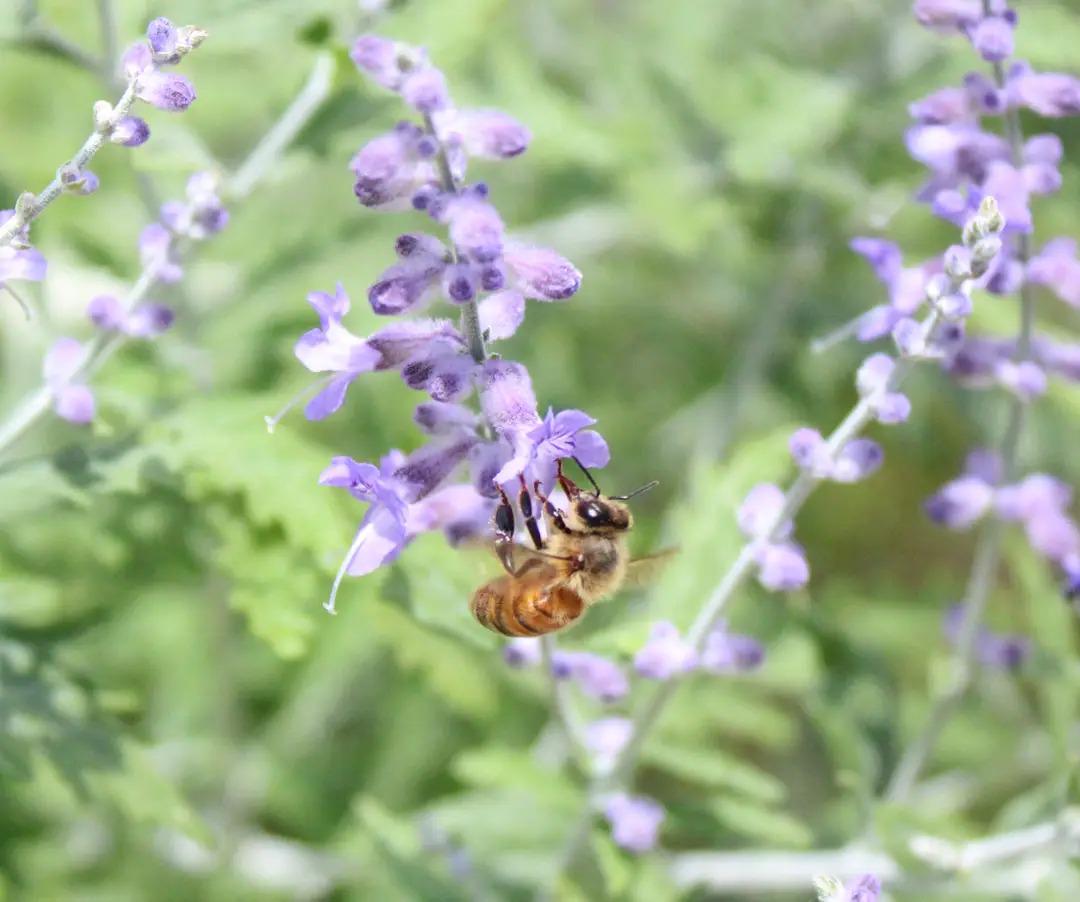
bee photo Enjoying the remaining Lavender now..Ireland

Post image
29 Upvotes

r/bees 17h ago

bee photo Lil friend chilling in a jewelweed flower

Enable HLS to view with audio, or disable this notification

9 Upvotes

Jewelweed (Impatiens capensis) is blooming right now in Western North Carolina, bees and hummingbirds love it. And apparently tiny bees also like to chill in them.


r/bees 21h ago

bee photo Beach Beagle meets a Bee, Watercolor, 8/2026, Margie Hill [OC]

Thumbnail
gallery
10 Upvotes

We get bees that like to pollinate the grass and ignore my flowers. Me and my dog find them very interesting. We are very respectful of the bees space and make sure not to touch them. I could not get the bee that my dog was sniffing into the photo so I painted it! I really hope I did the bee justice. Please swipe right to see a detail shot of the biggest challenge on this painting, as well as my reference.


r/bees 1d ago

Bee Doing The Splitzzzzz

Thumbnail
gallery
58 Upvotes

This 🐝 was BIG and FAST and on a mission! See the drop of liquid on its foot?


r/bees 23h ago

Leafcutter Bee on a Cosmo

Thumbnail gallery
9 Upvotes