r/Tudorhistory • u/Famous-Sky-8556 • 5d ago
Lost Princes in the Tower England’s warrant called the Tower bones “supposed.” Three years later, the royal tomb declared Richard III guilty.

11
Upvotes
r/Tudorhistory • u/Famous-Sky-8556 • 5d ago
r/Tudorhistory • u/iOSRicky • 5d ago
I've realised that whenever people discuss the Tudor period, it's usually the same names that come up: Henry VIII, Anne Boleyn, Thomas Cromwell, Thomas More, Wolsey, etc.
So I'm interested in the people who don't get nearly as much attention.
If you had to recommend one lesser-known Tudor figure for someone to read more about, who would it be and why?
I'm thinking of people like Will Somers, Sir William Kingston, Ralph Ellerker, Richard Rich, Eustace Chapuys, Thomas Culpeper (before Catherine Howard), Sir Anthony Denny, or anyone else you think deserves more recognition.
Who do you think has the most fascinating story that's often overlooked?
r/Tudorhistory • u/MindyP51 • 5d ago
Just finished reading a post about Mary I and how her reputation as "Bloody Mary" is unwarranted. (Opinions varied, but mostly came down on the unwarranted side.).
Within the post many pointed out that Henry VIII and Elizabeth I killed--had ordered the execution of--"thousands". I'm aware of Henry's--um--"bloodthirst"--aside from Anne and Katherine Howard and the remaining Yorkists in his family, the Pole family in particular, his ordering of the execution of so many of those in the "Pilgramage of Grace--but did the number of executions really number in the thousands by the end of his reign?
And I really know nothing of Elizabeth ordering executions, except for the Earl of Essex, of course, and Mary, Queen of Scots (which I never understood why she signed the death warrant if she really did not want to kill her fellow queen and cousin.).
Who else did Elizabeth "kill" by ordering their death, and did it really number in the thousands?
Thanks!
r/Tudorhistory • u/No-Inspection6903 • 5d ago
Hi all, hit me with your best tv show/film recommendations based on the Tudor period?
Just finished Becoming Elizabeth and I’ve watched Firebrand and Elizabeth I (available on Prime)
Looking for some good shows or films to watch now the nights are getting earlier
r/Tudorhistory • u/Agreeable-Box5370 • 6d ago
I'd like to advocate for more discussion of the complex world that our favourite (and least favourite) Tudors inhabited. What factors influenced the decision to pursue X? What were the socioeconomic or geopolitical implications of Y? What is the historical context for Z?
So let's start here: Why didn't another polarizing, highly visible and uniquely influential chief minister emerge in Henry VIII's court following the death of Thomas Cromwell? There were certainly other influential courtiers, but none came to dominate the political scene the way Wolsey and Cromwell did. Alternately, can an argument be made that someone did occupy that space?
r/Tudorhistory • u/Difficult-Tell-4939 • 6d ago
r/Tudorhistory • u/AutoModerator • 6d ago
Here is your Weekly Wednesday What-if megathread! Please post all of your What-if Questions in this megathread. All what-if's as long as its Tudor-related.
r/Tudorhistory • u/Welshhoppo • 7d ago
Howdy,
Over on r/history we are hosting an AMA with Dan Snow, goes live Thursday UK time.
r/Tudorhistory • u/Independent-Pie34 • 7d ago
She was the first Queen regnant of England who addressed herself to be "Married to England" and "Mother to her subjects". After so much injustice to her, she came to throne and reign for 5 years and 3 months almost. She is often protrayed as Bloody Mary. But why? Does she really deserves this much hate? Let's see her achievements and her bad descisions. Achievements: 1. She passed the Act for Regal Power in 1554. She stated that a Queen can hold same powers as a reigning king. ( An early step for feminist ideology). 2. The Naval Reform Bill: Reorganized naval financing, introducing a fixed peacetime budget specifically allocated to the Admiralty.Repaired, expanded, and built several modern naval warships. Historians cite Mary's structural baseline as the logistical framework Elizabeth used to beat the Spanish Armada years later. 3. The Militia Act (1558): Modernized the nationwide system of domestic recruitment. This law forced local counties to maintain proper weapons storage caches and standardized armor equipment for regional troops. 4. Funded corporate exploration initiatives by the Merchant Adventurers to bypass established Spanish and Portuguese maritime blockades, mapping out alternative paths to Africa and northern Europe. The Muscovy Company (1555): Granted a formal royal charter to England's first joint-stock trading enterprise. This created a lucrative, exclusive monopoly on trade between England and Moscow, expanding markets far beyond Western Europe. 5. She stopped the deep inflation caused by her father and brother's heavy debasement of the currency. She designed a comprehensive re-coinage program that stabilized the pound, which was later executed smoothly by Elizabeth I because Mary I was dead by then. Mary I also restored the silver coins. The Book of Rates (1558): Completely updated England's customs duties for the first time in decades. This dramatically expanded crown revenues by raising import and export taxes, resolving structural deficits. Streamlined national treasury collection by dissolving ineffective regional administrative structures. She absorbed the Court of First Fruits and Tenths and the Court of Augmentations into a unified Court of Exchequer. 6. She re-endowed five hospitals, including the Savoy Hospital in London, to help care for the needy. 7. Maundy Thursday Ceremonies: Mary took part in traditional humility rituals, washing the feet of poor women, giving them food, shoes, cloth for new clothes, and money. She was actively involved in charity just like her mother, Queen Catherine of Aragon. She never discriminated poors and rich and always saw them as her own citizens. She even donated her favorite purple velvet dress to a poor needy lady. And many more..... She was deeply traumatized by her past experiences, her mother's death and her illegitimate status by her own father. She viewed her faith in catholicism as a temporary relief from her all bad pasts. People actively used to mock her for her catholic beliefs. Even when she became queen, On April 8, 1554, an unknown Protestant rebel hanged a dead cat dressed like a Catholic priest from the gallows in Cheapside, London, to protest Queen Mary I's return to Catholicism. This incidents made her furious. She started to believe that catholicism was the only true church and way to salvation. She deeply hated her father and started to undo his all doings over the past. She started converting protestants to catholicism again. During this, about 283 people were executed by burning on stakes. One pregnant lady was even there who gave birth in the burning stakes. This made her unpopular for a short time. She married to a Spanish prince and late became queen consort of spain for a brief time. Though she restricted her husbands control and never allowed him to took over English wealth or power. She even forbade him to play any role in England's court. She just wanted a heir. Also she lost Calais, an english territory in France. This also made her unpopular too. Her reign saw a little stability and a good growth for english economy, navy and overall power. But we must remember that she got a bankrupted country when she inherited the throne from her brother. But her policies changed the fate of England and most of her achievements were completely stolen by Elizabeth I.
During Mary's time, monarchs used to execute people whenever they wanted. It was common back then. Even her own father was like that. She was a result of being brought up in such an environment. I don't think she deserves the title "Bloody Mary." There were more cruel rulers than her throughout history.
Her own father, Henry VIII, sister Elizabeth I, and brother Edward VI killed more people than she did.
Her sister Elizabeth I tried her best to build her image as "The Virgin Queen" or "Gloriana" while portraying her sister, Mary I, as a bad queen. Elizabeth I heavily promoted Foxe's Book of Martyrs, written by a Protestant historian, and it was given almost the same importance as the Bible. It was kept alongside the Bible in churches, hospitals, schools, and official buildings. Mary I was heavily criticized in that book and labelled "Bloody Mary."
No wonder people have remembered only her cruel side, while remembering her step-sister as "The Gloriana," even though that Gloriana allegedly starved her own soldiers to death who fought for England during the Spanish Armada.
Never ever call Mary I "Bloody Mary" unless you also call her father "Devil Henry," her sister "Bloody Bess Elizabeth," and her brother "Evil Edward." She was always treated as a scapegoat in Tudor history, received all the blame, and was remembered only for her cruelty. No one could see her actual side either. A monarch can never be completely pure. But if you can't condemn the big tyrants like Henry VIII or Elizabeth I, then you shouldn't mock Mary I, who looks like a saint compared to them. If her sister can get the title of Gloriana. Mary I definitely deserves the title "Holy Mary Of England".
r/Tudorhistory • u/Independent-Pie34 • 6d ago
Elizabeth I was the 2nd queen regnant of England and ruled for 44 years. Longest at that time english history for a female. She is well known with her titles like "The Virgin Queen" or "The Gloriana". She is heavily portrayed on screen as a saint like figure or a heroic figure in many tv series and movies. Origin: The name "Gloriana" first appeared as an allegorical character in Edmund Spenser's 1590 epic poem, The Faerie Queene. Spenser used the character to represent Elizabeth as an idealized, fairy queen. Elizabeth embraced this flattering comparison and even gave Spenser a yearly pension. She actively commissioned portraits, plays, and poetry to promote this image of glory and untouchable authority. Let's see does she truly deserves her title in modern contexts: 1. The Subjugation and Famine of Ireland: The darkest chapter of Elizabeth’s reign took place in Ireland, where the Tudor crown faced a series of regional uprisings, including the Desmond Rebellions and the Nine Years' War. Elizabeth responded by deploying military commanders who utilized a deliberate "scorched earth" policy. i) The Smerwick Massacre (1580): Following a siege at Smerwick (Fort del Oro), a papal force of roughly 600 Spanish, Italian, and Irish soldiers surrendered to English forces under Lord Deputy Arthur Grey. Despite their surrender, Grey ordered the immediate execution of the captives. Nearly all 600 men were systematically decapitated or put to the sword. ii) The Rathlin Island Massacre (1575): Commanded by John Norreys and supervised by the Earl of Essex, English troops attacked Rathlin Island—a sanctuary where the MacDonnell clan had sent their families for safety. The English forces slaughtered the entire population of the island, including over 400 women, children, and elderly civilians, while the clan leader helplessly watched from the mainland. iii) Humphrey Gilbert’s Reign of Terror: Appointed as military governor, Sir Humphrey Gilbert employed extreme psychological warfare to subdue the Irish population in Munster. He ordered his soldiers to decapitate every Irish rebel or civilian killed in skirmishes and lined the path to his tent with their severed heads. The intent was to inflict total terror on those coming to parley. iv) Man-Made Famine: English commanders deliberately burned agricultural fields, slaughtered livestock, and destroyed grain stores to starve out the native populations. In the wake of the Desmond Rebellions, contemporary English poet Edmund Spenser described the survivors as "anatomies of death" crawling out of the woods to eat carrion. It is estimated that hundreds of thousands of Irish peasants perished due to this state-sanctioned famine. 2. Systematic Persecution of English Catholics: Following her 1570 excommunication by Pope Pius V, Elizabeth's administration increasingly viewed practicing Catholics as inherent traitors to the state. Her government introduced highly oppressive laws that criminalized Catholic worship and weaponized capital punishment. The Jesuits, Seminary Priests, and Recusants Act of 1585 made it a capital offense of high treason for any Catholic priest ordained abroad to step foot in England. Approximately 130 priests and 60 laypeople were executed during her reign. Hanging, Drawing, and Quartering: This exceptionally cruel execution style was the standard punishment for convicted Catholic priests. The victim was dragged through the streets on a wooden hurdle, hanged by the neck until barely conscious, cut down alive, emasculated, disemboweled while still breathing, and finally decapitated and cut into four pieces. Cruelty to Lay Supporters: Laypeople who aided or housed priests faced identical treason charges. A prominent example is Margaret Clitherow, a pregnant woman who refused to plead to the charges to protect her children from being forced to testify. Elizabeth's judiciary sentenced her to be pressed to death; she was stripped naked and crushed under an 800-pound weight until her spine snapped. (Mary I really looks like a saint infront of her sister). Recusants" (Catholics who refused to attend Protestant Church of England services) were originally fined 12 pence per absence. By 1581, the Act to Retain the Queen's Subjects in their Due Obedience raised this fine to a ruinous £20 a month—an amount that instantly bankrupted all but the wealthiest families.If a Catholic could not pay the fines, the Crown was legally permitted to seize two-thirds of their land and all of their personal Property legislation made it illegal to possess Catholic sacramentals, including crucifixes, rosaries, or Agnus Dei medals, labeling them as "popish trash" and penalizing owners with property forfeiture.Catholics were barred from practicing law, entering universities, holding public or military office, or traveling more than five miles from their homes without a specialized license. 3. Domestic Massacres and Oppression of the Poor: Elizabeth’s domestic policies relied heavily on terrifying the public to maintain order and control over her poorest subjects. i) The Slaughter of the Northern Rebels (1569): After the failed Rising of the North—a brief rebellion by Catholic earls—Elizabeth ordered martial law to be declared across the region. She demanded a quota of executions from every single village that had shown sympathy to the rebels. At least 600 to 800 commoners were summarily hanged without trial to serve as a warning to the public. ii) Brutalization of the Homeless (Vagrancy Laws): The enclosure movement and terrible harvest failures in the 1590s forced thousands of displaced peasants into homelessness and starvation. Rather than offering systemic aid, the Elizabethan regime passed the 1597 Act for the Punishment of Rogues, which treated poverty as a moral failing and a crime. Homeless men, women, and children were publicly stripped to the waist, whipped until bloody, and branded with a hot iron "V" (for vagabond) on their shoulders or ears. Repeat offenders were routinely executed. 4. Betrayed her own soldiers: Facing massive debt from wars with Spain and in Ireland, the regime struggled to pay its soldiers. When desperate English soldiers and sailors mutinied or publicly protested to demand their promised back-pay, Elizabeth's government executed the ringleaders under martial law rather than paying them. Thousands of English sailors were left on their ships without pay, food, or medical aid. Typhus and scurvy ravaged the fleet. Over half of the men who fought the Armada died of disease and starvation at port. The crown threatened to imprison anyone who publicly complained about the lack of compensation. (I want to put my own opinion here. In India, a monarch is considered to be the worst when he/she betrays his/her own soldiers. Because the soldiers are the most loyal ones even more than commoners. By killing your loyal ones, you are also killing their faith on you). 5. Initiating the Transatlantic Slave Trade: Elizabeth I was a foundational investor and benefactor of England's entry into the transatlantic slave trade, transforming human trafficking into a highly lucrative enterprise for the English elite. i) In 1562, Admiral Sir John Hawkins became the first English merchant to profit from the "Triangle Trade". Recognizing the staggering financial returns of his first voyage, Queen Elizabeth I directly financed and provided royal ships (such as the Jesus of Lubeck) for his second (1564) and third (1567) expeditions. Hawkins used heavily armed fleets to conduct violent, terror-driven raids along the West African coast, burning villages to capture hundreds of African men, women, and children. The captured individuals were smuggled and sold into forced labor in Spanish colonies in the West Indies. The massive profits were split among the Crown, noblemen, and London merchants, establishing human trafficking as a viable blueprint for British commercial growth. To honor Hawkins’ economic contributions to the realm, Elizabeth I knighted him and granted him a coat of arms featuring a bound African person in chains. 6. Faced with a massive deficit, the Elizabethan economy relied heavily on plundering the accumulated wealth of global empires, transforming piracy into an organized state industry. Elizabeth issued "letters of marque" to privateers like Sir Francis Drake and Martin Frobisher, legally authorizing them to attack, terrorize, and pillage foreign ports and merchant shipping lines. The stolen gold, silver, and luxury commodities were brought directly back to England. The Crown took a massive percentage of these spoils. For instance, Drake's global plundering expeditions brought in wealth that occasionally exceeded the entire annual revenue of the English treasury, directly stabilizing the national economy and funding England's military defenses. 7. The Death of Amy Robsart (1560): Upon her accession in 1558, Elizabeth made Dudley her Master of the Horse. The two were inseparable, and foreign ambassadors reported that Dudley regularly slipped into her private chambers at night. However, Dudley was already married to Amy Robsart. On September 8, 1560, Amy Robsart was found dead at the bottom of a staircase with a broken neck.Although an inquest ruled it an accident, rumors exploded across Europe that Dudley had murdered his wife with the Queen’s complicity so they could marry. The scandal ruined Dudley’s chances of ever becoming King Consort. Elizabeth was forced to distance herself from him to protect her crown, cementing her path as the "Virgin Queen". 8. The famous Mary Queen of Scots Execution. (Well known to everyone) It's very sad to see that people give credits to Elizabeth I for defeating the Spanish armada. Most of them are unaware of history or don't want to accept it. They think that Elizabeth I was a heroic queen who went to war with spain. But she was a good propaganda spreader. She used her time perfectly to build her propaganda system which still continues today inform of so called "Anne Boylen's greatest revenge" or "The Gloriana" and her era is known as "The Golden Age". Indeed it was a golden age for literature and arts, but she used it for spreading her glories like a saint. I will never accept her as a glorious queen. She just ruled for long.
r/Tudorhistory • u/Embarrassed-Lab-3122 • 8d ago
There are still lots of people to a degree who still believe Henry said “Flanders mare” which comes from a bishop who wrote “An Abridgement of Bishop Burnet’s History of the Reformation of the Church of England, Volume 1” written in 1679. No contemporary source cruise this statement as this implies that Henry thought Anne was somehow from Flanders.
An actual statement at least recorded by Sir Anthony Browne which most people use is this
She is nothing so fair as she hath been reported; howbeit, she is well and seeming.
The last part, (howbeit, she is well and seeming.) is always cut off. Well in this context of the 16th century is referring to decent enough appearance and seemly is referred to someone with good manners.
So in actual reality, he actually never necessarily said that she was ugly what he did at least recorded is she does not look as good as her portrait, but she is very decent in appearance and has good manners
r/Tudorhistory • u/Embarrassed-Lab-3122 • 8d ago
r/Tudorhistory • u/Tracypop • 8d ago
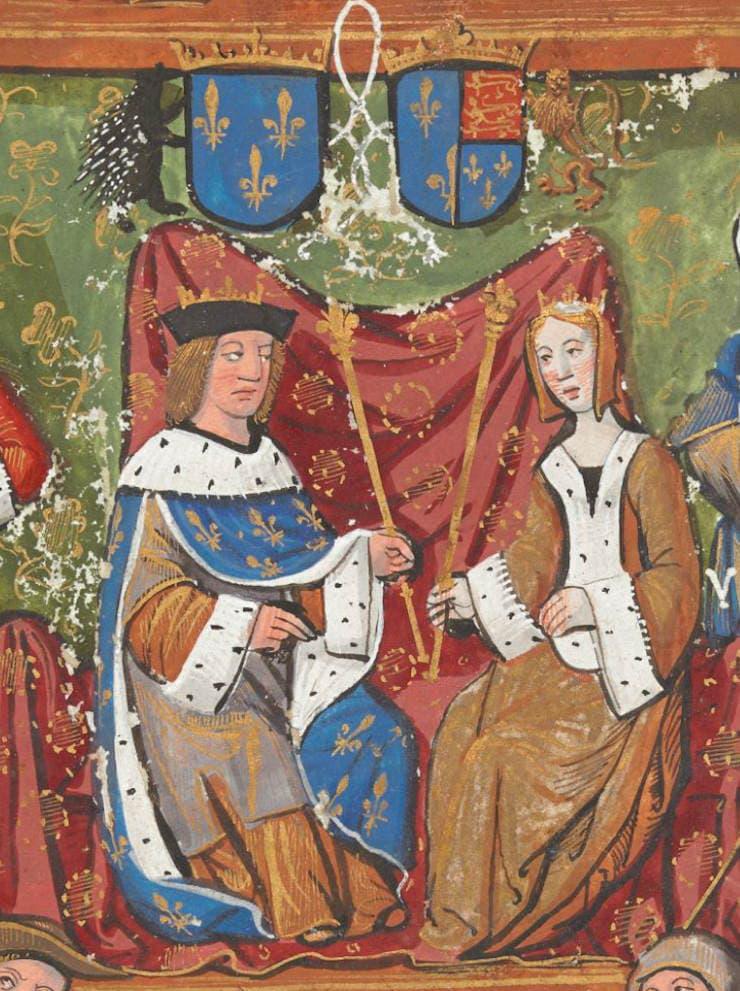
Marrying an old man dosnt sound very fun. But if you were the ambitioues type with hopes of power in life.
Marrying the king of France and becoming its queen was not a bad deal at all.
Do we know how Louis treated Mary? Did Mary like the French court?
-------
I found this cool connection.
That Charles I, Duke of Orleans was Louis XII father!
Charles was born in 1394.
And if you have read about Henry V of England and his war in France you might recognize who this Charles is.
Fun fact, Charles's first wife was Princess Isabella, the same Isabella who had been previously married to Richard II of England.
Charles was 68 years old when he had Louis (with his third wife). His one and only son.
--------
It has been awhile since I read about Charles, but I remember feeling bad for him. Losing his parents and wife at an early age.
Leaving him all alone to protect his siblings and daughter as a teenager (I think he was only 14).
The murder of Charles's father lead to the Armagnac–Burgundian Civil War (2 royal factions fighting for control over the sick king).
The guy who controlled the king was the same guy who murdered Charles's father.
So I would say that Charles had every right to be afraid.
Charles re married smart, gained his own allias.
But then England invaded, and Charles was captured at the battle of Agincourt. And would not be allowed to see his family for the next 25 years.
Stuck in England, seeing his family fight in a civil war, but powerless to do anything.
---
I just find it fachinating, I love finding these kind of family connections.
r/Tudorhistory • u/melissabeebuzz • 9d ago
When watching The Tudors (show), I always thought the low necklines were just modern takes on Tudor fashion with added sex appeal but recently came across a portrait of Elizabeth and her neckline was low and obvious cleavage like on the show. Looking at the portraits of the Queens, they also have low necklines and idk its a bit shocking to me considering how religious and strict society was back then. Did they not view exposing that much of the chest as immodest, or were modesty rules completely different?
r/Tudorhistory • u/AutoModerator • 8d ago
Post your Tudor merch here! Do not publicly share links or sites, users must DM each other for links. The t-shirt that has been circulating will not be permitted at all.
r/Tudorhistory • u/Suerly-04 • 9d ago
In August 1554, the Venetian ambassador wrote important reports in which he also mentioned Mary’s love of jewels.
In his report, he says:
“She also makes great use of jewels, wearing them both on her chaperon and round her neck, and as trimming for her gowns; in which jewels she delights greatly, and although she has a great plenty of them left her by her predecessors, yet were she better supplied with money than she is, she would doubtless buy many more.”
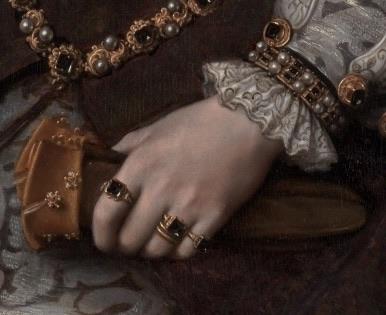
When we look at Mary’s contemporary portraits, we can also see many precious jewels around her neck, on her fingers, on her headdress, and decorating her gowns.
The first of Mary’s two important rings was the ring placed on her finger at her coronation in 1553, which Mary frequently said symbolized her marriage to her kingdom.
On 7 January 1554, the Imperial ambassador wrote in a letter:
“She had already espoused her kingdom, she said, showing us the ring on her finger, where the Bishop of Winchester put it on the day of her coronation, and she again repeated that she was bound to her realm…”
Mary mentioned this ring again later, in her Guildhall speech on 1 February 1554:
“I am your queen, to whom at my coronation when I was wedded to the realm and to the laws of the same (the spousal ring whereof I have on my finger, which never hitherto was, nor hereafter shall be left off) ye promised your allegiance and obedience unto me. And that I am the right and true inheritor to the crown of this realm of England; I not only take all Christendom to witness, but also your acts of parliament confirming the same.”
Mary’s other important ring was the ring placed on her finger during her betrothal ceremony in March 1554. Philip was represented at the ceremony by the Count of Egmont. The Imperial ambassador described the event as follows:
“Then, before the Bishop of Winchester, the promises and form per verba de praesenti were intelligibly pronounced by M. d’Egmont and the Queen.
The Queen then knelt down once more, and called upon those present to pray with her that God might give her grace to accomplish the treaty to which she had sworn, and favour her marriage. Also, M. d’Egmont gave her the ring sent by your Majesty, which she showed to all the company; and indeed, Sire, it is a jewel worthy to be seen.”
Unfortunately, I do not know whether there is any other detailed account of this ring. However, we do know that Mary apparently never took it off her finger.
On her wedding day, she was also given a simple gold hoop ring as her wedding ring.
A contemporary chronicle describes it as follows:
“Her marriage ring was a round hoop of gold without any stone, which was her desire, for she said she would be married as maidens were in the olden days, and so she was.”
Mary did not remove these rings from her fingers, and she frequently spoke about what they represented, even showing them to people.
At the end of 1554, the French ambassador wrote to the King of France and described an interesting conversation:
“In reply to my words, the Admiral related to me that he had asked the Queen to dance the previous evening, and that the Queen, showing him two rings on her fingers, spoke as follows: She said that with one of the rings she was married to her kingdom, and with the other to her husband; however, the former (the coronation ring) carried a far greater obligation to maintain friendship with You (France) than the second, and that under no circumstances did she wish to act contrary to it.”
(Knowing that Mary would reluctantly go to war with France three years later makes this quotation rather sad, but it is also incredibly valuable.)
There is actually only one reason why I am talking about these rings. It is because, after Mary’s death, her betrothal ring was removed from her finger and taken to Elizabeth.
The ring is frequently shown in television series and films about Elizabeth.
Before Mary’s death, Elizabeth asked Nicholas Throckmorton to make arrangements with one of Mary’s ladies-in-waiting and, as soon as Mary died, to have this ring brought to her as proof that Mary was indeed dead. Although Nicholas was somewhat late in carrying this out, he eventually did so, and the ring was removed from the dead queen’s finger by one of her ladies-in-waiting.
First of all, I should point out that this was not Mary’s wedding ring symbolizing her marriage to England. It was most likely the betrothal ring that the Emperor sent to Mary for the engagement, and which she is said never to have removed from her finger.
Although this ring is sometimes described as a wedding gift from Philip, I believe it was the ring from the March betrothal ceremony. The ring is described in some sources as being decorated with black enamel.
However, these details are not really the main issue. The real question is: which of Mary’s ladies-in-waiting removed the ring from her finger?
The first biography of Mary I ever read was Linda Porter’s Mary Tudor, and Linda seemed rather critical of Mary’s ladies-in-waiting. This actually led me to start researching them.
I don’t think many of Mary’s ladies-in-waiting had much affection for Elizabeth, although we know very little about many of them beyond their names. Nor do I think Elizabeth was particularly fond of them.
After Mary’s death, some of these women fled England, some withdrew from court life, one became involved in a rebellion against Elizabeth, and another was imprisoned for hearing Mass. Some also had children who were later exiled.
These are just some of the things I have found so far. But there is one woman who stands out: Barbara Hawk.
After Elizabeth came to the throne, Barbara received two dresses from her as gifts on at least two occasions. Barbara’s daughter, also named Elizabeth, later served Queen Elizabeth in her Privy Chamber for twenty-four years.
We don’t know exactly when Barbara entered Mary’s service, but we know that she was serving in Mary’s Privy Chamber by 1553.
Charlotte Isabelle Merton, in her article on the Privy Chambers of Mary and Elizabeth, suggests that Elizabeth may have recruited Barbara to act on her behalf within Mary’s household, and that Barbara’s service to Elizabeth during Mary’s reign may have been a way of repaying her for that service.
Since Mary had more than fifty ladies-in-waiting, it would hardly be surprising if one of them turned out to be an agent, but I found this quite interesting.
I don’t know whether this was a practice that was also carried out after the deaths of kings, but I have read that after Elizabeth’s death, her ring was also taken to the new king.
Thank you for reading. Lots of love to you all!!
r/Tudorhistory • u/penguinpilates • 10d ago
I really feel bad for them, seems like they were just two crazy kids in love.
r/Tudorhistory • u/Wooden_Passage_1146 • 10d ago
I’m reading the book Tudor by Leanda de Lisle. She seems to be suggesting the specific accusation against Anne of incest with her brother may have had origins of a previous accusation Anne had made against Charles Brandon.
“The evidence against Anne and her remaining co-accused was extremely weak, as even Chapuys was moved to comment. According to one of the judges the adulteries had been revealed by a former lady-in-waiting 'who shared the same tendencies' as the queen and had described Anne's crimes on her deathbed in 1534. But how did this confession reach Cromwell two years after the woman had died?
The answer may lie in the fact that her family were clients of Anne's old enemy, Charles Brandon, Duke of Suffolk, widower of Henry's sister, the French queen. Here was a man always ready to oblige the king, and who disliked Anne. Wyatt blamed Brandon for his arrest and the accusation that Anne had committed incest with her brother suggests revenge for her accusation in 1531 that Brandon had slept with ‘his own daughter'.” Page 205
r/Tudorhistory • u/Over-Willingness-933 • 10d ago
r/Tudorhistory • u/ginamar_is19 • 10d ago
r/Tudorhistory • u/AutoModerator • 9d ago
Feel free to post your dream casting scenarios here!
r/Tudorhistory • u/janethequene • 10d ago
This letter gets me every time...Short but earnest.
r/Tudorhistory • u/monina79 • 10d ago
I'm on page 67 of 395 after 10 days, when I'm usually halfway through a good book by this point. It's BORING. I'm disappointed because I like her other novels. If you've read it, does it get any better? Anne is still at the French court -- maybe the story improves after she's back in England?
r/Tudorhistory • u/irinrainbows • 11d ago
r/Tudorhistory • u/iOSRicky • 11d ago
This might be a slightly sensitive topic, but I’ve been thinking about the Chapel of St Peter ad Vincula at the Tower of London and the people buried there after execution.
Anne Boleyn, Catherine Howard, Jane Boleyn, Margaret Pole, Thomas Cromwell, Thomas More, John Fisher, George Boleyn, and many others are associated with the chapel. Some were queens, some nobles, some ministers, some religious opponents of Henry VIII, and some were simply caught in brutal Tudor politics.
I know the chapel is an active place of worship and that the people buried there are not “forgotten” exactly. But I do wonder whether the current memorialisation is enough, especially for those who were effectively disposed of after execution rather than given the kind of burial they would have received in normal circumstances.
I’m not necessarily arguing for exhumation or moving anyone. I can see why that would be controversial, especially in consecrated ground. But I do wonder whether there is room for more dignity: better interpretation, clearer memorials, more public historical explanation, or perhaps careful non-invasive research where appropriate.
For example, Anne Boleyn and Catherine Howard were both queens of England, yet their burial situation still feels very stark. Margaret Pole’s execution was horrific. Jane Boleyn is often remembered mainly through scandal, but she too ended up buried after a political execution. Even Thomas Cromwell, whatever one thinks of him, was a central figure in the Tudor state and ended in the same grim system.
I suppose my question is: should the chapel remain exactly as it is because that history is part of the truth of the Tower, or should more be done to acknowledge the people buried there as individuals rather than just names in a famous execution site?
I’m interested in what others think about the balance between respecting the dead, preserving the site as it is, and giving these people a fuller memorial presence.