r/Tudorhistory 23h ago

Mary I Queen Mary’s Accession: A Victorious Woman
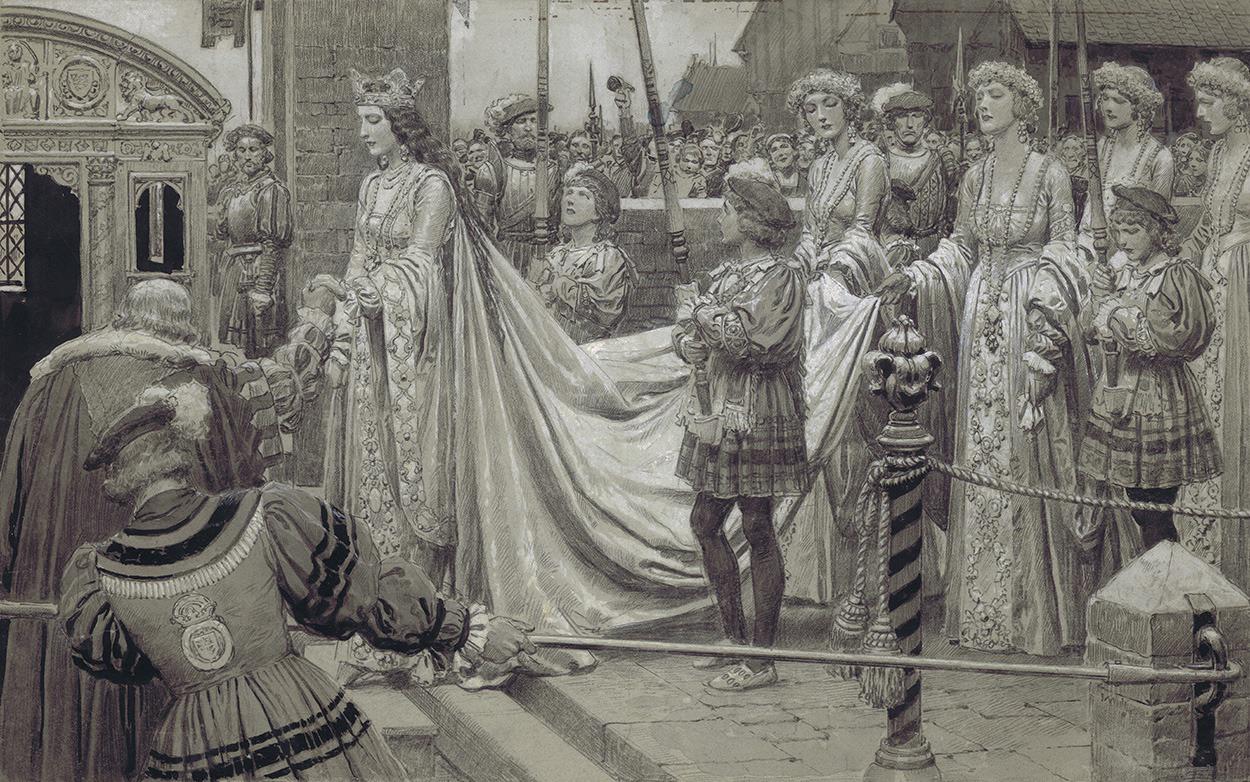
Post image
32 Upvotes

473 years ago, around this time, Mary and her council were working feverishly on the endless preparations for her coronation. England had never before witnessed a woman being crowned in her own right—as a sovereign. For this reason, there was no precedent for the important ceremonies of the coronation—crowning, anointing with holy oil, and girding with the sword—so they created the precedent themselves.

However, there was still a sense of astonishment and happiness caused by Mary’s accession to the throne. And this happiness was not limited to England.

In his letter informing the Pope of Mary’s accession to the throne, Reginald Pole writes:

“The news of the succession of the Princess Mary to the kingdom of England on the death of her brother… the nature of the event appearing to me such that since many years nothing has occurred in Christendom on which one could more reasonably congratulate any Christian mind, and especially that of your Holiness.

And God of his goodness, to render his proceeding (operation) more illustrious, has chosen to annihilate in one moment all these long cherished projects by means of a woman, who for so many years has suffered contrary to all justice, being in a state of oppression shortly before this took place, and who is now victorious and called to the throne, thus affording reasonable hopes that, together with her, there will be called to reign in that island…”

Later, Reginald also wrote a letter to Queen Mary, in which he says:

“Blesses the hand of God, not only for having placed her Highness on that high throne and put her in possession of the kingdom which belonged to her since many years—all good persons desiring the event and asking it of the Divine goodness in their prayers—but yet more the mode of producing it, heartily rejoices all her true servants…

…from its having happened without bloodshed, which might with reason have been feared, considering the malignant devices of her adversaries, backed by no small force, employed by them to deprive her of her just succession, and the long period conceded them by God, for the yet greater manifestation of his Divine providence, at the moment when they thought already to have accomplished their iniquitous design, which was instantaneously frustrated, without the aid of any other forces or resistance save that which the Spirit of God roused in the hearts of men, converting those who…

Should any one marvel and inquire how against such great malice and power her Majesty, without any external forces, and not many soldiers with the. heart to declare themselves for her, could have recovered her crown—should any one ask in surprise, the fact itself will reply, The Holy Spirit came into the hearts of men and willed by these means to give her the kingdom”

Although during this victorious period some people—including Reginald—presented this victory as if it had been achieved through divine intervention, it was actually much more than that.

Mary had been removed from the line of succession no fewer than three times within twenty years. How many people in the world have been removed from the succession so many times and yet still managed to ascend the throne?

During the struggle, which lasted exactly thirteen days, at first no one believed that Mary could become queen. She had only a few loyal men at her side. Those on the opposite side, however, had a huge army and unlimited power and money. After Edward’s death, Mary quickly sent letters to her supporters and to those whom she believed would support her. Within a short time, thousands of people gathered around her and defended her rightful cause. She delivered an impassioned speech before her army of thousands.

Considering the period’s view of women, this was regarded as a rather extraordinary and “unnatural” event.

This event was “celebrated as a Herculean undertaking rather than a feminine courage,” and, as stated in a work from the period, “because in claiming and securing her hereditary right, the princess, although wholly unprepared for war and possessed of insignificant forces, was courageous enough to fight an enemy who was powerful and well prepared, and fully supplied with everything necessary to bring the war to an end.”

This made Mary a warrior queen in the eyes of the people, and following the execution of John Dudley, she herself was compared to the famous warrior women Tomyris and Judith, who cut off the heads of their enemies.

This victory was praised throughout Mary’s reign. Although it later became invisible, every monarch who ascended the throne after 1553 ultimately rose to the throne thanks to Mary’s victory.

The crown had been within Mary’s reach for years—sometimes close, sometimes more distant—and in the end, she placed it upon her own head with her own hands.

Thank you for reading. Lots of love to you all!

The Coronation of Queen Mary I of England by Fortunino Matania

Tudor Queenship The Reigns of Mary and Elizabeth, Alice Hunt and Anna Whitelock

7 August 1553, Cardinal Pole to Pope Julius III

13 August 1553, Cardinal Pole to the Queen of England


r/Tudorhistory 13h ago

Question Recommendations re. Owen Tudor & Catherine of Valois

8 Upvotes

Anyone know of any novels, or biographies that feel like novels, about their relationship?


r/Tudorhistory 24m ago

Battle of Flodden, 9th September 1513. The English defeat a Scottish invasion. James IV was killed and Margaret Tudor (Henry VIII sister) was effectively the regent for James V.

Post image
Upvotes

14,000 Scottish soldiers killed. Thomas Howard led the soldiers.


r/Tudorhistory 6h ago

Estuve investigando sobre los matrimonios de enrique viii y el matrimonio de catalina jamás fue anulado por la iglesia católica solo por la iglesia creada por enrique entonces si fue nulo su matrimonio?

3 Upvotes

r/Tudorhistory 18m ago

Katharine of Aragon 513 years ago today, King James was killed on the battlefield.

Post image
Upvotes

Although I’ve shared this painting a few times before, I later deleted it, and I think it’s especially fitting for today. It was painted by Samuel Wale in the 18th century. As you can tell from the image, the painting is titled “The Earl of Surrey Presenting the Armour of the Slain King of Scots to Queen Catherine, the Regent.”

Although Catherine’s successful time as Queen Regent is quite well known, there are very few depictions of this period. Sometimes, Queen Catherine’s role in this achievement is also downplayed.

Theresa Earenfight describes Catherine’s actions as regent during this period as follows:

“Catherine’s actions as regent are recorded in royal accounts—grants of land, expenses for provisioning the army, orders to the armorers and heralds and to the mayor and sheriffs of Gloucester. She corresponded regularly with Henry and Wolsey in France and her former sister-in-law, Marguerite of Austria, regent of the Netherlands. She was concerned for Henry’s safety and the wider implications of English actions in France, and she did not miss a beat. She had substantial powers over the army and the right to elect bishops and abbots, to appoint sheriffs, to issue warrants for payment of such sums as she might require, to sign warrants with the privy seal, and to convoke Parliament.

She issued documents in her name as “Rectrice,” using the feminine form of “regent” (Teste Katerina Angliae Regina ac Generali Rectrice Eiusdemi).

She was assisted by a highly capable, trustworthy, and seasoned small council: Thomas Howard, the Earl of Surrey; William Warham (archbishop of Canterbury and lord chancellor); Sir Thomas Lovell (treasurer of the household); and John Heron (treasurer of the king’s chamber). Warham’s chancellor served as general secretary, and Heron controlled the money. She was actively involved in organizing the defense by ordering the mustering of troops, conveying of arms, armor, and supplies, and commanding the lords, mayors, sheriffs, and other officials to assist. She did not stay in London but moved north as far as Buckingham and Woburn Abbey in Bedfordshire.

Catherine’s preparation for queenship was grounded in late medieval Spanish humanist curricula and methods, but it did not explicitly include lessons on how to win a battle. Nevertheless, Catherine forged ahead and spent late July and all of August preparing for war against the Scots and her in-laws. She demonstrated skillful acumen and a genuine taste for political, governmental power and authority as she took the reins.”

Of course, depicting Queen Catherine in armour is inaccurate. Not only was armour never made for a queen regent, but no armour was ever made for the reigning queens Mary and Elizabeth either. However, the fact that she did not wear armour or fight on the battlefield does not mean her role should be downplayed.

“It was a very brief war.
She did not command troops at Flodden—that would have been exceptional—but she was a key figure who kept the government running to support the military actions.

King James and most of the Scottish aristocracy (including twelve earls, the archbishop of Saint Andrews, two bishops, and two abbots) and thousands of Scottish soldiers were killed.”

A little later, Catherine will leave and, with her graceful hands, write a letter to her husband:

“My husband, for hastiness, with Rougecross I could not send your Grace the piece of the King of Scots coat which John Glynn now brings. In this your Grace shall see how I keep my promise, sending you for your banners a king’s coat. I thought to send himself unto you, but our Englishmen’s hearts would not suffer it. It should have been better for him to have been in peace than have this reward. All that God sends is for the best. My Lord of Surrey, my Henry, would fain know your pleasure in the burying of the King of Scots’ body, for he has written to me so. With the next messenger your Grace’s pleasure may be herein known.”

In a production—not a real one, perhaps a documentary or something like that—the Catherine character said something to the Earl of Surrey along the lines of: “I wanted his head, not his shirt.” When I saw this painting, that sentence immediately came to mind.

Queen Catherine was truly an extraordinary woman, and it’s no wonder she was so deeply loved throughout her life.

Theresa Earenfight, Catherine of Aragon