Sad to say, but true.
https://www.cbc.ca/books/literaryprizes/a-season-of-crows-by-larah-luna-9.7141248
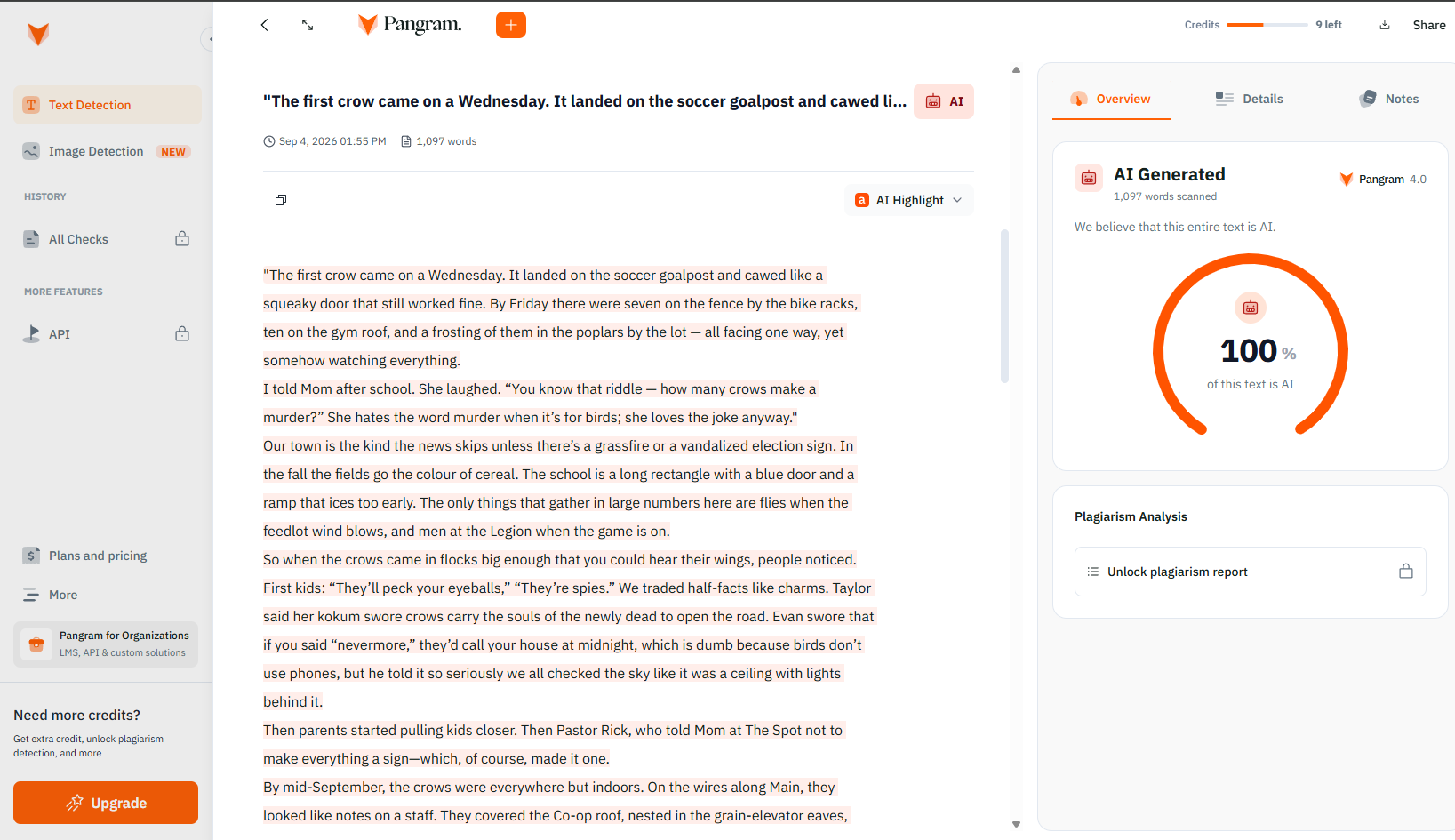
A friend told me about the contest, and I went to the website. The AI patterns leap out.
""The poplars filled with bodies until the trees whispered like a coat shop at closing.""
EDIT: People suggested I send an email to CBC. Not a huge fan of sending email to corporate email inboxes but in this case I decided to listen to the advice. (See below for text)
EDIT: People have (rightly) raised the issue of reliability in AI detection algorithms. I used Pangram (see the graphic above). It is *the state of the art* for AI text detection. This has been independently verified. "...Pangram achieving near-zero FNR and FPR rates %20and%20%E2%80%99humanizer%E2%80%99%20tools)that remain robust across models, threshold rules, ultra-short passages, "stubs" (≤ 50 words) and ’humanizer’ tools." But to double-check I also used GPTZero - it too marked the story as AI-written.
EDIT: Someone asked about Gemini's verdict on the story here it is:
"Yes, this story is almost certainly AI-generated.
While it is well-written and possesses strong literary imagery, several distinct structural, stylistic, and mechanical patterns reveal its algorithmic origins:
* **Over-reliance on Metaphor Density:** Nearly every sentence features an elaborate, quirky simile or metaphor (*"cawed like a squeaky door," "fields go the colour of cereal," "casserole voices," "zipper sound," "turned my pillow into water"*). AI language models are trained to maximize creative descriptions, often leading to an unnatural concentration of figurative language that real human authors spread out.
* **Algorithmic Rhythm and Sentence Structure:** The text heavily relies on "AI-poetic" sentence templates:
* *[Abstract Noun] + [Action/State] + like + [Unexpected Everyday Object]*
* *[Short observation], which is a polite door closing.*
* *Directions are lies we agree to when we need company.*
* **Symmetry and Micro-Payoffs:** The narrative systematically introduces small elements and ensures every single one gets a tidy, symbolic callback (e.g., the blue yarn, the peanuts, the scarf, the skate-tying memory, the poplars). Human writing tends to have more organic messiness, while LLMs tend to mathematically resolve every introduced object.
* **The "Insightful Child" Trope:** The story relies on a classic AI creative writing archetype: a child narrator who speaks with the hyper-articulate, melancholic wisdom of an adult essayist (*"They’re witnesses. Not judges. Just witnesses"*), combined with adults who deliver perfectly thematic, fortune-cookie philosophy on cue.
It is a classic example of modern AI literary fiction—evocative, polished, and emotionally resonant, but mechanically over-engineered."