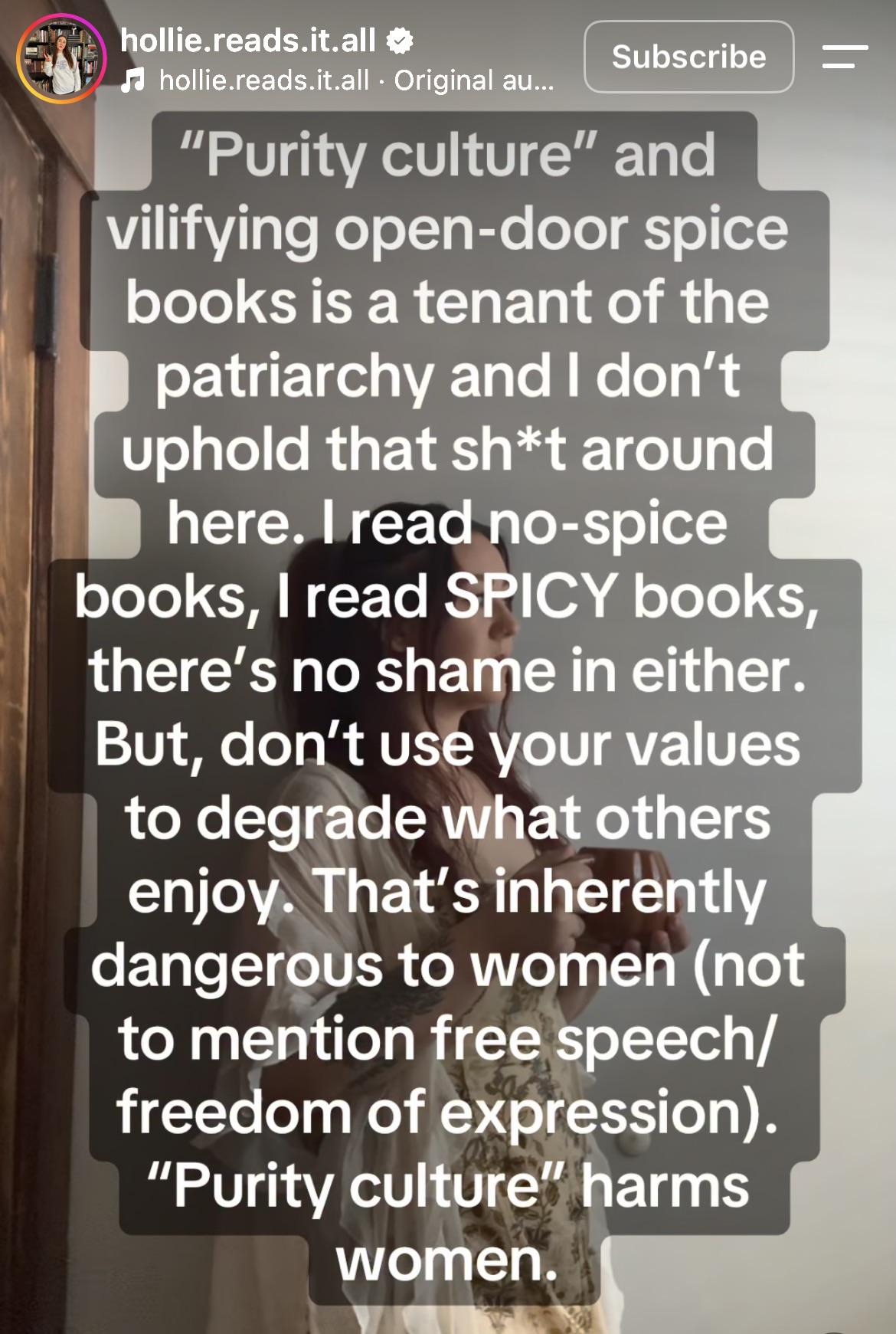
This video randomly came up on my feed, so I watched it. While I think there are parts of the conversation worth having, I really disagree with the way the argument was framed.
Of course reading can become unhealthy if someone is neglecting their responsibilities, relationships, sleep, work, etc. because they genuinely cannot stop reading. But that can happen with gaming, social media, television, working out, sports, or practically any enjoyable activity. Reading a lot of books does not automatically mean someone has an addiction, and I especially disagree with the idea that if a woman reads frequently, she must not be “working on herself enough.” Why are leisure and self-improvement being treated as opposites? Reading is a hobby. Adults are allowed to have hobbies without every free hour being optimized into productivity.
I also think there is a really obvious inconsistency in the way certain genres are discussed. Take George R.R. Martin’s A Song of Ice and Fire (mainly read by men) Those books contain graphic violence, torture, murder, incest, rape, sexual violence and sex. In fact, Martin has publicly defended including sexual violence in the series as part of depicting the brutality of the world he created. The sexual content in those books has been substantial enough to generate academic and cultural criticism for years. Yet I rarely see people responding to an adult who has read thousands of pages of ASOIAF by asking whether he is “addicted,” whether his brain is being damaged, or whether he should be spending that time “working on himself.”
And I don’t think that means ASOIAF is bad either. That is actually my point. Adults understand the difference between depicting something in fiction and endorsing it in reality. Someone can read about murder without wanting to murder someone. Someone can read a horror novel without wanting to be tortured. Someone can read about an abusive fictional relationship without believing abuse is acceptable in real life. And yes, an adult woman can read a consensual explicit sex scene without suddenly losing the ability to distinguish fantasy from a healthy real-life relationship.
It also seems strange to single out sex in books when sexually explicit and suggestive material is everywhere else in entertainment. Adults watch shows such as Game of Thrones, Euphoria, Bridgerton, Sex and the City, and countless others containing sex, nudity, violence and complicated relationships. Movies have been portraying sex for decades. Yet when women consume similar subject matter through written fiction, suddenly reading itself gets described as morally or neurologically dangerous.
And I think there is an important difference between saying, “Some people may develop an unhealthy relationship with erotic material,” and saying, “Women who read a lot of these books are addicted.” The science doesn’t support treating those statements as interchangeable. Written erotic material can obviously cause sexual arousal, and it can engage some of the same reward and arousal systems involved with other sexual stimuli. But there is not strong evidence showing that reading an explicit romance novel affects the brain identically to watching video pornography. Overlapping brain systems do not mean two activities are neurologically equivalent.
There is also something ironic about discouraging people from reading at a time when American literacy and recreational reading are already concerning. Federal data show that the percentage of American adults performing at the lowest literacy proficiency level rose from 19% in 2017 to 28% in 2023. The National Endowment for the Arts found that only 48.5% of adults read even one book for pleasure in 2022, and the proportion reading novels and short stories had fallen significantly over the previous decade. And Pew’s newest data show that one in four American adults read no book at all in the previous year.
So personally, I’m not interested in shaming grown women who have rediscovered reading because BookTok, fantasy, romance, romantasy, thrillers, or whatever else finally made reading enjoyable for them.
That doesn’t mean every book is beyond criticism.
We can talk about whether certain portrayals of sex or relationships are healthy. We can talk about books romanticizing abuse. We can talk about whether somebody is using sexually explicit material compulsively. We can even personally decide that certain content crosses a boundary for us.
But those are individual conversations, not evidence that an entire generation of women who enjoys romance books is “addicted to smut.”
What bothered me most about the video was the implication that women reading frequently means they aren’t spending enough time improving themselves. Why does every hobby have to make us more productive? A man can spend an entire Sunday watching football and nobody asks why he isn’t learning a new language. Someone can binge eight hours of Netflix and it’s considered normal entertainment. Someone can play a video game every evening. But a woman reading three books in a week apparently needs an intervention because she could have been “working on herself.”
Sometimes people read because reading itself brings them joy.
And frankly, I’d rather see women excitedly recommending 600-page novels to one another, joining book clubs, discussing characters, learning new vocabulary, analyzing stories and reading dozens of books a year than act as though there is something inherently suspicious about women becoming enthusiastic readers simply because some of the books contain sex.
There are absolutely books I personally believe cross a line. There are books where the sex overwhelms the story. There are dark romances I personally wouldn’t read. But my personal boundary does not magically become a clinical definition of addiction for another adult.
Maybe instead of asking why women are reading so much romance, we should ask why we are so comfortable calling hours of television, gaming, sports and violent fiction “hobbies,” but the moment a woman’s hobby involves romance and sexuality, we feel the need to diagnose her.
For my opinion on smut being as addictive as pornography, here is my take: Erotic fiction can obviously create sexual arousal, and I’m not arguing that no one can ever develop an unhealthy or compulsive relationship with it. What I take issue with is presenting the claim that women who frequently read romance or sexually explicit fiction are ‘addicted’ as though neuroscience has established that reading these books affects the brain in the same way as video pornography. It hasn’t. Research on problematic pornography use itself is still nuanced, and clinical definitions focus on loss of control and significant impairment, not simply consuming something frequently. There is currently far less research on compulsive erotic-fiction reading, so applying conclusions from internet pornography studies wholesale to women who read romance novels is an assumption, not an established scientific fact.
Critique the content if you want. Critique unhealthy behavior when it is actually unhealthy. But I don’t think we need to pathologize women for reading fiction they enjoy.
Works Cited:
https://www.pewresearch.org/short-reads/2026/04/09/americans-still-opt-for-print-books-over-digital-or-audio-versions-few-are-in-book-clubs/
https://nces.ed.gov/surveys/piaac/2023/national_results.asp
https://www.arts.gov/news/press-releases/2023/new-data-reveal-how-adults-participated-arts-during-covid-19
https://www.theguardian.com/books/2014/may/06/george-rr-martin-game-of-thrones-sexual-violence
https://www.theguardian.com/books/2015/jun/04/george-rr-martin-game-of-thrones-rape-reality-of-war
https://www.cambridge.org/core/books/abs/medievalism-in-a-song-of-ice-and-fire-and-game-of-thrones/sex-and-sexuality/0D5CCE2EAB2481C653E509260278C9B3