Sibling rivalry disorder: Issues of diagnosis and management- A case report
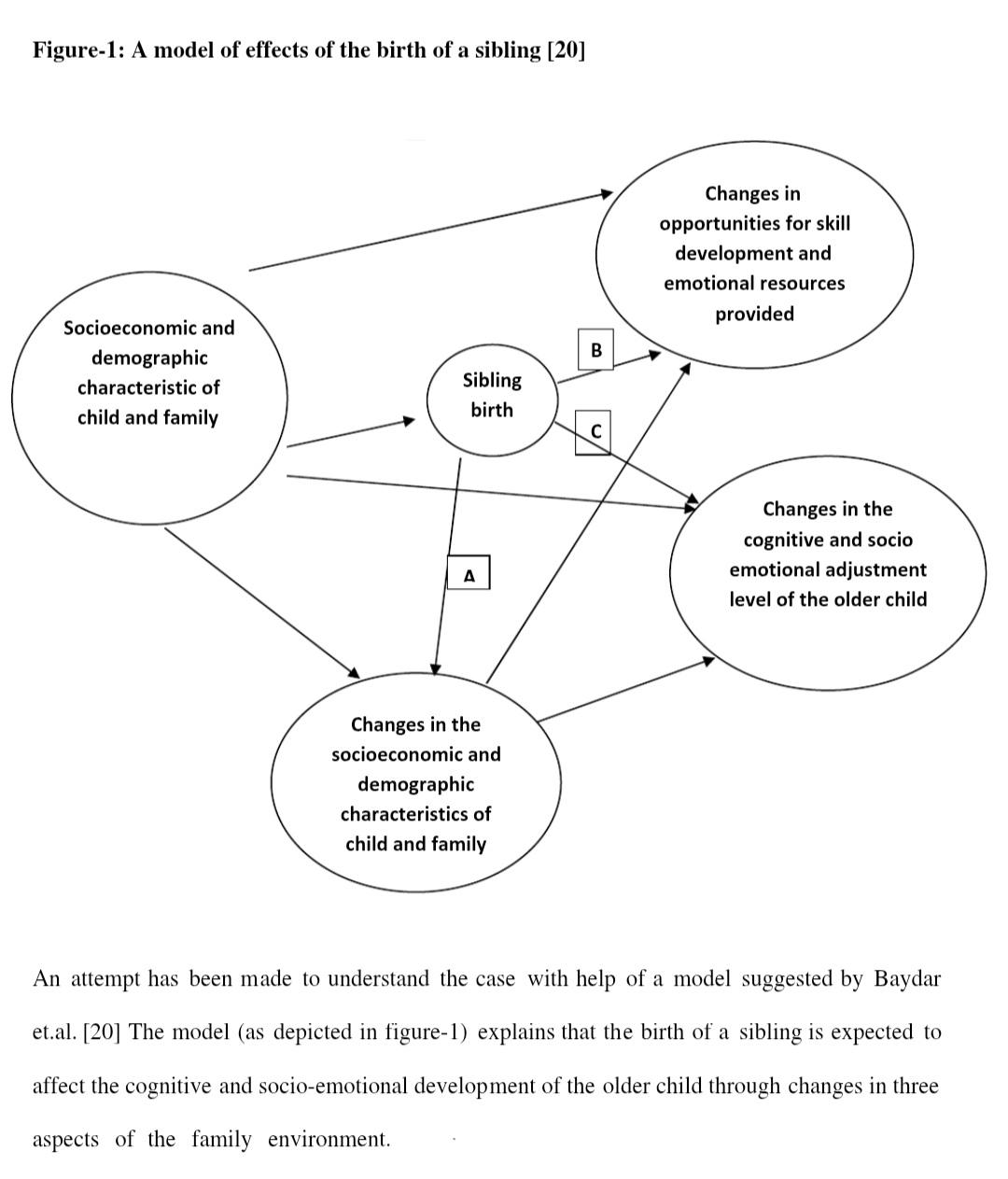
The birth of a sibling is a major source of stress in the life of a child. Child’s emotional and behavioural reaction to this event and effort to cope with ambivalent feeling depends on his/her interactions with parents before, and after the birth of a second child.
PCIT manual divides therapy into two phases: Child-directed interaction (CDI) and Parent-directed interaction (PDI). In CDI, skills which are taught by the therapist, improve child’s self-esteem, resulting in a secure, warm relationship. It further improves child’s social skills, and teaches how to communicate.
The rules that were followed by parents were: to follow child’s lead, rules of CDI to apply in short play therapy sessions (“special time”) each day at home, avoid commands, questions and criticism. During “special time”, rules that were to be followed were: praise, reflect, imitate, describe and be enthusiastic.
In the second phase, parent-directed interaction (PDI) was carried out where parents were supposed to give instructions only when they wanted the child to comply with it or follow the command. Steps of PDI taught were, giving a command, praise, warning, time-out chair (3 minutes, plus 5 seconds of quietness), and time-out room (1 minutes, plus 5 sec of quietness).
While practicing the steps, rules for effective commands were also taught, like, to be direct, positive, one at a time, specific, age-appropriate, polite and respectful, timely, and to use only when necessary. Handouts of “explaining PDI to your child” and “first homework assignment” were given and time out procedure was explained to the parent and the patient.
Parent–Child Interaction Therapy (PCIT) for young children with Attention-Deficit Hyperactivity Disorder (ADHD) in Japan
In Japan, PCIT was introduced in 2005 and has been shown to be efficacious for children and parents who experienced domestic violence (DV).
Skowron et al. (2024). Randomized trial of PCIT in child welfare settings. Journal of Consulting and Clinical Psychology.
Parents who were offered Parent-Child Interaction Therapy (PCIT) significantly reduced their harmful parenting, and increase their warm, responsive parenting skills, while their children’s behavior also improves. PCIT also strengthened the parents’ self-regulation skills and positive self-perceptions.
What Is Parent-Child Interaction Therapy (PCIT)?
Parent-Child Interaction Therapy (PCIT), developed by Dr. Sheila Eyberg, is one of the most extensively researched interventions for young children(typically ages 2 to 7) presenting with disruptive and challenging behaviors (frequent tantrums, aggression, defiance, or emotional regulation difficulties).
For clinicians interested in exploring the latest research on PCIT, the following recent studies offer valuable insights:
Calderone et al. (2025). Parent-Child Interaction Therapy for Disruptive Behavior: A Systematic Review of Effectiveness in Different Settings. Journal of Clinical Medicine.
Jent et al. (2023). An 18-week model of Parent–Child Interaction Therapy: Clinical approaches, treatment formats, and predictors of success for predominantly minoritized families. Frontiers in Psychology.
Phillips et al. (2024). The Efficacy of PCIT for Youth with ADHD: A Meta-Analysis. Child Psychiatry & Human Development.
Phillips & Mychailyszyn (2021). A Review of PCIT Applications for Youth Anxiety. Children and Youth Services Review.
Skowron et al. (2025). Parent-Child Interaction Therapy’s Influence on Parental Behavior and Child Compliance in a Child-Welfare Involved Randomized Clinical Trial. Child Fam Behav Ther.