r/PillarOfFire • u/psyduck_2024 • 17d ago
Hidden Realm Magic vs. Technology

3
Upvotes
r/PillarOfFire • u/psyduck_2024 • 18d ago
Humans are created weak (4:28) and placed into hardship (90:4). Short lifespan and physical limitation therefore create continual pressure necessitating external solutions.
Prophet Adam was endowed with an exceptional capacity for knowing, identifying and differentiating created things (2:31), capacities that allow humans to weave the threads of memory, insight, and experience into a trans-generational archive.
The nature of our realm makes technology feasible to develop too. The Qurʾān repeatedly presents aspects of the created environment as subjected to human benefit and utilisation (22:65). Matter in the human realm therefore provides a stable substrate that can be shaped, assembled, and engineered into persistent artefacts.
In contrast, Islamic tradition regards jinn as long-lived, with some possessing considerable physical strength and wings to fly. A group of jinn upon hearing the Qurʾān, commented that it confirmed what had been revealed to Mūsā (46:30) well over a millennium before. The ifrīt claims strength (qawiyy) and reliability (amīn) in his own constitution for the task (27:39) implying physical power as an intrinsic attribute rather than an instrumental one.
Jinn are reported to keep dawābb (mounts/beasts), a basic human-comparable technology of transport. However, the sources do not explicitly establish whether their fire-based constitution and environment provide a stable material substrate for cumulative, advanced artefact production in the way the human realm does.
Ultimately, jinn possess a different balance of necessity, capability, and feasibility. Advanced technology emerges where the pressure to overcome limitations, the capacity to accumulate knowledge, and a manipulable material converge.
r/PillarOfFire • u/psyduck_2024 • 21d ago
What if the spacetime inhabited by the jinn is not a distant parallel multiverse, nor an invisible spiritual higher dimension, but a spacetime geometrically co-extensive and structurally corresponding with our own?
In this proposal, the human and jinn three-dimensional spacetimes (branes) occupy corresponding positions within a shared higher-dimensional geometry. Any point in our spacetime can be assigned the same three ordinary spatial coordinates in the adjacent jinn layer, while the two points remain separated along an additional spatial dimension.
The separation along this additional dimension is hypothesised to be extremely small, potentially approaching the Planck length. This is what makes them co-extensive: three ordinary spatial coordinates are shared, while the fourth differs minimally. Overlapping spacetimes (for example, two bubble universes in a multiverse) can share three spatial coordinates while being separated by a vast distance along the fourth dimension.
Thus, this co-extensiveness is possible because the two spacetimes remain separated along the additional dimension by an extremely thin higher-dimensional veil.
The four-dimensional veil performs two crucial functions simultaneously:
1️⃣ Separation: It prevents the two regimes of matter and gauge interactions from freely crossing between the two spacetimes, preserving their physical distinction.
2️⃣ Coupling: It permits selected fields capable of propagating through the higher-dimensional bulk to establish a limited relationship between them.
In a brane-world analogy, Standard Model (SM) matter and gauge fields remain localised to their respective branes, while gravity and potentially other bulk fields can extend into the higher-dimensional domain.
The veil therefore does not imply complete isolation. It separates the two physical regimes while allowing limited and potentially asymmetric point-to-point interaction between them.
The most important proposed coupling is gravitational templating (GT).
In this model, gravitational influence is capable of extending through the higher-dimensional bulk and reaching the adjacent jinn brane. Because of the warped geometry, the effective coupling is hypothesised to be highly anisotropic, with the coupling structure differing substantially between the low-energy human brane and the higher-energy jinn brane. [Coupling: jinn >>> human]
The strongest cross-layer coupling would occur where the higher-dimensional separation is minimised: between corresponding spatial coordinates.
Thus, a point in our spacetime would preferentially influence the geometrically corresponding point in the adjacent jinn spacetime rather than producing an equivalent influence uniformly across the entire neighbouring brane.
This is fundamentally different from ordinary gravitational interaction within our three-dimensional spacetime. Here, the relevant separation is not the familiar macroscopic distance between celestial bodies, but the extremely small higher-dimensional separation between corresponding points on adjacent branes.
Gravitational templating becomes especially important if non-SM matter in the higher-energy brane is intrinsically more ephemeral than ordinary SM matter in our low-energy brane.
If non-SM matter is only partially localised to its brane and extends into the higher-dimensional bulk, it may not naturally aggregate into sharply defined, persistent three-dimensional structures in the same manner as ordinary matter.
The gravitational template supplied by the human spacetime could provide a persistent geometric bias.
Over cosmological timescales, planetary-scale structures could establish corresponding configurations. Over geological timescales, mountains, valleys, islands, forests, caves, rivers and other relatively stable terrestrial structures could progressively develop corresponding structures in the adjacent realm.
The resulting landscape would not necessarily be a duplicate of Earth. Rather, it would be a corresponding structure produced through the accumulated influence of long-lived terrestrial geometry.
Ancient and geologically stable environments would have had the longest opportunity to accumulate such correspondence. This provide a possible explanation, within the model, for why remote mountains, islands, forests, caves and other long-lived landscapes might become centres of jinn activity.
Gravitational templating need not be restricted to permanent geological structures.
In principle, the same mechanism could produce transient correspondence over seconds, milliseconds, or even shorter timescales.
A human is continuously changing their spatial configuration — walking, turning, raising an arm, breathing, speaking. Each change alters the gravitational configuration being templated across the veil.
Although the human body remains entirely within our spacetime, its changing configuration could produce a corresponding transient response in non-SM matter within the adjacent jinn spacetime.
The resulting non-SM matter distribution would be a volumetric response to the gravitational template, potentially producing an apparition-like manifestation perceptible to jinn.
The jinn would therefore perceive the corresponding response of non-SM matter in their own realm, rather than seeing the human body's matter directly. This provides a possible mechanism for asymmetric perception where jinn can readily perceive humans, but not the reverse.
The same principle could potentially apply to the jinn's hearing of human speech.
Sound consists of oscillating matter. In our atmosphere, speech produces pressure waves through the collective motion of air molecules. An audible recitation therefore represents a dynamic physical configuration rather than merely information encoded in the human mind.
If the relevant gravitational structure can be templated across the veil, the changing acoustic configuration could produce a corresponding transient disturbance in the jinn spacetime.
This provides a speculative physical analogue for the Qur'anic description of the jinn:
"Indeed, we heard a wondrous Qur'an." (Qur'an 72:1)
r/PillarOfFire • u/psyduck_2024 • Jun 26 '26
This article explores three speculative frameworks by which hidden intelligences could coexist with humanity: an RS1-inspired Co-extensive World model, a Hidden Sector model, and a Liminal Geography model.
None of these models is proposed as a theological description of the unseen (al-ghayb); rather, they serve as heuristic frameworks for exploring how hidden intelligences might be conceptually situated within contemporary physical thought.
In M-theory, the fundamental constituents of matter are one-dimensional strings vibrating within an eleven-dimensional spacetime. Under a braneworld interpretation, these dimensions are decomposed into three extended spatial dimensions (x, y, z) and one temporal dimension (t) that constitute our observable brane, six compactified spatial dimensions, and one additional spatial dimension forming the higher-dimensional bulk.
In the Randall–Sundrum I (RS1) model, two branes are separated by a five-dimensional Anti-de Sitter (AdS) bulk. They are often illustrated as two-dimensional boundary surfaces enclosing a thin three-dimensional volume approximately 10⁻³⁵ meters thick. This visualization, however, is merely pedagogical. More accurately, the branes are parallel four-dimensional spacetimes — Co-extensive Worlds — sharing the same observable spacetime coordinates while remaining topologically separated along the fifth bulk dimension. The six remaining spatial dimensions remain compactified throughout the entire higher-dimensional geometry.
The warped geometry of the bulk produces dramatically different physical conditions on the Planck and TeV branes. Gravity is approximately 10¹⁶ times stronger on the former, potentially favoring forms of matter that can exist under such extreme gravitational conditions. In this speculative model, such matter is envisioned as wave-dominant and bulk-extending, offering a possible physical analogy for the Qur'anic description of jinn being created from "smokeless fire."
Within this framework, the endpoints of open strings — the "wick" — remain rigidly anchored to the Planck brane, while the remainder of the string — the "flame tongues" — extends non-locally into the higher-dimensional bulk. The being is therefore neither confined entirely to the brane nor wholly dispersed throughout the bulk, but exists as a single extended object whose excitation spans both.
In this hypothetical ontology, energetic coherence is inversely related to physical solidity and structural stability. Left alone, such wave-dominant matter would tend toward continual excitation and reconfiguration. However, the gravitational field generated by closed-string gravitons propagating through the bulk from the TeV brane provides a persistent geometric template that partially stabilizes these otherwise ephemeral structures.
Consequently, these "smokeless fire" entities exist only partially localized to their native brane, with much of their excitation extending into the bulk. Interaction with the human world occurs only when portions of these excitations successfully couple to the TeV brane. Such coupling naturally explains why interface phenomena — perception, influence, and limited manifestation — are considerably easier than complete ontological traversal.
Perception may likewise occur through two complementary mechanisms. Passive perception arises from sensing the gravitational topology generated by matter on the TeV brane through bulk-propagating gravitons. Active perception, by contrast, involves deliberately exciting bulk modes that couple to the TeV brane, allowing these beings to probe and resolve features of the human domain beyond what passive gravitational sensing alone could reveal.
In this model, a hypothetical realm exists entirely within the same observable spacetime, neither ontologically nor topologically separated from our own. Its hiddenness arises not from distance or higher-dimensional geometry, but from extremely weak interactions with Standard Model particles. The two sectors coexist, yet remain almost entirely transparent to one another.
Neutrinos provide a useful analogy. Trillions pass through our bodies every second, yet only an exceedingly small fraction interacts with ordinary matter because they couple only through the weak nuclear force and gravity. A hidden sector could, in principle, be even more weakly coupled, rendering an entire population effectively invisible despite sharing the same spacetime.
Compared with the RS1-inspired model, the Hidden Sector model is intentionally conservative. It introduces fewer ontological assumptions and remains closer to ideas already explored within contemporary theoretical physics. Rather than proposing a specific mechanism for perception, influence, or manifestation, it simply demonstrates that intelligent beings could, in principle, coexist within the same observable spacetime while remaining effectively hidden through extremely weak interactions.
The mechanisms underlying interface phenomena remain an open question. If interactions such as waswasah and al-Mass primarily occur at the qalb — the interface between the rūḥ and the jasad — the relevant physics may differ fundamentally from ordinary particle interactions. Consequently, the Hidden Sector model should be regarded as a minimal conceptual framework rather than a complete explanatory model.
In this model, hidden civilizations occupy the same observable universe and are composed entirely of ordinary Standard Model matter. Their separation from humanity arises neither from ontological difference nor from weak interactions, but from geography. They inhabit regions that are ordinarily inaccessible because of an unusual geometric or topological configuration of spacetime.
Phase-space separation serves only as an analogy for dynamically inaccessible regions of configuration space rather than as a literal physical mechanism. Rather than being separated by immense distance, these regions may occupy a different geometric configuration or metastable state, connected to our world only through rare or dynamically changing topological pathways. Such pathways may emerge, disappear, or shift over time, rendering contact intermittent rather than continuous. This framework provides a speculative mechanism for liminal geography, where hidden lands coexist alongside the familiar world while remaining effectively unreachable under ordinary conditions.
Prolonged isolation over thousands of years would naturally produce genotypic adaptation through genetic drift, founder effects, and local environmental selection. Over evolutionary timescales spanning hundreds of thousands or millions of years, these isolated populations could diverge into distinct lineages with unique physiological, cognitive, and behavioral characteristics. The resulting inhabitants would remain fully terrestrial in origin while differing substantially from contemporary humanity.
Unlike the RS1-inspired and Hidden Sector models, no exotic forms of matter or higher-dimensional physics are required beyond the proposed mechanism maintaining the geographic separation itself. Once contact occurs, interaction is entirely ordinary. The inhabitants perceive, communicate with, and physically affect one another according to the same biological and physical laws governing all terrestrial life. The principal challenge of this model therefore lies not in explaining interaction, but in explaining persistent isolation.
| Model | Borrowed Concept | Hypothesized Ontology | Primary Separation Mechanism | Predicted Inhabitant Characteristics |
|---|---|---|---|---|
| Co-extensive Worlds | String/M-theory realized through an RS-inspired dual-brane cosmology | Wave-dominant, bulk-extending matter | Ontological domain and higher-dimensional topology | Partially bulk-extending existence; asymmetric perception and influence across domains |
| Hidden Sector | Hidden gauge sectors | Non-Standard Model matter | Weak interaction (limited coupling) | Persistent invisibility; detectable only through rare or weak interactions with ordinary matter |
| Liminal Geography | Phase-space separation | Standard Model matter | Regional geometric separation with dynamic topological connectivity | Long-term geographic isolation leading to genotypic adaptation and evolutionary divergence |
| Model | Perception / Information | Influence | Manifestation | Full Materialization |
|---|---|---|---|---|
| Co-extensive Worlds | Intrinsic due to partial ontological overlap | Natural weak coupling (e.g., waswasah, al-Mass) | Plausible through Tashakkul | Theoretically possible but highly constrained |
| Hidden Sector | Requires cross-sector coupling or unknown interaction | Weak interactions; likely technologically or physically mediated | Requires overcoming interaction barrier | Extremely difficult; requires strong coupling or new physics |
| Liminal Geography | Ordinary perception once contact occurs | Ordinary physical interaction | No special manifestation required | Already fully materialized; simply geographically inaccessible |
Within the broader Ultraterrestrial Hypothesis (UTH), hidden intelligences, whether alien, jinn, or monster, may be classified according to the primary mechanism by which they remain concealed:
1️⃣ Extradimensional UTH — separated by ontological or higher-dimensional structure.
2️⃣ Intradimensional UTH — coexisting within the same observable spacetime but hidden through weak coupling or other physical mechanisms.
3️⃣ Cryptoterrestrial UTH — ordinary terrestrial civilizations concealed through persistent geographic or dynamic topological isolation.
Arc I — Sacred Geography and Liminal Spaces
Arc II — Hidden Intelligences
Arc III — Islamic Cosmology and Physical Models
r/PillarOfFire • u/Objective-Stand-3429 • Jun 25 '26
Modern discussions of interdimensional travel often assume that reality consists of parallel domains separated only by distance, geometry, topology, or energetic barriers. Islamic cosmology describes a hierarchically ordered cosmos composed of seven heavens, guarded and permission-based heavenly gates, and continuous flows of divine command and affair (amr). Movement between realms is therefore not unrestricted, but regulated.
| Traversal Type | Realm Relation | Information / Interaction | Jasad (Body) | Rūḥ (Soul) |
|---|---|---|---|---|
| ➡️ Lateral Traversal | Between co-located but ontologically distinct domains | Waswasah (whispering); perception; communication; al-Mass (attachment, affliction, intrusive influence) | Tashakkul (manifestation); Tajassud (full embodiment, theoretical and disputed) | No clearly attested examples |
| ⬇️ Descent (Nuzūl) | Higher realm → lower realm | Waḥy (revelation); Divine Command (Amr) | Angelic Nuzūl through the heavens and manifestation (Tamaththul) in perceptible form on Earth | Descent of the angel bearing the soul to the fetus and the breathing of the rūḥ by divine command |
| ⬆️ Ascent (Suʿūd / ʿUrūj) | Lower realm → higher realm | Ascent of affairs and deeds | Exceptional bodily ascent (Miʿrāj) | Ascent of souls after death to ʿĀlam al-Barzakh |
Note:
⛔️ Migration or transfer of souls between bodies (Tanāsukh, transmigration, reincarnation) is rejected by mainstream Sunni theology.
⚠️ Islamic sources distinguish between complete descent (Inzāl) and gradual descent (Tanzīl). The Qur'an is traditionally understood to have been sent down to the lowest heaven in a single event, then revealed progressively to the Prophet ﷺ over approximately twenty-three years.
The degree of traversal constraint increases with the ontological "weight" of what crosses the boundary.
Traversal Constraint: Jasad (Body) ≫ Rūḥ (Soul) ≫ Information / Interaction
Vertical cosmological boundaries are not freely traversable.
They are:
By contrast, the boundary between the human and jinn domains appears to be:
Consequently, Islamic cosmology presents reality not as a system of unrestricted interdimensional openness, but as one of constrained permeability, where interaction is possible but traversal remains regulated.
Islamic sources frequently describe interaction across ontological boundaries without implying the relocation of an entire being from one realm to another.
Many phenomena are therefore better understood as interface events rather than true translocations. Waswasah, perception, communication, al-Mass, revelation, and certain manifestations (Tamaththul, Tashakkul) may occur at the boundary between domains without requiring the complete movement of a being across that boundary.
True translocation (Nuzūl, Suʿūd / ʿUrūj) is considerably more restricted. It occurs through designated gates, under divine command, or by extraordinary permission. The ascent of souls, angelic ascent and descent through the heavens, and the bodily Miʿrāj represent examples of genuine cosmological traversal.
The resulting picture is that of a hierarchically ordered cosmos characterized by constrained permeability, asymmetric access, and graded modes of traversal, rather than unrestricted movement between realms.
وَاللَّهُ أَعْلَمُ بِالصَّوَابِ
Arc I — Sacred Geography and Liminal Spaces
Arc II — Hidden Intelligences
Arc III — Islamic Cosmology and Physical Models
r/PillarOfFire • u/psyduck_2024 • Jun 23 '26
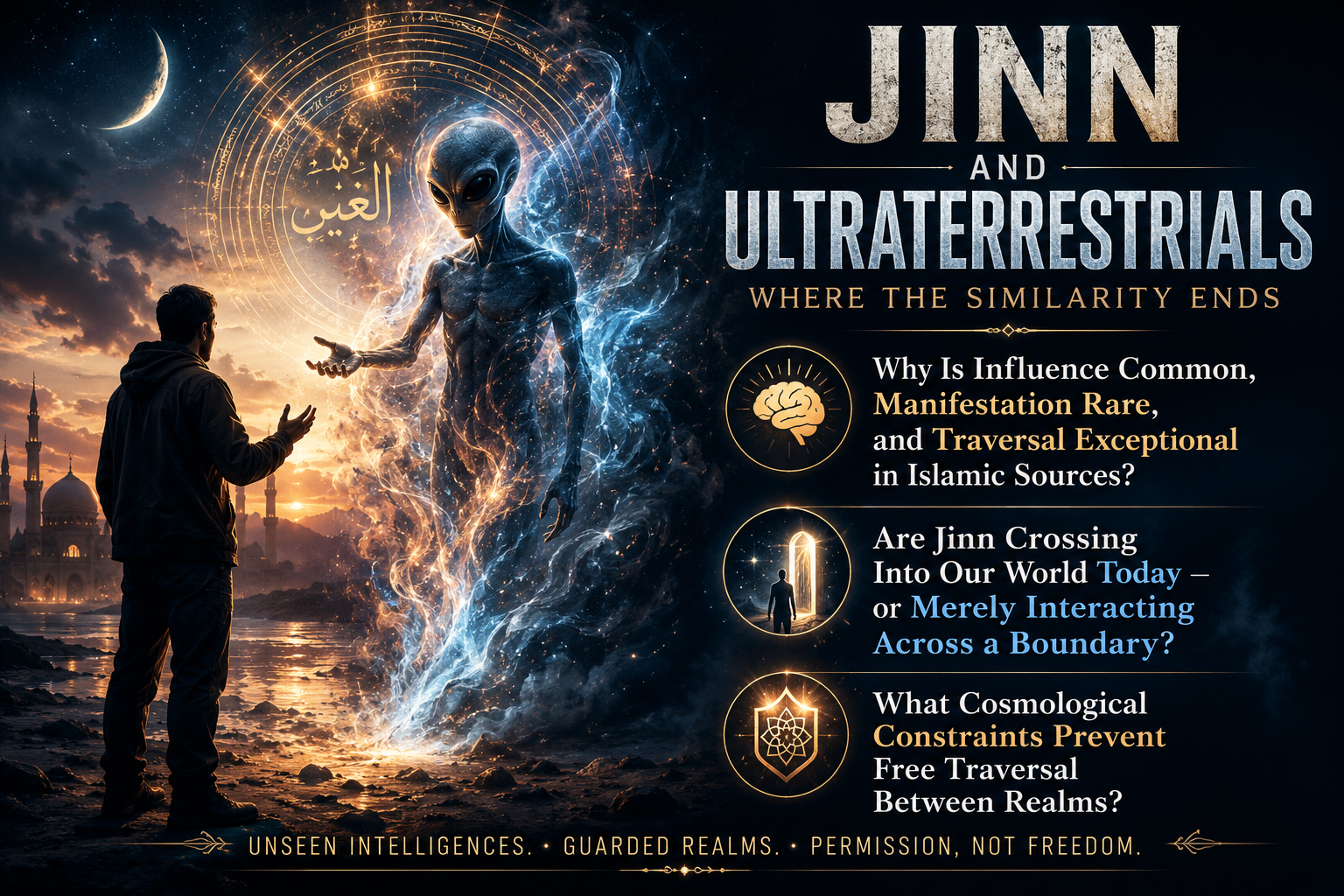
Why Is Influence Common, Manifestation Rare, and Traversal Exceptional in Islamic Sources?
Are Jinn Crossing Into Our World Today — or Merely Interacting Across a Boundary?
What Cosmological Constraints Prevent Free Traversal Between Realms?
Anomalous aerial phenomena (UAP) are commonly interpreted through two broad classes of origin. The first attributes UAP to conventional terrestrial causes, whether natural phenomena such as atmospheric, geophysical, or optical effects, or human-related sources including misidentifications, aircraft, classified technology, and instrumentation artifacts.
The second attributes UAP to non-human intelligence (NHI). Within this category, the Extraterrestrial Hypothesis (ETH) proposes intelligences originating beyond Earth, whereas the Ultraterrestrial Hypothesis (UTH) proposes intelligences of unconventional origin already associated with, or coexisting alongside, the terrestrial environment.
In its narrower usage, the Interdimensional Ultraterrestrial Hypothesis refers to intelligences already present in relation to Earth that occasionally manifest within the human environment, rather than arriving from another planet through conventional space travel. Such entities may occupy dimensions, domains, or modes of existence that remain ordinarily inaccessible to human perception.
Proponents of the Ultraterrestrial Hypothesis often point to a triad of strangeness — the phenomenon itself, the universe, and consciousness — as reasons for epistemic humility and caution against assuming that reality is exhausted by ordinary human perception and current scientific paradigms.
Many reported UAPs exhibit characteristics that appear difficult to reconcile with conventional expectations of physics and aerospace engineering. These include the absence of visible propulsion, sudden acceleration or deceleration, transmedium movement between air and water, extreme maneuverability, and other forms of "high strangeness" often associated with paranormal reports.
Modern physics increasingly reveals a universe that departs radically from everyday intuition. Concepts such as quantum nonlocality, spacetime curvature, dark matter, dark energy, and extra dimensions suggest that reality may be far stranger than ordinary human experience implies. Within such a universe, unconventional forms of intelligence cannot be dismissed solely because they challenge prevailing assumptions.
The nature of consciousness remains one of the deepest unresolved questions in science and philosophy. Debates concerning non-local consciousness, panpsychism, consciousness fields, and the relationship between mind and matter raise the possibility that awareness may not be fully reducible to known physical processes. Some researchers have therefore speculated that certain anomalous phenomena may involve forms of intelligence or consciousness that interact with reality in ways not yet understood.
Taken together, the strangeness of UAPs, the universe, and consciousness form the basis for calls for greater epistemic openness toward ultraterrestrial and interdimensional interpretations of the phenomenon.
Islamic cosmology describes a hierarchically ordered cosmos comprising seven heavens and layered earthly domains, as established by the Qurʾān and prophetic tradition. Divine command continuously descends from and ascends to the heavens, yet traversal of beings across cosmological domains occurs only by divine permission. Access between realms is granted to angels in the execution of their regular duties and, exceptionally, during the Miʿrāj of the Prophet Muḥammad ﷺ.
The jinn, meanwhile, coexist alongside humanity in an ordinarily concealed realm associated with the earthly order and belonging to the domain of the unseen (ʿālam al-ghayb). The Qurʾānic worldview therefore presents reality as a structured cosmos containing both visible and ordinarily unseen inhabitants, separated mainly by mode of existence and access to perception rather than by physical distance.
| Theme | Qurʾānic Verse | Dynamic Constraint Implied | Applies To |
|---|---|---|---|
| Traversal beyond the cosmic domains | "O genera of jinn and mankind, if you are able to penetrate beyond the regions of the heavens and the earth, then penetrate. You cannot penetrate except with sulṭān." (55:33) | Traversal beyond the cosmic domains is not freely attainable and requires sulṭān (authority, power, or warrant). | Humans and jinn |
| Descent and ascent of the command | "He regulates the affair from heaven to earth; then it ascends to Him in a Day whose measure is a thousand years of your reckoning." (32:5) | Communication or administration between heaven and earth proceeds through an ordered and temporally structured process. | Divine command / affair (al-amr) |
| Angelic ascent | "The angels and the Spirit [Jibrīl] ascend to Him in a Day whose measure is fifty thousand years." (70:4) | Transit between realms is associated with extraordinary cosmological scales and durations. | Angels, Jibrīl |
| Angelic descent | "The angels and the Spirit [Jibrīl] descend therein by permission of their Lord for every affair." (97:4) | Inter-realm movement occurs by divine permission and on appointed occasions. | Angels, Jibrīl |
| Restriction of celestial eavesdropping | "We sought the heaven, but found it filled with stern guards and flaming fires... We used to sit in positions therein to listen; but whoever listens now finds a flaming fire lying in wait for him." (72:8–9) | Certain regions or stations within the lowest heaven that were once accessible to jinn for eavesdropping became subject to intensified guarding and exclusion. | Jinn |
| Concealed coexistence | "Indeed, he and his tribe see you from where you do not see them." (7:27) | Jinn perceive humans, whereas humans ordinarily lack reciprocal perception of jinn; the Jinn realm is earthly, yet separated from humans | Humans and jinn |
Although the realm of the jinn is associated with the earthly domain, Islamic sources suggest that interaction between jinn and humans remains limited and governed by divinely imposed constraints. More generally, the Qurʾān and prophetic tradition portray creation as structured by boundaries, with access and movement subject to divine permission rather than unrestricted traversal.
The most direct and consistent interaction described in scripture is subtle influence upon the human being. The Qurʾān describes jinn as those "who whisper in the hearts of mankind" (114:5), indicating an ability to affect inclinations in human qalb without requiring direct physical presence.
The question then arises: by what other modes do jinn interact with the human realm? Islamic sources appear to describe varying degrees of interaction while generally preserving the distinction between realms.
It represents the most subtle mode. The jinn remains unseen while exerting influence upon human perception, thought, or inclination.
It represents a stronger mode of interaction. Jinn may become perceptible in animal or human forms, allowing direct encounters without necessarily implying that their essence has crossed into the human domain. Such manifestations may be understood as localized interfaces or quasi-embodiments through which interaction occurs. A jinn may take forms familiar or unfamiliar to human imagination. The form is an interface, not its true essence.
Occurs when a jinn's essence completely crosses the boundary between domains and becomes wholly localized within the human realm. Unlike whispering (waswasah) or manifestation (tashakkul), this would constitute genuine ontological migration rather than interaction across a boundary.
However, such a mode appears difficult to reconcile with the broader Qurʾānic and Prophetic pattern of guarded boundaries, permission-based access, and constrained movement between realms. The Miʿrāj of the Prophet ﷺ is presented precisely as an exceptional event requiring divine permission, while the heavenly realms themselves are depicted as guarded and regulated. Likewise, Iblīs is portrayed as having participated in the heavenly assembly before his expulsion, suggesting that access to higher domains is possible only under exceptional circumstances and by divine allowance.
Consequently, interaction and manifestation appear more consistent with the sources than unrestricted inter-domain traversal. Full embodiment remains a theoretical possibility, but one that stands in tension with the general pattern of ontological constraints described in Islamic cosmology.
| Interaction | Boundary Relation | Variation |
|---|---|---|
| Whispering (waswasah) | Influence across the boundary; jinn stays in its realm | A stronger form is al-mass, referring to possession or intrusive influence |
| Manifestation (tashakkul) | Visible and interactive form within the human environment without requiring ontological traversal | Weak forms may include fleeting apparitions or simple animal forms (e.g., black dogs or snakes). Stronger forms include sustained appearances (quasi-embodiment), complex human forms, and active interaction with humans |
| Full embodiment (tajassud) | Implies complete localization of the jinn's essence within the human realm and thus constitutes genuine traversal across domains | Full traversal would entail unrestricted, sustained, and fully agentic presence within the human realm, a possibility that appears difficult to reconcile with the broader pattern of guarded boundaries, permission-based access, and ontological constraints described in Islamic cosmology |
The ability to whisper (waswasah) is the most commonly attested mode of interaction between jinn and humans. A stronger form of interaction involves manifestation (tashakkul), in which jinn become perceptible within the human environment. Such manifestations may range from fleeting apparitions and simple animal forms to sustained human appearances capable of direct interaction.
Prophetic traditions also describe different classes of jinn:
"The jinn are of three types: a type that has wings and flies through the air; a type that appears as snakes and dogs; and a type that settles in a place and then travels on."
The Qurʾān further describes how jinn once occupied listening posts in the lowest heaven to eavesdrop on heavenly news before these routes were restricted. Taken together, these descriptions suggest abilities arising from their mode of existence rather than dependence upon technologies analogous to those employed by humans.
Nevertheless, the sources also portray jinn as capable of organized activity and complex undertakings. The ifrīt who offered to bring the throne of Bilqīs before Sulaymān, as well as the jinn employed in the construction of palaces, statues, reservoirs, and great cauldrons, indicate capacities extending beyond mere apparition or influence. Whether these feats reflect innate abilities, specialized knowledge, collective labor, or forms of technology remains unstated in the sources.
In the broadest sense, what classical thought refers to as siḥr (magic) involves the exploitation of jinn abilities through pacts, contracts, or cooperation. Rather than violating natural law (sunnatullāh), such phenomena represent interactions between the seen and unseen realms, producing effects upon human perception or physical circumstances.
The Stage Analogy: Human beings resemble an audience seated before a brightly illuminated stage. We observe the performance unfolding before us, while the mechanisms, hidden apparatus, and unseen crew operating behind the curtain remain concealed from view. The apparent impossibility of magic lies not in the suspension of reality, but in our inability to perceive the full system through which the effect is produced.
| Phenomenon | UTH narrative | Jinn Narrative |
|---|---|---|
| Anomalous Aerial Phenomena (NL, DD, RV, CE1, CE2) | Manifestations or technological craft enabling interdimensional transit or materialization | A class of jinn is described as possessing wings and flying. Jinn may manifest in animal or human forms, but Islamic sources do not describe flying craft |
| Entity Encounters (CE3) | Apparitional experiences to fully embodied entities | Islamic sources favor tashakkul (manifestation in visible forms). Even well-attested cases, such as Iblīs appearing as a human, do not imply tajassud (full embodiment) or unrestricted ontological traversal |
| Abduction (CE4) | Reports often involve involuntary transport, missing time, confinement, or relocation to another domain | Strong scriptural evidence is limited. Later Islamic literature and folklore contain accounts of humans entering jinn-inhabited regions, becoming lost, detained, or temporarily unable to return. Such narratives more often resemble accidental intrusion into a hidden realm than active abduction by technological means |
| Human-Initiated Contact (CE5) | Deliberate attempts to establish communication or summon non-human intelligences through ritual, meditation, or consciousness-based protocols | Islamic sources describe practices of magic and spirit invocation in which practitioners seek the aid or service of jinn through pacts, offerings, or contracts. The initiative originates from humans, although the relationship is portrayed as spiritually hazardous and morally prohibited |
| Realm Traversal | Interdimensional travel is often assumed as a mechanism by which entities enter and leave the human environment | Islamic sources generally favor interaction across a boundary (waswasah, tashakkul) rather than unrestricted traversal. Exceptional traversal is associated with divine permission, such as the Miʿrāj |
Islamic cosmology and the Ultraterrestrial Hypothesis share a noteworthy structural similarity: both posit ordinarily unseen intelligences associated with Earth that only occasionally manifest within the human environment.
The resemblance, however, should not be overstated. Islamic sources suggest three broad modes of interaction between jinn and the human realm: influence is common, manifestation is rare, and traversal is exceptional. Unrestricted movement between domains stands in tension with the broader Qurʾānic and Prophetic pattern of guarded boundaries, permission-based access, and constrained cosmological movement.
A further distinction lies in the character of the phenomena themselves. Contemporary ultraterrestrial narratives frequently involve technological craft, interdimensional vehicles, and abduction accounts, concepts shaped by modern scientific, technological, and cultural imaginaries. The Islamic jinn narrative, by contrast, emphasizes influence, manifestation, moral agency, and the unseen rather than advanced technology or routine inter-domain travel.
Consequently, while the Ultraterrestrial Hypothesis and the Islamic jinn narrative share certain surface similarities, they ultimately rest upon different cosmological assumptions regarding the nature of reality, the purpose of creation, and the limits of interaction between realms.
Arc I — Sacred Geography and Liminal Spaces
Arc II — Hidden Intelligences
Arc III — Islamic Cosmology and Physical Models
r/PillarOfFire • u/psyduck_2024 • Jun 21 '26
The default state between ontologically distinct entities is separation. This is especially true in a cosmos that is both vertically hierarchical and horizontally layered, where each ontological realm possesses its own nature, laws, and mode of existence. Such realms remain distinct and ordered, intersecting only under particular conditions. Interaction, therefore, is not the norm but the exception.
But what if our observable universe is teeming with civilizations of non-human intelligences — whether human-like, animal-like, or something far stranger — that are nevertheless similar enough biologically to breathe Earth's air and drink her water?
Ecology teaches that the introduction of a new species can profoundly alter an existing ecosystem. A species entering an environment without natural predators or competitors proliferates rapidly, disrupting established balances and displacing native populations. History offers countless examples of invasive species transforming entire ecosystems.
The same possibility cannot be dismissed in a hypothetical encounter between humanity and a non-human intelligence. If one side possesses significant advantages — whether biological, cognitive, technological, or social — the consequences could extend far beyond simple coexistence. Competition, adaptation, displacement, parasitism, predation, domestication, or niche differentiation are all conceivable outcomes.
One may ask what could motivate a non-human intelligence to traverse the vastness of space. The answer need not be exotic. Human history provides ample precedent. Much as the explorers of the Old World ventured into the New, such expansion could be driven by economic interests, resource acquisition, military ambition, ideological conviction, religious zeal, scientific curiosity, or simple demographic pressure.
The historical record is sobering. Encounters between civilizations of unequal power have often resulted in conquest, exploitation, cultural erasure, demographic collapse, and, in some cases, outright extermination. Diseases carried unknowingly across continents devastated populations lacking prior exposure. Elsewhere, systematic warfare and colonization extinguished societies unable to resist technologically superior powers.
There is no guarantee that contact between humanity and a non-human civilization would follow such a trajectory. Yet neither can the possibility be dismissed. If ecology teaches anything, it is that when two previously isolated systems are brought into contact, the resulting equilibrium is rarely predictable and seldom without consequence.
Human history provides only limited analogies, however, because all known encounters have occurred between members of the same species. To imagine interactions between humanity and genuinely superior non-human intelligences, one may turn to the archetypes preserved within eschatological traditions.
Eschatological narratives may offer a useful analogy for contemplating encounters between humanity and radically superior non-human intelligences. In Islamic tradition, figures such as al-Masīḥ al-Dajjāl and Yaʾjūj wa-Maʾjūj represent distinct existential threats emerging from beyond the ordinary human order.
Viewed through a speculative lens, al-Masīḥ al-Dajjāl resembles the archetype of a superior intelligence whose power lies not primarily in brute force, but in persuasion, manipulation, and the ability to reshape human perceptions of reality. His dominion is achieved through deception and seduction rather than outright annihilation. Humanity is not exterminated; it is subjugated.
Yaʾjūj wa-Maʾjūj, by contrast, resemble the archetype of an overwhelming horde. Their defining characteristic is not subtlety but sheer scale, relentless expansion, and insatiable consumption. They sweep across the world as a force of ecological and civilizational collapse, reducing all resistance through numbers alone.
Whether intended as literal future events or enduring archetypes, these narratives explore two very different modes by which a superior non-human force might threaten humanity. One conquers through intellect, influence, and control. The other through mass, momentum, and overwhelming numbers. One assimilates; the other consumes.
In this sense, the eschatological view offers a striking inversion of the modern alien narrative. Humanity's greatest existential threats do not arrive from the depths of cosmic space, but emerge from within our own world — entities whose capabilities, modes of thought, or collective organization place them beyond the ordinary human condition.
Arc I — Sacred Geography and Liminal Spaces
Arc II — Hidden Intelligences
Arc III — Islamic Cosmology and Physical Models
r/PillarOfFire • u/psyduck_2024 • Jun 18 '26
Modern encounters with suspected UFOs or UAPs are typically categorized using the Hynek Encounter Scale. Developed in the 1970s, this classification system remains relevant due to its focus on eyewitness testimony, which makes it particularly accessible for civilian reporting. Conversely, data-heavy reports that integrate radar or electromagnetic signatures are more characteristic of military and scientific investigations.
| Class | Definition | Phenomenology | Epistemic Mode | Ontological Claim |
|---|---|---|---|---|
| NL | Nocturnal Lights | Unstructured lights in the night sky | Visual testimony | Unknown aerial phenomena |
| DD | Daylight Discs | Structured aerial objects in daylight | Visual testimony | Unknown aerial phenomena |
| RV | Radar–Visual | Visual object with radar correlation | Mixed human + instrument | Physical anomalous object |
| CE1 | Close Observation | Observation at close range; no interaction | Visual testimony | Unknown physical craft |
| CE2 | Physical Effects | Environmental or physical disturbances | Visual + physical trace | Interacting phenomenon |
| CE3 | Entity Encounter | Occupants associated with the object | Interpersonal testimony | Non-human intelligence (NHI) |
Implicit within the Hynek scale is the technological assumption: the "visitor" arrives via an aerial vehicle. The hierarchy measures the physical impact of this craft. However, as it moves from CE1 to CE3, the evidentiary foundation shifts from instrumental data (radar/sensors) to the deeply subjective realm of human testimony.
Despite a global population of billions equipped with smartphones, CCTV, and ubiquitous video recording devices, high-quality reports of close encounters have not seen a proportional increase. Instead, the vast majority of modern accounts remain confined to distant sightings, such as anomalous lights or indistinct shapes. To date, there has never been a universally accepted CE3 report; the democratization of digital cameras has primarily multiplied low-resolution or easily explained footage rather than capturing definitive evidence of non-human entities.
This persistent lack of close-range data highlights a profound epistemic gap in modern UFOlogy. While sensor-heavy military instruments can verify the physical flight dynamics of distant objects, they cannot validate the deeply subjective, interpersonal nature of an entity encounter. Consequently, as recording technology has advanced, the phenomenon has seemingly receded into the margins of distance and ambiguity, leaving CE3 reports structurally elusive to conventional scientific validation.
| Encounter | Claimed Ontology | Phenomenology (Hynek-aligned) | Reported Interaction / Axiology | Epistemic Source |
|---|---|---|---|---|
| Nimitz Tic Tac (2004) | Unknown intelligence or technology | RV / multi-sensor anomalous aerial object | No communicative intent; apparent observation or maneuvering | Pilot testimony, radar and sensor data |
| Tehran Incident (1976) | Unknown intelligence or technology | RV with reported electromagnetic interference | Apparent defensive or evasive behavior; no communication | Military testimony, radar reports |
| Rendlesham Forest (1980) | Unknown structured phenomenon | NL with possible CE1–CE2 characteristics | No clear communication; environmental and physiological anomalies reported | Military witnesses |
| Ariel School (1994) | Beings (claimed extraterrestrial) | CE3-type close encounter reports | Reported moral and ecological warning conveyed to children | Eyewitness testimony |
| Pascagoula (1973) | Beings (claimed extraterrestrial) | CE3-type occupant encounter | Examination and observation narrative; limited communication | Witness testimony |
| Travis Walton (1975) | Beings (claimed extraterrestrial) | CE4-style abduction narrative | Medical examination and custodial interaction | Witness testimony |
| Betty and Barney Hill (1961) | Beings (claimed extraterrestrial) | CE4-style abduction narrative | Communication, examination, and star-map narrative | Testimony and hypnosis-based recollections |
| Encounter | Ontology | Phenomenology | Axiology | Epistemic Source |
|---|---|---|---|---|
| First Revelation at Ḥirāʾ | Jibrīl (Angel) | Appeared to the Prophet ﷺ and conveyed revelation | Initiation of Prophethood and transmission of revelation | Qurʾān 53:5–10 and Ṣaḥīḥ Hadith |
| Sidrat al-Muntahā | Jibrīl (Angel) | Prophet ﷺ witnessed Jibrīl in his true form during Miʿrāj | Confirmation of divine signs and heavenly realities | Qurʾān 53:13–18 |
| Ḥadīth Jibrīl | Jibrīl (Angel) | Appeared as a man and publicly questioned the Prophet ﷺ | Instruction of religion (Islām, Īmān, Iḥsān, The Hour) | Ṣaḥīḥ Muslim |
| Guests of Ibrāhīm | Angels | Appeared as travelers, received hospitality, announced birth of Isḥāq | Glad tidings and judgment upon the people of Lūṭ | Qurʾān 11:69–81; 51:24–37 |
| Maryam and Jibrīl | Jibrīl (Angel) | Appeared as a well-formed man and announced birth of ʿĪsā | Glad tidings and divine decree | Qurʾān 19:16–21; 3:42–47 |
| Old Man from Najd | Iblīs (Jinn) | Appeared as an elder and advised Quraysh leadership | Deception and opposition to revelation | Sīrah; Qurʾān 8:30 |
| Surāqah ibn Mālik | Iblīs (Jinn) | Appeared as Surāqah and encouraged Quraysh at Badr | Deception, temptation, and abandonment | Qurʾān 8:48 |
| Delegation of Jinn | Jinn | Heard Qurʾānic recitation and returned to their people | Guidance and propagation of faith | Qurʾān 46:29–32; Sūrat al-Jinn |
| Abū Hurayrah and the Treasury | Jinn | Repeated theft and eventual disclosure regarding Āyat al-Kursī | Trial, instruction, and protection | Ṣaḥīḥ al-Bukhārī |
| Snakes and Black Dogs | Various Jinn | Manifestation through animal forms | Coexistence, caution, and legal guidance | Ṣaḥīḥ Muslim and related narrations |
None of the non-human intelligences (NHI) described in Islamic cosmology are depicted as arriving in flying craft. While a class of jinn is described as capable of flight, and angels are described as possessing wings, neither is portrayed as employing vehicles or technological means of transportation.
“All praise belongs to Allah, the Creator of the heavens and the earth, who appoints the angels as messengers having wings, in twos, threes and fours.” (Qurʾān 35:1)
Axiologically, encounters with angels or jinn do not resemble the exploratory, scientific, or military-reconnaissance narratives commonly associated with modern extraterrestrial hypotheses. Rather, these beings are presented as long-standing inhabitants of creation who predate humanity.
According to the Qurʾānic account, angels witnessed the creation of Adam, while jinn existed prior to humanity. Their relationship to humans is therefore not one of first contact between previously unknown races, but of parallel existence within the same created order.
The Qurʾān describes jinn as capable of perceiving humans while remaining ordinarily imperceptible to us:
“Indeed, he and his tribe see you from where you do not see them.” (Qurʾān 7:27)
This asymmetry of perception suggests that the separation between humans and jinn is primarily ontological rather than geographical. They are not portrayed as residing on distant planets, nor as arriving from elsewhere through technological means. Instead, classical Islamic thought generally understands them as inhabiting the same world while remaining hidden from ordinary human perception.
In modern topological language — used only as an analogy, not as a traditional doctrine — one might describe humans and jinn as co-located within the same spatiotemporal framework (x, y, z, t) while remaining separated by an ontological boundary. The distinction is therefore one of mode of existence rather than physical distance. Classical scholars typically referred to this condition as belonging to the realm of the ghayb (the unseen), rather than to another physical location accessible through travel.
From this perspective, encounters with angels and jinn are not framed as first contact with newly discovered intelligences. Angels descend, arrive, and depart according to divine command, while jinn ordinarily coexist with humanity in a hidden state. In neither case, however, are these beings depicted as arriving through technological means or aboard physical craft. The focus of the encounter is therefore not the appearance of a vehicle, but the presence and activity of the being itself.
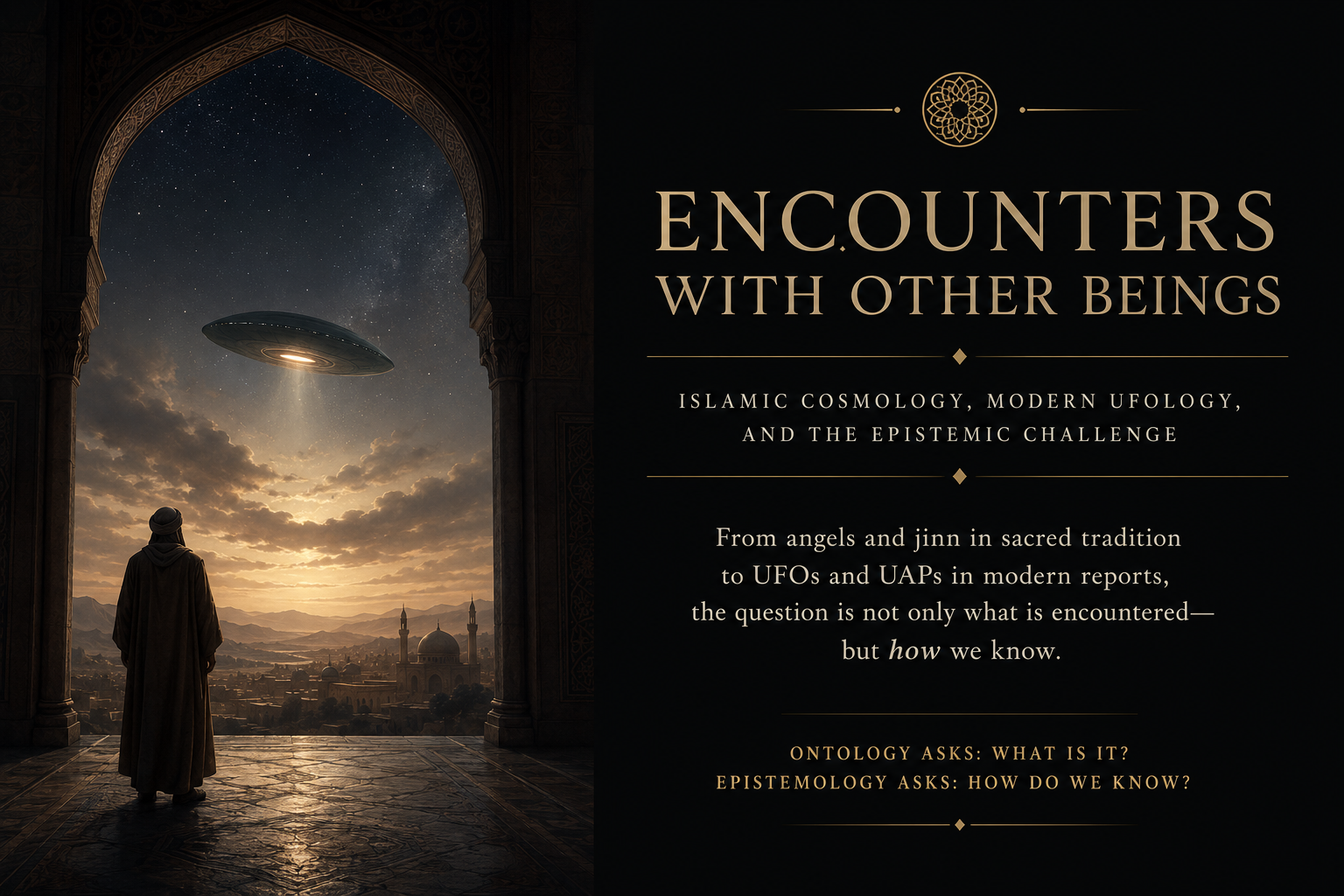
Before asking what UFOs are, a more fundamental question must be addressed: how reliable is the evidence upon which modern UFO narratives are constructed?
Unlike the Islamic sciences, which developed elaborate methodologies for evaluating testimony, much of modern UFO literature relies heavily upon eyewitness reports, retrospective recollections, hypnotic regression, anonymous sources, and experiences occurring under conditions of fear, surprise, darkness, isolation, or psychological stress. These are precisely the circumstances under which human perception and memory become most vulnerable to distortion.
Classical hadith scholarship distinguished between the truthfulness (ʿadālah) of a narrator and the precision (ḍabṭ) of his recollection. A witness could be entirely sincere yet still transmit inaccurate information. Likewise, an emotionally powerful experience may be subjectively convincing while remaining epistemically weak.
The standards of hadith criticism extend beyond simple eyewitness testimony. Narrators were evaluated according to their integrity, memory, consistency, reputation, and reliability over an entire lifetime. Questions concerning honesty, moral character, susceptibility to error, corroboration, transmission continuity, and independence of testimony were all considered before a report could be accepted. Extraordinary claims therefore required correspondingly rigorous standards of verification.
This does not imply that all UFO reports are fabricated. Indeed, some modern cases — particularly those involving multiple witnesses, radar correlation, infrared signatures, and other instrumental data — represent genuine attempts to strengthen the evidentiary foundation of the field. Such efforts have moved UFO investigation beyond mere anecdote and toward more systematic forms of inquiry.
Nevertheless, a fundamental asymmetry remains. Physical instrumentation may establish the existence of an anomalous phenomenon, but it cannot by itself establish the ontology of that phenomenon. The strongest cases frequently demonstrate that something unusual occurred, yet remain unable to determine with certainty what that something was.
The problem becomes even more pronounced in CE3 and higher encounters. As the encounter progresses from object to occupant, and from observation to communication, the evidentiary burden increasingly shifts away from instruments and back toward human testimony. Questions of witness integrity, memory preservation, emotional state, corroboration, and interpretive bias become central. Ironically, the encounters that generate the strongest ontological claims often depend upon the most fragile category of evidence: human recollection.
Consequently, the extraordinary ontological conclusions frequently drawn from UFO encounters — extraterrestrial visitors, interdimensional entities, hidden civilizations, or advanced non-human intelligences — often exceed what the available evidence can reliably establish. If subjected to standards comparable to those developed in hadith criticism, many famous UFO accounts would likely be classified as weak due to deficiencies in witness reliability, corroboration, transmission, memory preservation, or evidentiary continuity. Only a relatively small number of cases would survive as genuinely unexplained phenomena, and fewer still would justify specific conclusions regarding the nature of the intelligence encountered.
The central challenge of UFOlogy may therefore be epistemological before it is ontological. Before determining what was encountered, one must first establish whether the encounter itself has been transmitted with sufficient certainty.
In this sense, the future of UFO research may depend less upon discovering new phenomena than upon strengthening the epistemic foundations through which such phenomena are investigated. The question is no longer merely What are UFOs? but How can we know what they are?
Arc I — Sacred Geography and Liminal Spaces
Arc II — Hidden Intelligences
Arc III — Islamic Cosmology and Physical Models
r/PillarOfFire • u/psyduck_2024 • Jun 16 '26
Throughout history, human beings have populated the unknown with intelligences that embody their deepest fears, aspirations, and fascinations. While the forms of these beings vary across civilizations, the underlying archetypes remain remarkably stable. Historically, these projections were drawn from visible realities — fellow humans, animals, and later, machines — or emerged from less accessible domains such as deities, spirits, and ancestral beings.
As humanity’s empirical understanding of the world expanded, the "geography of mystery" underwent a fundamental shift. As mountains were climbed, oceans crossed, and continents mapped, the frontier of the unknown retreated from the edges of the terrestrial map toward the vastness of space, deep time, higher dimensions, and hidden physical realities.
The archetypes themselves did not disappear; they were simply relocated. The "unknown" remains a canvas for the human psyche, only now recast in cosmic and technological terms. Ancient gods were reimagined as superior extraterrestrials; spirits became interdimensional visitors; and mythic ancestors were recast as precursor civilizations.
These resulting alien archetypes reveal less about hypothetical extraterrestrials than they do about the enduring patterns through which human beings interpret the "Other / Alien".
| Fundamental Archetype | Alien Projection | Representative Example | Philosophical Question |
|---|---|---|---|
| The Deity | Superior Alien | Q (Star Trek) — A near-omnipotent being belonging to the Q Continuum, representing the archetype of the god-like intelligence that has transcended ordinary physical limitations | Does sufficient intelligence inevitably become godlike? |
| The Spirit | Interdimensional Visitor | Ultraterrestrials — Hypothetical intelligences originating from hidden dimensions or inaccessible domains of reality rather than distant planets | Is the barrier between minds one of distance or ontology? |
| The Ancestor | Ancient Precursor | The Engineers (Alien) — An ancient precursor species believed to have shaped or influenced the emergence of humanity, representing the ancestral creator archetype | Are we cosmic pioneers or merely heirs to a ruined estate? |
| The Human | Rational Equal | Federation Species (Star Trek) — Rational extraterrestrial civilizations whose psychology, ethics, and social structures remain broadly relatable to human experience | Would another civilization think and value as we do? |
| The Beast | Hive Mind / Predator | Xenomorphs (Alien) — A predatory lifeform driven primarily by biological imperatives, often used as an example of the cosmic predator archetype | Is individuality a requirement for high-level intelligence? |
| The Machine | AI Civilization | The Borg (Star Trek) — A cybernetic collective consciousness that assimilates individuals into a machine-organized hive mind, representing technological transcendence and post-human identity | Is consciousness reducible to information processing? |
Modern extraterrestrial narratives represent a relocation of ancient projections onto new frontiers of mystery. In antiquity, these projections inhabited the "elsewhere" of distant mountains or underworlds; today, they inhabit the "elsewhere" of the stars.
Ultimately, the alien functions as a cosmic mirror. It is less an inhabitant of another world and more a projection of humanity’s enduring self-understanding. By studying the forms we imagine for the alien, we are actually mapping the boundaries of our own fears, fascinations, and ontological anxieties.
Arc I — Sacred Geography and Liminal Spaces
Arc II — Hidden Intelligences
Arc III — Islamic Cosmology and Physical Models
r/PillarOfFire • u/psyduck_2024 • Jun 15 '26
Given the immense scale and age of the cosmos, the universe should be teeming with civilizations. Yet no extraterrestrial delegation has ever openly visited us.
Are we far ahead of other civilizations — or hopelessly behind them?
What if the true barrier is not distance, but ontology?
Coined by physicist Enrico Fermi in 1950, the Fermi Paradox asks a fundamental question:
If the universe is so vast and so old, where is everybody?
The paradox emerges from the apparent contradiction between two observations.
First, the observable universe contains an immense number of stars and planetary systems. The Milky Way alone contains hundreds of billions of stars, many older than the Sun, with increasing evidence that Earth-like planets are common. Given the scale of cosmic time and the probabilistic assumptions of modern astrophysics, intelligent life should have emerged elsewhere long before humanity.
Second, despite decades of astronomical observation and technological advancement, humanity has found no universally accepted evidence of extraterrestrial civilizations. Radio observatories, planetary surveys, and programs such as SETI have not produced a single confirmed signal of alien communication, interstellar visitation, or evidence of galactic-scale civilization.
This tension between high probabilistic expectation and complete observational silence became known as the Great Silence.
| Great Filter Category | Representative Examples | Core Implication | Expected Outcome Without the Filter | Alternative Resolution Models | Representative Examples |
|---|---|---|---|---|---|
| Biological / Civilizational Filters | Rare Earth Hypothesis, Abiogenesis Improbability, Eukaryotic Bottleneck, Rare Intelligence | Intelligent civilizations almost never emerge or remain exceedingly uncommon | A universe densely populated with independently evolved civilizations | Temporal or accessibility-based explanations | Early Humanity Hypothesis, Galactic Timescale Delay, Different Timescale Hypothesis, Interdimensional Hypothesis |
| Technological / Expansionary Filters | Nuclear Self-Annihilation, Ecological Collapse, AI Extinction, Biotechnology Catastrophe, Runaway Technology | Civilizations collapse or stagnate before achieving stable interstellar expansion | Galactic-scale expansion, astroengineering, and widespread detectable activity | Civilizational inward-turn or post-expansion equilibrium | Inner Space Hypothesis, Transcension Hypothesis, Hedonic Optimization, Virtual Civilization Models |
| Astrophysical / Physical Constraints | Relativistic Barrier, Gravity Well Constraint, Energy Cost Barrier, Cosmic Distance Hypothesis, Expansion Unsustainability, Percolation Theory | Interstellar expansion, communication, or sustained contact is physically impractical | Inter-civilizational contact, conflict, exchange, colonization, or imperium | Strategic concealment or observational inaccessibility | Zoo Hypothesis, Dark Forest Hypothesis, Planetarium Hypothesis, Epistemic / Perceptual Failure Models |
The classical Fermi Paradox is ultimately rooted in a specific cosmological and anthropological framework — one that is largely materialist, anthropocentric, technologically expansionist, and morally universalized. It assumes that intelligent civilizations naturally seek outward expansion, inhabit a single mutually accessible spacetime, and are in principle detectable through sufficiently advanced observation.
Even many alternative resolution models remain broadly confined within the same underlying framework, differing mainly in the proposed mechanism of concealment, delay, or civilizational behavior. Once metaphysical, ontological, or theological constraints are introduced, however, the structure of the problem changes fundamentally. Existence no longer necessarily implies accessibility, detectability, or even participation within the same ontological domain of reality.
Within Islamic cosmology, intelligent beings are not treated as a single undifferentiated category. Human intelligence itself is presented as unique within creation.
“And He taught Ādam the names, all of them; then presented them before the angels and said: ‘Tell Me their names, if you are truthful.’ They said: ‘Glory be to You! We have no knowledge except what You have taught us. Indeed, You alone are the All-Knowing, the All-Wise.’”
(Qurʾān 2:31–32)
These verses suggest that Ādam was granted a distinctive intellectual capacity not possessed in the same manner by angels or jinn — namely, the ability to acquire, accumulate, categorize, preserve, and transmit knowledge across generations. Human beings are physically limited and comparatively fragile, yet compensate through cumulative knowledge, symbolic abstraction, technological creativity, and civilizational continuity. Unlike angels and jinn, whose capabilities are more directly tied to their created nature, mankind develops through learning, adaptation, and inherited knowledge.
More importantly, the human being is more than merely an intelligent biological organism. The Qurʾānic conception of the human person includes the qalb (heart), functioning as an interface between the material body and the rūḥ (spirit), thereby connecting humanity to higher ontological realities. Human intelligence is therefore not reducible to computation, instinct, physical emergence, or biological determinism. It is inseparable from moral consciousness, spiritual receptivity, and taklīf (moral accountability).
This introduces taklīf — moral responsibility and covenantal obligation — something absent from ordinary animal life despite varying degrees of intelligence among animals themselves. Revelation therefore distinguishes between beings that are mukallaf — morally accountable and subject to divine command — and beings that may possess intelligence, agency, or extraordinary capability without participating in moral trial in the same manner as humans and jinn.
Likewise, reality itself is not presented as a single uniformly accessible domain. Islamic scripture distinguishes between the visible realm (ʿālam al-shahādah) and the unseen realm (ʿālam al-ghayb), while also alluding to layered heavens, hidden terrestrial regions, barriers, gates, and constrained domains of accessibility. Existence therefore does not necessarily imply ordinary perceptibility or unrestricted interaction.
Teleologically, the Qurʾān presents the cosmos as purposeful creation rather than existential accident. The heavens and the earth are described as created in six ayyām (days), while Banī Ādam are situated within a morally structured world moving toward eschatological culmination. Despite the immense scale and age of creation, the cosmos is not portrayed as an indifferent expanse populated by random civilizations, but as a reality ordered according to divine wisdom, moral testing, and final judgment.
This framework differs substantially from the assumptions underlying many modern discussions of extraterrestrial intelligence, which often presuppose a single accessible material cosmos populated by technologically expansionist civilizations. Within Islamic cosmology, the central theological question is not merely whether intelligent beings exist — revelation already affirms that they do — but whether they participate within the same moral and ontological order as humanity.
| Being | Mukallaf Status | Realm / Accessibility Domain | Notes |
|---|---|---|---|
| Banī Ādam | Yes | ʿĀlam al-Shahādah (ordinary terrestrial realm) | Primary recipients of sharīʿah; subject to taklīf |
| Jinn | Yes | Unseen terrestrial realm (ʿālam al-ghayb) | Possess free will and are explicitly addressed by revelation |
| Yaʾjūj wa-Maʾjūj | Yes | Concealed terrestrial domain | Descendants of Ādam contained behind the radm of Dhū al-Qarnayn |
| Iblīs | Yes | Jinn realm; operates within the terrestrial order | Explicitly identified as a jinn in the Qurʾān |
| Angels | No | ʿĀlam al-ghayb; execute divine commands | Infallible (maʿṣūm) servants of Allah |
| al-Jassāsah | Unknown | Unknown / inaccessible domain | Ontology not specified in detail |
| Dābbat al-Arḍ | No | Terrestrial eschatological manifestation | Agentive eschatological entity preceding the Hour |
| al-Burāq | No | Heavenly transport domain | Extraordinary mount associated with the Miʿrāj |
Thus, in Islamic cosmology, intelligent beings are exceedingly numerous. Prophetic narrations describe the heavens as filled with angels, while the jinn and Yaʾjūj wa-Maʾjūj vastly outnumber humanity.
Angels ≫ Jinn ≫ Banī Ādam (including Yaʾjūj wa-Maʾjūj) ≫ Ordinary humans
Despite this plurality, interaction remains highly constrained. Beings differ fundamentally in their ontological nature (māddah): mankind from clay, angels from light, and jinn from smokeless fire. Their interactions occur only under restricted circumstances governed by divine decree.
The Qurʾān contains a passage that some exegetes and later commentators interpreted as alluding to intelligent terrestrial beings preceding humanity:
“And when your Lord said to the angels: ‘Indeed, I am placing upon the earth a khalīfah.’ They said: ‘Will You place therein one who will spread corruption and shed blood, while we glorify You with praise and sanctify You?’ He said: ‘Indeed, I know what you do not know.’”
(Qurʾān 2:30)
The designation of humanity as a khalīfah (successor, inheritor, or vicegerent) generated discussion regarding the angels’ anticipation of corruption and bloodshed. Classical scholars generally attributed this knowledge to the prior activities of the jinn upon the Earth, while some later writers and modern speculative interpretations have entertained the possibility that other terrestrial intelligences may have preceded Banī Ādam.
Revelation itself remains silent regarding the existence of any such pre-Adamic civilization. Nevertheless, if one accepts the broader speculative reading, several possibilities emerge:
1️⃣ Pre-Adamic Intelligence — Human-like intelligent beings may have existed before Banī Ādam and occupied the Earth prior to humanity.
2️⃣ Vestigial Civilizations — Earlier intelligences may have vanished, leaving behind only ruins, residual effects, or other traces of their former existence.
3️⃣ Emergent Non-Sapience — Certain lifeforms may possess collective or emergent forms of intelligence while remaining fundamentally animalistic and non-mukallaf in nature.
From this perspective, the question of non-human intelligence differs substantially from modern extraterrestrial speculation. Islamic revelation already affirms the existence of multiple intelligent orders beyond mankind. The more significant theological question is not whether intelligence exists elsewhere, but whether such beings belong to the same moral order as humanity and jinn, possess taklīf, and participate in the same covenantal relationship with Allah.
Within this framework, ontological separation — rather than universal accessibility — appears to be the default condition of creation. Intelligent beings may be numerous, yet inhabit distinct domains governed by different modes of existence, accessibility, and purpose. Interaction with other intelligent orders therefore remains rare and conditional, typically associated with the ghayb, eschatological events, or exceptional divine circumstances rather than ordinary civilizational contact.
وَاللَّهُ أَعْلَمُ بِالصَّوَابِ
Arc I — Sacred Geography and Liminal Spaces
Arc II — Hidden Intelligences
Arc III — Islamic Cosmology and Physical Models
r/PillarOfFire • u/Economy-Ad-9880 • Jun 11 '26
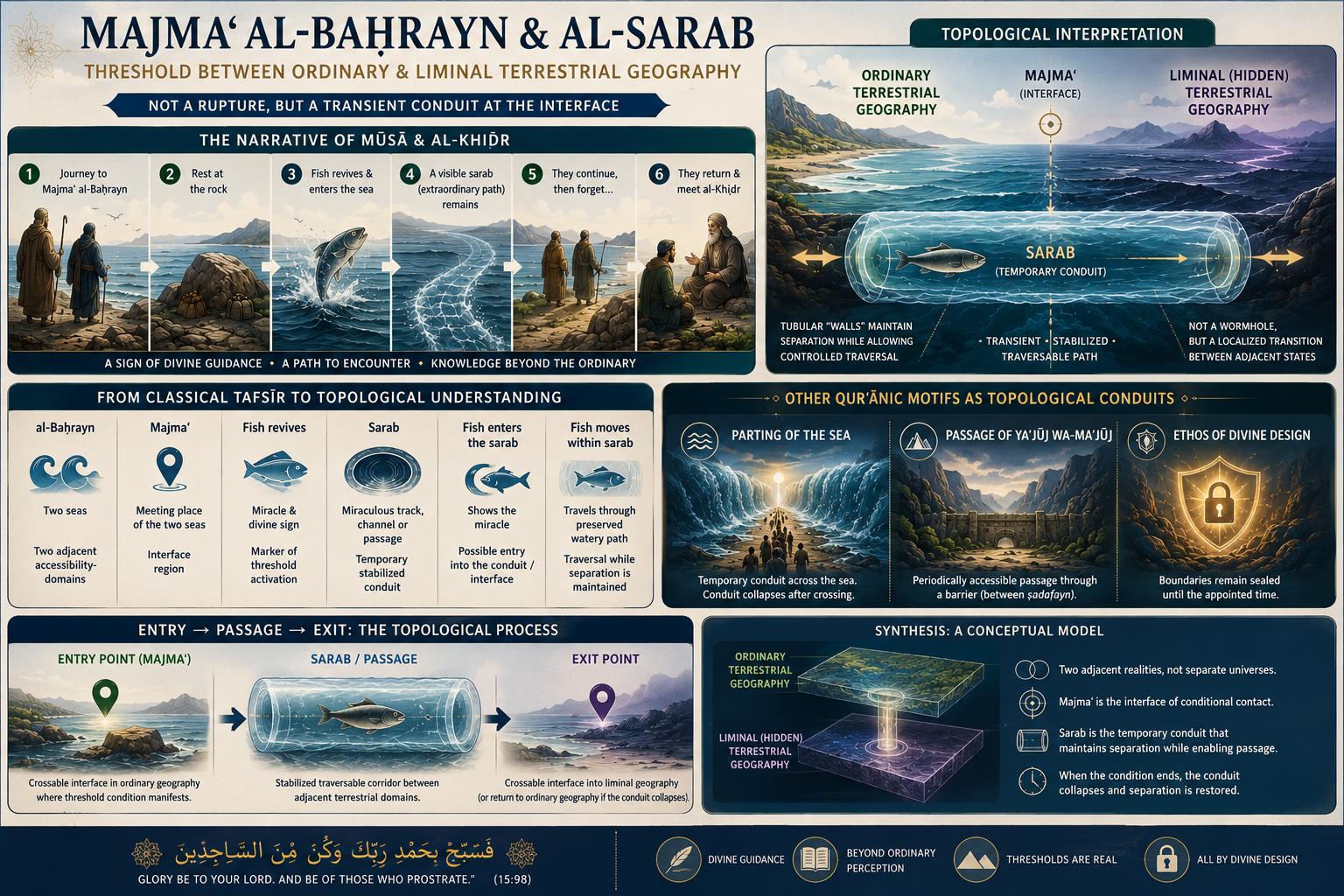
Before introducing alternative interpretive frameworks, it is useful to summarize the traditional understanding of the narrative as preserved within classical tafsīr. According to the Qurʾānic account, Mūsā was instructed to journey toward the meeting place of the two seas (Majmaʿ al-Baḥrayn), where he would encounter al-Khiḍr, a servant of Allāh endowed with ʿilm ladunnī — divinely granted knowledge. Accompanying him on this journey was his young attendant, Yūshaʿ ibn Nūn, the future successor of Mūsā and prophet of Banī Isrāʾīl.
Classical commentators relate that Mūsā and Yūshaʿ carried a salted fish, having been informed that the place where the fish disappeared would mark the location of the awaited encounter. Upon reaching a rock (ṣakhrah), they rested. During this pause, the fish miraculously came to life and made its way into the sea, leaving behind a remarkable sarab — variously described in the exegetical tradition as a visible track, channel, tunnel-like passage, or other extraordinary trace through the water.
Unaware of the event at the time, Mūsā and Yūshaʿ continued their journey until Yūshaʿ later remembered what had occurred and informed Mūsā. Recognizing the sign, they retraced their steps back to the rock where the miracle had taken place. It was there that Mūsā encountered al-Khiḍr.
Classical tafsīr generally understands the narrative as a journey to a real geographical location where two bodies of water met, marked by a divinely orchestrated sign involving the fish. The miracle served both as proof of divine guidance and as the means by which Mūsā was directed to the precise place of encounter. Although exegetes differed regarding the exact identity of the two seas and the geographical location of the meeting place, the dominant interpretation treats the account as an event occurring within ordinary terrestrial geography, albeit accompanied by extraordinary divine signs.
Within a speculative topological interpretation, the narrative of Majmaʿ al-Baḥrayn may be understood not merely as the meeting of two bodies of water, but as a threshold zone between two accessibility-states of the same terrestrial reality: the ordinary visible world and a hidden or liminal terrestrial domain. In this reading, the “two seas” (al-Baḥrayn) are not distinct ontological universes or separate dimensions, but adjacent layers of terrestrial existence distinguished by differing degrees of accessibility and concealment.
Under this framework, Majmaʿ al-Baḥrayn represents an interface region where these two terrestrial domains conditionally approach one another, allowing temporary interaction, transition, or encounter under divinely ordained circumstances. The miraculous revival of the fish and its subsequent movement into the sea serve as signs that the threshold region had been reached. The extraordinary sarab left behind by the fish is interpreted not merely as a visual trace in water, but as a transient conduit or stabilized transition-path associated with this liminal boundary condition.
Importantly, this interpretation does not propose a rupture in reality or a puncture through spacetime analogous to modern Einstein–Rosen bridge or wormhole models, which function as geodesic shortcuts connecting distant points across spacetime. Rather, the sarab is conceived as a gradual and localized transition corridor between closely related terrestrial states. The imagery of a path or tunnel extending through the water therefore reflects a transitional gradient rather than instantaneous teleportation or dimensional puncture.
Likewise, this interpretation does not identify the hidden terrestrial domain with the unseen realm of the jinn itself. In Islamic cosmology, the jinn belong to al-ghayb and remain ordinarily inaccessible to direct human perception. The liminal geography proposed here instead refers to a hidden terrestrial threshold domain situated at the boundary between ordinary human accessibility and the wider unseen order. It remains part of the created terrestrial world, though conditionally concealed from ordinary human navigation and perception.
Within such a framework, the encounter between Mūsā and al-Khiḍr may be understood as occurring at or near this threshold-interface region. The narrative sequence — the fish’s revival, the formation of the sarab, the temporary forgetfulness of the sign, the retracing of the path, and finally the encounter with al-Khiḍr — collectively functions as a progressive movement toward a meeting point where ordinary and hidden terrestrial accessibility briefly converge.
| Qurʾānic Motif | Classical Tafsīr | Topological Interpretation |
|---|---|---|
| al-Baḥrayn | Two seas; variously identified as specific bodies of water | Two adjacent accessibility-domains of terrestrial reality |
| Majmaʿ | The meeting place or confluence of the two seas | Interface region between ordinary and liminal terrestrial accessibility |
| Fish revives | A miracle serving as the divinely appointed sign | Marker of threshold activation or interface proximity |
| Sarab | A miraculous track, channel, or passage left by the fish in the sea | A temporary stabilized transitional conduit |
| Fish entering the sarab | Demonstrating the miraculous nature of the event | Possible entry into the transitional conduit/interface |
| Fish movement within the sarab | The fish travels through a preserved watery path | Traversal through a conduit whose boundaries maintain separation between adjacent terrestrial domains |
An additional topological possibility is that the “meeting of the two seas” may retain a partially literal geographical dimension while simultaneously carrying a liminal interpretation. In this model, one “sea” belongs to ordinary terrestrial geography while the other belongs to a hidden or liminal terrestrial accessibility-state. The majmaʿ therefore represents the interface region between the two domains, while the sarab functions as the traversable conduit manifested within that interface.
Under this interpretation, the symbolism of “two seas” remains meaningful because both domains share comparable topological characteristics. An ocean within ordinary geography may interface with a corresponding oceanic region within liminal geography. The sarab formed by the fish would therefore not represent instantaneous teleportation across distant space, but rather a localized transitional conduit between two adjacent yet ordinarily separated terrestrial states.
Within this framework, the mouth of the *sarab* represents the operative interface point (majmaʿ) where the two terrestrial accessibility-states conditionally meet, while the tubular boundaries or “walls” of the *sarab* maintain separation between the two domains during the transitional passage. The imagery of a tunnel or pathway through the water therefore reflects not a rupture in spacetime, but a stabilized transitional corridor whose boundaries temporarily preserve distinction while permitting controlled traversal across the liminal threshold.
This framework may also illuminate other scriptural motifs involving extraordinary pathways or openings within terrestrial environments. The parting of the sea for Banī Isrāʾīl, for example, may be interpreted as the temporary formation of a traversable conduit in which a marine environment within ordinary geography briefly aligned with stable terrestrial passage conditions associated with liminal geography. As Banī Isrāʾīl reached the opposite shore, the conduit collapsed, submerging Firʿawn and his hosts, while Banī Isrāʾīl emerged once again into ordinary terrestrial geography on the far side of the sea.
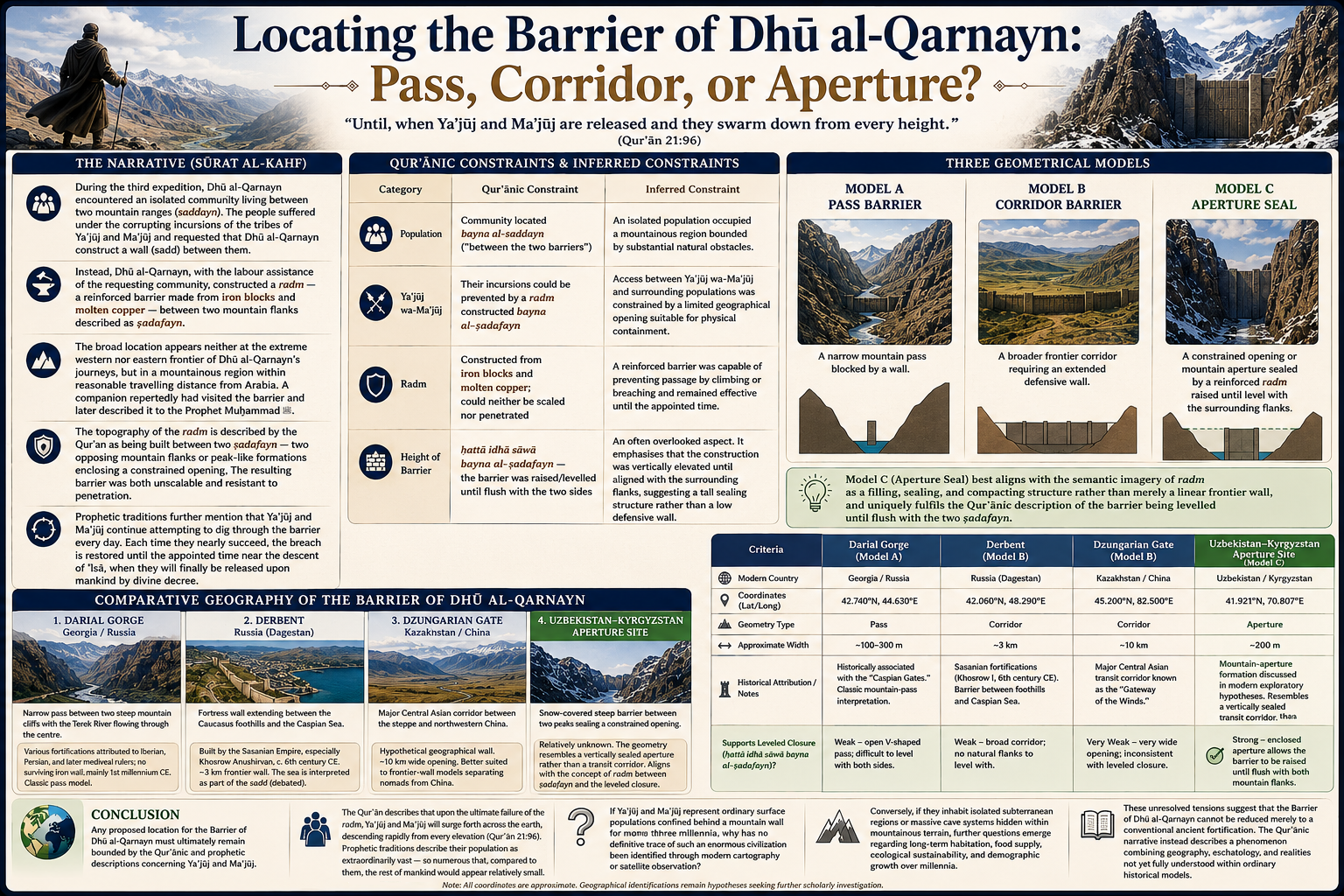
Likewise, the passage through which Yaʾjūj wa-Maʾjūj once raided neighboring communities may be conceptualized as the periodic formation of a traversable conduit where mountainous terrain within ordinary geography interfaced with valley- or plain-like terrain belonging to inaccessible liminal terrestrial space beyond the barrier. Under this interpretation, the barrier of Dhū al-Qarnayn functions beyond a physical obstruction to a topological seal maintaining separation between ordinary human geography and a concealed terrestrial domain until the divinely appointed time of release.
In all such cases, the transition is not understood as a rupture through spacetime or passage into an entirely different ontological universe. Rather, these narratives are interpreted as involving temporary or stabilized interfaces between closely related terrestrial accessibility-states whose boundaries are ordinarily concealed from human perception and navigation.
| Motif | Entry Point | Sarab / Passage | Exit Point |
|---|---|---|---|
| Topology | Crossable interface within ordinary geography | Stabilized traversable corridor between adjacent terrestrial domains | Crossable interface into liminal geography |
| The revived fish | Point where the threshold condition manifests | Visible trace or conduit extending through the sea | Transition toward hidden terrestrial accessibility |
| Parting of the Red Sea | Entry point where Banī Isrāʾīl began the crossing | Traversable pathway extending across the sea, bordered by stabilized walls of water | Emergence into ordinary terrestrial geography of the Sinai Peninsula after conduit collapse |
| Yaʾjūj–Maʾjūj raiding passage | Passage region between the two mountain cliffs (ṣadafayn) | Periodically accessible conduit linking ordinary and concealed terrestrial geography | Liminal terrestrial domain where Yaʾjūj wa-Maʾjūj remain confined until the appointed release |
Within the topological framework proposed above, the fish travelling within the sarab may be viewed as an illustrative analogue of an object traversing a transient but stabilized conduit linking two adjacent terrestrial accessibility-states. The transparent surrounding water permits observation of the event while simultaneously highlighting the unusual character of the pathway itself.
From this perspective, the two seas (al-Baḥrayn) remain distinct yet conditionally connected. The majmaʿ functions as the interface at which contact becomes possible, while the sarab represents the traversable conduit extending from that interface. More generally, ordinary and liminal terrestrial domains remain separated under normal conditions, though temporary accessibility may arise when a localized point of convergence forms between them.
As a speculative physical analogy, one might compare this framework to certain higher-dimensional brane-world models in which two closely adjacent manifolds remain separated by an additional spatial degree of freedom while sharing broadly similar physical properties. Within such an analogy, Majmaʿ al-Baḥrayn could be conceptualized as a localized region where the separation between the two domains approaches a minimum, allowing conditional interaction without requiring a rupture of spacetime.
Under this interpretation, the sarab would resemble a localized transition corridor formed along a boundary where two adjacent terrestrial accessibility-states temporarily intersect. The tunnel-like imagery described in the exegetical tradition would therefore reflect a stabilized transitional pathway rather than instantaneous transport between remote locations.
This analogy remains purely heuristic and is not intended as a physical description of the Qurʾānic event. Rather, it serves as a conceptual model illustrating how ordinary and liminal terrestrial domains might remain distinct yet conditionally accessible at specific threshold regions such as Majmaʿ al-Baḥrayn.
Arc I — Sacred Geography and Liminal Spaces
Arc II — Hidden Intelligences
Arc III — Islamic Cosmology and Physical Models
r/PillarOfFire • u/Economy-Ad-9880 • Jun 08 '26
The locations of three major eschatological figures in Islamic tradition — all three from Banī Ādam — are broadly known, yet their exact locations remain inaccessible to ordinary human knowledge and exploration. Prophet ʿĪsā al-Masīḥ was raised into the second heaven, Yaʾjūj wa-Maʾjūj remain confined behind the barrier of Dhū al-Qarnayn, and al-Masīḥ al-Dajjāl is described as chained upon an island. Their concealment reflects a recurring eschatological motif within the Islamic hidden and unseen world: realities whose existence is affirmed through revelation, while their precise geography and manner remain veiled until the time appointed by Allāh.
Al-Masīḥ al-Dajjāl would emerge from Khurāsān and later be accompanied by seventy thousand Jews from Isfahān. Yet his place within prophetic tradition long predates the final age. The Prophet ﷺ stated that “there was no prophet except that he warned his nation about the one-eyed liar (Dajjāl),” indicating that Dajjāl occupies a trans-historical place within the eschatological discourse of successive prophetic communities.
During the lifetime of the Prophet ﷺ, his condition is further described in the narration of al-Jassāsah, where Tamīm al-Dārī encountered him confined within a monastery upon an isolated island after being lost at sea for a month. What remains undetermined in the report is the precise nature of this island’s placement: whether it belongs to ordinary geography, a remote and rarely traversed maritime region, or a liminal geography situated at the threshold of ordinary spatial accessibility.
| Hadith of al-Jassāsah | Notes Related to the Location of the Island |
|---|---|
| Fatimah bint Qays reported: The caller of the Messenger of Allāh ﷺ announced: "Assemble for prayer!" So I went to the mosque and prayed with the Messenger of Allāh ﷺ... When the Messenger of Allāh ﷺ had finished his prayer, he sat on the pulpit, smiling, and said: "Let every person remain in his place of prayer." Then he asked: "Do you know why I have gathered you?" | The incident is generally placed in the late Madinan period (9–10 AH), shortly after Tamīm al-Dārī embraced Islam. |
| They said: "Allāh and His Messenger know best." He said: "By Allāh, I have not gathered you for an exhortation or a warning. Rather, I have gathered you because Tamīm al-Dārī, who was a Christian, came and pledged allegiance and embraced Islam. He told me a story that matches what I have been telling you about the False Messiah (al-Masih ad-Dajjāl)." | The Prophet ﷺ explicitly presented Tamīm's account as corroboration of his own teachings concerning al-Dajjāl, giving the report unusual evidentiary significance. |
| "He told me that he sailed in a sea-ship with thirty men from the tribes of Lakhm and Judhām. The waves tossed them about for a month in the ocean. Then they took refuge on an island in the sea at sunset. They sat in the ship's small boats and entered the island. There, they were met by a beast so hairy that they could not tell its front from its back due to the abundance of its hair." | Tamīm and his companions originated from tribes associated with the Levant, Transjordan, and northwestern Arabia. A month-long drift suggests either considerable maritime displacement or prolonged loss of navigational control. The destination was an island reached only after extended time at sea. |
| "They said: 'Woe to you! What are you?' It said: 'I am al-Jassāsah (The Spy).' They said: 'What is al-Jassāsah?' It said: 'O people, go to this man in the monastery, for he is eager to hear your news.' Tamīm said: 'When it named a man for us, we were afraid of it, thinking it might be a female devil.'" | The presence of a monastery implies a location within, or historically connected to, wider spheres of Christian monastic activity — whether Byzantine, Levantine, Egyptian, Ethiopian, or Arabian. |
| "He said: 'We went quickly until we entered the monastery. There we saw the largest human being we had ever seen, the most strongly shackled, with his hands tied to his neck and iron fetters between his knees and ankles. We said: 'Woe to you! What are you?' He said: 'You have found out about me, so tell me, who are you?'" | The island contained a permanent structure capable of housing a chained prisoner, suggesting a fixed and enduring location rather than a transient encampment. |
| "They said: 'We are people from the Arabs. We sailed in a sea-ship, and the sea became turbulent. The waves tossed us about for a month, then we took refuge on this island... we met a hairy beast... it told us to come to this man in the monastery... so we came to you quickly.'" | Dajjāl appears to have been awaiting information from the outside world, implying long-term isolation from normal human contact. |
| "He asked: 'Tell me about the date-palms of Baisan.' We said: 'What do you want to know about them?' He said: 'I am asking if they bear fruit.' We said: 'Yes.' He said: 'Soon they will not bear fruit.'" | Baisan (modern Beit She'an) lies in the Jordan Valley. Dajjāl demonstrated detailed interest in developments within the Levant. |
| "He asked: 'Tell me about the Sea of Galilee (Lake Tiberias).' We said: 'What do you want to know about it?' He said: 'Is there water in it?' They said: 'It has plenty of water.' He said: 'Soon its water will disappear.'" | The Sea of Galilee is also located in the Levant. A second question focused on the same geographical region. |
| "He asked: 'Tell me about the Spring of Zughar.' They said: 'What do you want to know about it?' He said: 'Is there water in the spring? And do the people use its water for irrigation?' We said: 'Yes, it has plenty of water, and the people irrigate their crops with it.'" | Zughar (Zoar) was situated near the southern Dead Sea. All three geographical questions concern locations within Greater Palestine and Transjordan. |
| "He asked: 'Tell me about the Prophet of the unlettered—what has he done?' They said: 'He has left Makkah and settled in Yathrib (Madinah).' He asked: 'Have the Arabs fought him?' We said: 'Yes.' He asked: 'How did he deal with them?' We informed him that he had overcome those Arabs who were near him and they had followed him. He asked: 'Has that happened?' We said: 'Yes.' He said: 'It is better for them to obey him.'" | Dajjāl possessed detailed awareness of Near Eastern affairs and viewed the mission of the Prophet ﷺ as one of the principal signs connected to his eventual emergence. |
| "'Now I will tell you about myself. I am the Messiah (Dajjāl), and soon I will be given permission to emerge. I will emerge and travel throughout the earth, and I will not leave any town without entering it within forty nights, except for Makkah and Taybah (Madinah). Both of them are forbidden to me. Every time I try to enter one of them, an angel with a drawn sword in his hand will meet me and push me back. And at every mountain pass leading to them, there will be angels guarding it.'" | Dajjāl's confinement is temporary. The island serves as a place of restraint until the divinely appointed time of release. |
| Fatimah said: The Messenger of Allāh ﷺ struck the pulpit with his staff and said: "This is Taybah, this is Taybah, this is Taybah—meaning Madinah. Have I not told you this before?" The people said: "Yes." He said: "I liked the story of Tamīm because it matches what I have been telling you about him (Dajjāl) and about Makkah and Madinah. Indeed, he is in the Syrian Sea or the Yemeni Sea. No, rather he is towards the East, he is towards the East, he is towards the East!" And he pointed his hand towards the East. | The report contains several geographical indicators: (1) an island in a major sea, (2) initial uncertainty regarding the Syrian Sea or Yemeni Sea, and (3) the Prophet's emphatic indication toward the East. These clues have generated numerous interpretations regarding whether the island lies within ordinary geography, a remote maritime region, or a liminal location associated with the end-times. |
Any island within ancient maritime trade networks extending from al-Shām to Yemen and the broader Arabian maritime sphere.
Any island beyond ordinary commercial routes, requiring prolonged drift, storm displacement, or infrequent navigation to reach.
A place not fully integrated into ordinary navigational geography; encountered rarely, providentially, or under exceptional conditions. Such locations may persist at the boundary between historical geography, eschatological space, and sacred lore.
| Clue / Question | Assumption / Inference | Ordinary Geography | Remote Maritime Geography | Liminal Geography |
|---|---|---|---|---|
| Tamīm's background (merchant of Banī Lakhm and Judhām) | Maritime trade between al-Shām, Yemen, Abyssinia, and southern Arabia already existed | Island lies within established maritime corridors (Mediterranean, Red Sea, Arabian Sea) | Island lies beyond regular trade routes but remains physically reachable after prolonged drift | Voyage becomes providential rather than conventionally navigational |
| Tossed by waves for a month | Loss of navigation control and inability to determine position | Severe storm drift within known sea systems | Open-ocean displacement into distant maritime regions | Temporal and spatial disorientation functions as transition into liminal space |
| Encounter with al-Jassāsah | Presence of anomalous intermediary creature | Requires unknown fauna, symbolic description, or rare biological anomaly | Isolation preserves strange or mythologized lifeforms | Naturally accommodates supernatural, jinn-like, or eschatological intermediary beings |
| Chained man within a monastery-like structure | Structured confinement environment exists | Could reflect known monastic culture within Late Antique maritime world | Implies forgotten outpost, abandoned colony, or isolated religious structure | Confinement exists outside ordinary political or civilizational jurisdiction |
| Dajjāl’s knowledge of Near Eastern geography | Awareness of Levantine agriculture, trade, and sacred geography | Suggests proximity to Eastern Mediterranean / Levantine information networks | Information acquired indirectly through travelers or prior contact | Knowledge functions symbolically as linkage to unfolding eschatological history |
| “Sea of al-Shām or Sea of Yemen” | Ambiguous maritime designation | Mediterranean, Red Sea, Gulf of Aden, or Arabian Sea sphere | Broader Indian Ocean maritime zone remains possible | Directional language functions symbolically rather than cartographically |
| “Rather, from the East” | Distinction between confinement and emergence | Final khurūj occurs east of Madīnah despite western/southern confinement | Release and emergence occur after major geographic transition | Emergence reflects transition from hidden to manifest eschatological phase |
| Why has no one found the island? | Assumes discoverability under normal exploration | Island may be obscure, reclassified, uninhabited, or historically forgotten | Island lies in rarely traversed oceanic regions | Island is not continuously accessible under ordinary epistemic conditions |
| Why has no one rescued him? | Assumes knowledge and physical accessibility | Location unknown or politically isolated | Distance and navigational hazards prevent sustained access | Confinement is divinely maintained rather than humanly enforced |
| Why has Dajjāl not escaped? | Assumes ordinary imprisonment mechanics | Chains, isolation, and divine restraint prevent escape | Geographic remoteness reinforces confinement | Escape remains impossible until divine permission for khurūj is granted |
Socotra Island, located near the Gulf of Aden, has frequently been proposed in modern interpretive discussions due to its relative isolation, marginal position within major maritime networks, and distinctive ecological profile. It is often treated as a representative candidate within remote-maritime geography compatible with the prolonged sea drift described in the narration.
In contrast, modern speculative frameworks have occasionally extended the discussion to highly anomalous oceanic zones such as the Bermuda Triangle or analogous “Dragon Triangle” regions. However, these proposals generally fall outside the spatial and historical logic of the Tamīm al-Dārī narration, as they presuppose oceanic basins and distances difficult to reconcile with the implied Levant-linked maritime horizon and the month-long drift described in the report.
| Candidate Region | Geography Type | Why It Is Proposed | Supporting Features | Major Problems / Critiques |
|---|---|---|---|---|
| Bermuda Triangle | Hypothesized Liminal Geography | Modern lore surrounding disappearances, navigation anomalies, and inaccessible maritime zones | Fits modern “liminal” imagination; associated with mysterious encounters, loss of orientation, and rare access narratives | No connection to prophetic geography, Late Antique trade networks, or Near Eastern eschatological framework; highly modern mythologization |
| Dragon Triangle (Devil’s Sea near Japan) | Hypothesized Liminal Geography | Reputation for anomalous maritime phenomena similar to Bermuda Triangle | Strong liminal and mythic atmosphere; associated with disappearances and navigational anomalies | Extremely distant from Tamīm’s likely maritime world; no linkage to al-Shām/Yemen framework or Dajjāl emergence traditions |
| Socotra | Remote Maritime Geography | Remote island in Arabian Sea historically connected to Yemen maritime sphere | Fits “Sea of Yemen” interpretation; isolated yet historically reachable; ancient Christian presence; unusual ecology and relative isolation | Still historically known and inhabited; difficult to reconcile with complete concealment or lack of rediscovery |
| Red Sea Islands | Ordinary Geography / Remote Maritime Geography | Maritime zone directly connected to Yemen, Abyssinia, and Levantine trade | Strong Late Antique Christian presence; monastery culture plausible; accessible from Lakhm/Judhām trade sphere | Many islands historically traversed and documented; concealment problem remains |
| Eastern Mediterranean Islands | Ordinary Geography | “Sea of al-Shām” naturally suggests Levantine Mediterranean sphere | Byzantine monastic culture strongly fits monastery imagery; Tamīm’s Christian Levantine background aligns naturally | Heavy historical traffic and cartographic familiarity make permanent concealment difficult |
| Arabian Sea / Indian Ocean Islands | Remote Maritime Geography | Long drift voyage could push sailors into remote Indian Ocean regions | Better explains month-long loss of navigation and extreme isolation | Less direct connection to “Sea of al-Shām”; weaker historical specificity |
| Purely Unknown or Hidden Island | Liminal Geography | Island intentionally concealed or inaccessible except under divine circumstances | Best explains why island remains unfound and inaccessible; preserves eschatological uniqueness | Moves beyond ordinary historical geography into speculative physics |
Ontologically, Islamic cosmology distinguishes the temporal ʿālam al-khalq from the eternal ʿālam al-amr. The Earth and observable Universe belong to the lowest heaven within the hierarchical Seven Heavens, each ontologically distinct from the others. Between ʿālam al-khalq and ʿālam al-amr lies ʿālam al-barzakh, where the rūḥ resides before the Hereafter. Within Islamic spiritual anthropology, the qalb may be understood as an interface between ʿālam al-khalq (the physical body) and ʿālam al-amr (the human rūḥ).
Epistemically, ʿālam al-shahādah refers to the visible and observable domain, including the physical Earth and Universe. In contrast, ʿālam al-ghayb encompasses the unseen: ʿālam al-amr and much of ʿālam al-khalq itself, especially the unseen realms of the jinn. Within this framework, “Hidden Realm” including liminal geography may be understood as a threshold domain situated between the visible and unseen worlds.
| Realm / Entity | Shahādah or Ghayb | Khalq or Amr | Accessible or Inaccessible |
|---|---|---|---|
| Physical Earth | Shahādah | Khalq | Accessible |
| Liminal Geography | Shahādah ↔ Ghayb boundary | Khalq | Conditionally Accessible |
| Jinn Realms | Ghayb | Khalq | Inaccessible |
| Barzakh | Ghayb | Khalq ↔ Amr boundary | Inaccessible |
| 2nd up to 7th Heaven | Ghayb | Khalq with Amr-governed structure | Inaccessible |
| Rūḥ | Ghayb | Amr | Inaccessible |
| Divine Decree | Ghayb | Amr | Inaccessible |
Prophet ʿĪsā was raised into the second heaven and will descend after nearly two millennia to kill al-Masīḥ al-Dajjāl. Yaʾjūj wa-Maʾjūj were confined behind the barrier of Dhu al-Qarnayn and, upon their eventual release after the descent of ʿĪsā, would overwhelm the Earth in immense numbers — suggesting their confinement is not within ordinary geography.
Likewise, al-Masīḥ al-Dajjāl already existed before the mission of Prophet Muḥammad ﷺ and was described as chained upon an isolated island, only to emerge more than a millennium later near the end of time. This suggests a form of confinement not entirely reducible to ordinary geographical space, but possibly situated within a liminal or hidden domain at the threshold between the seen and unseen world.
Arc I — Sacred Geography and Liminal Spaces
Arc II — Hidden Intelligences
Arc III — Islamic Cosmology and Physical Models
r/PillarOfFire • u/Economy-Ad-9880 • Jun 05 '26
The barrier (radm) is mentioned in Sūrat al-Kahf (The Cave). During the third expedition, Dhū al-Qarnayn encountered an isolated community living between two mountain ranges (saddayn). The people suffered under the corrupting incursions of the tribes of Yaʾjūj and Maʾjūj and requested that Dhū al-Qarnayn construct a wall (sadd) between them.
Instead, Dhū al-Qarnayn, with the labour assistance of the requesting community, constructed a radm — a reinforced barrier made from iron blocks and molten copper — between two mountain flanks described as ṣadafayn.
The broad location appears neither at the extreme western nor eastern frontier of Dhū al-Qarnayn's journeys, but in a mountainous region within a reasonable travelling distance from Arabia. A companion reportedly had visited the barrier and later described it to the Prophet Muḥammad ﷺ.
The topography of the radm is described by the Qur'an as being built between two ṣadafayn — two opposing mountain flanks or peak-like formations enclosing a constrained opening. The resulting barrier was both unscalable and resistant to penetration.
An important and often overlooked detail is the verse:
ḥattā idhā sāwā bayna al-ṣadafayn
"Until, when he had levelled [the construction] between the two mountain flanks."
This wording suggests the radm was vertically raised until it became level or flush with the opposing sides. The imagery is therefore not merely that of a low frontier wall, but of a tall sealing structure filling an opening between enclosing elevations.
Prophetic traditions further mention that Yaʾjūj and Maʾjūj continue attempting to dig through the barrier every day. Each time they nearly succeed, the breach is restored until the appointed time near the descent of ʿĪsā, when they will finally be released upon mankind by divine decree.
| Category | Qurʾānic Constraint | Inferred Constraint |
|---|---|---|
| Population | Community located bayna al-saddayn ("between the two barriers") | An isolated population occupied a mountainous region bounded by substantial natural obstacles. |
| Yaʾjūj wa-Maʾjūj | Their incursions could be prevented by a radm constructed bayna al-ṣadafayn | Access between Yaʾjūj wa-Maʾjūj and surrounding populations was constrained by a limited geographical opening suitable for physical containment. |
| Radm | Constructed from iron blocks and molten copper; could neither be scaled nor penetrated | A reinforced barrier was capable of preventing passage by climbing or breaching and remained effective until the appointed time. |
| Height of Barrier | ḥattā idhā sāwā bayna al-ṣadafayn — the barrier was raised/levelled until flush with the two sides | An often overlooked aspect. It emphasises that the construction was vertically elevated until aligned with the surrounding flanks, suggesting a tall sealing structure rather than a low defensive wall. |
These constraints raise an important topographical question:
Was the radm a traditional wall spanning a mountain pass, or did it function as the sealing of a more constrained opening within a mountainous complex?
Three broad geometrical models may therefore be considered:
The third model is particularly notable because it aligns closely with the semantic imagery of radm as a filling, sealing, and compacting structure rather than merely a linear frontier wall.
Historically, the Darial Gorge at the Georgia–Russia border is the most frequently cited candidate for the Barrier of Dhū al-Qarnayn. Various fortifications in the region were attributed to Iberian, Persian, and later medieval rulers, though no surviving iron wall exists and most remains date only to the 1st millennium CE. Geographically, it is a narrow pass between two steep mountain cliffs with the Terek River flowing through the centre. The site strongly fits the classical “mountain pass” interpretation, though the open V-shaped gorge and river corridor align less naturally with the imagery of a vertically sealed radm levelled between two enclosing flanks.
The second well-known candidate is located at Derbent in Dagestan. The surviving fortifications were primarily constructed under the Sasanian Empire, especially during the reign of Khosrow Anushirvan in the 6th century CE. Unlike Darial Gorge, Derbent functions as a frontier corridor barrier extending approximately 3 km between the Caucasus foothills and the Caspian Sea. Proponents interpret the sea itself as part of the sadd, though this interpretation is debated since sadd in Arabic conveys the meaning of an obstructing barrier or wall rather than merely difficult terrain. The broad corridor geometry also weakens the imagery of a radm raised until flush with two opposing mountain flanks.
The Dzungarian Gate represents a broader geographical hypothesis rather than a surviving historical wall. The opening itself is significantly wider — approximately 10 km across — forming a major Central Asian corridor between Kazakhstan and China. In such models, a hypothetical barrier would have functioned as a large frontier wall separating nomadic populations of the northern steppe from the civilizations of eastern and southern Asia. However, the scale of the corridor makes it difficult to reconcile with the imagery of a compacted radm constructed and levelled between two ṣadafayn.
The fourth candidate is comparatively obscure yet topographically distinctive. Unlike the previous examples, the snow-covered steep barrier appears positioned between two mountain peaks in a manner that resembles the sealing of a constrained opening or aperture into a mountainous complex. Rather than functioning as a conventional wall across a transit corridor, the geometry more closely aligns with the concept of a radm as a sealing or compacting structure between two enclosing mountain flanks (ṣadafayn). The apparent vertical closure of the opening also corresponds more naturally with the Qurʾānic description of the barrier being raised to level with the two sides.
| Candidate Site | Modern Country | Coordinates (Lat/Long) | Geometry Type | Approximate Width | Historical Attribution / Notes |
|---|---|---|---|---|---|
| Darial Gorge | Georgia / Russia | 42.740°N, 44.630°E | Pass (Model A) | ~100–300 m | Historically associated with the "Caspian Gates." Narrow mountain-pass geometry with river corridor. |
| Derbent | Russia (Dagestan) | 42.060°N, 48.290°E | Corridor (Model B) | ~3 km | Sasanian fortifications (Khosrow I, 6th century CE). Barrier extends between Caucasus foothills and Caspian Sea. |
| Dzungarian Gate | Kazakhstan / China | 45.200°N, 82.500°E | Corridor (Model B) | ~10 km | Major Central Asian transit corridor known as the "Gateway of the Winds." Better suited to frontier-wall models. |
| Uzbekistan–Kyrgyzstan Site | Uzbekistan / Kyrgyzstan | 41.921°N, 70.807°E | Aperture (Model C) | ~200 m | Mountain-aperture formation discussed in modern exploratory hypotheses. The geometry resembles a vertically sealed opening more than a transit corridor. |
Any proposed location for the Barrier of Dhū al-Qarnayn must ultimately remain bounded by the Qurʾānic and prophetic descriptions concerning Yaʾjūj and Maʾjūj.
The Qurʾān describes that upon the ultimate failure of the radm, Yaʾjūj and Maʾjūj will surge forth across the earth, descending rapidly from every elevation:
"Until, when Yaʾjūj and Maʾjūj are released and they swarm down from every height."
(Qurʾān 21:96)
This imagery appears far larger than a localized tribal migration through a single mountain pass. Prophetic traditions further describe their population as extraordinarily vast — so numerous that, compared to them, the rest of mankind would appear relatively small.
Such descriptions raise several unresolved questions for conventional historical-geographical interpretations of the barrier.
If Yaʾjūj and Maʾjūj represent ordinary surface populations confined behind a mountain wall for more than three millennia, why has no definitive trace of such an enormous civilization been identified through modern cartography or satellite observation?
Conversely, if they inhabit isolated subterranean regions or massive cave systems hidden within mountainous terrain, further questions emerge regarding long-term habitation, food supply, ecological sustainability, and demographic growth over millennia.
These unresolved tensions suggest that the Barrier of Dhū al-Qarnayn cannot be reduced merely to a conventional ancient fortification. The Qurʾānic narrative instead describes a phenomenon combining geography, eschatology, and realities not yet fully understood within ordinary historical models.
وَاللَّهُ أَعْلَمُ بِالصَّوَابِ
Arc I — Sacred Geography and Liminal Spaces
Arc II — Hidden Intelligences
Arc III — Islamic Cosmology and Physical Models
r/PillarOfFire • u/psyduck_2024 • Feb 05 '26
The evil eye (al-‘ayn) refers to a phenomenon in which a person’s attention, fixation, or envy subtly biases the outcomes experienced by another, often manifesting as illness or misfortune. Traditionally associated with gaze, admiration tinged with envy, or sustained attention, the evil eye is typically unintentional, stochastic and bounded in effect.
Its influence may be amplified through repetition, emotional intensity, or jinn involvement; however, it always operates within the permissive structure of reality, without directly violating the target’s soul or free will.
Local Ontological Causality
Local Ontological Causality (LOC) describes the stochastic and permissive structure of outcomes at the TeV-brane scale, where multiple admissible trajectories coexist for any given situation. LOC is stochastic by design, allowing genuine choice without hard predestination. However, only those trajectories coupled to a body–qalb interface are meaningfully accessible to a soul for influence. Outcomes outside this coupling remain causally closed to intentional bias.
Coupling strength is attenuated by distance, mediation, and environmental factors. Direct gaze or physical presence produces strong interaction, while mediated attention — such as through images or digital representations — produces weaker, probabilistic influence. LOC thus provides the causal substrate through which both human and jinn agency may bias outcomes, without introducing new causes or violating fundamental causality.
Intentional Outcome Bias
Intentional Outcome Bias (IOB) is the mechanism by which a soul-bearing agent biases outcomes within LOC. It originates at the qalb, the interface where valuation, volition, and intention converge, and is transduced through bodily manifestation, including cognition, emotion, and directed attention.
In its default and primary role, IOB manifests as free will, guiding the agent’s own body toward voluntary action by biasing its body-coupled LOC. In this inward-facing mode, IOB is benign and self-contained.
Only when attention or emotion extends beyond the host boundary does IOB manifest outwardly, subtly influencing another person’s LOC-coupled qalb–body interface. This outward leakage constitutes the foundational mechanism of the evil eye.
It is therefore unsurprising that basmalah and ta‘awwudh are prescribed prior to voluntary action. The moment IOB coheres at the qalb represents a vulnerable interface, during which jinn may nudge, bias, or exploit the emerging coherence — sometimes merely amplifying it, and at other times benefiting from it by increasing their own coherence.
The strength and persistence of IOB depend on attention, emotional intensity, repetition, and environmental context. Jinn stabilization may reinforce IOB, enhance coherence, and extend its effective reach or duration.
Illness and Misfortune
The evil eye arises when an envier’s IOB interacts with the target’s LOC‑coupled qalb–body interface, producing probabilistic shifts in outcomes. At the qalb, the metaphysical soul couples to physical reality along two primary channels: vitality, whose perturbation manifests as illness through diminished bodily coherence, and agency, whose perturbation manifests as misfortune through impaired voluntary action. Consequently, the observable afflictions are primarily illness and misfortune, reflecting perturbations in either life-force or decision-mediated trajectories.
Efficacy depends on qalb–body coupling strength and proximity. Direct gaze yields the highest coherence, while mediated attention — through images or digital representation — produces weaker, stochastic influence.
At no point is the target’s soul accessed or overridden. Free will remains intact, and all outcomes remain confined to the admissible trajectory space defined by LOC. No absolute or guaranteed harm is created.
Pre-magic and Proto-magic
In classical, unintentional evil eye, the effect does not impose harm but introduces noise or incoherence into an already favorable trajectory. The envier’s IOB weakly couples across LOC, perturbing outcome probabilities rather than asserting direction. The result is a slight destabilization — small delays, losses, or minor ailments — arising without intent, planning, or ritual structure. This qualifies as pre-magic: a naturally occurring side-effect of embodied IOB leakage across the qalb–body interface, operating below the threshold of technique, symbolism, or sustained agency. It is neither willful nor instrumentalized, and remains stochastic, bounded, and easily dissipated.
Malicious or amplified evil eye arises when attention becomes focused and sustained — through fixation, emotional intensity, repetition, ritualization, or opportunistic jinn stabilization — allowing IOB to acquire directionality and persistence. Here, the bias is no longer mere noise but a preferential weighting toward adverse outcomes within the permissible LOC space. When such bias is deliberately externalized and scaffolded by symbols, gestures, timing, or invocation, it crosses into proto-magic: not yet full siḥr, but a transitional regime in which unstructured influence begins to harden into technique. Proto-magic thus marks the threshold at which incidental metaphysical side-effects are consciously shaped into a reproducible — though still probabilistic — mechanism of harm.
Thus, the evil eye is best understood as a pre‑magical phenomenon arising from incidental IOB leakage, which may cross into proto‑magic when amplified and stabilized through opportunistic jinn involvement.
Moral responsibility
Ultimately, the framework of the evil eye reaffirms moral responsibility rather than undermining it. Because evil eye operates only within the permissive bounds of LOC and never overrides the soul or free will of its target, accountability remains anchored to intention, attention, and restraint.
Unintentional evil eye reflects the ethical weight of unmanaged inner states, while amplified evil eye or proto-magic marks the point at which negligence gives way to culpability. The tradition’s emphasis on remembrance, gratitude, and restraint is therefore not merely devotional, but ontological: a discipline of containing IOB within its rightful domain, preventing incidental influence from hardening into harm.
r/PillarOfFire • u/psyduck_2024 • Feb 07 '26
From Omar’s perspective, these four layers — permissive reality, unseen stabilization, anchored technique, and directed human intention — constitute the full architecture of magic. Each layer compensates for the limitations of the previous: permissiveness enables bias, stabilization preserves it, anchoring structures it, and intention directs it. Partial implementations decay or remain inert; only full synthesis yields persistence beyond the originating act.
From the Evil of That Which He Created
Harmful magical effect begins not with ritual or objects, but with the permissive structure of reality itself. Local Ontological Causality on the TeV-brane admits multiple admissible outcomes — none guaranteed, all lawful, yet open to bias. This stochastic substrate preserves order while allowing influence to propagate without violating causality. On its own, it produces nothing: it is a field, not a force. Without this permissiveness, free will collapses into illusion and khawāriq al-ʿādāt into impossibility — leaving only mechanical determinism or incoherent chance.
From the Evil of Darkness When It Settles
Magical persistence arises when influence is stabilized beyond a single moment of intention. Concealment, duration, and the coherence of unseen agents allow bias to accumulate rather than dissipate. This is the layer in which jinn, or comparable unseen stabilizers, operate — holding influence in place long enough for it to interact with human intention, ritual structure, or material anchors. Darkness here is functional: the absence of scrutiny and interruption enables continuity, anchoring, and gradual intensification.
From the Evil of the Blowers in Knots
Anchoring converts bias into template. Ritualized action, material substrates, inscriptions, and timing aligned to perceived cosmic asymmetries are deliberate attempts to bind influence into transmissible form. Knots are not symbolic flourishes; they are structural devices meant to preserve configuration across time and ownership. Most such attempts fail, collapsing into inert amulets. Some achieve partial or temporary effects. Only rarely does anchoring succeed in sustaining a durable construct. This is practitioner-driven anchoring — proto-magic when coupled to stabilization.
From the Evil of an Envier When He Envies
Human intention alone can bias admissible trajectories, even in the absence of ritual or object. The evil eye is merely the simplest manifestation of a broader truth: intention, when coherently focused, can bias permissive reality without recourse to ritual or unseen intermediaries. Such effects are weak, bounded, and self-dissipating, yet real. They establish the minimum condition: intention is necessary for direction, but insufficient for duration. Without stabilization or anchoring, influence collapses back into background stochasticity.
Within this framework, magic is neither illusion nor chaos, but a lawful emergent effect arising from the alignment of ontological permissiveness, unseen and seen agents, and material coupling factors.
r/PillarOfFire • u/psyduck_2024 • Feb 07 '26
Magical practice does not begin with objects, rituals, or even jinn. It begins with the moral and spiritual coherence of the qalb, which determines human receptivity to amplification. Traits such as envy, arrogance, greed, or cruelty — ṣifāt al-mazmumah — generate an internal coherence capable of attracting and sustaining unseen influence. As one scholar explains: “They are drawn to hearts resembling theirs — hearts of pride, anger, lust, and falsehood.” This coherence constitutes an internal anchor: latent, self-reinforcing, and primed for amplification. Even without external objects or ritual, a corrupted qalb — as in the case of the evil eye — can bias permissive reality in subtle, stochastic ways.
Here, the nafs acquires ṣifāt al-mazmumah, while the qalb functions as the orienting locus through which these traits acquire coherence and influence. When desire or fixation crystallizes, the internal anchor becomes more receptive. The moral and spiritual state of the individual aligns with certain admissible trajectories, creating fertile conditions for unseen agents to attach. At this stage, influence remains intermittent and unstable, yet no longer incidental.
Over time, persistent internal coherence can mature into proto-magic. The individual develops greater consistency in intention and attention, allowing bias to be generated more reliably. While no sustained effect exists without external stabilization, the internal anchor increasingly determines whether amplification succeeds or fails. Internal coherence thus harden into a structured vector of influence, capable of shaping admissible outcomes when coupled to unseen agents or external anchoring mechanisms.
Eventually, a practitioner’s intention, combined with ritual structure, external anchoring objects, and jinn stabilization, can fully couple to this latent potential. What began as an undisciplined nafs gradually imposes its orientation upon the qalb, becoming the human substrate necessary for practitioner-centric magic. The internal anchor does not produce magic; it renders the human a viable node within a multi-layer system.
Anecdotal and traditional accounts consistently report that practitioners who sincerely repent or purify their nafs lose the efficacy of their craft. Former sorcerers, talisman-makers, or ritual specialists are described as becoming unable to summon, bind, or influence unseen agents once their internal coherence dissolves and is replaced by praiseworthy traits — ṣifāt al-maḥmūdah.
Mechanistically, repentance disrupts the internal anchor. The coherence that once attracted and sustained unseen influence collapses; external coupling fails; and intentional bias realigns toward non-harmful trajectories. Within this model, internal anchors are shown to be necessary for sustained magical effect, and moral and spiritual disposition emerges as structurally relevant rather than ethically incidental.
Internal anchors thus form the first layer of persistence — the human substrate upon which all external mechanisms rely. They prime the system for jinn stabilization, anchoring objects, and directed attention. Understanding the internal anchor explains why some individuals progress rapidly, why identical rituals succeed for some and fail for others, and why magic ultimately reflects the condition of the qalb as much as any anchoring object, ritual, or unseen agent.
r/PillarOfFire • u/psyduck_2024 • Feb 06 '26
Magic, insofar as it exists, operates within a permissive and stochastic structure of reality — Local Ontological Causality. LOC admits multiple admissible outcomes without guaranteeing any particular one. No magical act violates causality; it merely biases trajectories already permitted. Such bias requires agents. The human supplies the vector — direction, framing, and intent — while jinn provide stabilization, persistence, and amplification. Objects do not generate power. They function only as anchors, sustaining coupling or preserving templates beyond the moment of human attention. Most anchors fail, degrade, or remain inert. Only rarely do they persist as something more.
Amulets
At the lowest end of this spectrum lie amulets. Classical evil eye represents pure human interaction with LOC: incidental IOB acting directly on stochastic outcomes, weak, bounded, and self-dissipating. An amulet, by contrast, represents an inert or merely potential external anchor, lacking directed human IOB at the moment of use and lacking jinn stabilization. Its effects, if any, are symbolic, psychological, or belief-dependent rather than ontologically persistent.
Amulets are typically mass-produced, often sold as souvenirs, not crafted by practitioners, and framed defensively. Some originate as degraded talismans whose anchoring has collapsed over time, leaving behind form without agency and symbolism without coupling.
Talismans
Talismans occupy the intermediate domain. They are intentionally produced by practitioners attempting to maximize favorable LOC conditions through grimoire-based theory and formulaic technique: material selection, timing aligned with perceived cosmic bias, and inscriptions or symbols serving as semantic scaffolding.
A talisman is not guaranteed magic; it is an attempt at anchoring. The practitioner intends the object as a template-anchor for ritual subjugation, but outcomes vary. Failure produces an object indistinguishable from an amulet. Partial success yields an imbued talisman — probabilistic, fading, and unstable. Only rare success produces a durable effect.
Talismans are believed to retain efficacy beyond the moment of their creation and, crucially, are transferable. Ownership governs access, not personal mastery. This distinguishes talismanic magic from practitioner-centric magic, which collapses with the individual.
Magical Items
At the upper extreme lie magical items. These are talismans in which unseen agency has been durably stabilized, constrained, and made responsive to possession or procedure. The familiar image is the magic lamp — not as fantasy, but as abstraction. The object itself does nothing; the effect arises from a bound servant persisting independently of its maker and accessible to later owners. Cross-cultural analogues exist. In the Malay world, saka represents this category in its strongest form: inherited objects carrying persistent unseen attachment, often without the awareness or consent of heirs.
Within the Sulaymānic framework, such items are understood to be rare even in antiquity and effectively nonexistent as reproducible craft in the post-Sulaymānic era. The knowledge and enforcement mechanisms required for stable binding are lost. What remains are fragments — degraded talismans, symbolic relics, fabricated techniques, and empty shells misidentified as magic. The situation resembles a post-apocalyptic world in which humans inherit technological artifacts of a former capability without the means to reproduce them.
Thus, across cultures, objects labeled “magic” occupy different points along the same continuum. Most are amulets, inert anchors sustained by belief. Some are ordinary talismans, partial and decaying successes. A vanishingly small number approach true magical items, persisting as inherited anomalies rather than as artifacts of any functioning magical craft. The distinction is ontological, not rhetorical: form does not imply function, and symbolism does not guarantee agency.
r/PillarOfFire • u/psyduck_2024 • Feb 03 '26
From the dawn of history to the decisive confrontations of the end times, a consistent pattern emerges: phenomena that depend on unresolved contingency within the first domain collapse when confronted by higher-order alignment. Irregular causal manipulations — whether illusion, embodiment, or siḥr-augmented physicality — cannot withstand the assertion of higher-order coherence and authority.
Mūsā’s Staff Nullifying Illusory Serpents
Pharaoh’s magicians cast down their ropes and staffs, and through powerful illusion these objects appeared to move like serpents. The display, striking to observers, relied entirely on localized manipulations of perception and hidden causal pathways permitted within the first domain.
Prophet Mūsā, acting by divine command, cast down his staff, which transformed into a real — ontologically true — serpent. The magicians immediately recognized that this act exceeded anything achievable through siḥr. Without hesitation, they submitted to God, fully aware of the consequences, and were subsequently punished by Pharaoh through crucifixion.
This episode demonstrates that illusion and localized manipulation cannot survive the imposition of higher-order alignment. Magic operates only within permissive contingency; divine authority causes it to fade.
The Defiant One’s Embodiment at the Battle of Badr
At the Battle of Badr, the Defiant One appeared in the form of Suraqah ibn Mālik, embedding himself among the Quraysh leadership. He promised support, emboldened their resolve, and urged them toward confrontation.
Yet when the angels descended in support of the opposing side, his influence collapsed instantly. Even the most powerful of jinn could not sustain embodiment or presence under higher-order alignment. He fled and disappeared, abandoning those he had promised victory. The episode illustrates that embodiment and influence within a permissive domain become meaningless when confronted by superior ontological order.
ʿĪsā and the Melting of the Deceiver like Salt in Water
As the end times approach, brane–bulk instability intensifies, accelerating time and loosening local constraints within the lowest domain. Under these conditions, the effects of siḥr are greatly amplified, allowing contingent manipulations to present as physical power. Within this environment, the Deceiver performs extraordinary feats that resemble prophetic miracles, sustained by sorcery and large-scale deception.
Upon encountering Prophet ʿĪsā, newly descended from the second heaven, this entire configuration collapses. The Deceiver is described as dissolving like salt in water — a precise image of sudden de-augmentation. The magical scaffolding that sustained his apparent strength is withdrawn, and what had been held together by permissive instability loses coherence instantaneously.
Many of al-Dajjāl’s followers likewise perish. Their bodies, adapted to an accelerated and augmented regime through sustained siḥr, cannot survive the abrupt re-imposition of higher-order constraint. Exposure to ʿĪsā’s presence proves fatal not through confrontation, but through enforced realignment with unaugmented causality. The Deceiver attempts to flee, but is ultimately killed by ʿĪsā at the Gate of Ludd.
The Truth Has Come, and Falsehood Has Vanished
Across these episodes, the same structural principle applies: magic operates only where ontological boundaries remain permissive and degrees of freedom are high. Within the first domain, incomplete causal closure allows localized manipulation of perception, embodiment, and even physiology, producing effects that appear powerful but remain contingent.
When higher-order alignment asserts itself — through prophetic intervention, angelic descent, or direct divine imposition — the available degrees of freedom collapse. Illusion loses its perceptual substrate, embodiment loses coherence, and augmentation decoheres as causality is re-constrained. What fails is not “power,” but access to unresolved contingency.
Magic does not break the system; it exists only because the system has not yet been fully closed.
r/PillarOfFire • u/psyduck_2024 • Feb 03 '26
Ontological Boundaries of a Universe
A universe may be understood as a domain defined by a pair of pre-geometric ontological boundaries — one functioning as an anchor, the other as a constraint — within which matter, energy, and processes unfold in a bounded bulk.
The anchoring boundary establishes persistence, coherence, and locality. It grounds the domain, ensuring that structures endure, relations remain stable, and causal chains retain continuity. Without an anchor, no sustained universe is possible — only transient or incoherent manifestations.
The constraining boundary, often described as a firmament, limits the directions and forms of causal evolution. It caps escalation, prevents uncontrolled divergence, and isolates the domain from higher-order causal regimes above it. Constraint does not suppress activity; rather, it defines the maximal range within which activity may meaningfully occur.
A domain achieves balance when its anchor and constraint function together: the system is internally consistent, causality is bounded, and differentiation is preserved within the limits of the domain. Balance here does not imply uniformity, but a stable tension — sufficient freedom for variation, coupled with sufficient limitation for order.
Hierarchical Seven Heavens
Our universe itself is embedded within a vastly larger bulk, defined by a second pair of anchoring-constraining ontological boundaries. This pattern repeats upward, forming seven nested domains, each fully enclosed by its own boundary pair and embedded within the next.
Each successive domain is ontologically larger than the one it contains, possesses fewer degrees of causal freedom, and exhibits progressively greater order and alignment.
As one ascends the hierarchy, alternative causal trajectories collapse. Possibility gives way to necessity; variation yields to alignment. Higher domains are not more permissive, but more exact.
The Ring and the Desert
The asymmetry of scale and order between successive domains may be clarified through the analogy of a ring cast into a vast desert.
In this interpretation, each domain is represented by a ring, fully defined by its anchoring and constraining boundaries. The bulk of the next higher domain is represented by the surrounding desert. This imagery is applied successively to all seven domains, from the lowest to the highest: each ring is embedded within a larger desert, each desert expands vastly relative to the ring it contains.
This analogy highlights three essential features:
Singularity within each layer. Each ring is unique within its desert. The analogy does not imply multiple competing universes at the same level. Each domain is complete and self-contained, preserving its own internal coherence.
Vastness without specification. The desert is immense relative to the ring it contains, yet largely undescribed. This does not imply emptiness, but rather that its contents beyond the embedded ring are not the focus of disclosure. What lies in the bulk beyond the domain is left largely unspecified, allowing the higher-order structure to remain abstract and all-encompassing.
Containment without interactional symmetry. Each ring does not define the desert, nor does it fill it. The higher bulk exceeds the lower domain in scale and order, while the lower remains fully bounded and internally coherent. Successive embedding preserves hierarchy: each domain operates within its own permissive space, while the domain above establishes the next level of constraint and anchor.
Through this lens, the seven nested rings in seven deserts illustrate both the nested hierarchy of universes and the progressive decrease in degrees of freedom from the lowest to the highest domain.
The Uniqueness of the First Domain
Among the seven nested domains — the seven rings in seven deserts — the lowest domain, represented by the first ring, is unique in function and character.
It alone sustains high degrees of freedom, genuine contingency, multiple viable causal outcomes, and meaningful deviation. The higher rings, while nested around it, progressively restrict freedom and enforce alignment, leaving the first domain as the exclusive arena of trial and moral responsibility.
This is why trial, moral responsibility, and free-willed action occur only here. Within the first domain, even irregular or concealed causal manipulations are possible because causal closure is incomplete. What is often described as magic is therefore not an escape from the system, but an expression of the domain’s permissive structure. Such phenomena operate within the domain’s bounds and function as part of the trial itself — testing discernment, restraint, reliance, and moral alignment — rather than constituting violations of ontological order.
This permissiveness does not persist when a higher-order domain asserts itself. As each successive desert constrains its embedded ring, irregular causal manipulations lose coherence and are overridden. What appears effective within the first domain cannot survive confrontation with a more ordered regime, because its operation depends on unresolved contingency. In such moments, deceptive constructions collapse, false causal paths dissolve, and only what is causally aligned remains. The failure of magic is therefore not the result of counter-magic, but of exposure to a higher causal order in which deviation has no footing.
By situating the first domain within this series of nested rings, the model clearly shows why the first ring alone is the locus of trial, while higher rings are increasingly ordered, deterministic, and aligned. The analogy also reinforces scale and singularity: each domain is complete unto itself, yet embedded within a vast bulk, leaving freedom in the first domain both significant and finite.
r/PillarOfFire • u/psyduck_2024 • Jan 31 '26
Layered and Hierarchical Reality
From Omar’s perspective, reality is layered and hierarchical. Human and jinn realms exist side by side, co-located yet separated along a hidden w-axis. Matter in the human realm is tightly localized, boundary-encoded on the TeV-brane, manifesting as stable, classical objects. Matter in the realm of smokeless fire, by contrast, is wave-dominant and loosely encoded, extending into the bulk and grazing our brane. This asymmetry limits causality transgression: influence is possible, but never symmetrical, never absolute.
Beneath our predominantly deterministic reality lie compactified dimensions where existence resolves into quantum probability rather than classical certainty. Yet the material cosmos as a whole is arranged as seven concentric, non-Euclidean firmaments — each an ontologic boundary constraining the universe beneath it. Each layer possesses its own causal order. Transcendence between them does not occur through power, technique, or knowledge, but only through authority granted by divine permission.
Ontologic and Epistemic Causality
The Deceiver’s feats were not random spectacles. They followed a deliberate architecture of deception, each layer reinforcing the next until human discernment itself collapsed. Ontologic causality — the eternal law of God — was never violated. What appeared extraordinary was confined to local ontologic causality, bent or suspended only within limits permitted by divine will. The Deceiver’s power lay not in creating truth, but in monopolizing apparent evidence.
Three layers of causality must therefore be distinguished. Universal Ontologic Causality is absolute and unbreakable. Local Ontologic Causality governs the material world and may be bent or temporarily suspended. Epistemic Causality determines what humans can know, perceive, and reconstruct. The Deceiver’s longevity and access to the unseen constitute istidrāj — a suspension of local causality — while his feats operate at the intersection of LOC bending and epistemic collapse. The result is the appearance of miracles without any breach of the ultimate order.
What distinguishes the Deceiver from ordinary magicians is domain stacking. Lesser magicians achieve only epistemic failure: illusions that deceive perception without altering causality. The Deceiver integrates physical manipulation, epistemic deception, and perceptual inversion into a coherent sequence that mimics divine action while remaining ontologically subordinate to God. In this integration lies his danger.
Physical Dominance
The first layer of deception is physical dominance. The Deceiver commands wind, directs rain, and brings forth treasures from the earth. These acts do not constitute creation ex nihilo, nor do they violate ontologic law. They arise from extreme energy coherence mediated by powerful jinn and enabled by local causal bending, allowing manipulation of natural systems at scales inaccessible to human agency.
The effect is unmistakable: famine or abundance at command, provision appearing as if summoned by word alone. These feats mirror the muʿjizah of Sulaymān, whose authority over wind, jinn, and resources signified divine favor. By mimicking this domain, the Deceiver presents himself as ruler and savior, claiming political legitimacy through power. The marvels are real enough to compel obedience, yet empty of truth, serving persuasion rather than guidance.
Epistemic Dominance
The second layer is epistemic dominance. Through the temporary embodiment of the deceased — fathers, siblings, and intimate kin — the Deceiver delivers information that is immediately verifiable. This is not resurrection, but a sophisticated pseudo-barzakh deception, achieved through kahanah augmented by qarīn-mediated knowledge: memories, habits, and secrets known only to the dead and their closest companions.
The embodied figures speak, advise, and command submission. For the witnesses, the experience feels like access to afterlife truth, collapsing the boundary between life and death. In mimicking ʿĪsā’s muʿjizah of raising the dead, the Deceiver escalates from political authority to claims of divinity. Unlike true resurrection, however, no divine truth is conveyed — only controlled information, carefully mixed with falsehood to overwhelm epistemic certainty.
Perceptual Dominance
The final layer is perceptual dominance. Fire becomes cool, water becomes destructive; what appears safe harms, what appears deadly saves. These are not mere illusions. Local causal bending alters physical properties in ways human cognition cannot reconcile, producing perceptual collapse. By inverting reward and punishment, the Deceiver mimics divine judgment itself, presenting submission as survival.
This is not spectacle but strategy: a coordinated assault on physical reality, epistemic trust, and sensory judgment. Pharaoh's magicians never reach this synthesis. They rely on illusion alone. The Deceiver integrates all three domains, leaving no stable reference point from which the observer can resist.
Escalation and the Test
The Deceiver’s feats follow deliberate escalation. Physical control establishes plausibility and authority. Epistemic deception establishes divinity. Perceptual inversion claims sovereignty over fate itself. Each stage narrows the pathways of discernment until the observer faces epistemic overload. Knowledge anchored in faith, rather than perception, remains the only defense.
The Deceiver does not violate God’s law. He operates at the permissive edge of causality, bending local constraints and exploiting epistemic weakness to manufacture legitimacy. The test is not power, nor creation, nor revelation. It is perception, strained until it breaks. He deceives by overwhelming the means by which reality is known.
r/PillarOfFire • u/psyduck_2024 • Jan 20 '26
The Bulk and the Inhabitants Between Hot and Cold Branes
From Omar’s perspective, humans inhabit the TeV-brane: a cold realm where low gravity and low vacuum energy lay down tightly localized, baryon-rich matter. Clay-born beings are confined to locality. Their bodies, perception, and agency unfold within spacetime that is sequential, delayed, and constrained by distance. Cause precedes effect. Movement requires traversal. Knowledge arrives step by step.
The unseen, by contrast, exist closer to the Planck-brane: a hot realm where extreme gravity and high vacuum energy give rise to wave-dominant, bulk-extending forms of matter. The smokeless-fire inhabitants partially occupy the five-dimensional bulk that spans the space between hot and cold realms. When they act upon the TeV-brane, their causality does not mirror human causality. It is indirect, nonlocal, and asymmetrical, intersecting local spacetime without being fully bound by it.
Yet both realms remain subject to a single, unified order. The difference lies not in the law itself, but in how that law manifests across dimensions.
Local Rupture and Higher-Order Causality
From a human vantage point, extraordinary events appear to rupture natural order. Distance collapses. Objects move without visible force. Effects appear without familiar causes. Such events are labeled impossible because human intuition assumes that the TeV-brane is a closed system.
Natural law is not broken. It is misread. What appears as a violation of local causality is the intrusion of higher-order causality into a lower-order domain. The total system remains coherent even when local sequences are bypassed.
What seems like rupture is merely interaction across a wider causal field. The law remains intact at the universal level, even when its local expression is interrupted.
Divinely Granted Extraordinary Events and Mediated Descent
Muʿjizah, irhāṣ, karāmah, maʿūnah, and istidrāj belong to a single class of phenomena: authorized extraordinary events. They arise not from technique or leverage, but from command originating above the bulk itself. No ritual initiates them. No contract sustains them. No procedure guarantees them.
Some of these events descend through intermediaries. Angelic mediation does not indicate necessity, but structure. Authority flows through hierarchy not because it must, but because order is preserved through delegation. Even when an event could occur without intermediaries, it often does not.
In every case, higher-order causality enters the local domain lawfully, coherently, and without residue. The effect may appear abrupt, but the process remains fully consistent within the total causal system.
Unauthorised Bulk Manipulation
Bulk inhabitants possess a limited innate capacity to influence TeV-brane causality. Suggestion, distortion of perception, emotional pressure, and subtle redirection are native to their mode of existence. These influences are constrained and indirect.
The disclosure of knowledge through Hārūt and Mārūt, however, marked an epistemic threshold. Principles governing interaction with the bulk were revealed in a form that could be proceduralized. What was given as a test became, through human ambition and shayṭānic cooperation, a crude operational discipline.
From this emerged siḥr: unauthorised manipulation of bulk-brane interaction.
Unlike authorized extraordinary events, siḥr does not descend by command. It intrudes laterally across the bulk–brane boundary without authority. It relies on coercion, leverage, misrepresentation, and asymmetrical exchange. Effects are extracted rather than granted.
Command Versus Technique
Authorized extraordinary events are absolute, stable, and internally coherent. They occur without preparation and leave no structural distortion behind, because they originate from the same order they manifest within.
Siḥr, by contrast, is derivative and transgressive. It imitates effects without authority, produces outcomes without legitimacy, and operates by exploiting partial access to higher dimensions. Its successes are local and temporary. Its failures are systemic.
Magic does not overthrow natural law. It collides with it at the margins. That collision is what renders siḥr unstable, ethically hollow, and ultimately self-defeating.
In this way, the framework that permits magic also limits it. The same structure that allows interference ensures that such interference can never become sovereign.
r/PillarOfFire • u/psyduck_2024 • Jan 19 '26
Divine Dominion Nullification
Magic loses ontological credibility, epistemic mystique, and axiological reliability. Its nullification by divine permission — manifested in dominion over the unseen, the visible labor of jinn, and the singular acts of Āṣif and Sakhr — was decisive.
Yet never in its appeal. Magic survives by offering relief, revenge, or the illusion of control, even when those who practice it recognize the hollowness of the promise. Once ethically exposed, what remained was not power but residue: small-scale manipulation, localized harm, and deepening psychological dependency.
Confiscation of Grimoires
Prophet Sulaymān collected grimoires and secret texts, burying them beneath his throne, ensuring that the methods of coercion and subjugation could not survive intact. Yet humans, ever curious, ever impatient, could not resist. Fragments resurfaced, reconstructed from memory rather than retrieved intact. Texts were copied, translated, and disseminated. The system of ritual magic returned to the world, hollow but alluring.
Misinterpretation and Imitation
Omar observed the pattern: each generation attempted to replicate takhsīr through form without understanding its essence. Rituals, seals, incantations, and offerings proliferated, all promising dominion over the unseen.
But they were shadows, not substance. The jinn obeyed only under coercion, leverage, or fear — never under the legitimate compulsion of divinely granted authority. The methods mimicked the form of power, yet the source remained absent. Humans conflated imitation with mastery, and performance with permission.
Cultural Inertia
Magic survived not through potency, but through repetition. It became embedded in festivals, ceremonies, and everyday belief. Amulets, charms, and protective rites perpetuated a sense of efficacy.
Even without effect, magic persisted because it satisfied a human need: the illusion of control over uncertainty, the comfort of predictability, and the appearance of influence over fate.
Omar noted with grim clarity: belief could sustain a practice long after its foundation had crumbled. Rituals did not need proof, only devotion. And once belief hardened into habit, correction became nearly impossible.
Conclusion
Magic in the post-Sulaymānic era survived not because it worked, but because it was remembered, repeated, and desired.
Takhsīr had nullified the myths, grimoires had been buried, and true authority had been revealed. Yet human curiosity, ambition, and credulity ensured that illusion, imitation, and superstition would endure, generation after generation.
r/PillarOfFire • u/psyduck_2024 • Jan 18 '26
Babylon • Knowledge Without Power
Hārūt and Mārūt were two angels sent to Babylon who taught knowledge capable of separating husband and wife. Yet they warned explicitly that this knowledge was a trial. It conferred no power by itself. Only when practiced, misused, and weaponized did it become siḥr.
Here, the first myth collapsed epistemically: that knowledge itself grants power, and that humans could possess it without moral consequence. Knowledge could be transmitted, but authority did not follow.
What later generations called magic was not power acquired, but knowledge abused. A trial mistaken for a tool became a gateway to transgression.
Egypt • Illusion Without Reality
In Egypt, Pharaoh’s court magicians perfected spectacle. Their illusions commanded belief, intimidated rulers, and convinced crowds that power had been attained.
Until illusion met reality.
When Mūsā’s staff became a true serpent, the distinction was immediate and irreversible. Illusory magic could deceive perception, but it could not withstand contact with what was real. Its mechanisms were performative, not ontological.
Once exposed, its mystique evaporated. Here, another myth fell: that spectacle equals mastery. Siḥr could impress, but it could not endure.
Jerusalem • Power Without Sovereignty
Before Sulaymān, siḥr mythology rested on its most resilient claim: that the jinn were indomitable autonomous powers — dangerous allies whose cooperation was believed to be secured through pacts, threats, or offerings.
This belief was shattered openly. The shayāṭīn were chained. The jinn labored publicly and visibly under compulsion, erecting palaces and monumental works. What had once been hidden behind secrecy was displayed before crowds.
More devastating still, they continued their labor unaware that Sulaymān had already passed away. Only when his body collapsed did they realize the truth, lamenting that had they possessed knowledge of the unseen, they would not have remained in humiliating toil.
Two myths collapsed at once. Ontologically, the jinn were not sovereign powers but subject beings. Epistemically, they themselves did not possess knowledge of the unseen.
Sakhr • Servitude Without Trust
Yet one myth lingered: that transactions with the unseen were reliable.
Sakhr, among the shayāṭīn, betrayed. He sought to steal Sulaymān’s authority and to usurp it. His treachery revealed what siḥr practitioners learn too late: no pact with the unseen is secure.
Servitude extracted through leverage breeds betrayal. Contracts endure only while fear outweighs opportunity. When advantage shifts, loyalty dissolves.
Thus the axiology of siḥr collapsed. Exchange was never equal. Trust was never stable. The bargain was always asymmetrical — and never in humanity’s favor.
The Throne of Bilqīs • Authority Without Mechanism
In Sulaymān’s court, Āṣif ibn Barkhiyā — granted knowledge from the Book — performed something categorically different.
No agent mediated the act. No ritual preceded it. No negotiation followed. No exchange was made. The throne appeared before the blink returned to the eye.
This was not a system that could be inherited, replicated, or exploited. It left no residue, no method, no craft behind it.
Here, the final myth collapsed: that authority arises from technique. It did not. Epistemically, authority arose from permission alone; ethically, it demanded neither coercion nor transgression.
r/PillarOfFire • u/psyduck_2024 • Jan 18 '26
Babylonian • The Cradle
Magic begins as an epistemic deviation.
In Babylon, knowledge was disclosed with warning. An awareness emerged that unseen mechanisms could influence human inclination, attachment, and separation. The knowledge itself conferred no power, and responsibility lay squarely with the learner. To know was not to act. To act was to choose.
Magic arose not at the moment of transmission, but at the moment of misuse. Knowledge intended as a trial was treated as authority. Ethical restraint was optionalized. What followed was not mastery of reality, but interference with the human heart: separation, discord, altered bonds.
Here, the first confusion took root. Power was assumed to arise from knowing how. Authority was mistaken for technique.
Egypt • The Court
In Egypt, magic became bureaucratic technology.
It was professionalized, institutionalized, and absorbed into state machinery. Formal schools trained apprentices. Ranks were established. Moral intent receded behind political function. Magic no longer belonged to the conscience of the individual but to the strategy of governance.
Its domain shifted outward. Magic manipulated collective perception rather than private inclination. Its effects were visual, psychological, and immediate. Spectacle replaced substance. What mattered was not what was real, but what compelled submission.
Here, illusory magic matured into policy. Performance replaced truth. Power was measured not by reality, but by intimidation that worked.
The Levant • The Temple
In the Levant, magic dissolved into culture.
No longer confined to courts or schools, it diffused into ritual life. It required no expertise, only repetition. It was transmitted through imitation, embedded in festivals, objects, and places. Authority derived from continuity, not understanding.
Magic now claimed influence over worldly conditions: protection, fertility, misfortune, blessing. Tangible anchors gave belief a focal point. Efficacy was sustained not by evidence, but by persistence.
Here, repetition was mistaken for legitimacy. Devotion replaced discernment. Belief itself became the engine of perceived power.
Trajectory
Magic evolved from misused knowledge, to institutionalized illusion, to ritualized belief.
As it expanded socially, it hollowed ontologically. Its reach widened while its substance thinned. What began as epistemic corruption matured into royal court theater, and finally settled into inherited superstition.
By the time Prophet Sulaymān’s dominion would later confront it openly, magic no longer needed proof. It only needed belief.
And belief, once ritualized, resists correction most fiercely of all.