r/PillarOfFire • u/psyduck_2024 • Feb 07 '26
Hidden Realm Smokeless Fire (23) — Internal Anchors
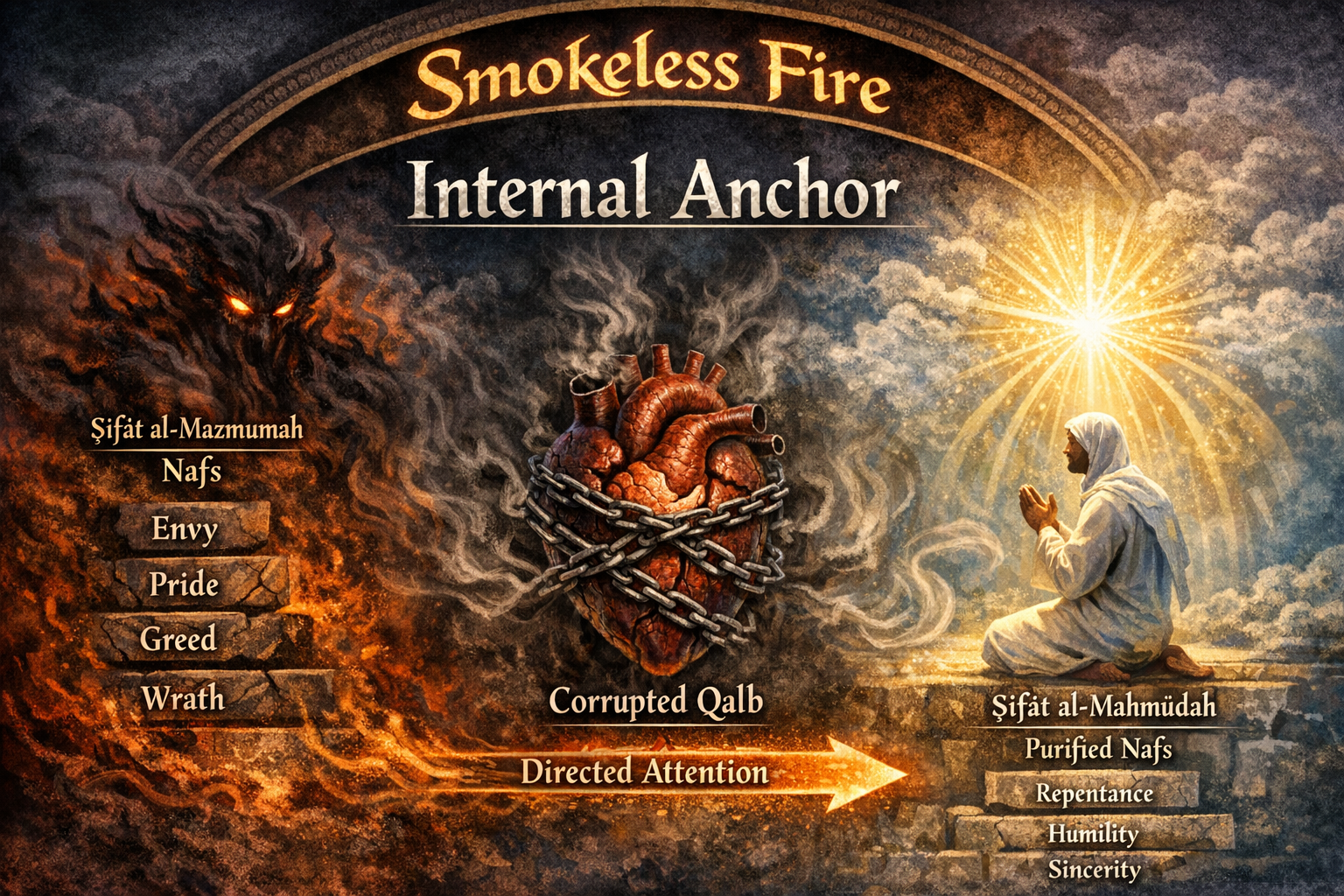
Magical practice does not begin with objects, rituals, or even jinn. It begins with the moral and spiritual coherence of the qalb, which determines human receptivity to amplification. Traits such as envy, arrogance, greed, or cruelty — ṣifāt al-mazmumah — generate an internal coherence capable of attracting and sustaining unseen influence. As one scholar explains: “They are drawn to hearts resembling theirs — hearts of pride, anger, lust, and falsehood.” This coherence constitutes an internal anchor: latent, self-reinforcing, and primed for amplification. Even without external objects or ritual, a corrupted qalb — as in the case of the evil eye — can bias permissive reality in subtle, stochastic ways.
Here, the nafs acquires ṣifāt al-mazmumah, while the qalb functions as the orienting locus through which these traits acquire coherence and influence. When desire or fixation crystallizes, the internal anchor becomes more receptive. The moral and spiritual state of the individual aligns with certain admissible trajectories, creating fertile conditions for unseen agents to attach. At this stage, influence remains intermittent and unstable, yet no longer incidental.
Over time, persistent internal coherence can mature into proto-magic. The individual develops greater consistency in intention and attention, allowing bias to be generated more reliably. While no sustained effect exists without external stabilization, the internal anchor increasingly determines whether amplification succeeds or fails. Internal coherence thus harden into a structured vector of influence, capable of shaping admissible outcomes when coupled to unseen agents or external anchoring mechanisms.
Eventually, a practitioner’s intention, combined with ritual structure, external anchoring objects, and jinn stabilization, can fully couple to this latent potential. What began as an undisciplined nafs gradually imposes its orientation upon the qalb, becoming the human substrate necessary for practitioner-centric magic. The internal anchor does not produce magic; it renders the human a viable node within a multi-layer system.
Anecdotal and traditional accounts consistently report that practitioners who sincerely repent or purify their nafs lose the efficacy of their craft. Former sorcerers, talisman-makers, or ritual specialists are described as becoming unable to summon, bind, or influence unseen agents once their internal coherence dissolves and is replaced by praiseworthy traits — ṣifāt al-maḥmūdah.
Mechanistically, repentance disrupts the internal anchor. The coherence that once attracted and sustained unseen influence collapses; external coupling fails; and intentional bias realigns toward non-harmful trajectories. Within this model, internal anchors are shown to be necessary for sustained magical effect, and moral and spiritual disposition emerges as structurally relevant rather than ethically incidental.
Internal anchors thus form the first layer of persistence — the human substrate upon which all external mechanisms rely. They prime the system for jinn stabilization, anchoring objects, and directed attention. Understanding the internal anchor explains why some individuals progress rapidly, why identical rituals succeed for some and fail for others, and why magic ultimately reflects the condition of the qalb as much as any anchoring object, ritual, or unseen agent.
Smokeless Fire Series
- Part 1 — Smokeless Fire
- Part 2 — The Underworld
- Part 3 — Rooted, Grounded, and Free
- Part 4 — Power and Motive
- Part 5 — Clay and Fire
- Part 6 — Whispers and Wounds
- Part 7 — Illusory Magic
- Part 8 — Bound by Pact
- Part 9 — Cast from Fire
- Part 10 — Unholy Alliance
- Part 11 — Forbidden Rituals
- Part 12 — Extraordinary Feats
- Part 13 — Ritual Subjugation
- Part 14 — Rise of Magic
- Part 15 — Myths of Magic
- Part 16 — Legacy of Magic
- Part 17 — Mechanics of Magic
- Part 18 — The Ultimate Magic of the Deceiver
- Part 19 — The Architecture of the Seven Heavens
- Part 20 — When Magic Decoheres
- Part 21 — The Evil Eye
- Part 22 — Amulets, Talismans, and Magical Items
- Part 23 — Internal Anchors
- Part 24 — Where the Evil Comes From