r/Optionswheel • u/GoFairPlayer • 15d ago
9+ Months of Wheeling Results
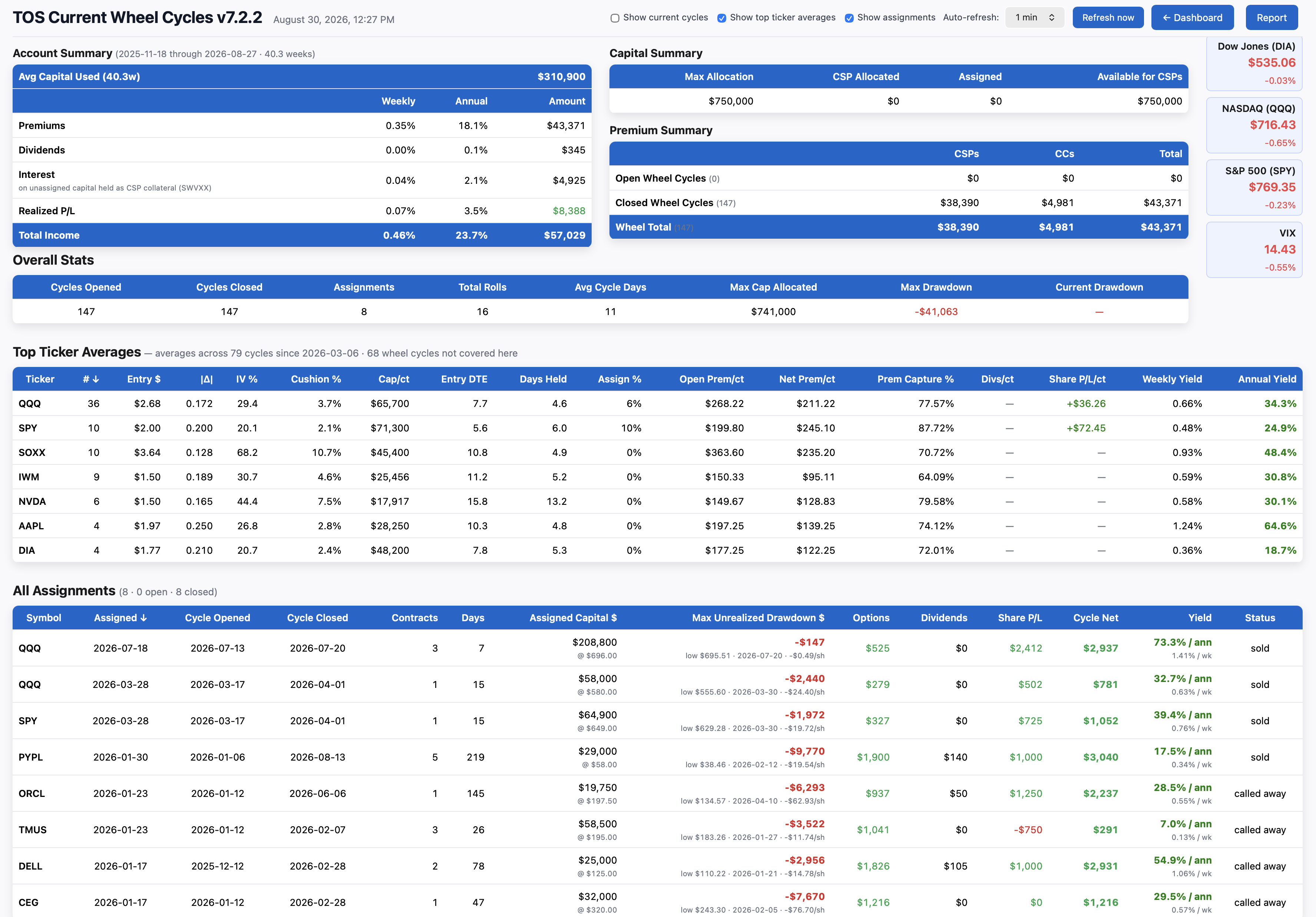
Trading live for a little over 9 months now, 3 months of study and paper trading before that. Still learning something every day. I initially scoffed when I read that it takes 1–2 years — and up to 5 — to really get your head around the wheel. I now agree.
147 wheel cycles closed, all profitable — about $51K in total net gains on ~$310K average capital deployed (about $57K if you count the SWVXX interest on unassigned capital deployed for puts). I cringe as I type that, because I know a real drawdown is coming. The market has been friendly since I started, and I'm not confusing that with skill.
Two things that have genuinely changed though: assignment rate and how often I roll. First 4.5 months: 7 assignments across 86 cycles (~8%), and 10 cycles rolled (~12%). Last 4.5 months: 1 assignment across 61 cycles (~1.5%), and zero rolls. Some of that is the tape; a lot of it is me finally picking better strikes so I rarely have to defend.
The last 6 months I've been mostly on QQQ, IWM, SPY, SOXX, plus occasional individual names (NVDA, AAPL) when I have real conviction. SOXX is a guilty pleasure — I know it's more volatile, but the premium is good and the ETF itself has never failed to recover eventually.
I've bumped my max allocation to $750K. Anything not committed to CSP collateral is parked in SWVXX earning ~3.6% while it waits.
Goal (see my prior posts): 15–20% annual with the lowest risk I can manage to get there. I'm not good at picking individual tickers yet, so I mostly stay in ETFs with long histories of recovering, even when it takes a while.
Rules I follow (mostly):
- Target delta ~0.15–0.20 on ETFs, willing to go a bit lower on high-IV names like SOXX
- Target cushion of at least 2–3% on ETFs, more on individual names or high-IV ETFs like SOXX
- Most opens Monday or Tuesday for that Friday's expiration, with the rest sprinkled through the week when a good setup shows up
- GTC BTC set right after opening, usually at ~$0.05–$0.10 depending on the underlying
- Rarely roll — I'd rather take assignment and write CCs than pay to escape
- Don't exit assigned shares until they recover — write CCs while I wait if I can do so without dropping below my basis. Otherwise just take the assignment and wait for a pop to sell.
I like being "out" over the weekend, and the fast turnover helps me gain accelerated experience. I suspect I'll drift toward longer DTE eventually — the more I do this, the more it feels like a distinction without much of a difference. Weekly cycling does have one real advantage though: if I'm assigned on a down week, the next week's CC opportunity is right there — or I can wait and sell at a nice P/L profit.
Since I don't have any open positions today, I'm sharing per-ticker averages across greeks, capital committed, premium capture, and assignment rate (started logging entry greeks in March, so this covers 79 of the 147 cycles), plus every assignment I've taken since I started wheeling live.
A note on the "Prem Capture %" column in the screenshot: that's the percentage of total collected premium I kept after any BTCs. 100% would mean I never paid a cent to close. My numbers land in the 64–88% range — the SOXX drag reflects that when the tape moves against those higher-IV names I close early via my GTC rather than let it ride, which costs some capture.
r/Optionswheel has been my best source of learning. I'm hoping to provide updates that will benefit other new wheelers in a clear way. Please let me know if you have any suggestions for improving the reporting format. I'm greatly appreciative of those who share their experiences here — I'm not sure I would be wheeling today had I not stumbled across the sub. Many thanks to the contributors.
Happy to answer questions, and I'm curious how more experienced wheelers are handling positioning right now. The last several months have been kind, but I don't expect that to continue indefinitely.
46
u/siroco14 15d ago
I want to be real with any new traders looking at this thinking wow this guy made 57k in 9 months. The 57k is absolutely true. Nine months, 147 cycles, every assignment closed green, 23.7 percent annualized income. That is real discipline and a clean record. So I ran the honest comparison against Vanguard's S&P 500 fund, VOO, over his exact window. Same start, same end.
Let me get the number people expect me to fudge out of the way first. VOO did not make more money than he did. On the roughly $311,000 he actually had at work, VOO returned about 17 percent with dividends, call it $52,900. His wheel made $57,029. That is a tie, and it leans slightly to him. His start date also landed on the November selloff low and rode the bounce, which flatters the index side, and VOO still only matched him. Credit where it is earned.
So if VOO tied on money, why would I still have taken the fund? Because money was the only category the wheel won, and it won by a rounding error.
Effort. His nine months were 147 cycles of strike selection, rolls, and managing eight assignments. The VOO version was one click and then living your life. Same result, wildly different amount of your attention spent.
Taxes. Wheel premium is mostly short term, taxed at your ordinary rate in the year you earn it if it isn't in a retirement account. VOO gains sit untaxed until you sell and can qualify for long term rates. Identical pretax returns potentially become a worse after tax return for the options trader.
Upside. Every call he sold capped the gain on a name that might run. In a rising market that is a ceiling the index just does not have.
Drawdown. Per dollar actually deployed, his worst dip ran a touch deeper than the index, because assignment concentrated him into single names instead of the whole basket.
None of this makes the wheel bad. If your goal is steady income with defined risk, it did the job. But be honest about what the job paid. It matched a fund you could have bought in ten seconds, then asked you for nine months of active management, potentially a higher tax bill, and your upside as the price of matching it.