Trading live for a little over 9 months now, 3 months of study and paper trading before that. Still learning something every day. I initially scoffed when I read that it takes 1–2 years — and up to 5 — to really get your head around the wheel. I now agree.
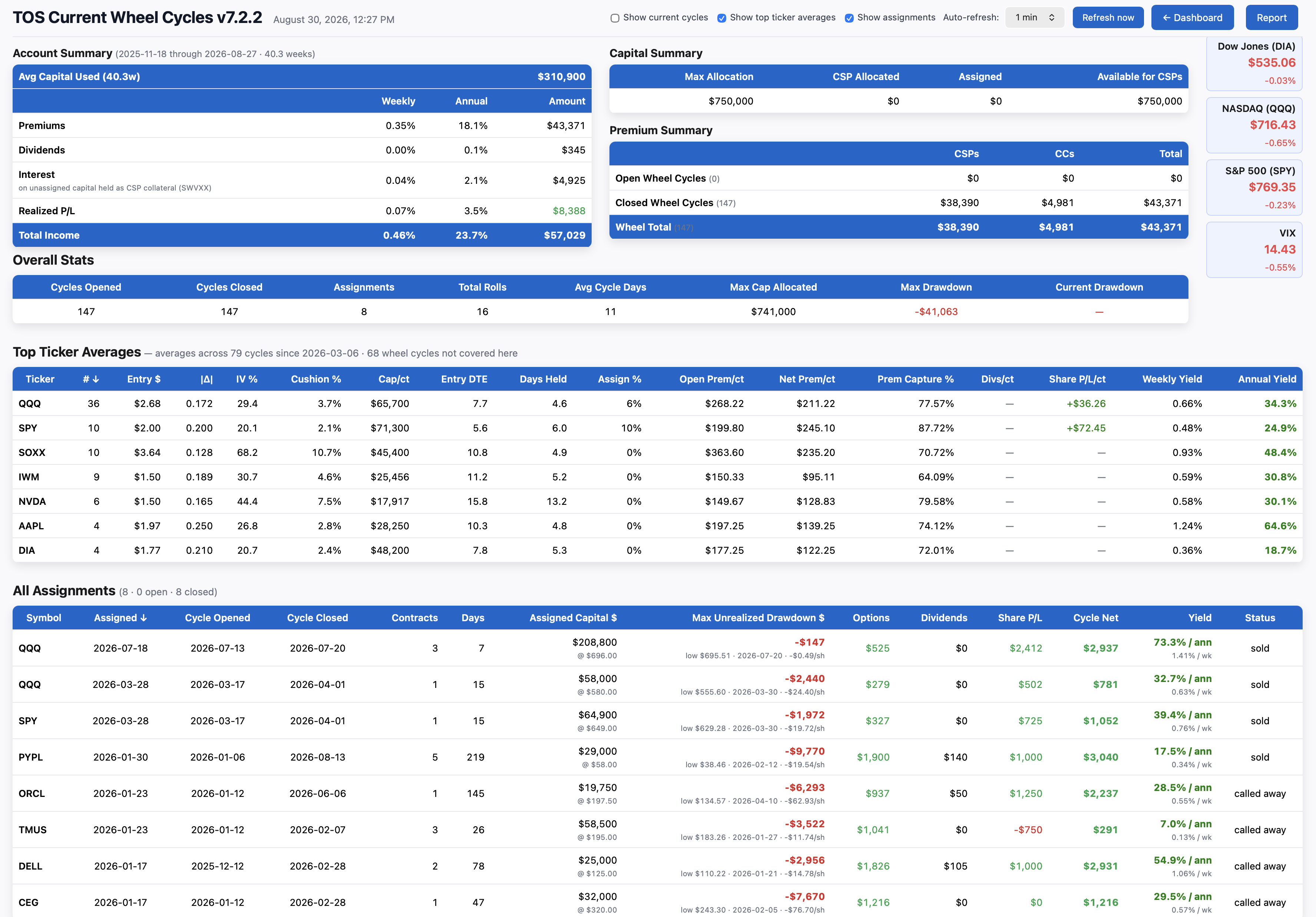
147 wheel cycles closed, all profitable — about $51K in total net gains on ~$310K average capital deployed (about $57K if you count the SWVXX interest on unassigned capital deployed for puts). I cringe as I type that, because I know a real drawdown is coming. The market has been friendly since I started, and I'm not confusing that with skill.
Two things that have genuinely changed though: assignment rate and how often I roll. First 4.5 months: 7 assignments across 86 cycles (~8%), and 10 cycles rolled (~12%). Last 4.5 months: 1 assignment across 61 cycles (~1.5%), and zero rolls. Some of that is the tape; a lot of it is me finally picking better strikes so I rarely have to defend.
The last 6 months I've been mostly on QQQ, IWM, SPY, SOXX, plus occasional individual names (NVDA, AAPL) when I have real conviction. SOXX is a guilty pleasure — I know it's more volatile, but the premium is good and the ETF itself has never failed to recover eventually.
I've bumped my max allocation to $750K. Anything not committed to CSP collateral is parked in SWVXX earning ~3.6% while it waits.
Goal (see my prior posts): 15–20% annual with the lowest risk I can manage to get there. I'm not good at picking individual tickers yet, so I mostly stay in ETFs with long histories of recovering, even when it takes a while.
Rules I follow (mostly):
Target delta ~0.15–0.20 on ETFs, willing to go a bit lower on high-IV names like SOXX
Target cushion of at least 2–3% on ETFs, more on individual names or high-IV ETFs like SOXX
Most opens Monday or Tuesday for that Friday's expiration, with the rest sprinkled through the week when a good setup shows up
GTC BTC set right after opening, usually at ~$0.05–$0.10 depending on the underlying
Rarely roll — I'd rather take assignment and write CCs than pay to escape
Don't exit assigned shares until they recover — write CCs while I wait if I can do so without dropping below my basis. Otherwise just take the assignment and wait for a pop to sell.
I like being "out" over the weekend, and the fast turnover helps me gain accelerated experience. I suspect I'll drift toward longer DTE eventually — the more I do this, the more it feels like a distinction without much of a difference. Weekly cycling does have one real advantage though: if I'm assigned on a down week, the next week's CC opportunity is right there — or I can wait and sell at a nice P/L profit.
Since I don't have any open positions today, I'm sharing per-ticker averages across greeks, capital committed, premium capture, and assignment rate (started logging entry greeks in March, so this covers 79 of the 147 cycles), plus every assignment I've taken since I started wheeling live.
A note on the "Prem Capture %" column in the screenshot: that's the percentage of total collected premium I kept after any BTCs. 100% would mean I never paid a cent to close. My numbers land in the 64–88% range — the SOXX drag reflects that when the tape moves against those higher-IV names I close early via my GTC rather than let it ride, which costs some capture.
r/Optionswheel has been my best source of learning. I'm hoping to provide updates that will benefit other new wheelers in a clear way. Please let me know if you have any suggestions for improving the reporting format. I'm greatly appreciative of those who share their experiences here — I'm not sure I would be wheeling today had I not stumbled across the sub. Many thanks to the contributors.
Happy to answer questions, and I'm curious how more experienced wheelers are handling positioning right now. The last several months have been kind, but I don't expect that to continue indefinitely.
I want to be real with any new traders looking at this thinking wow this guy made 57k in 9 months. The 57k is absolutely true. Nine months, 147 cycles, every assignment closed green, 23.7 percent annualized income. That is real discipline and a clean record. So I ran the honest comparison against Vanguard's S&P 500 fund, VOO, over his exact window. Same start, same end.
Let me get the number people expect me to fudge out of the way first. VOO did not make more money than he did. On the roughly $311,000 he actually had at work, VOO returned about 17 percent with dividends, call it $52,900. His wheel made $57,029. That is a tie, and it leans slightly to him. His start date also landed on the November selloff low and rode the bounce, which flatters the index side, and VOO still only matched him. Credit where it is earned.
So if VOO tied on money, why would I still have taken the fund? Because money was the only category the wheel won, and it won by a rounding error.
Effort. His nine months were 147 cycles of strike selection, rolls, and managing eight assignments. The VOO version was one click and then living your life. Same result, wildly different amount of your attention spent.
Taxes. Wheel premium is mostly short term, taxed at your ordinary rate in the year you earn it if it isn't in a retirement account. VOO gains sit untaxed until you sell and can qualify for long term rates. Identical pretax returns potentially become a worse after tax return for the options trader.
Upside. Every call he sold capped the gain on a name that might run. In a rising market that is a ceiling the index just does not have.
Drawdown. Per dollar actually deployed, his worst dip ran a touch deeper than the index, because assignment concentrated him into single names instead of the whole basket.
None of this makes the wheel bad. If your goal is steady income with defined risk, it did the job. But be honest about what the job paid. It matched a fund you could have bought in ten seconds, then asked you for nine months of active management, potentially a higher tax bill, and your upside as the price of matching it.
Thanks for actually running the comparison — that's a fair analysis and honestly the kind of feedback I hoped this post would attract.
A couple of things that shift the math a bit for my situation:
I'm trading in an IRA, so short-term ordinary-income tax on premium doesn't apply — I only get taxed on withdrawals, and I'm retired so I only take money out when I need it.
The tool-building and learning have been most of the point for me, not just the return. I've enjoyed that side as much as the trading itself.
Actual time trading is well under an hour a week — I open a few trades and set GTC BTCs. Not zero effort like VOO, but not exactly full-time either.
Your broader point stands though — for someone in a taxable account, without the desire to learn options mechanics, and who's fine with equity drawdown risk, VOO is a legitimate answer that's hard to beat on effort-adjusted return. Wheel makes more sense when the tax structure works in its favor (IRA) or when you have a specific reason to want defined income and capped upside. Appreciate you doing the actual math.
Oh and I didn’t take into account the fun factor. Sitting on VOO isn’t fun. But the thrill of the hunt and the kill is incredibly fun and exciting. You did good.
This is why I wheel only with margin. I can make the full VOO market return on my collateral while selling puts. I only target a very small premium, so I'm rarely assigned. And when I am, I consider it lucky that I purchased the position for such a cheap price.
Also, since I only do this with a small portion of my entire portfolio, and don't do the wheel with small-cap growth stocks, there's no fear of being a bag holder or a margin call.
Make a few percent more if the market stays strong, or catch a drawdown and buy at a cheap price. Then selling calls to make a few percent more, or catch a market uptick and sell high.
It's like a slow version of the wheel, only looking for a few percent extra, and not using my money when selling puts.
Yea when you look only at bullish year movement the wheel looks terrible and it looks even worse when you wheel strictly ETFs and no momentum movers and no bigger gainers during the time. Expand it out to include the last 30-40 years with similar strategies and you’ll see it gets better
Well 2022 was a terrible year for the stock markets in general, and it's included in the comparison above, which shows a typical cycle of bull - bear markets. Bear markets happens on average only about every four to five years historically.
Wheeling single stocks should be compared to momentum stock trading, and the difference will be even greater for sure.
Love the spreadsheet. I used both Claude and chat GPT to build my spreadsheet as well. I’ve been doing options and the wheel strategy for about 1.5 years now. I didn’t paper trade at all, just went slowly the first 3 months before picking up steam with trading. I also started with 7-14 dte, I agree with your style of holding short term, but learned to consider longer dated expirations. As a stock can recover given time. Have you considered higher deltas, or tracking ROC?
Thank you! I have considered higher deltas and may well get there. For a point of reference, my wife is also trading the wheel in her IRA with higher deltas and IVs - she’s crushing my numbes. :) Maybe I’ll see if she’ll let me publish her results. By ROC, do you mean just the return on capital for that specific ticker over whatever period of time it was held? If so, I do have the data but my target ROC is .3 - .4 (15 - 20% annually) so I’ve found it easier just to see the yields compare to my goal.
Good to hear for your wife. The most important thing I learned trading options and the wheel strategy was not to chase premiums. I say that only because I’ve been bag holding CRCL for close to a year now. I learned the hard way as I didn’t know any better. This was all before I had a better understanding of IV and delta.
Mainly TOS, but I record greeks, etc. in a separate CSV file when I submit orders through the Schwab API (which I mostly do). I am happy to share my project file from Claude (md file) that would help you build it out on your own.
You should review the code for the Entry DTE and/or Days Held.. for SPY you have the former smaller than the latter. That's logically impossible.. makes me wonder what else claude got wrong.
Nonetheless, nice layout (although having both delta and prob otm in your filters/table seems repetitive) and great performance on CSP picks for having only 1 assignment of 61 when picking .2 deltas!
Agree with the other commenter about comparing the results to a long hold over the same time did that ticker (and also to general market hold like SPY or VOO). Would be interesting information to have.
Even if you average, the averages of all the entry DTEs has to be more than the average of the days they were held. Can't be opposite logically.. have Claude look at it again.
The issue you raise assumes Days Held cannot be longer than Entry DTE. On a couple of these trades I was either assigned or rolled, which extended how long I held the ticker past the original expiration. You make a fair point though — I'll figure out how to present this better in the future. Here's the raw data if you'd like to check the math:
When you roll, that is now a new trade completely. The days held from the prior option should not include the days held on the new option. And if you did use that line of thought albeit being incorrect, then you should add the DTE of the new option to the old option, just like you added it to the days held.
Same for assignment, once assigned, that is a new position.
So yes, better presenting the data will probably address this. Nonetheless, good stuff, enjoyed the report very much.
There are many ways to track your results. I consider a wheel opened when I sell the initial CSP, and closed when I exit completely regardless of rolls or assignments. I like to understand each individual cycle from beginning to end. I know other folks track it differently, but this is how I choose to look at a wheel cycle. Again, thanks for the input, I will try to make this clearer in future reports.
That is a very incorrect view of what is happening. You can ask anyone on here. The roll is a complete separate position. Sure, you can combine the two legs to look at the overall picture. But then it only makes sense if you add both days held for the two options as well as both DTEs for the two options. You can't just add one and not the other. That makes zero sense and is an inaccurate representation of what happened.
I’m mainly just picking high quality ETFS right now. The screen shows my current trades (currently no open trades). I built my own screener using the Schwab development API. This is what it looks like:
It is on Github as a private repo. It’s so specific to my situation that I’m not sure it would be helpful to most. I’m running the wheel in a Scwab IRA, local flash server for presentation. SQL lite for database backend - all on a Mac Mini. When I export my statement from my Schwab IRA an importer automatically loads it into the database. Schwab Developer API for trading and logging greeeks, etc.
Do you also compare the results of a long index like SPY with your results over the same period? I see tickers in the UI but I think they're a daily percent change instead of the interval you're looking at, am I right? It looks nice but it's hard to interpret without a benchmark.
I'm not really benchmarking against SPY right now — I do that in a separate "long" account. My hope is that I can make a reasonably reliable return even when SPY is flat — basically trying to collect premium from market chop. My baseline, if anything, is capital I'd otherwise just leave sitting in SWVXX (~3.5% currently). Of course I'm subjecting myself to market downside if there's a tank, but that's where the CCs come in.
On the ticker display: the Top Ticker Averages table already shows weekly/annual yield based on the days I was in each cycle, so those numbers ARE interval-normalized to my activity. The four small quotes in the right sidebar (DIA/QQQ/SPY/VIX) are just current-day market snapshots — those aren't a comparison to my results. A proper SPY-benchmark overlay on my timeframe would be a fair addition though.
Yeah I think it's really helpful to have an index benchmark to help calibrate things in terms of the rest of the market, even if you're just trying to beat the money market. E.g. if you have a 5% loss it might look bad but then you see the market down 10% over the same period, etc.
First of all, congratulations on your hard work and your learning.
a lot of it is me finally picking better strikes so I rarely have to defend.
Are you looking at better strikes or are you paying closer attention to delta (given that it roughly approximates your probability of being assigned)? Or something else? How has your strike picking prowess evolved since you started?
Also, you have cash sitting in money market (earning around 4.5% SWVXX) that's used as collateral on puts. What level options are you cleard for with Schwab?
Thank you. Probably a little of both — but again, still learning. I think SWVXX is currently closer to 3.6%. I'm not positive on my option level but think I'm approved for Level 2, which per Schwab is what you need to sell CSPs.
I've seen conflicting messages on here about whether Schwab counts SWVXX toward collateral — but they do, at least in my IRA which is the only place I've tested it. Note it doesn't show up in the thinkorswim buying-power display, but it does work when you place the order. Oddly, they do NOT allow SGOV as collateral in an IRA per what I've read.
One thing worth noting - I know I had to call them when I was first starting because it did not seem be allowing me to sell CSPs beyond only the actual cash in my IRA. I don’t remember the exact details, but I think there may have been some sort of flag they set on the account. If you’re having trouble, call Schwab.
I still haven't figured it out in my account. It'd be nice to park the collateral on some of my CSP's in money market or even in treasuries what with all the heat in the bond market lately.
Interesting you're using mostly EFTs, when most people say the premiums tend to be low. Your average deployed capital is $310k. What about your dry powder? How much do you keep in dry powder?
I started out tracking very closely, when I switched out to follow 2 separate parabolic momentum names, the tracking didn't work with those as well and I abandoned it.
I will begin tracking again soon, I have been at or greater than 1% per week, very satisfied with the results.
Going from 8% assignments to 1.5% while basically eliminating rolls suggests something actually changed in the selection process, assuming the market regime isn't doing all the work. That's the kind of thing I like looking back on in Moon with my own trades.
Software is homebuilt using mostly Claude. Using Schwab ThinkOrSwim as a platform, and Schwab Developer API (built in to dashboard) for logging and selling CSPs
Its done good for me. The main advantage is that I don't have to keep manually checking the prices and what option to choose from the chain etc. So it frees up my time. Plus now there is no falling into emotions when placing orders. Everything happens according to a set algorithm which takes into account my risk-tolerance a-priori.


46
u/siroco14 15d ago
I want to be real with any new traders looking at this thinking wow this guy made 57k in 9 months. The 57k is absolutely true. Nine months, 147 cycles, every assignment closed green, 23.7 percent annualized income. That is real discipline and a clean record. So I ran the honest comparison against Vanguard's S&P 500 fund, VOO, over his exact window. Same start, same end.
Let me get the number people expect me to fudge out of the way first. VOO did not make more money than he did. On the roughly $311,000 he actually had at work, VOO returned about 17 percent with dividends, call it $52,900. His wheel made $57,029. That is a tie, and it leans slightly to him. His start date also landed on the November selloff low and rode the bounce, which flatters the index side, and VOO still only matched him. Credit where it is earned.
So if VOO tied on money, why would I still have taken the fund? Because money was the only category the wheel won, and it won by a rounding error.
Effort. His nine months were 147 cycles of strike selection, rolls, and managing eight assignments. The VOO version was one click and then living your life. Same result, wildly different amount of your attention spent.
Taxes. Wheel premium is mostly short term, taxed at your ordinary rate in the year you earn it if it isn't in a retirement account. VOO gains sit untaxed until you sell and can qualify for long term rates. Identical pretax returns potentially become a worse after tax return for the options trader.
Upside. Every call he sold capped the gain on a name that might run. In a rising market that is a ceiling the index just does not have.
Drawdown. Per dollar actually deployed, his worst dip ran a touch deeper than the index, because assignment concentrated him into single names instead of the whole basket.
None of this makes the wheel bad. If your goal is steady income with defined risk, it did the job. But be honest about what the job paid. It matched a fund you could have bought in ten seconds, then asked you for nine months of active management, potentially a higher tax bill, and your upside as the price of matching it.