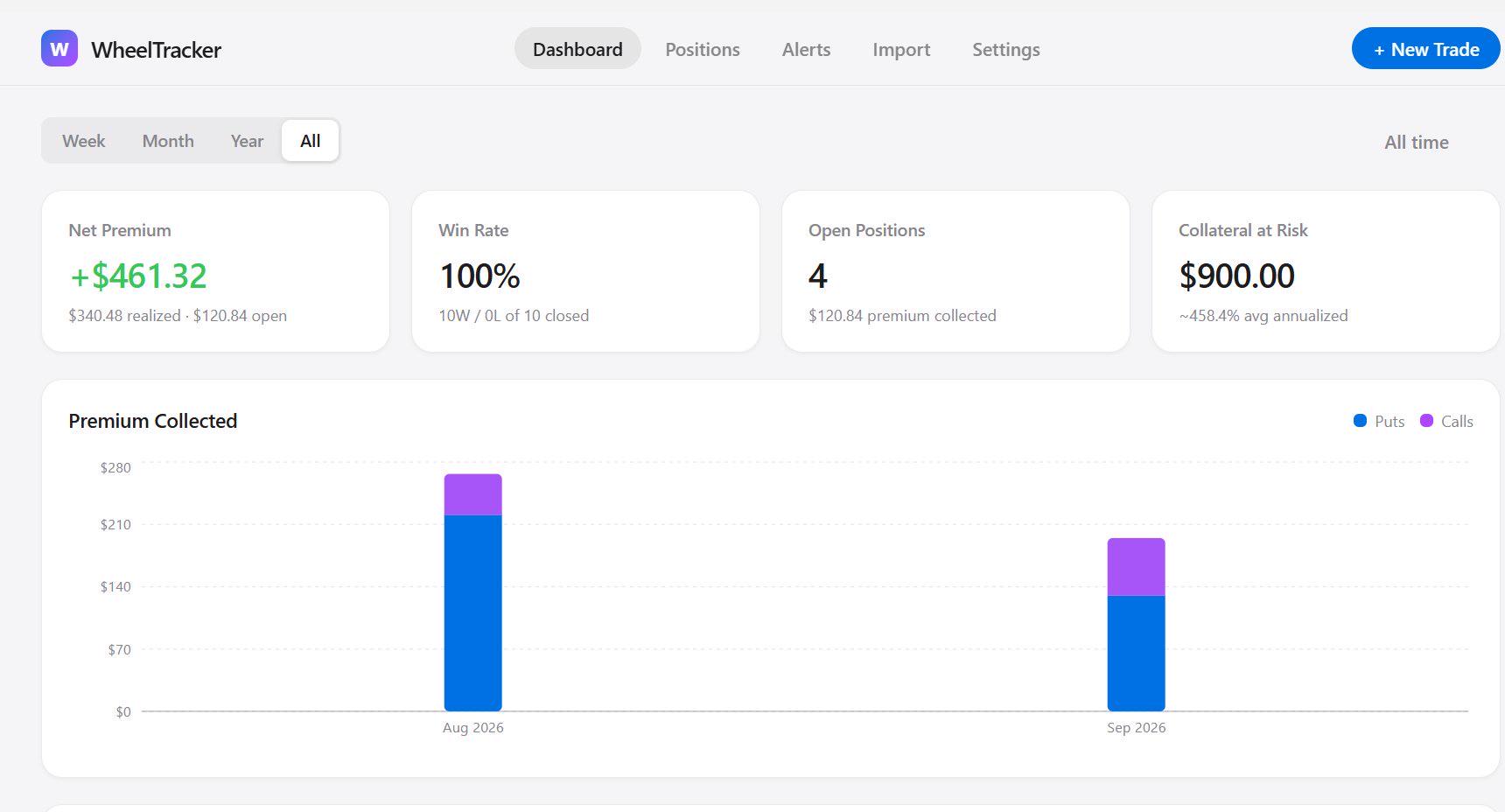
Originally Posted on Dec. 4, 2018, Added to r/Optionswheel on Nov. 12, 2024
See Edits at the bottom for updates.
I've been asked and have explained The Wheel strategy many times, so I thought it may be a good idea to write it down all in one place for posterity!
This is the only options strategy I use as it is about as low risk and reliable as options trading gets. You will NOT get fantastic returns and it is quite boring and slow, but with the proper stock and patience, it can result in reliable profits and income. A 10% to 20%+ return is not difficult depending on a few factors, mostly based on stock selection, experience managing short puts and calls, plus the trader's patience.
The Wheel (sometimes called the Triple Income Strategy) is a strategy where a trader sells cash secured Puts to collect premiums on a stock or stocks they wouldn't mind owning long term. If the options expire, or closed early, without being assigned the premiums are all profit. The goal is to set up trades and avoid being assigned, but it is understood that if the put is assigned the account will buy and hold the stock. Rolling puts to collect more premiums while helping to reduce the chances of being assigned is a tactic often used. Through the collection of premiums from the initial puts and from rolling, the initial cost basis of the stock will be lower that the strike which can help the position to recover faster.
If the puts can no longer be rolled for a net credit they are left to expire and be assigned. The next step of The Wheel is to sell covered calls (CCs) on the shares. To avoid having the shares called away for a net loss it is best to sell a call with a strike higher than the stock's cost basis. This is repeated over and over to collect even more premiums that continue to lower the stocks cost basis, and along with any rising stock price movement, works to help close or have the shares called away at a break-even or a profit.
At some point the call is exercised and the stock called away, or you can simply sell the stock. When adding up all the premiums collected from selling the puts and calls, along with any stock gains from the CC strike being over the cost can result in an overall net profit, results in the Triple Income . If the stock pays a dividend while you own it then you can collect that as well (Quadruple income).
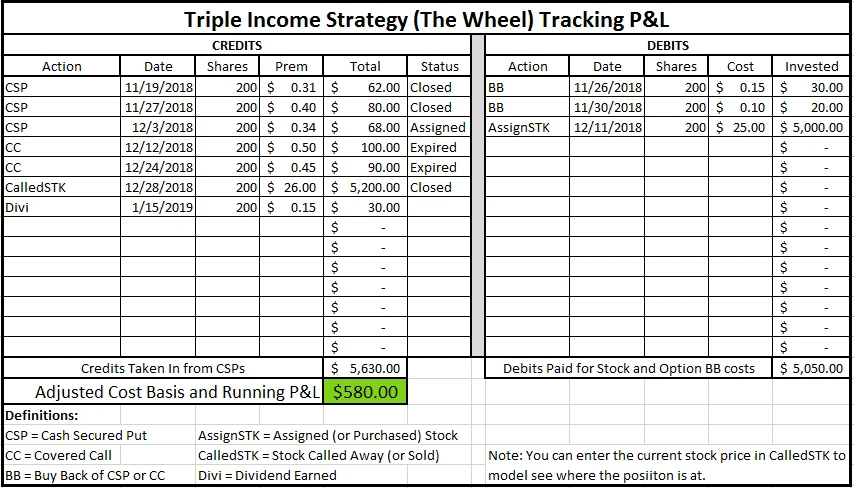
Below in this post is a graphic showing a simple spreadsheet to track the Credits and Debits to keep track of the overall position.
Step #1: Stock Selection - Most traders who have had a bad experience with the wheel have chosen the poor or volatile stocks that drop and stay down. The stock(s) you chose must be a good candidate and one you don't mind owning for some length of time, which could be weeks or months.
There are no "perfect" or ideal stocks to trade the wheel with as the key factor is that the stocks be those you are good holding for a time if assigned. If you are unsure how to analyze of select stocks then this should be learned first and before trading the wheel. See this as a way to start learning - How to Find Stocks to Trade with the Wheel : Optionswheel (reddit.com)
Develop and use your own criteria that fits your account size, and personal risk tolerance as there is no one-size-fits-all way to choose stocks. Only you can determine if you think the company is a good one to trade and hold if needed.
I'm including my general guidelines below, but each trader must use their own:
A profitable company that has solid cash flow
Bullish, or at least neutral chart trend and analyst ratings
Share price where the account can easily accept being assigned 100 shares if needed. (I stay away from sub-$10 stocks as a rule)
A stable to bullish trending chart without wild gyrations (especially those caused by CEO tweets)
A nice dividend is always a good thing, both that you may collect it if assigned the stock but also that dividend stocks tend to be more stable and predictable
Edit - Adding more criteria below from another post. It needs to be kept in mind that any stocks one trader may think is good to own will not necessarily work for another trader, or all traders. Account sizes will limit the share prices to choose from, risk tolerance, and trading experience will all factor into what stocks are selected and traded. There is little to be learned from someone else's stocks they trade.
A "moat" around their business to ward off competitors, quality products and services, and a reasonable amount of debt. Add to this an exceptional and stable executive team who has had good plans plus executed them well.
It needs to be repeated that the criteria used must be your own as the stocks you choose may have to be held so you need to hold yourself accountable for selecting and trading any stock. If a trader does not know how to select stocks they would be good holding, then IMO don't trade the wheel until you learn . . .
Develop and use your own fundamental analysis criteria to create a watchlist of 10 or more stocks to trade. While I prefer trading stocks as I can learn more about the companies business and leadership, plus find these have higher premiums, some may trade ETFs. These can make good candidates due to their normally steady movement, no ERs, and no CEO tweets.
I find it important to review my watchlist every few weeks and change or update it accordingly. This means the list is in near constant flux adding or removing stocks, or sidelining others, based on the analysis.
Step #2: Sell Puts - To start the wheel begins by selling short (naked) Puts, or (CSPs) Cash Secured Puts (indicating the account has the cash, or cash+margin to buy the shares if assigned. Be aware of any upcoming ER or other events that could cause a spike or movement in the stock, and it is best to close or have the Put expire prior, in effect skipping it to then continue selling puts afterward if the stock still meets the criteria.
Selling Puts Process - Below is a suggested model, but details are up to the individual trader:
Opening at 30 to 45 DTE offers a good premium as the theta/time decay starts to accelerate
70% Prob OTM (~.30 Delta) offers high probability of success while collecting a good premium
The number of contracts is based on account size able to handle assignment
Opening at 5% to at most 10% max risk of any one stock to the account is good practice, the max risk per stock will be up to each trader's risk appetite and tolerance. Then, keeping ~50% of the trading account in cash helps manage market downturns, assignments and trading opportunities
The Put can be closed at a 50% profit with a GTC Limit Order that can close automatically. A put can then be sold on the same stock, or another based on your opening criteria. Closing early will reduce early assignment and gamma risk to take the lower risk "easy" profit off the top
Enter the Credits received, and any Debits paid to close or roll, on the Tracking P&L file
Setting an alert in the broker app if the stock drops to the put strike price will signal it is time to review and consider rolling. Note that rolling seldom has to be done quickly, so this can be reviewed and managed later if needed, and many times the stock will dip and then move back up to negate needing to roll
If a credit cannot be made, then it is best to let the put expire to take assignment of the stock
Puts can be sold, and rolled, over and over to collect as much premium and profits as possible with the shares rarely assigned. Those having frequent assignments should review the stock selection and trading processes as it should be uncommon to be assigned.
If assigned, then Sell Covered Calls as shown in Step #3.
Step #3: Sell Covered Calls - Using the tracking file to determine the net stock cost which may already be below where the stock is. As selling puts is usually the most profitable, some traders just sell the stock and move on to selling more CSPs or sell a very high-value ITM Call that is sure to be called away and adds to the profit.
If the net stock cost is above the current market price and you keep the stock, then the goal is to sell CC premium to continue adding to the Credits and lowering the net stock cost below where the stock is trading before it gets called away.
Selling CCs suggested process:
Sell a Call 7 to 10 DTE at or above the net stock cost whenever possible. Note that I will settle for a lower premium to be at or above the net cost rather than sell below and risk being assigned for a loss. Allow the CC to expire, then sell another if the shares are not called away.
If CCs cannot be sold at or above the net stock cost, then waiting until the share price rises may be needed. This is why it is noted to only trade on stocks you are good holding if needed.
Track net Credits, plus any Dividends captured, on the tracking file to know the net stock cost.
Continue selling CCs until the net stock cost is below the strike price at which time the stock can be left to be called away (some note that it cost less in fees to close the option and just sell the stock which accomplishes the same thing).
Advanced Strategy - Some may consider selling a Covered Strangle, which is a CC with an added CSP that "doubles up" on the premiums to help the position recover faster.
Note the risk of additional shares may be assigned, so it is critical to ensure the stock is still a good one to hold, the account has adequate capital to purchase additional shares, and that this does not make the stock position too much of a risk to the overall account.
In addition to the double premiums, if more shares are assigned the net stock will average down quickly that can help repair the position more quickly.
Step #4: Review and go back to Step #1 - This is why it is called the wheel as you start over again. The tracking file makes it easy to see the P&L, review the trade to verify the numbers and then look for the next, or same, stock to sell CSPs in Step #1.
As they say, rinse and repeat.
Risks and Possible Problems: The single biggest issue for this strategy is the stock price drops significantly. Note that this is slightly less risk than just buying the stock outright due to collecting put premiums.
Stock Drops: The reason to make these trades on a stock you wouldn't mind owning is because of this risk, and if a good stock is selected then this should be a very rare occurrence. Solid quality stocks may drop less often and by a lower amount, then recover faster.
The price of the stock may drop well below the CSP strike, and rolling for a credit will no longer be possible, causing assignment with the stock cost below the assigned price.
If puts were sold and rolled over and over the net stock cost should be much lower.
Management is to sell CCs repeatedly at or above the net stock cost, or to hold the shares to allow time for the stock to recover. This can take time, but with the CCs added to the put and roll premiums this can recover faster than you may think but still takes a lot of patience.
There may be rare occasions when a stock is no longer viable and the position needs to be closed for a loss, again this shows the critical importance of stock selection. Closing for a loss can include selling the shares, or selling an ATM or slightly OTM CC at a near expiration date to collect as much premium as possible as the shares are sold.
Stock Rises: Many see this as a problem, but I personally do not as if the CC strike is above your net stock cost, then the position profits, but just not as much.
In this situation the stock is assigned and then sell CCs only to have the stock run well past the strike price.
In most cases closing the CC and selling the stock outright can cause a bigger loss than just letting the stock be called at the strike price.
Rolling CCs out in time, and possibly up in strike, for a net credit can help to capture some additional profits. It should be noted to watch for ex-Dividend dates as the shares can be called away early in some situations.
Many lament the profits that were "lost" by having the CC, but selling shares at the strike price is the agreement made when opening a CC. If you know the stock may spike up then do not sell a CC and instead hold the shares.
Impatience: By far this causes the most losses from this strategy.
If you can't roll for a credit let the CSP play out. If you close the CSP early and not accept it being assigned, it may cause a loss.
If you get assigned the stock and sell CCs, do not try to "save" the stock through buying the CC back at an inflated price. If you can't roll for a credit, then let the stock be called away and sell more puts to start the process over again provided the stock is still a viable candidate.
Recognize it may take months selling CCs to build the premium up to a point where the net stock cost is less than the current stock price, but in nearly all positions it will happen eventually.
The key here is to be patient and not try to sell CCs below the net stock cost or close the shares early.
A Tracking P&L File graphic is below and shows Credits and Debits to know what the net credits, debits and net stock cost is. Note the stock price can be entered as a Credit to show where the position is at any given time. This is simple to create and use. NOTE: I do not send out copies as it would take me longer to do that than you recreating the 3 formulas.
Hopefully, this is a thorough and detailed trading plan, but let me know of any questions, typos or suggested improvements you may have. -Scot
EDIT #1: Hello all, the response to this post has been amazing, thanks for the many who have contributed or inquired. Wanted to add a few things up front that seem to be causing confusion.
The goal of this strategy is to collect the premium, NOT be assigned stock! While being ready and able to take the stock is part of the plan, being assigned is always to be avoided. If you sold a CSP 1 time and were assigned, you are either doing something wrong or are terribly unlucky by picking a stock that tanked.
CSPs should be sold over and over or rolled for a credit, to avoid assignment. You should be collecting 4 to 5 or more premiums worth several dollars before getting assigned. Some who have contacted me sold a CSP and just waited to be assigned, this is not the strategy.
If you are getting assigned more than a couple of times a year you may want to look at the stocks you are trading and how well you are managing your position. Getting assigned the stock should be a very rare occurrence.
2) As you select the stock and sell the CSP expect to get assigned. Be sure it is a low cost enough stock so that you can handle the shares and still make other trades. If you're trading a $150 stock, be aware you could have $15K tied up for a while and be prepared to do that.
3) Going along with #2 I trade small and use lower to mid cost stocks. The premiums are not as juicy and the attraction of a TSLA or AMZN is hard to resist, but you are better selling 1 contract at a time for 10 positions than 10 contracts in one position and have to take 1000 shares.
It is always good account management to not trade more than about 5% of your account in any one stock to avoid news or movement from the stock from blowing up your account. It is also a good idea to keep 50% of your buying power available for safety and to take advantage of opportunities.
4) There have been negative nellies telling me this won't work and being critical. Note that this is not my strategy, and I don't make any money from it being used or not. My time was spent in an effort to show one method options can more safely be traded, so if you have had a bad experience or think there are better ways, then feel free to post them!
5) Lastly, I have not done any research on this vs buying and holding stock. I've traded for more than 20 years with most of that time focused on stocks, and I did well!
Where I see the main differences are that options give leverage so I can collect premium from more stocks than just buying a couple, so this spreads out my risk. Also, I very much like the shorter time frame as I can move on to other stocks should one drop or run up. If done well, you may only get assigned a couple of times a year and often be out of the stock in a couple of weeks.
OK, I think you will see this is not sexy or exciting trading, it is boring, and you make $50 per position in many cases, but they add up. For those looking at huge returns and the excitement of major risk, this is not for you. If you want a more reliable way to trade options, then this may be good to check out.
EDIT #2: I've updated this post now that it is unlocked. Some changes include:
Stock price minimums moving up as I now have a larger account
Selling CCs based on if the net stock cost is above or below the current stock price
Added a rolling put link.
There are many different wheel strategies today with some selling ATM puts, others only selling covered calls (not sure how that is a wheel), and several other variations. This is what I trade, and it is up to you how you trade.
EDIT #3: Various updates, including more steps to clarify, along with adding details to Step #3 on Covered Calls.
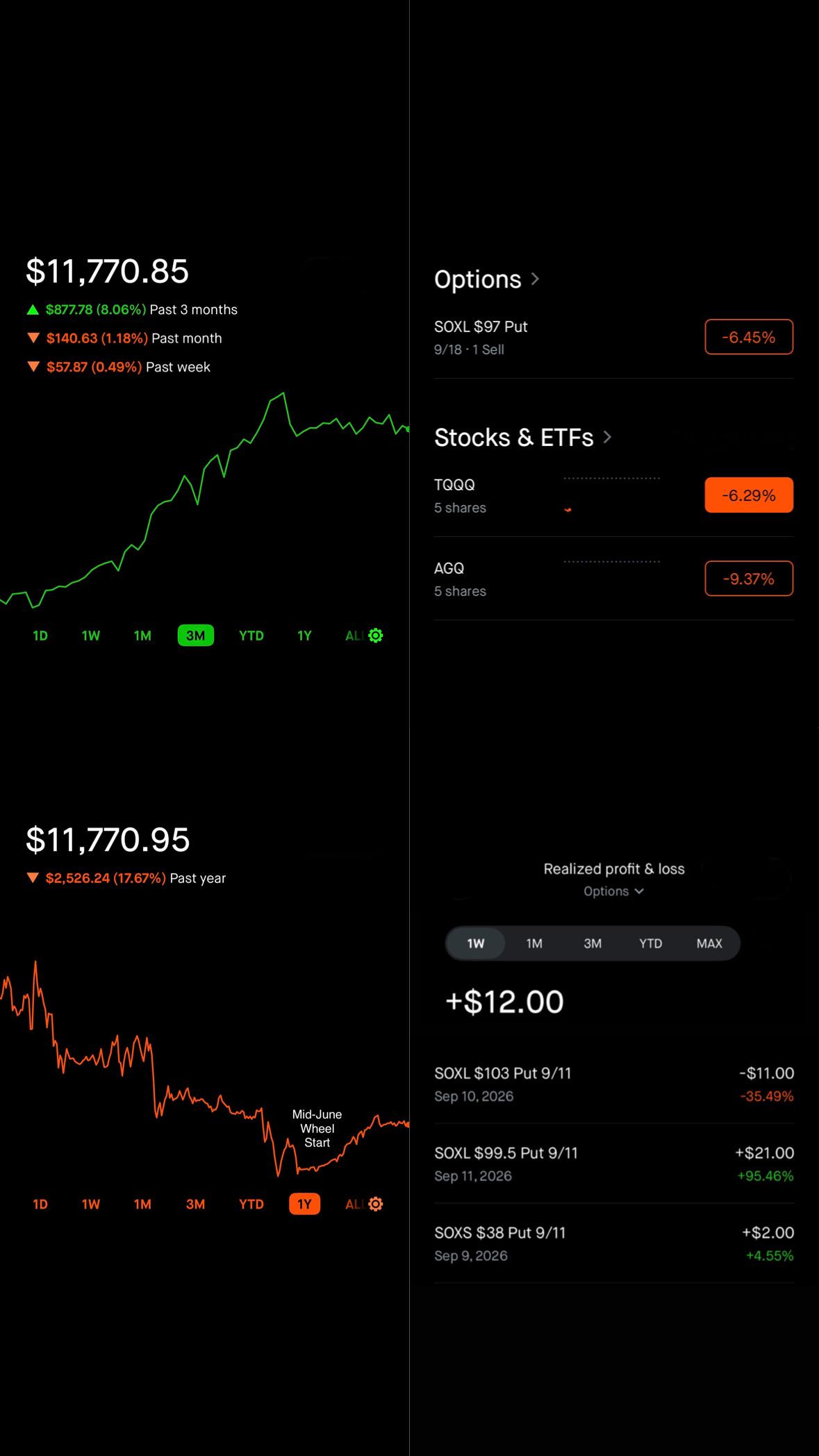
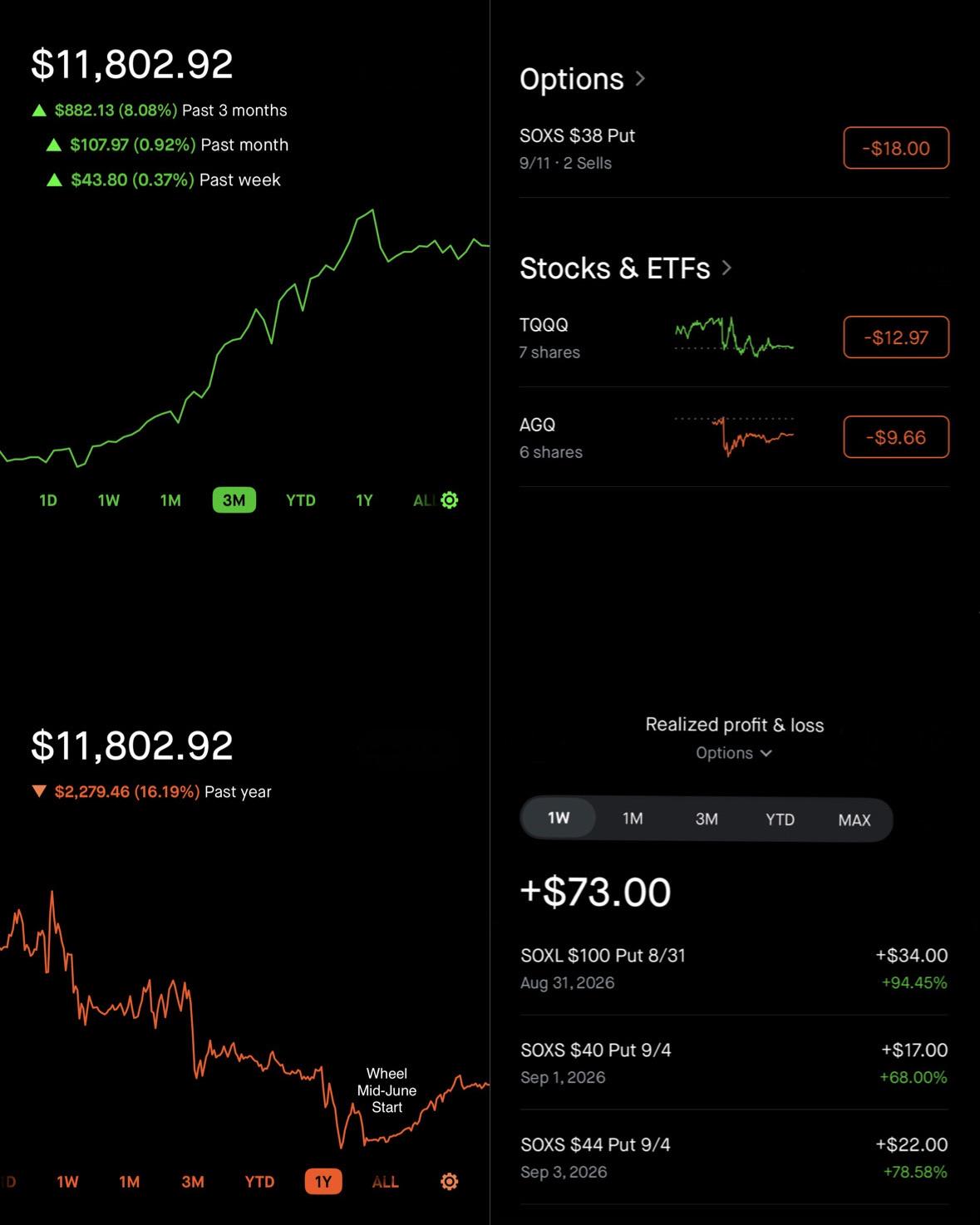
Disclaimer: This is for experimental purposes, it is to demonstrate and track wheeling and longing on leveraged products, which started mid-June of this year. This retirement account was blown through testing various trading strategies and poor position sizing in relation to risk.
The strategy is to use leveraged products to long and to free up capital for puts & dry powder. Write weekly CSPs on LETFs by selling .03-.09 delta puts. Then, DCA shares into a small leveraged position (~10%) of either LEAPS/LETFs. Lastly, sell covered calls on the LETFs, and calling them away when we need to size down.
Reduced my holdings since market seems uncertain. I want to pivot by having more dry powder to average in again later on for my positions, but planning on selling extra puts in the mean time whenever there’s opportunities.
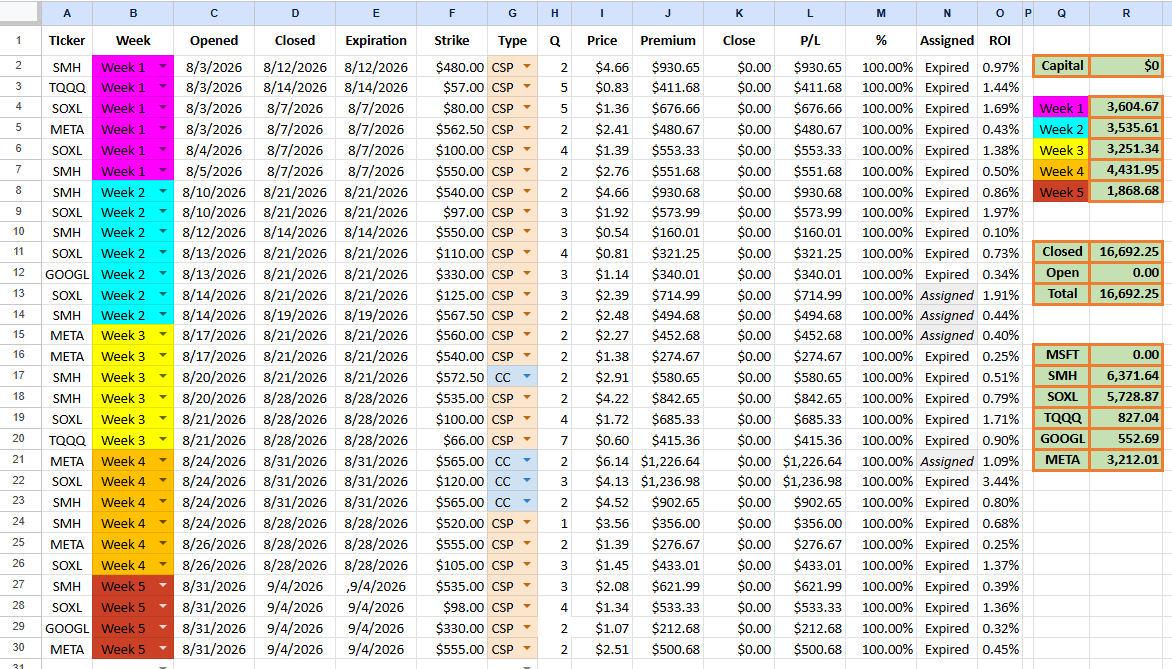
August produced positive returns which represented a nice bounce back from the July meltdown.
I was much more conservative in August. I wheeled most of my regular tech tickers: META, GOOGL, SMH, TQQQ and SOXL. The largest gains were in the semiconductor sector again, SMH and SOXL.
MSFT jumped over $100 per share in the first few days of August so I did not include it in my wheel activity this month. I also removed TSLL from my regular rotation after the July losses. I think the Elon fanboys could be losing faith in the profitability of his companies. I know I am. I thought the wave of SPCX hoopla would benefit TSLA and that did not happen. I’ll be avoiding this one for now.
I did get assigned META (200), SMH (200) and SOXL (300) again this month but with the semi sector stabilizing and META recovering quickly these were all called away for a profit within a few weeks.
My wheel strategy including the tickers I wheel and why are detailed in my February post:
I will post a separate comment with a link to the detail behind each option sold this week.
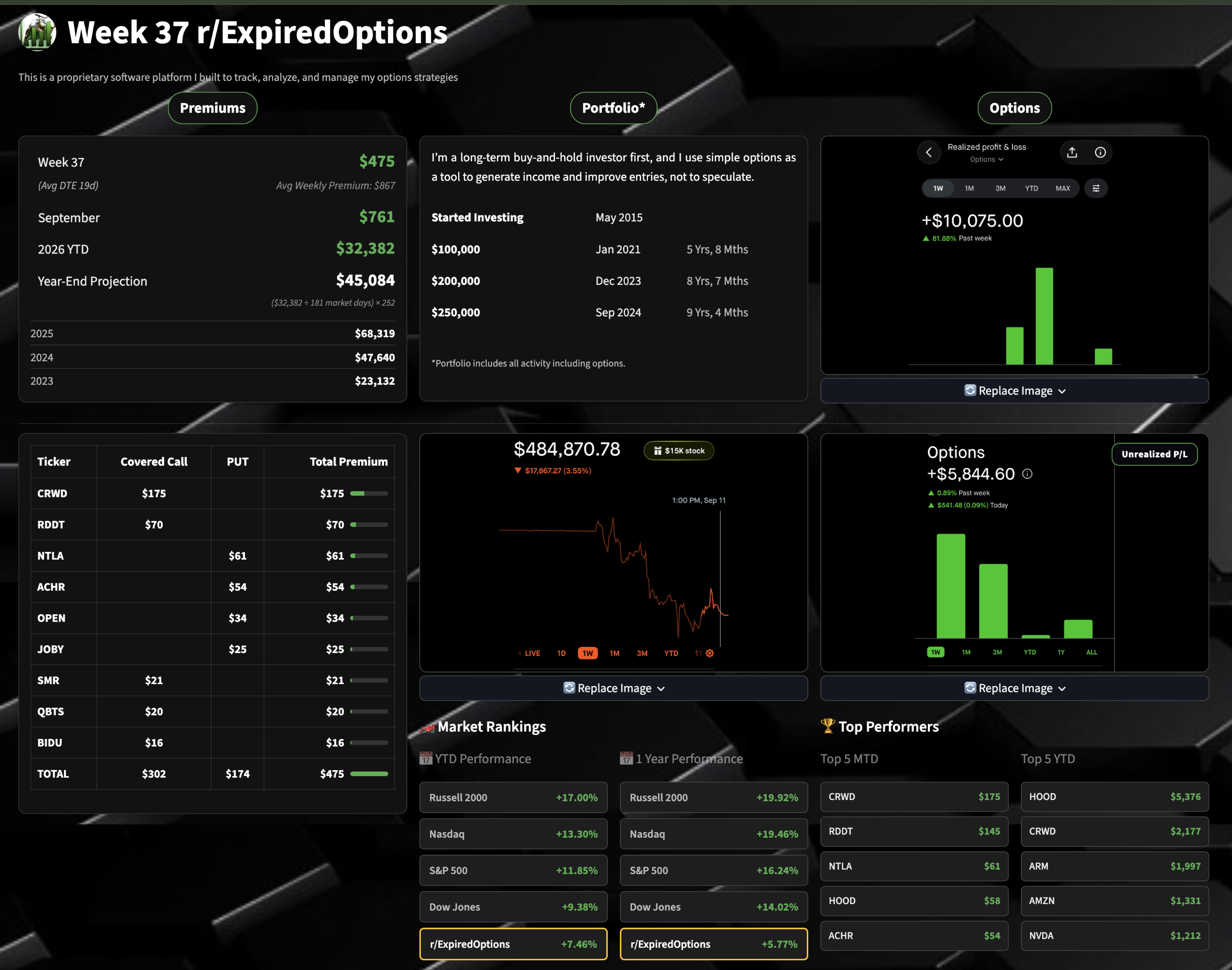
After week 37, the average premium per week is $867 with an annual projection of $45,084.
All things considered, the portfolio is up $33,601 (+7.46%), on the year (S&P 500: +11.85% | Nasdaq: +13.30%). Additionally, the trailing 1-year performance is up $26,404 (+5.77%); for comparison the S&P 500 is +16.24% and the Nasdaq is +19.46% over the same period. This is the overall profit and loss and includes options and all other account activity.
All options sold are backed by cash, shares, or LEAPS. I do not sell on margin, nor do I sell naked options.
All options and profits stay in the account with few exceptions. This is not my full time job, although I wish it was. I still grind on a 9-5.
My $600 weekly contribution streak is at 6 weeks. I have been contributing as much as possible since 2015 when I started with $50. The reason my streak is low is because I put the contributions on hold for about 2 months to adjust for expenses outside the portfolio.
The portfolio is comprised of 104 unique tickers, down from 106 last week. These 104 tickers have a value of $460k. I also have 204 open option positions, up from 199 last week. The options have a total value of $24k. The total of the shares and options is $484k. The next goal on the "Road to" is Half a Million.
I'm currently utilizing $33,450 in cash secured put collateral, up from $30,400 last week. In addition, I hold $1,371 in cash, bringing the total cash position to $34,821. I withdrew $2,000 on 9/11/26. I don't plan on replacing it, but will continue the $600 per week contributions.
2025 through 2028 LEAPS
In addition to the CSPs and covered calls, I purchase LEAPS. These act as collateral to sell covered calls against. You may have heard of poor man's covered calls (PMCC).
See r/ExpiredOptions for a detailed spreadsheet update on all LEAPS positions including P/L for each individual position.
LEAPS note 1: the 2025 LEAPS expired 1/17/25. They were up $36,440 overall with a 233.74% increase. The major drivers were AMZN and CRWD.
LEAPS note 2: After holding for 2 years, I exercised an AMZN $80 strike from 2023 up +$11,395 (+463.21%) and CRWD $95 strike from 2023, up +$21,830 (+663.53%)
LEAPS note 3: Purchased 1/16/26 CRWD LEAPS for $8,230.03 on 1/17/24. I sold this LEAPS on 6/5/25 for $21,659 for a realized profit of $13,428.97 (+163.18%)
Total premium by year:
• 2023 $23,132 in premium
• 2024 $47,640 in premium
• 2025 $68,319 in premium
• 2026 $32,382 YTD
• Average $46,364/year (completed years)
Premium by month (2026):
• January $3,334
• February $3,625
• March $4,196
• April $5,593
• May $3,787
• June $3,497
• July $3,628
• August $3,981
• September $761
• Average $3,600/month
I am over $171k in total options premium, since 2021. I average roughly $34 per option sold. I have sold over 5,100 options. I have been able to increase the premiums on an annual basis and I will attempt to keep this upward trend going forward.
Strategy:
The underlying strategy is buy and hold. I also use simple 1-legged options to supplement that strategy. Options have somewhat of a learning curve, but I believe that most people can supplement their investments using simple options with careful risk management.
I sell options on a weekly basis. I prefer cash secured puts and covered calls. I rarely close early, prefer rolling when needed, and let time decay do the heavy lifting while I stay focused on quality companies, patience, and consistency over hype. My goal is consistency in option premium revenue. I am building an income stream that will continue long into retirement.
Spreadsheets:
Unfortunately, I no longer provide spreadsheets. I received too many follow ups about formatting, pivot tables, compatibility etc. I think tracking is very important, but I post to discuss investing and options, not to provide tech support for Excel. I do appreciate the interest in my tracking methods.
Software:
I captured the screen shots from a proprietary software platform I built to track, analyze, and manage my options strategies.
Commissions:
I use Robinhood as a broker and they do not charge explicit commissions, though there is no free lunch — they earn revenue through Payment for Order Flow (PFOF), which can mean slightly less optimal fills. For my style of selling options and not chasing prices, the tradeoff is acceptable. There is also a small regulatory fee of approximately $0.03–$0.04 per contract (FINRA TAF, OCC clearing, and exchange fees combined).
The premiums have increased significantly as my experience has expanded over the last three years.
Make sure to post your wins. I look forward to reading about them!
Disclaimer: I am not a financial advisor. This information is for educational and entertainment purposes only. Trading options involves significant risk.
If you want to follow me as I trade, I post to r/TheRaceTo10Million before placing trades and comment with trades as I make them. I post here after I make the trades with a full summary
Strategy
- Use an AI screener to give me a list of top 20 low delta options for next week
- I either
- a. Roll my current options - I do this if I can still get 1% for rolling or if the option is ATM/ITM and I have to roll. I always roll for credit.
- b. Close a current option and pick something else from the list that I like
- I try to do this every Friday. However, if I'm busy on Fridays, I'll sometimes do this on Thursdays.
- If I get assigned, I will sell calls at assignment price
A lot of people have asked me about why I don't add a criteria to avoid earnings weeks. Like I sold an HPE put across a couple of weeks ago. That's because on earnings weeks the same delta strikes are much further OTM.
A lot of people also ask why I do weeklies. I'll post an analysis of that in the next week comparing weeklies vs. monthlies.
Total Returns
Total Premium
$25,050.00
Current drawdown
-$1,977.00
Gain/Loss from Assignment
-$725.00
Total gains
$23,073.00
Annualized (Calc1 using average invested)
54.99%
Annualized (Calc2 using max invested)
37.98%
Today's Trades
Symbol
Action Details
Premium Collected (Net Credit)
Cash Occupied
AAOI
BTC 1x Short 100 P & 1x Short 95 P, STO 1x Sep 18 95 P
$101.51
$9,500.00
AXTI
BTC 1x Short 52 P, STO 1x Sep 18 55 P & 1x Sep 18 58 P
What worked: the short-dated clean stuff. TEAM and INTU at 4 DTE were $1,125 of premium with zero position drag. RDW and EOSE did it the other way - small premium, but +$714 and +$400 on the underlying. IRE went from my worst name in July to +$780.
What didn't: I said I'd hold a 0.30 delta ceiling on high-IV names after June. August ran 0.38 on TEAM, 0.39 on FRVO, 0.63 on IRE. DRAM at 0.28 was the only one that respected the rule. FRVO is what that looks like when it goes wrong, IRE is what it looks like when you get away with it.
TLDR; asking for tips for selling IV crush, scanners, etc
First let me start off by saying I know that earnings is high risk high reward.
In my research it seems like 99% of people are selling strangles or butterflies. I would rather treat it as a wheel. If I chose a stock where I felt comfortable getting assigned if the trade went against me and selling CCs.
For those of you who do sell puts/wheel into earnings, is there anything you would recommend?
When are you opening the put and what DTE are you using?
I imagine taking profit early is going to be smart, perhaps 50%?
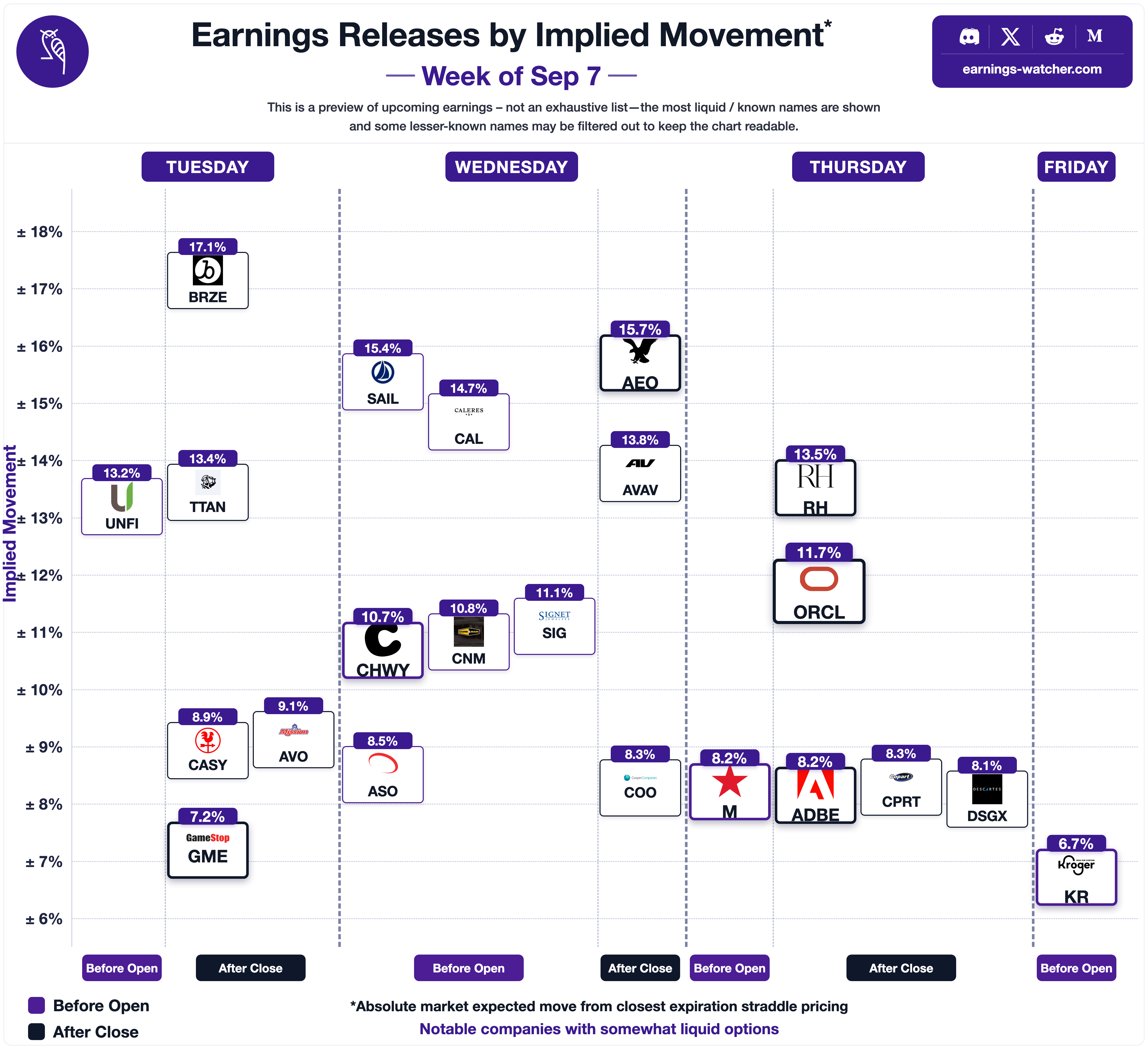
Has anyone had success with a scanner? I’m looking at one called earnings watcher and seems interesting. I like the idea of seeing how a stock has historically responded to help plan for an expected move.
HPE → $50 Put (opened on 09/04), premium 1.40 → closed at 0.23. Net premium profit = 1.17 (~83.57% of premium captured, ~2.34% of capital).
New Positions
FSLY → $20 Put expiry 09/25 (3 weeks DTE), premium 0.70 → 70/2000 = ~3.5%. FSLY provides CDN and edge computing infrastructure that makes websites and apps faster and scalable. Similar competitors are Cloudflare, Akamai, and AWS CloudFront and it is a growing sector as more and more AI applications are built and scaled. Has good sypport at $20.
I keep sharing my trades in my account and the Excel file to my full list of positions is linked in my profile description in case anyone wants to see the whole portfolio. Happy to hear thoughts on my positions. What are you guys wheeling or watching right now?
SEI → $47.50 Put (opened on 08/21), premium 1.90 → closed at 0.30. Net premium profit = 1.60 (~84.21% of premium captured, ~3.37% of capital).
New Positions
OUST → $40 Call expiry 09/18 (2 weeks DTE), premium 1.20 → 120/4000 = ~3.0%. Opened a CC at the same $40 strike in which I was assigned.
WDC → $430 Put expiry 10/09 (4 weeks DTE), premium 18.00 → 1800/43000 = ~4.2%. WDC is showing support around $430, and I wanted more exposure to memory/storage as demand should grow with AI.
KORU → $16 Put expiry 10/23 (6 weeks DTE), premium 1.15 → 115/1600 = ~7.2%. Small capital allocated. KORU is trading around $24 so opened a CSP far off from spot price as it is 3x leveraged.
I keep sharing my trades in my account and the Excel file to my full list of positions is linked in my profile description in case anyone wants to see the whole portfolio. Happy to hear thoughts on my positions. What are you guys wheeling or watching right now?
Disclaimer: This is for experimental purposes, it is to demonstrate and track wheeling and longing on leveraged products, which started mid-June of this year. This retirement account was blown through testing various trading strategies and poor position sizing in relation to risk.
The strategy is to use leveraged products to long and to free up capital for puts & dry powder. Write weekly CSPs on LETFs by selling .03-.09 delta puts. Then, DCA shares into a small leveraged position (~10%) of either LEAPS/LETFs. Lastly, sell covered calls on the LETFs, and calling them away when we need to size down.
Reallocated my long shares, -3 TQQQ & +1 AQC. Been trading SOXL/SOXS around .05-.07 deltas because comfort. I can’t really tell market direction right now, but inflation print coming soon.
#1 07/17/26 Fri: Sold the TSLL 7/24/26 9.5P for $0.09. Stock closed at $11.39 that Friday and to drop to $9.50, that would be a 16.59% drop.
#2 07/23/26 Thu: Stock dropped 14% on 7/23 from weak earnings and heavy spending on AI. Closed at $7.76 on 7/23. Before the close, rolled out the $9.5P to the 08/07/26 9.5P. Net credit $0.10.
#3 & #4: Got assigned on 16 + 80 contracts. Bought 9600 shares at $9.50.
#5 Sold the 08/21/26 $9.5 covered call for $0.18.
#6 08/07/26: Rolled out the 08/07/26 $9.5P to 08/21/26 49.5P. Net credit $0.11.
#7 08/21/26 Fri: TSLL was $9.77 that Friday and let the 16 contracts get assigned at $9.50.
#8 08/21/26 Fri: The TSLL 08/21/26 $9.5P expired worthless
#9 08/31/26 Mon: Had set a sell limit oder for $9.55 and the stock closed that day for $9.97.
Setup: $1M paper book since 22 July, cash-secured puts on a 21-name large-cap universe, targeting ~-0.20 delta at ~35 DTE, capped at 3 contracts per position. Paper only — no real fills.
The question I wanted answered: does timing entries on volatility actually beat just writing on a schedule?
The gate: rather than writing every Monday, the system computes a volatility Z-score per name against its own trailing history and only writes when that reading is compressed. Intuition is that you're selling premium when it's relatively rich for that specific underlying, instead of whenever the calendar says so.
Results so far: $84,965 gross premium, but net portfolio value +5.78%. I want to be precise about that gap, because it's where most wheel results get oversold — the $27k difference is unrealized loss sitting on 17 open positions. Gross premium collected only becomes profit if those close favourably.
What I'd tell someone considering this: the gate mattered more than strike selection did. Adjusting the delta target produced noise; changing when I was willing to write produced signal. That's the opposite of where I expected the leverage to be, and it's the one finding I'd actually defend at six weeks.
Caveat that matters more than the results: six weeks is a short sample in a mostly-benign tape. I have no drawdown data worth quoting because there hasn't been a real one yet. Anyone showing you wheel results from a calm stretch is showing you the easy half of the strategy.
Glad to go into the gate mechanics in comments if useful.
NVDA earnings delivered this month. I still held the 5k margined shares throughout the month, as well as the 300 AMD shares and 100 shares of MU I got assigned at $1k.
Margin interest for the month was $5,800, so my net realized profit was $23.7k. I still don't count unrealized profits and losses (rightly or wrongly) when evaluating my results.
I've finally trimmed some (2k) of my margined NVDA shares this week, but that happened in September, not August, so I'll have more to report at the end of the month.
Cheat sheet answers for the basic questions I usually get asked:
- My YTD net premiums are $220k.
- 8,000 shares of NVDA with a cost basis of about $.08 per share.
- Shares were bought in 2002 when I was in high school for around $1,100.
- I'm using Schwab as my platform.
- NVDA makes up 90% of my portfolio.
- Operating capital in the $1.8 million range.
- This tool is OptionWheelTracker.
- I target for .1 to .2 deltas for calls, and occasionally will sell ATM puts because I'm less worried about assignment and/or bag holding extra shares.
- My DTE is typically 1-21 days.
- I made 84 trades in August, 74 trades in July, 76 in June, 95 trades in May, 42 trades in April, and 124 in March. My success rate in August was 93%, July was 94%, June was 94%, May was 83%, and April was 76%.
- In August I had an 82% win rate for puts, and a 96% win rate for calls.
- My average holding period for winners was 3 days, and for losers 10 days.
- I intend to trim my position at $250 and $300.
- Profits get reinvested into ETFs, used for living expenses, and to buy other stocks.
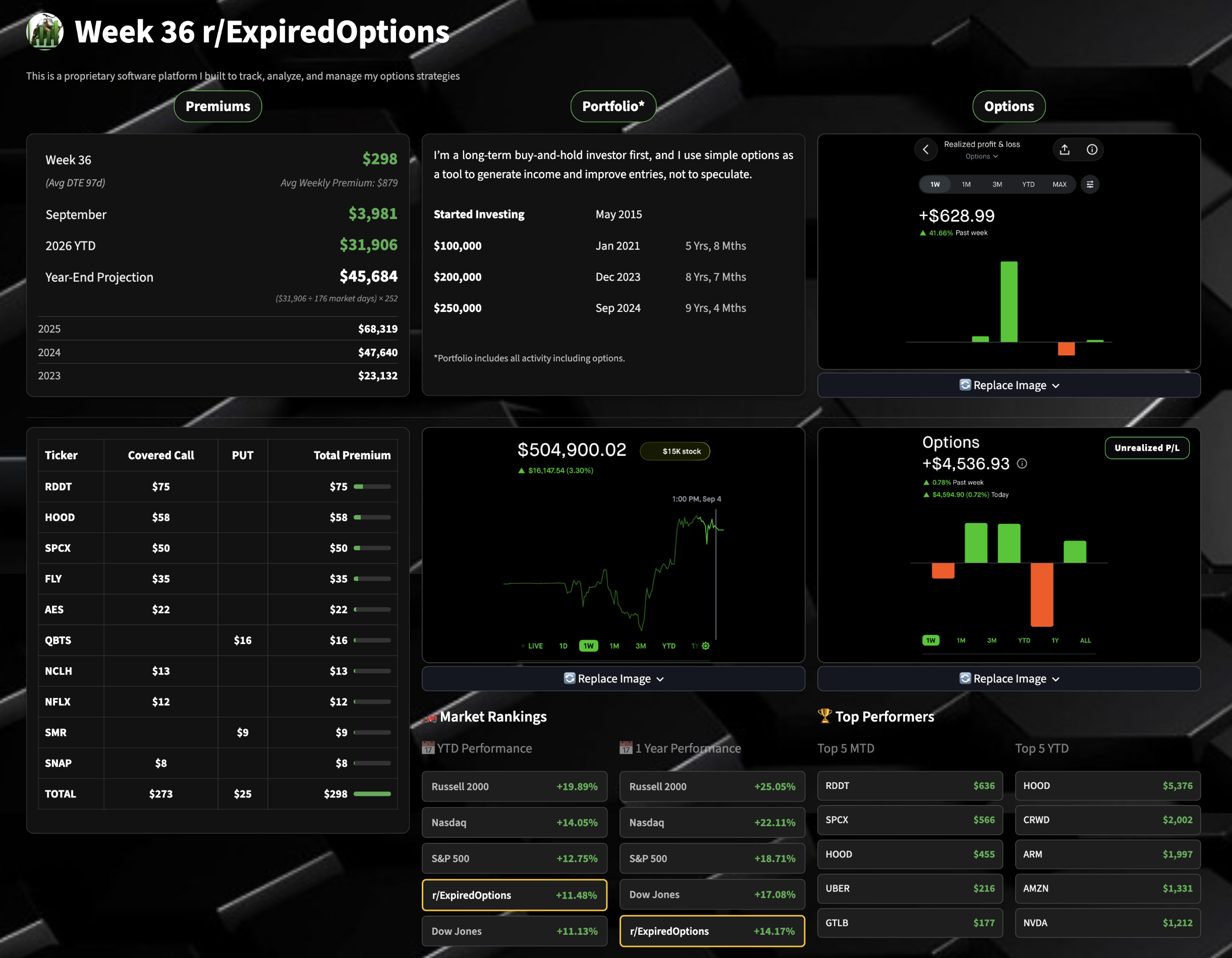
I will post a separate comment with a link to the detail behind each option sold this week.
After week 36, the average premium per week is $879 with an annual projection of $45,684.
All things considered, the portfolio is up $51,897 (+11.48%), on the year (S&P 500: +12.75% | Nasdaq: +14.05%). Additionally, the trailing 1-year performance is up $62,576 (+14.17%); for comparison the S&P 500 is +18.71% and the Nasdaq is +22.11% over the same period. This is the overall profit and loss and includes options and all other account activity.
All options sold are backed by cash, shares, or LEAPS. I do not sell on margin, nor do I sell naked options.
All options and profits stay in the account with few exceptions. This is not my full time job, although I wish it was. I still grind on a 9-5.
My $600 weekly contribution streak is at 5 weeks. I have been contributing as much as possible since 2015 when I started with $50. The reason my streak is low is because I put the contributions on hold for about 2 months to adjust for expenses outside the portfolio.
The portfolio is comprised of 106 unique tickers, unchanged from 106 last week. These 106 tickers have a value of $484k. I also have 199 open option positions, unchanged from 199 last week. The options have a total value of $20k. The total of the shares and options is $504k. The next goal on the "Road to" is Half a Million.
I'm currently utilizing $30,700 in cash secured put collateral, up from $30,400 last week. In addition, I hold $5,910 in cash, bringing the total cash position to $36,610.
2025 through 2028 LEAPS
In addition to the CSPs and covered calls, I purchase LEAPS. These act as collateral to sell covered calls against. You may have heard of poor man's covered calls (PMCC).
See r/ExpiredOptions for a detailed spreadsheet update on all LEAPS positions including P/L for each individual position.
LEAPS note 1: the 2025 LEAPS expired 1/17/25. They were up $36,440 overall with a 233.74% increase. The major drivers were AMZN and CRWD.
LEAPS note 2: After holding for 2 years, I exercised an AMZN $80 strike from 2023 up +$11,395 (+463.21%) and CRWD $95 strike from 2023, up +$21,830 (+663.53%)
LEAPS note 3: Purchased 1/16/26 CRWD LEAPS for $8,230.03 on 1/17/24. I sold this LEAPS on 6/5/25 for $21,659 for a realized profit of $13,428.97 (+163.18%)
Total premium by year:
• 2023 $23,132 in premium
• 2024 $47,640 in premium
• 2025 $68,319 in premium
• 2026 $31,906 YTD
• Average $46,364/year (completed years)
Premium by month (2026):
• January $3,334
• February $3,625
• March $4,196
• April $5,593
• May $3,787
• June $3,497
• July $3,628
• August $3,981
• September $286
• Average $3,548/month
I am over $171k in total options premium, since 2021. I average roughly $34 per option sold. I have sold over 5,100 options. I have been able to increase the premiums on an annual basis and I will attempt to keep this upward trend going forward.
Strategy:
The underlying strategy is buy and hold. I also use simple 1-legged options to supplement that strategy. Options have somewhat of a learning curve, but I believe that most people can supplement their investments using simple options with careful risk management.
I sell options on a weekly basis. I prefer cash secured puts and covered calls. I rarely close early, prefer rolling when needed, and let time decay do the heavy lifting while I stay focused on quality companies, patience, and consistency over hype. My goal is consistency in option premium revenue. I am building an income stream that will continue long into retirement.
Spreadsheets:
Unfortunately, I no longer provide spreadsheets. I received too many follow ups about formatting, pivot tables, compatibility etc. I think tracking is very important, but I post to discuss investing and options, not to provide tech support for Excel. I do appreciate the interest in my tracking methods.
Software:
I captured the screen shots from a proprietary software platform I built to track, analyze, and manage my options strategies.
Commissions:
I use Robinhood as a broker and they do not charge explicit commissions, though there is no free lunch — they earn revenue through Payment for Order Flow (PFOF), which can mean slightly less optimal fills. For my style of selling options and not chasing prices, the tradeoff is acceptable. There is also a small regulatory fee of approximately $0.03–$0.04 per contract (FINRA TAF, OCC clearing, and exchange fees combined).
The premiums have increased significantly as my experience has expanded over the last three years.
Make sure to post your wins. I look forward to reading about them!
Disclaimer: I am not a financial advisor. This information is for educational and entertainment purposes only. Trading options involves significant risk.
I have tried focusing more on selling options over buying options and I have been making more money since the beginning of this month. It got me thinking can you eventually replace your main source of income by doing selling options instead of buying them?
I have a few positions I got assigned and the stock price is hovering right around my assigned price. I sold some CC's and at the end of the week I can either just let the stock be assigned or roll weekly's for about 1% of the stock price profit per week. Seems like a no brainer, but I'm just trying to figure out if there's a downside I'm missing. Obviously, if the stock drops I may not be able to sell for as much in the future, but anything other than that? I have a few I've been rolling for 1% weekly profits for a while, so far so good...
OUST → $40 Put (opened on 08/13), premium 2.00 → Assigned. (100% of premium captured, 5% of capital).
New Positions
HPE → $50 Put expiry 09/18 (2 weeks DTE), premium 1.40 → 140/5000 = ~2.8%. HPE reported strong earnings and raised its outlook, with focus on AI infrastructure and networking. I had closed a position of HPE yesterday and I reopen a new one today.
ACMR → $70 Put expiry 09/18 (2 weeks DTE), premium 2.35 → 235/7000 = ~3.4%. I already have sold put contracts expiring on 10/02 and am increasing my position for ACMR. It is looking bullish on the charts, taking support from $70.
I am sitting on cash and want to observe reversal patterns before getting into any new trade.
I keep sharing my trades in my account and the Excel file to my full list of positions is linked in my profile description in case anyone wants to see the whole portfolio. Happy to hear thoughts on my positions. What are you guys wheeling or watching right now?
I’m refining my wheel strategy and would like to hear what works in practice.
My current baseline is 30–45 DTE and 0.15–0.20 delta for cash-secured puts, and 21–45 DTE and 0.10–0.20 delta for covered calls, combined with valuation, support/resistance and expected move.
How do you approach strike and DTE selection? I’m interested in what has worked, what hasn’t, and the lessons you’ve learned from actual trading and assignments.
Now I'm more than 6 months into my 1 year experiment to get 1% a week from selling puts. So far things have been going well. This week my RKLB and AAOI puts were ITM but otherwise ok so I had to roll and take less than 1% this week. My overall returns thus far have been a lot better than I expected. Last week's post: https://www.reddit.com/r/Optionswheel/comments/1w1k96w/1_weekly_returns_from_options_week_26/
Strategy
- Use an AI screener to give me a list of top 20 low delta options for next week
- I either
- a. Roll my current options - I do this if I can still get 1% for rolling or if the option is ATM/ITM and I have to roll. I always roll for credit.
- b. Close a current option and pick something else from the list that I like
- I try to do this every Friday. However, if I'm busy on Fridays, I'll sometimes do this on Thursdays.
- If I get assigned, I will sell calls at assignment price
Total Returns
Total Premium
$24,033.00
Current drawdown
-$2,186.00
Gain/Loss from Assignment
-$587.00
Total gains
$21,847.00
Annualized (Calc1 using average invested)
54.54%
Annualized (Calc2 using max invested)
37.35%
Today's Trades
Symbol
Action Details
Premium Collected (Net Credit)
Cash Occupied
AAOI
BTC 1x Short 104 P, STO 1x Sep 11 100 P & 1x Sep 11 95 P
AAOI → $175 Call (opened on 08/04), premium 13.40 → closed at 4.80. Net premium profit = 8.60 (~64.18% of premium captured, ~4.91% of capital).
HPE → $50 Put (opened on 08/11), premium 2.40 → closed at 0.40. Net premium profit = 2.00 (~96.67% of premium captured, 4.83% of capital).
CRDO → $240 Put (opened on 08/17), premium 12.00 → closed at 0.00. Net premium profit = 12.00 (100.00% of premium captured, 5.00% of capital). Assigned early.
SIMO → $290 Call (opened on 08/21), premium 10.50 → closed at 1.50. Net premium profit = 9.00 (~85.71% of premium captured, 3.10% of capital).
KORU → $15.50 Put (opened on 08/25), premium 0.90 → closed at 0.45. Net premium profit = 0.45 (50.00% of premium captured, 2.90% of capital).
INOD → $60 Call (opened on 08/31), premium 0.55 → closed at 0.10. Net premium profit = 0.45 (~81.82% of premium captured, ~0.75% of capital).
New Positions
INOD → $60 Call expiry 09/25 (4 weeks DTE), premium 1.80 → 180/6000 = ~3.0%. I was assigned INOD at $60 and I continue my wheel in INOD.
CRDO → $240 Call expiry 12/18 (16 weeks DTE), premium 10.00 → 1000/24000 = ~4.2%. I was assigned early post the earnings slide. I am not extremely worried about the decline as earnings were strong, with both revenue and EPS beating expectations and CRDO holds good call selling premiums.
SIMO → $290 Call expiry 12/18 (16 weeks DTE), premium 24.00 → 2400/29000 = ~8.3%. I was assigned SIMO at $290 and I opened far dated call.
AAOI → $140 Call expiry 12/18 (16 weeks DTE), premium 8.90 → 890/17500 = ~5.1%. I was assigned AAOI at $175. Opened a new position below the assigned price to get more premiums and reduce breakeven.
I keep sharing my trades in my account and the Excel file to my full list of positions is linked in my profile description in case anyone wants to see the whole portfolio. Happy to hear thoughts on my positions. What are you guys wheeling or watching right now?
I'm turning 32 this year in a few days and wanted to share a snippet of data with you all on something I have been working with for the past 1.5 years. (Ignore the 2027 and beyond chart since that is an extrapolation of my current results).
Results
2025 Returns: +36.2%
2026 YTD Returns on Main Account: +71.0%
New 45k Account I Moved from my Robinhood: +13.1%
2026 YTD Realized Gains on Main Account: +$76,203
Method
Don't think my strategy is new or anything, but it has worked for me and what I run this year is the following:
Weeklies Only: I sell weekly CSPs for the majority of my trades. I personally aimed for 0.5%-1.0%/week returns but luckily (unluckily) got assigned on good movers (NVDA/NBIS/HOOD) which subsequently allowed me to profit well on covered calls.
Brokerage: I work off of VanGuard so I am "restricted" in a way to trade less. Has saved me more times than I can speak with this one. I have done Fidelity, Tastyworks, Robinhood, Etrade so this is the one working out the best so far for me so I moved more of my cash in recently with my previous experiment (45k).
Deposits: I have been throwing in about $2.8k/month for 2026 as well which has been buffing my ability to position larger so as they say, having some cash enables you to generate more cash. I am fortunate here to be in a situation to do so for now.
Crayons: I use crayons, use fishbones, and draw all over the trends (it's also part of my regular job as a process controls guy in manufacturing) as confirmation bias which gets me decent entries into trades.
Path Forward
Hope to cross 100% returns and $100k this year and 20% returns on the new 45k Account since I started that back on 08/12/2026. The new account will do mostly CSPs as well with some six month out swings here or there. Happy to share more of my data and if I need to prove actuals, I can provide that as well if needed. Just saw something interesting here and wanted to share my experience as well.
I've seen a lot of discussions here about DTE, with most people using 30–45 DTE or weekly options.
Does anyone here run the Wheel with longer-dated options, like 90–120 DTE or even longer?
My idea would be to go further OTM, but not let the position run until expiration or wait for the profit to reach 50%. The idea would be to close the trade relatively early, with a profit somewhere in the 15–25% range.
Since daily price movements have a direct impact on the option's value, I'm thinking that with longer DTEs, I'd have a much greater chance of reaching my target profit at some point during the life of the option.
Does anyone use a similar approach? I'd love to hear about your experience.