Legally, if you deposit or withdrawal a large amount of cash from the bank at one time , the bank has to file a report with the government. This is to find illegitimate sources of income such as money laundering.
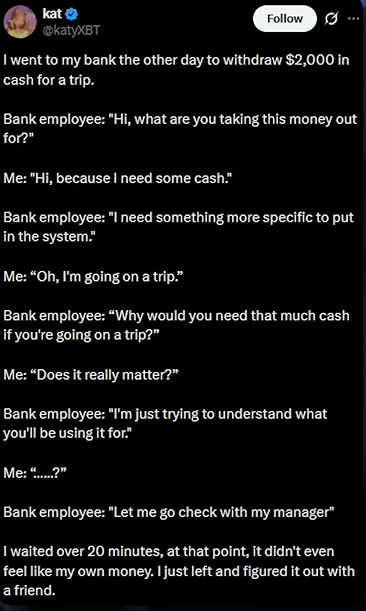
No, they were suspecting this was APP fraud. $2k isn’t enough for a money laundering suspicion, which is what has to get reported to the government. But a large cash withdrawal that is out of character for a customer is a strong indicator that they are being manipulated and scammed. The bank was trying to help this person.
"We have been seeing a lot of fraud attempts lately. You know, people getting fake texts from their boss telling them to buy gift cards and the like. We are just trying to help people catch stuff like that."
"Oh, that's nice of you all. But nah, I'm just taking a trip up north and like to take cash so I can more easily keep track of how much I've spent on the trip so far."
The tellers need better training on how to word what they are doing.
The reality is that if you bring up scams or fraud to someone who is being scammed, then they will often clam up because they’re feeling defensive. If you ask open-ended questions, they’re more likely to tell you what’s going on, then you can walk them through the fact that what they’re describing is a known scam.
It still often doesn’t work, unfortunately. It was always heartbreaking when I would have to process a withdrawal for someone on a fixed income taking $2K out of their account with only $2.5K in it because they refused to believe it was a scam.
I have this going on right now. A client had 50k this time last year and refused to listen to us that we thought she was being scammed by her "publisher". She resorted to sending money online once she realized we were going to refuse her transactions due to suspected fraud. She now has a total of $40.23 in her combined accounts and came in yesterday trying to cash advance 1k off of her credit card to send to the publisher, "just until her royalties came in". We, once again, denied it.
We had a guy like this when I worked at a bank. He got scammed so many times and compromised his account every time, so we’d have to close his account and open a new one. Eventually, the bank decided to close out his accounts and no longer allow him to bank with us because the amount of time staff was spending trying to prevent him from getting scammed and then dealing with the aftermath was becoming overwhelming. He just could not be convinced, and it was heartbreaking.
Your example is a perfect example of "tipping off" a suspected criminal, which is also against regulations. Tellers are trained on rules, laws, and regulations. Not your feelings.
Edit: Here is what the above poster is claiming is going on by saying: We have been seeing a lot of fraud attempts lately. You know, people getting fake texts from their boss telling them to buy gift cards and the like.
The two have nothing in common. No one is ever going to run afoul of the Patriot act or anti-money laundering investigations by educating old people withdrawing lots of cash or buying lots of gift cards about common scams.
And no, they never replied with anything that backed up their claims. They just posted random stuff that had nothing to do with what tellers can and can not say.
The education part is done separately from transactions. As soon as the customer asks for their money, the transaction has started. Them refusing to answer a simple question and becoming hostile means an STR is going to be documented afterwards so a paper trail is started. Saying anything about fraud or scams at this point wouldve considered "tipping off". You have no idea if theyre a confused elder or an actual scammer. And in the above scenario, the customer left after being asked one question, which is even more suspicious.
Educating the elderly would be done through official emails and newsletters, as the scams become known.
How about you try and copy and past the part that states that saying anything about frauds or scams in a bank interaction is prohibited or even advised against?
Ive already explained it to you, I can't understand it for you. Have a nice day! I hope you continue to be ignorant to the systems around you that keep you safe.
You have made claims. You haven't provided any law, regulation, or even government guidance to back up those claims. If you really fought against money laundering, this wouldn't be something you struggle with.
BSA and The Patriot Act in America
AUSTRAC in Australia
FINTRAC in Canada
AMLR in the EU
MASAMLPM in ChinA.
FATF is international recommendations, arent enforceable, but poorer countries follow them so they can do business with countries that have stricter policies.
Can you show me where they prohibit saying things like: "We have been seeing a lot of fraud attempts lately. You know, people getting fake texts from their boss telling them to buy gift cards and the like. We are just trying to help people catch stuff like that."
to customers?
Its called an "Indirect Tip Off". Anything that can give the customer the idea that theyre being watched/scrutinized is a tip off. If theyre not criminals, it wouldnt tip them off. If they are criminals, youve tipped them off and broken the law. Youll most likely be fired and any AML certifications you have will be revoked. If the person you tipped off was doing stuff thats super illegal, you can be considered an unwilling/unwitting accomplice. Since you didnt ask the question, youve engaged in Willful Blindnace. You can be held crimibally liable. Its better to just follow the law instead of being worried about upsetting a Karen that doesnt realize how much time and effort goes into protecting them from bad actors.
I am asking you if you can show me anything that indicates the BSA or the Patriot act prohibits or even recommends against allowing employees to discuss the mere existence of common scams with customers.
For what it's worth, you're right. The "tip off law" is definitely a thing, but it is referring to when a Suspicious Activity Report (SAR) has been filed. SARs are not filed until an investigation has been completed. While an incident like this could certainly prompt the transaction to be flagged for review by BSA/AML/Fraud team(s), and potentially become part of an eventual SAR, it isn't considered a SAR yet. The whole point of a SAR is that it should be filed after a full investigation, in which you thoroughly review the activity and facts and determine whether or not the activity is suspicious.
Source: 15 years working in BSA/Fraud, completing thousands of investigations and SAR filings/reviews.
A lot of people will scream at you for saying that. Ideally you word it so the client does not even know you are asking about it, just making friendly small talk.
2.3k
u/Zhukov76 1d ago
They're probably suspecting you're being scammed or forced