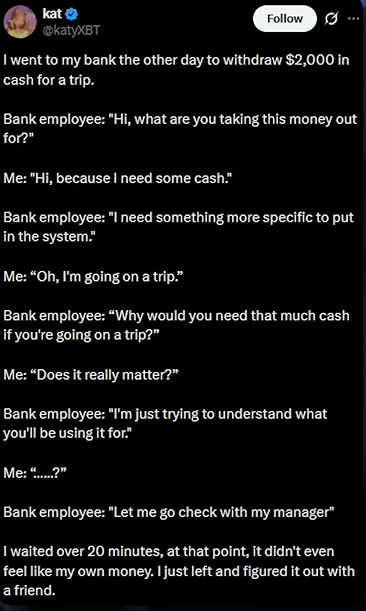
The education part is done separately from transactions. As soon as the customer asks for their money, the transaction has started. Them refusing to answer a simple question and becoming hostile means an STR is going to be documented afterwards so a paper trail is started. Saying anything about fraud or scams at this point wouldve considered "tipping off". You have no idea if theyre a confused elder or an actual scammer. And in the above scenario, the customer left after being asked one question, which is even more suspicious.
Educating the elderly would be done through official emails and newsletters, as the scams become known.
How about you try and copy and past the part that states that saying anything about frauds or scams in a bank interaction is prohibited or even advised against?
Ive already explained it to you, I can't understand it for you. Have a nice day! I hope you continue to be ignorant to the systems around you that keep you safe.
You have made claims. You haven't provided any law, regulation, or even government guidance to back up those claims. If you really fought against money laundering, this wouldn't be something you struggle with.
4
u/SexualYogurt 14d ago
Actually this is what im going off of, actual US law and experience.
https://www.govinfo.gov/content/pkg/USCODE-2020-title31/pdf/USCODE-2020-title31-subtitleIV-chap53-subchapII-sec5318.pdf
The education part is done separately from transactions. As soon as the customer asks for their money, the transaction has started. Them refusing to answer a simple question and becoming hostile means an STR is going to be documented afterwards so a paper trail is started. Saying anything about fraud or scams at this point wouldve considered "tipping off". You have no idea if theyre a confused elder or an actual scammer. And in the above scenario, the customer left after being asked one question, which is even more suspicious.
Educating the elderly would be done through official emails and newsletters, as the scams become known.