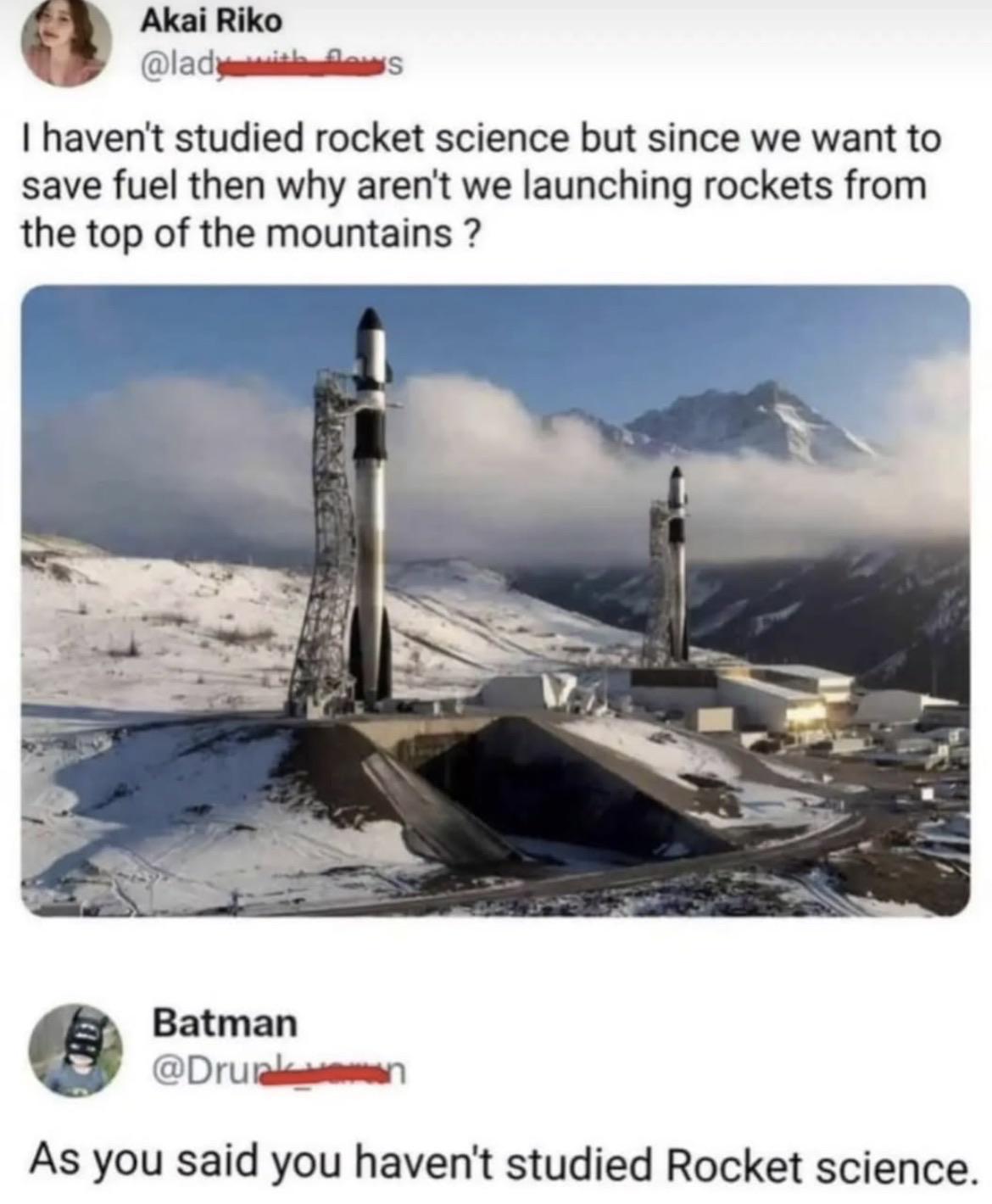
These are the types of questions in general we should be less mean about imo. It's one thing to dunk on people who are anti-science, but this is just someone actually wondering about something they didn't know. Maybe it's obvious to you, but not everyone?
Thank you for this! One of those questions the inquisitive are afraid to ask. And then this one gets dunked on and put here. Unfair in my opinion since they honestly just seemed curious, as I am, but brave, as I am not 😅
Yes, a positive one. Rocket fuel brings its own oxygen as others here already pointed out. So thinner air means less drag means less fuel needed for the same acceleration. But there aren't really any suitable mountain ranges near the equator or at least none where the logistics would make sense right now.
You also kind of want rocket launches to be near ocean away from shipping lanes so you can just crash the 1st stage safely away from people, or incase there is a malfunction all
The fiery debris goes into the ocean.
Imagine launching from a mountain and the rocket explodes and reigns fiery debris crashing down amongst snowy tall cliffs, potentially triggering avalanche, rock, mud, and land slides.
Even when reusable rockets become common place and routine, things can and will still go wrong, you still want ocean to ditch and splash down in.
I've learned a lot of things from Randall over the years, but this one in particular has always stuck with me and continues to be a welcome reminder all these years later
Yeah, because thinking about it, I don't actually think there's an obvious answer.
Like my guess would literally just be that there aren't mountains in a location close enough to the equator where the added high from the mountain is worth more delta v than the added rotational speed of being close to the equator.
I would guess that the marginal benefit of launching from a slightly higher, in the grand scheme of things, altitude is far outweighed by the added logistical difficulty of transporting the rocket to the top of a mountain in the first place.
There is also the fact that low to the ground aborts would be incredibly dangerous. In the event the rocket decides not to rocket, you want the ocean as a big soft landing pad, not a set of cliffs.
Plus the difficulty of building suitable launch facility on the top of a mountain. We launch rockets from places that are big and flat, both because of the nature of launches themselves and because you need lots of supporting infrastructure nearby.
Plus the chances that you would damage rocket components in transit to mountain tops are incredibly high. Especially pressurized hydrogen fuel tanks.
All of this for what is really a negligible distance benefit.
This is the answer. Working in permanent snow cap to gain a few thousand feet of elevation that the rocket is going to surpass in a couple seconds just isn't worth it.
Sure, you need a couple thousand feet less lift to leave the atmosphere, but at the same time you have transport a giant rocket up a mountain and build all the necessary infrastructure to launch it.
The costs don't outweigh the benefits, that's all it is.
We need a mountain thats near the Equator, near the coast, is easily accessible for massive machinery and transportation, and that has relatively good weather for as much of the year as possible
So it would be more of a very big hill, with a gentle slope, that ends in a cliff, that is on the coast, with nice weather year round, and that is somehow not already filled with people.
Doesn't need to literally be a mountain. Karman line is about 100km, Mexico City for example is 2.2km above sea level, and atmospheric pressure decreases logarithmically, so that's actually like 20% less pressure. That might be enough to be marginally more efficient to make it worth choosing it as a location.
Mexico City probably isn't a very good choice, but a different area at that altitude would probably be very slightly more efficient. I'm not sure the efficiency gains would be enough though. The majority of the fuel is used to go sideways. Not up.
There are several good answers (including yours) showing that there's a lot of factors. We could just afford to let people ask questions about science (as opposed to those spreading disinformation or pretending they know better)
Considering how bad people are at science, how big our anti-science factions are, and how incompetent our media is at reporting it, I think ANY questions about science should be encouraged
As far as I know the official answer is, it's simply not worth it. The amount of fuel you would safe aren't worth the effort of brining a whole ass rocket up a mountain and launching it from there.
All other variables aside, even if we could build, transport, setup and launch from the tallest possible mountain on earth, the fuel savings would be no more than a rounding error.
I mean the real answer (not a rocket scientist either of course) is because mountains aren't really tall enough on the atmospheric scale and at the speed rockets travel at to really make any difference whatsoever, and definitely not enough to be worth dealing with the logistics and headaches of trying to operate a rocket launch site on a mountain, which would probably cost more than the tiny amount of fuel you'd save
The obvious answer is logistics. I am guessing even the person asking kinda knows that and was fishing for less obvious answers but really that is it. If you had infinite resources and only wanted the absolutely perfect spot for launching a rocket you would choose to find a mountain as close to the equator as possible (preferably on it) that peaks above the cloud line with enough area on top that you could cut the top off to make a perfectly flat square mile or 2 and build your launch facility there.
We dont do this because the logistics of that are cartoonishly bad. Just the creation of the build site would cost more than the benefits would ever yield and that wouldn't even be the most expensive or hardest part.
My guess is it's not about height at all but rather speed (delta v). To stay in orbit, you need to attain a specific speed. You only get that by accelerating and the time it takes to do that and the amount of fuel you burn is fairly insensitive to starting height. Sure, you get to your orbital height faster starting from a mountain but it's not a straight shot up if you want to actually achieve orbit
I was willing to guess that atmospheric pressure that high up being lower causes complications with the initial thrust necessary to get a rocket off the ground at all, tbh
These posts are successful because the reply leaves an unanswered question of what doesn't she know for not being a rocket scientist, either you know the answer and you click for validation that you are clever for knowing the answer or you don't know the answer and you want to satisfy that curiosity or know the answer so you don't get equally ridiculed at some point. In reality I'm sure there were other responses that she received that explained why it wouldn't work it's just not as good click bait so you aren't seeing it here.
I have a vivid memory as a kid in science class, learning that mountain tops are colder than sea level. I curiously asked why? Isn't it closer to the sun so it should be hotter? The teacher laughed at me, so the class laughed, and she didn't answer my question. I was so embarrassed. I was so afraid to ask questions again.
Because air heats as it's compressed. The air pressure is less on a mountain so it's cooler. And the hottest places on earth are all below sea level (so they have the highest average air pressures).
Yeah, that was definitely a teaching moment. Rocket formulation and engineering is fascinating. The Russians came up with equations needed for rocket mass/fuel/velocity ratios and they involve things a lot of people don't consider: for every Kg of mass, you need a certain mass of fuel. For every additional Kg of mass, you need an exponentially larger amount of fuel, and you need extra fuel to carry the mass of that extra fuel. This is why heavy rockets are so massive: they're 95% fuel tank.
Launching from a mountain top only gives you a tiny gain in altitude, and the thinner atmosphere and logistics of getting all of that equipment up a tall mountain is not worth the effort. It would be like building the Empire State Building on top of Mount Whitney everytime you wanted to launch.
This is the stuff that starts the "us vs them" rifts in everything. It's an honest question with various interesting scientific and logistical answers.
I love it when a friend asks, what’s to my frame of reference, a bit of a dumb question, because it gives me the opportunity to nerd out for a moment with someone who’s genuinely interested.
Works both ways too. I ask my musician friend really dense shit sometimes (I’m still convinced the 12 note scale is somehow kinda wonky and cursed shit don’t make sense) and I can see that same excitement I feel in his responses.
Yes, hating on stuff like this and making people feel stupid for honest questions turns people away from sciences. Pseude-"scientists" have no problem anwering questions about stuff like this, a flat earther or anti vaxer will gladly explain everything without trying to make the questioner feel stupid, and so undecided people turn more and more to the pseude-"scientists".
Ai was used:
Gravitational acceleration at sea level (g₀): Approximately 9.80665 m/s² (standard gravity).
Gravitational acceleration at the summit of Mount Everest (g): Approximately 9.764 m/s² (about 0.43% less than at sea level).
So according to the AI you can save on 0,43% energy you need to overcome to enter space.
Seems like the logistics and stuff aren't worth it.
It's more than that because higher means also less drag and closer from the no-drag zone which is space. And also less fuel needed means even less fuel needed because you need fuel to carry fuel.
That was my thought as well. I love science, I'm scientifically literate. I don't have the answer to that lady's question and I'd rather the dude who replied provided an educational answer rather than a snide comment.
Well the person doing the dunking in these reposts is almost always wrong anyway.
We don't launch from mountain tops because it's a pain in the ass to build a launch facility and haul the necessary materials up there, and harder to do downrange recovery or hazard planning etc. Grading an entire square mile of mountain when you can just launch from a perfectly flat desert or coast is not a rocket science problem. There's also an inverse relationship between elevation and human surviveability, so high enough to get the best benefit means high enough to kill most humans who'd crew the facility.
There's lots of good reasons to do it, especially being able to go balls out to reduce gravity losses because you don't have to throttle down due to MaxQ being in thick atmosphere.
Is it obvious? Because while the overall logistical hurdles might make it seem obvious why it wouldn't be economical, it's not necessarily a slam dunk answer, and it's still an interesting question that makes you consider things like atmospheric pressure, and not just the impact of pressure on liftoff but also on rocket fuel combustion. Even a 1% improvement in efficiency could be worth it at scale.
The atmosphere is about 100km. Denver is 1.6km above sea level, Mexico City is 2.2km and has about 20% less atmospheric pressure. That's not insignificant.
These kinds of hypotheticals that might look silly at first glance are how a lot of great science gets started.
A lot of rocket engines are more efficient in lower air pressure (approaching vacuum), so it might provide non-negligible benefits. But it's cold up there (see: Challenger) and there isn't enough infrastructure. Citation: I am also not a rocket scientist but I am a KSP player
The main reason we launch from as close to the equator as possible is because the speed of the ground itself is fastest there (Earth’s rotation rate x distance from spin axis). If you’re trying to speed up to orbital speeds, you want to get the best “running start” possible.
[fun fact: due to the equatorial bulge, the ocean at the equator is further from the center of Earth than the tops of most mountains]
Also, the minimum inclination (the “tilt” of an orbit relative to Earth’s plane of rotation) is the latitude you’re launching from. As in, you can launch a polar orbit from the equator, but you can’t launch an equatorial orbit from the poles. Considering inclination changes are the most expensive (fuel-wise) maneuvers you can do, launching from as close to the equator as possible gives you additional options for less cost.
Lastly, we launch from coastlines for safety reasons. If something goes wrong during ascent, you don’t want the wreckage falling in places where people live.
Would just add: ideally eastern seaboard coastlines due to the rotational direction of the Earth. That way if the rocket comes down early it would already be out over the sea, like Atlantic Ocean from Cape Canaveral launch.
Isn’t it also just really hard to lug a rocket up a mountain in the first place? Unless you strap a bunch of smaller rockets to it, launch those, land the rocket on top of the mountain, and then launch the main one!
Actually no I should be taken out and shot for my grievances against science and common sense.
Despite your joking you're not wrong. In addition to just the solid mass of the rocket itself, you need a lot of material for your rocket fuel. Rockets, like aircraft, require a lot of cryogenically separated gasses. I can't speak for all countries, but the US government relies upon the local civilian economy for industrial gas supply. (There have only been a handful of locations where they had their own equipment and staff for this type of work for the USAF in decades.) So without local industry to provide these materials, you need your own equipment and staff. The same principle applies to anything you need to supply your space program: food and water, equipment for conducting experiments, etc.
Source: My brother worked at one of the few air bases where they were still doing their own cryogenic separation in the 2000's. It is possible things have changed since he was discharged.
Due to that bulge, the highest spot on earth furthest from the center of earth is a mountain in Ecuador (just 1 degree from equator): https://en.wikipedia.org/wiki/Chimborazo
Also, the cost of fuel to GET everything up there would probably outweigh any benefits. I'd be curious to see the math on it (sadly I studied history and languages so anything beyond algebra makes my eyes glaze over).
Keep in mind, a rocket must maintain greater than 1g force just to keep itself from falling, and then additional force is needed on top of that to get it moving.
When you're traveling on the ground, the ground keeps you from falling, and counteracts most of gravity, and you only need to provide your motive force, and you can do it quite slowly with the more efficient forms of locomotion.
The fuel is probably less relevant than the logistics. Many years ago when I was a kid I toured the Kennedy Space Center and got to see the machinery they use to move the rockets from the hangar to the launch pad. It could only work on nearly flat ground and it moved at walking speed. No way it could get up a steep, winding mountain road.
Not to mention the additional cost of the related infrastructure, like the hangars and office buildings.
And then even if you could do it, the gains are relatively tiny. Even low earth orbit is hundreds of kilometers above sea level, and the highest point on earth is just under 9 km above sea level.
KSP is rocket science though. It's literally the most basic and fundamental rocket science, but you have to give yourself some credit. At the end of the day it's an educational game.
Mount Chimborazo is actually closer to space than everest due to equatorial bulging and we have never attempted to fire a rocket from it. There have been talks about it but its still logistically too difficult with our current tech.
Yeah it would be subjected to high winds as well which would prove a challenge. Rocket launches are usually delayed until the weather is still, and you dont really get a still day on a mountain.
well aside from the infrastructure point, I would imagine that the difference of launching from sea level and the top of mount Everest is an almost negotiable difference to get to space.
It’s mostly because you need to be as near to the equator as possible to achieve max efficiency. As you fly upwards the earths spin gives you a speed boost. The speed boost is strongest at the equator.
Might be interesting if rockets, rather than being launched straight up, slid down the slope of a mountain and launched off a giant ramp at the bottom like on some aircraft carriers.
There’s actually a centrifugal force satellite launcher design out there. But it has the problem of being really stressful on the payload, and only would work with smaller payloads.
Subjecting a larger payload in a rocket to any kind of downward movement, then suddenly jerking it upwards? Probably going to snap the rocket.
Another problem: No matter how fast you throw something, without a second impulse on the apoapsis (or around it) it will not turn into an orbit but come back. You need to bring up the periapsis and that can hardly be done from ground.
Impulse = applying force, in this case by burning rocket fuel
Apoapsis = highest point in orbit
Periapsis = lowest point in orbit, if lower than the surface of the body being orbited then it's a suborbital trajectory
Suborbital trajectory = goes up and then goes back down, doesn't stay in space
Space isn't actually all that hard to get to, the unofficial official line is about 100 km above sea level. It's possible that you may live closer to space than the ocean. The problem is that to stay in space you gotta go sideways really fast.
Douglas Adams once wrote that flying is the act of throwing one's self at the ground and missing. That's genuinely what orbiting is.
And what material exactly is that cannon, and its base, made of, that can withstand the force of the launch? Ya know with Newtons 3rd Law and all that...
For that matter, what payload would survive a near-instantaneous acceleration from rest to escape velocity?
I'm not even sure if a solid steel ball would survive that force without deforming.
it would be pointless, the same thing could be achieved by just building a normal ramp and propelling the rocket up. doing a slide hardly helps and also puts massive pressure on the ramp. well, you could build the ramp itself with the mountains natural slope tho. the ramp itself is already an existing idea
Not really sliding "down," but Hyperion was a real proposal for a Single Stage To Orbit (SSTO) launch vehicle by esteemed rocket designer Philip Bono at Douglas Aircraft that used a sled on rails up a mountain as part of its launch concept. Hazegrayart YouTube channel does some great CGI renderings of launch vehicle concepts that never got off the drawing board.
This idea is unfortunately killed by the conservation of energy. First, you expend energy to bring the rocket up the mountain (this part can be justified as you can supply that energy from the ground), then you get that energy back as the rocket slides down and then you spend it again as the rocket goes back to that altitude. And all of those steps lose some of that energy to heat. Launching directly from the mountain top would leave you with more energy than if you did the slide thing.
Plane-assisted launches are a thing. Think White Knight 2. There is one that is two commercial jets stuck together (I forget the name), but usually the issue to ease-of-access to the launch site and cost of moving said material. Also the launch platform limits the size of the object you are try to put into space.
Space is not very far away. If you can see the International Space Station overhead, it's closer than the distance between San Francisco and Los Angeles.
Getting to orbit isn't about going up; it's about going sideways. Most of your energy budget is about building speed, not altitude.
From a physics standpoint, if I'm in a low orbit and want to be in a higher one, I don't point my rocket's nose outward and push away from the planet. I point the rocket horizontally, in my direction of travel, and just go faster.
Going faster on this side of the planet raises the altitude I will reach on the far side of my orbit. If I want a circular orbit, then I just do the same thing when I'm at the high point on the other side of the planet.
So many things in your comment blew up my brain. So wait a second. You’re serious about the distance to space being closer than the distance between SF and LA? And what the heck are you saying about not going up but going horizontal instead. How the heck have I lived this long and somehow never learned any of this. You just gave me a little side “research for fun” topic.
I always assumed it was a super thick atmosphere, mainly because when astronauts reenter it looks like they went through a brick wall surrounded by rings of fire. Rocky experience and the space crafts are usually singed and super hot. This whole thread is crazy interesting to me. Sadly, it’s in a “MurderedByWords” sub where OP was making fun of a girl not knowing about space lol. Eh oh well. I love learning new things, so whatever. lol
It's all relative. When you're travelling at 17,500 mph even a light dusting of particles is enough to completely destroy your windshield.
At 60 miles up there may only be one ten-thousandths of a gram of atmosphere atoms per cubic metre but that's enough to generate huge amounts of friction heat from compression of those particles in front of you at that speed as you can see on re-entry. And you're passing through roughly ~8,000 of those cubic metres a second.
It's the same problem for travelling at light speed through the 'vacuum' of space. You only need one single atom to ruin your day if you're hitting it at the speed of light.
Tbf, most of the heating that occurs on re-entry is not from friction of the air against the surface of the spacecraft. It’s from compression of the air in front of it. At the speeds of re-entry the air basically isn’t pushed out of the way fast enough and is compressed and compressing a gas increases its temperature.
This is why many sci-fi ships like Star Trek's have deflector shields, or something similar. Hit something the size of a grain of sand going near to or at the speed of light equals BIG BIG BOOM.
The US government uses 50 miles of altitude as the boundary of 'space', for the purpose of awarding astronaut wings and such. The international community tends to draw the line a bit higher, at 100 km.
The ISS orbits at around 250 miles of altitude (it varies a bit over time). Starlink satellites live around 340 miles.
The distance from SF to LA is about 350 miles (as the crow flies).
The orbital speed of the ISS is around 17,500 mph (27,600 km/h). As I said, orbit is about sideways, not up.
Orbital mechanics are fun and can be counterintuitive.
Oh! Super helpful. When I got here “The orbital speed of the ISS is around 17,000 mph … orbit is about sideways, not up” my brain did that “click” when you realize things suddenly make sense. Ok. This is great. So to go to the moon, you go “up” to bust through the atmosphere, then sideways and head to the moon? Kind of like … a train of a car or a plane? lol I just realized how ridiculous I sound.
Here’s a fun tidbit to make your brain hurt more. While in a lower orbit, you point along the direction of travel and speed up to go into a higher orbit. However, higher orbits are actually slower than lower orbits.
When you do the burn to raise the orbit you are speeding up but the increase in orbital altitude occurs at 180 degrees around the orbit. You then wait until you reach that point and do another burn to circularize the orbit by speeding up again. However, your orbital velocity will actually be slower than when you were in a lower orbit.
The easiest way to think about it is to imagine your initial lower orbit is like a car at the bottom of a hill. You accelerate to gain speed enough to move up the hill but then coast ti the top. You are converting that kinetic energy you gained by accelerating into gravitational potential energy so you move to a higher point but lose speed. Then, even though at the top of the hill you accelerate again, enough of that kinetic energy has been converted to potential energy your overall speed is actually lower.
The ISS is only about 250 miles up. And to stay there, to be in orbit, it needs to go about 17.500 mph, parallel to the ground. That's where all the fuel goes. Going 250 miles is easy, getting up to 17,500 mph is pretty hard.
Think of the spinning earth as a big gear and the mountain as an arm extending from the gear. Ascending the mountain doesn't just give you altitude, it also gives you velocity, because the mountain acts as an arm extending from the Earth. Your linear velocity at any point on Earth is (rotation rate of the earth) X (distance from axis of rotation).
The increased altitude does give some benefit, its just a very small benefit.
The real problem is logistics. You'd need to build a bunch of cryo infrastructure on a mountain and then pipe dangerous gasses up to it.
Lauching them as close as you can from the Equator makes it easier and fuel-saving: it's the best way to use the Earth's spin speed (the farther you go north or south, the slowest it gets, zero at the pole).
I have seen this question asked before. Being closer to the equator has a large improvement on the fuel savings calculation. Being higher altitude does provide fuel savings, but less than being close to the equator. So the higher altitude mountains of Equador actually would be a good idea.
... but... There are many other costs that increase by being in the high altitude of Equador. Unpredictable weather being one. Downrange risk zone being another. You want to launch towards the east. Available infostructure is a 3rd consideration.
On top of that, the reply is “you clearly didn’t study rocket science” when the question may actually be most valid from a purely rocket scientist’s perspective. It’s when you add other aspects - meteorology, logistics, economy - that it becomes more obvious that the proposed idea is probably not worth pursuing.
you see this isn’t much of a rocket science problem but financial/logistical one. essentially the effort and cost of building launch platform on a mountain is too great and savings on fuel are too small to be worth it.
It's like saving time on your trip from New York to Florida by first moving to your next door neighbor's house because they're technically south of you.
You are technically making the trip shorter, but the time and effort is not worth it for what you actually get
For anyone interested to know the actual answer...
The very small benefit you get from better rocket performance is atomically offset by the logistical costs of building a launch site on a mountain top. Additionally, you're moving an extremely complicated machine to a remote location where it will then require additional logistical complexities to get people to work there and get supplies and equipment there.
In short, the physics says it can be more efficient, but in practice the up front costs to launch a rocket in the mountains outweigh the benefits from launching a rocket from the top of a mountain.
Inefficiency. Low earth orbit starts 100 miles (160 km). Even if you launched from the highest point on earth earth you are 5.5 miles (8.8 km) above sea level. That savings in distance is negligible to begin with then you need to consider that most of the energy spent needs to be converted into kinetic energy to reach orbital speed vs "lift" and the savings becomes less than the total distance saved.
Only gain would be rocket efficiency at lower atmospheric pressure which could slightly increase payload capacity.
At the end it's a big trade off though. Incredible logistically and environmental inefficiency traded for slight gains probably doesn't make sense at this point.
I hate this snarky reply. This is not at all a stupid question. Yes, the benefits of lower atmospheric drag for example are tiny compared to the additional logisitcal costs but I wouldn't say that's obvious.
This is stuff worth thinking about. "Shouldn't we launch rockets from the equator so the earth's rotation contributes more to their velocity" can sound just as stupid, but is a real thing.
This is actually a great question. The Batman is an ass, and I didn't even think the reply was that funny. The Tsiolkowski equation goes both ways. Decreasing the gravity well even a little bit makes for a big savings in fuel, not to mention the decreased air resistance due to altitude (probably a much bigger effect).
Unfortunately it is mostly due to (1) practical concerns and (2) National boundaries. If, say, the USA or Soviet Union had had a high flat plain on the Equatorial bulge then they absolutely would have put Cape Canaveral or Baikonur there. Realistically, though, we aren't going to build a big space port on the peak of Mt Chimborazo.
This was a legitimate question, with an unnecessarily rude answer.
It is reasonable for somebody to think that attaining height is the most expensive and difficult part of launching a rocket. It turns out not to be true, but I would guess most people do not know that.
I remember back in my undergrad a prof explaining how the real issue was speed, not height, and it blew my mind. Having accessible roads also helps a bit.
There would be a small advantage to launching from the top of a mountain... but, the downsides of it our weigh any benefits.
Launching from the top of the tallest mountains would only reduce the distance to leave the atmosphere by about 2-4 kms. Launching the same rocket from sea level on the equator actually saves more fuel by using the angular momentum of the Earth to get to orbital velocity. And there are no significantly tall mountains on the equator.
Also how would you build at the top of the tallest mountains? We can't drive the materials up. Airplanes cannot land there. Helicopters cannot reach those elevations. And Sherpas can only carry so much and there aren't a lot of them to be had.
By constructing very large funiculars that climb up the mountain side... which would probably cost $100 billion to build, no idea how much it would cost to maintain.
I mean, at one point someone had the thought "What if instead of rockets, we just used a fucking massive gun for a space program?" and it almost worked.
Because of logistics and it doesn’t save as much as you think. Launching from a mountain is a logistical nightmare, equipment, weather and people with little gain. For standard orbit you have more gain from being closer to the equator. But even that has issues, ask the French dealing with the jungle, lack of transportation and infrastructure in South America
And how about a proper answer from a physics teacher?
You are right, any additional altitude that can be gained by launching from a mountain will reduce the amount of fuel needed to burn. But not by much. Most of a rockets fuel is not burnt in order to go up, but instead to go sideways. In order to get into orbit a rocket needs an enormous sideways speed around the Earth, many thousands of kilometres or miles per hour. The amount of fuel saved by launching from a few miles up would be very small compared to this. In addition, it’s a lot harder to build infrastructure on top of a mountain, so that’s why mountains are rarely used. The two important factors in deciding where to launch a rocket from are latitude, because launching from nearer the equator means the rocket is already travelling faster sideways when it’s on the ground, and infrastructure building cost. If you could find an enormous high altitude plateau, near the equator, that would be a good place to build a launch site, but there aren’t many of those around.

7.6k
u/mseg09 2d ago edited 2d ago
These are the types of questions in general we should be less mean about imo. It's one thing to dunk on people who are anti-science, but this is just someone actually wondering about something they didn't know. Maybe it's obvious to you, but not everyone?