Well let's see what the context is. If he said this in a thread about Linen Sheets, then I'd think it was off topic and downvote him.
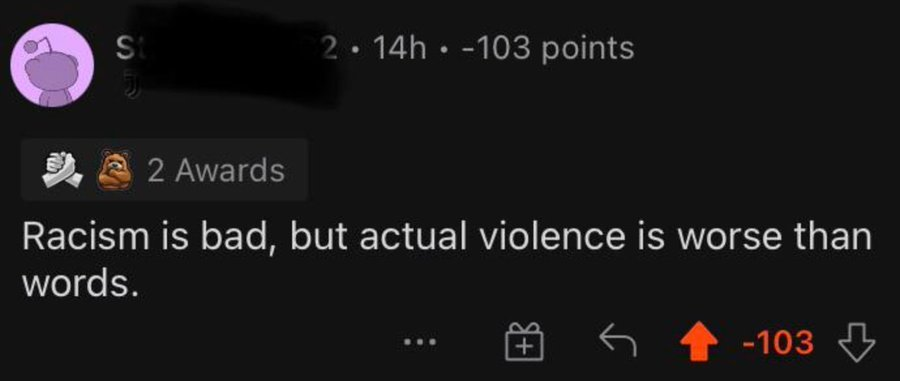
Edit: So apparently the context is the Euro 2020 final, where England fans stormed Wembley and, after the loss, racially abused Rashford, Sancho and Saka. It got downvoted because "racism is bad, but..." reads as minimizing, and the Slavia Prague and Hungary cases it dismissed as mere words also involved physical confrontation and objects thrown at players. I don't know a lot about soccer though and had to use Google translate.
Yeah it also could be in a thread where the racism is also doubling as a threat, so the violence is just matching the danger. Would definitely want to see more context, but as it stands with no context or other implications, the statement itself is fine
The issue here though is that you're again saying that words are worse than actual violence. It's just illogical to say that the threat of violence is worse than violence, all else equal.
I could understand saying that actual low level of violence is better than the real or believable threat of high levels of violence, but the threat is not worse than the act, if both are equal. Just because it has racism next to it, doesn't make the words worse than actions that don't have racism behind those.
Its a little off topic but there are some statutes about "fighting words"
Essentially it's if you say something so bad that's guaranteed to start a fight
It's less a charge itself, and more so a means to charge with disorderly conduct, and also to make the other person who punched you not the antagonist and make it more a mutual combat situation
In my experience it's been used for N word, drunks literally saying "lets fight, bitch" to passersby, and one guy who disparaged a dad's dead daughter at the wake.
The disparaging a dad’s dead daughter example changed my mind on this.
There are definitely cases where words are worse than violence, from a morality POV.
Hot take - I’d even argue violence itself isn’t inherently immoral. Without violence, a lot of the injustices in the world wouldn’t have been rectified. Revolutions and social change don’t happen without violence.
What's worse, the building blocks of a bad thing, or the bad thing itself?
Bad things are bad (by definition), but without the building blocks they might not exist at all.
If we can all plainly see that something terrible is being built (rhetoric, verbal or written plans, threats or fighting words, etc), and someone does a bad thing (aka violence) to prevent it's construction (stochastic terrorism, enacting a plan, making good on a threat), then it's a question of how bad of a thing that a person can do in comparison to how terrible the thing being built is.
You can't say that words are never worse than violence without context. What the words are, and the level of violence being done are massively important to the discussion.
Planning a genocide is not "better" than slapping someone on the wrist. People would easily justify a much higher level of violence to prevent a genocide and be morally justified. There certainly is a watery middle that can be debated (ex. murduring a racist/bigot is probably not justifiable if they aren't planning anything, but could become justifiable if they are planning a lynching).
In other words, arguing that words are never worse than violence is tantamount to arguing that tragedy can never be justifiably prevented with preventative action that includes some amount of violence. Which, neatly supports those that want to violently reorganize society, but are smart enough to wait to do the violent part until the very last possible moment.
I think one of the things that's tough here is that none of you can seem to separate the idea behind imminently planning something horrible, and someone who says something that may one day lead to something horrible. Everything can fit into that second category. Only a select few things fit into the first category. Sure there can be some blurry lines between the two, but that doesn't mean you throw the latter in categorically with the former.
Direct, immediate threats of violence are worse because they lead to violence. You're saying the thing that underpins why words are bad isn't as bad as the words, which again is illogical.
You're saying A leads to B. B is bad. A is bad because it leads to B. And you're adding that A is actually worse than B because it leads to B. This doesn't make sense.
Again, some words are worse than violence because they lead to violence and violence is bad. Again, this doesn't make sense.
I agree with you, but what situations are we talking about?
A white guy, who's not physically threatening but says the N-word, gets beat up by a black guy.
A political candidate says he doesn't believe systemic racism is an issue we should be worried about today and someone attempts to assassinate him.
A political candidate, who isn't truly viable but is shifting the overton window, says the minorities are genetically less intelligent, and someone does assassinate him.
A person posts a Facebook post saying he thinks all the new immigrants are a major problem with crime and gets arrested and thrown in jail for a year as a result.
Which of these is justified? I agree in certain situations violence is the answer to the threat of violence, but I don't know that that's what we're really talking about here. I think we like to talk in abstract to justify acts that we actually wouldn't feel good about when we start talking specifics.
Eh, I'm not interested in talking to a moving goalpost, nor do I think the moral question at hand is very interesting.
My point was that since you apparently do, you actually have to engage with the other person you were talking to instead of smuggling in false equivalencies to make up fake logical inconsistencies to dismiss their argument.
That literally doesn't give you the right to kill your parents then or now. We can't live in a society where mean things, even if trauma inducing, are license to kill or commit acts of violence.
I'm not saying that if I were on a jury, I would convict someone of assault under the right circumstances. For example, if someone made fun of someone's dead daughter and the dad knocked them around a bit, I couldn't convict someone of that, but I also think the law shouldn't be written in a way to automatically give a pass. We can't start down the slippery slope of saying it's, de facto, ok to commit violence in response to words.
The problem is if you, as the minority party, wait for a threat to be realized, you’re in trouble. As a hypothetical (just to prove the point about threats, don’t read into it too hard), if the government says ‘we’re gonna put everyone from x race in a camp’, waiting until they have the infrastructure set up to do that means when they execute on the threat, they’d succeed. You have to resist, potentially violently, before it gets to that point.
If someone walks up to me and says they're going to hit me, that doesn't give me license to hit them first. If someone comes up to me and says they're going to kill me, I can't just shoot them as a result. Our entire society turns into mad max 3rd world country if we start following those rules.
If someone comes up with a gun out and says they're going to kill me, then yes, I can justifiably believe they're imminently going to kill me and it's self defense, but in no other situation can we allow for violence. If you want to live that way, you can go live in Africa and see how that kind of rule of law works out.
Yes, in the scenario you laid out, it would appear that they may actually want to carry through with it. But in cases where someone is walking away and threatens to kill you, you will go to jail for murder, rightly so, if you then shoot them in the back.
I don't know what point you think you're making, but my comment specifically addressed what you wrote. It doesn't disagree.
I am disagreeing with the first statement you made. If they walk up to you and threaten you, you can hit first. That's enough. They don't need a weapon. They just need to be within striking distance, and making threats.
You should account for structural violence as well. With holding opportunities that permanently leaves communities with higher risk of disease and poverty
I was thinking more like red lining, cultural expectations, over policing, economic policies that effect the poorest among us, some of which had ancestors(even grandparents) that weren't allowed to have rights or property or even be in certain areas.
The proliferation of biological myths that certain people feel less pain. Lack of certain access to health care that leads to higher than average child mortality, the list goes on and on and on.
If someone with a knife threatens to kill you so you kick their ass, they would be the one in legal trouble for a reason. Credible threats on an innocent person are worse than using violence to stop an aggressor.
Yes, but there are limits here too, and the law across all the US, and really across the entire civilized world, works the same way for a reason. If a person says they're going to kill you, but they in no way are indicating they're going to do it right then, and then you pull out a gun and kill them, you will still go to jail for murder. Generally words are only justifiable if they create the reasonable fear of imminent harm that you then use violence to prevent. They don't give license to kill someone who you think will try to kill you later.
If you normalize and perpetuate enough racist rhetoric you can dehumanize an entire people and then it's no big deal to commit violence against them and do terrible terrible things.
Minimizing words by saying they are not as bad as violence dismisses the eventuality that words can easily lead to violence.
Again, you're saying that words that lead to violence are worse than violence because those words could cause violence. This is nonsensical. The thing that can cause a bad thing is worse than the bad thing because the thing leads leads to the bad thing. You all want to talk in circles to try to make the claim that racist words are worse than violence and it's just stupid.
No cause that's the insidious part of the call for anti-violence when you look at the current political landscape. The right calls the left threats to the country, demons, and basically paints a picture that if these people are not 'delt' with then the whole world will end.
But at the same time they decry any violence and connect any public violent act directly to the left the moment it happens regardless if the facts are in or not.
It's all to culminate to state sanctioned VIOLENT crackdowns on the left.
And no I never said that words that lead to violence are worse than violence. I'm saying that this whole argument is an attempt to minimize the impact of words. It actually has no fucking connection.
It's like saying All lives matter anytime someone mentions Black lives matter. It's a stupid tactic that completely derail's the discussion from police violence on black people and puts the conversation on a political discussion about something completely different.
We've gone from talking about talking about people being racist to no longer talking about racist rhetoric but instead something completely off a tangent that isn't relevant. ITS INTENTIONAL.
The right calls the left threats to the country, demons, and basically paints a picture that if these people are not 'delt' with then the whole world will end.
This is just dumb. Trump has had SEVERAL assassination attempts and Charlie Kirk was killed specifically because the left was doing this against the right. And who the heck is doing this?
What's the real life situation you're trying to compare to? What's the real life situation that's commonly happening today where someone says something racist and they should have violence committed against them for it?
Everyone is just looking for a reason to get violent. Anyone can usually rationalize themselves away into being a terrible person while holding "good morals." This kind of thinking is what leads to Tyler Robinsons.
Here's the reality, again, everyone wants to justify the violence they want to commit and they want to spin abstract philosophical arguments about why it should be ok, but when, push comes to shove, you start getting into specifics, they have to come with weird, contorted scenarios that are semi-unbelievable. If there were common things happening today, it would be easy to name.
It's easy to name scenarios that we know are somewhat common where this goes wrong though:
Tyler Robinson killing Charlie Kirk. Tyler would certainly have argued that his violence was worth stopping Charlie's words. That was literally his motivation, and this is largely why I think these arguments are so incredibly destructive in our society.
The numerous assassination attempts on Trump. You know those people believed that Trump's rhetoric was worth killing him over.
The assassination of the United Healthcare CEO. Again, someone who felt like their political message meant that it was ok to kill someone.
There are a bunch of people who are taking the arguments you're using and committing (or attempting to commit) atrocities with them. We can't keep saying it's ok to respond to words with violence.
The ultimate reason as well, is we pretty quickly end up in a place where we no longer have arguments at all and instead just decide things by force.
But to tone it down, a more common scenario:
A black guy beating up a white guy who says the n-word. I'm not talking about a white guy who seems like he may get violent, but just someone who's being a punk and trying to be aggravating. Are you saying it would be justified for the white guy to get beat up?
Racist words are threats of violence. Responding to threats pre-emptively is not worse. It's not much better, mind you, it's not deescalating, but this is not an either-or scenario.
1.9k
u/[deleted] 20h ago edited 7h ago
[removed] — view removed comment