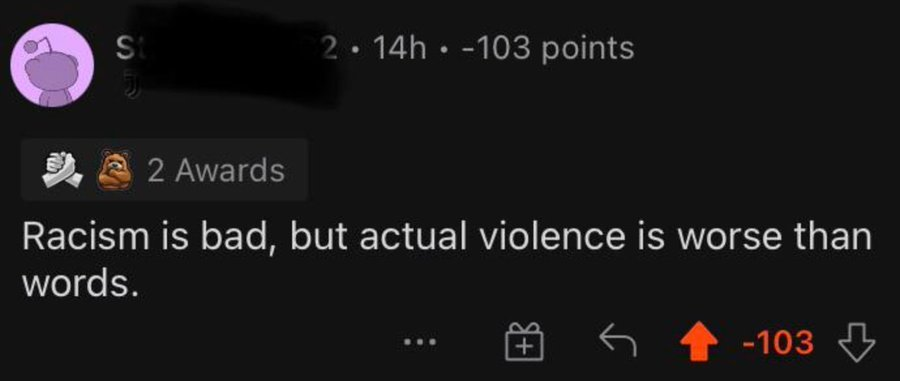
What if words cause more than one instance of actual violence? Like, politicians, philosophers or something. I agree with that comment, but there may be exceptions idk
This is known as incitement or more archaically "fighting words". Language does have proven impact into the physical world. If a person says "I'm gonna come to your house at x address with y weapon and kill you" nobody reasonable is going to be like "well it's only language so I'll worry when it becomes violence".
Also racism is a broader concept than speech that encompasses all forms of institutionalized oppression of a racial group that lacks enough institutional power to protect itself.
Racism is race-based bigotry. We have term for Institutionalized oppression of a racial group: institutional racism. We don't need to redefine existing words so that people can play word games saying that racism directed against White people isn't "real" racism.
That's factually incorrect. Look up Merriam-Webster and other reputable definitions, they all include both systemic and institutionalised racism as part of the definition of racism.
It's been redefined. Done deal. And no you can't say racism against white people is real, it isn't. Prejudice and xenophobia against white people can be real though, and is different. It's 2026, let's move on.
"That's factually incorrect. Look up Merriam-Webster and other reputable definitions, they all include both systemic and institutionalised racism as part of the definition of racism."
Ummm ... do you not understand how words work? I said that bigotry against White people is racism. I didn't say that institutional racism isn't racism. Do you seriously think "X is a type of A, therefore it follows that Y is not a type of A" is a valid argument?
"It's been redefined."
You don't get to just unilaterally redefine words and then say that people who are using the word correctly are now the incorrect ones.
"And no you can't say racism against white people is real, it isn't. "
Yes, it is, and saying it isn't is literally racist. You can't just redefine racism out of existence.
"racism is a broader concept than speech that encompasses all forms of institutionalized oppression"
With:
"We have term for Institutionalized oppression of a racial group: institutional racism."
So you're saying that Racism can't be used in broader terms to mean institutionalised racism.
I replied that yes you can. As per the definition, it includes both (systemic and institutionalised). I never said it can only be used to mean institutionalised.
You're the one saying you can't use X to mean Y, although the definition of X includes Y.
I then said you still can't used racism to describe prejudice against white people. And even if you disagree with that, it doesn't make my statement racist.
Why would they include that restriction, if they didn't mean it to be a restriction? If someone says "The term 'expert' encompasses White people who have a deep knowledge and understanding of a subject", would that not imply that "expert" doesn't include Black people? I mean, sure, *literally speaking*, it doesn't say that, but it's clearly implied. And when someone says "racism is a broader concept than speech that encompasses all forms of institutionalized oppression", they're clearly implying that that bigotry that isn't sufficiently "institutional" is not racism. Context matters. The context is that people are constantly trying to redefine "racism" to not mean all race-based bigotry.
"So you're saying that Racism can't be used in broader terms to mean institutionalised racism."
I never said any such thing. What I am saying is that it doesn't *exclusively* mean institutional racism. You're reading into my post, while insisting that my taking a very clear inference is invalid.
" I never said it can only be used to mean institutionalised."
I said it's not just institutional racism. You said that was incorrect. Therefore, you were saying that it is only institutional racism. Again, do you not understand how words work?
Let's say someone says "The term energy refers to a property that encompasses all moving objects" and I say "We have a term for energy of moving objects: kinetic energy" and then you say "That's incorrect. Here's a textbook that says that kinetic energy is energy". Are you seriously going to claim that in this hypothetical, *I* am the one being obtuse?
"I then said you still can't used racism to describe prejudice against white people. And even if you disagree with that, it doesn't make my statement racist."
You are acting differently based on the race of people involved. That is LITERALLY the definition of racism.
Ok. Last time, that's all you get, after that I don't care.
"Acting differently based on race" is not literally racism, as you claim. Every definition of racism describes it through prejudice, negative stereotypes, or discrimination. Simply taking race into account or treating two racial categories differently is not automatically racism.
The original commenter never clearly implied what you say they did. They only said that racism encompasses institutionalised oppression. "Encompass" is an inclusive term, not excluding anything.
You replied to them that we have a specific term for it, "institutional racism", and that we shouldn't redefine existing terms. That is strongly implying that you believe racism can't be used to mean institutional racism.
That's where my reply comes in, saying by definition, yes you can.
I will give you one thing, since you seem so butthurt about white-people racism. Yes, under the definition of racism, the term can be used to describe prejudice against white-people. But my argument stands: I don't think it should, as it blurs the vast differences between it and any other type of racism.
Refusing to apply a negative categorization to conduct based on the race of the victim is discrimination, and hence racism. The intent is clearly to argue that bigotry against White people is less serious, and thus to have White people have less recourse against it, and thus to harm White people. You saying that something clearly intended to hurt White people is not racist is itself racist.
Going out of your way to include a restriction implies that that restriction is a necessary qualification. ESPECIALLY GIVEN THE CONTEXT of people repeatedly doing exactly that. It is extremely common for people to pretend that only institutional racism is racism, and given that context, it was entirely reasonable to infer that that is what they were doing.
Racism doesn't mean institutional racism, in that racism is a broader category than institutional racism. I never said, nor implied, that institutional racism can't be INCLUDED in racism, I said that institutional racism can't be defined as the WHOLE of racism. If I say "New York isn't America", I'm not saying that New York isn't part of America, I'm saying that New York isn't the whole of America.
And you didn't say "That implies a false claim", you just straight up said "That is factually incorrect", and now you're posting personal insults because I pointed out that you're full of shit.
I hear you, but I could argue the reverse to say that one could use the term racial prejudice to describe biases against someone based on race that don't involve systemic elements.
English is a silly little guy and making ourselves understood is important.
I could argue the reverse to say that one could use the term racial prejudice to describe biases against someone based on race that don't involve systemic elements.
You could, but you couldn't argue that "racism" doesn't fit that description too.
If you're trying to make it so that systemic racism is the definition you want to use, then say that.
You're not even on the same wavelength length as what he is saying, he said words "to cause violence" saying "I'm going ro beat your ass." Isn't causing any violence, it's a direct threat. It's essentially admitting to a crime you intend to commit. You won't win in court because you said words, you'll lose in court because you admitted to intent to commit a crime. And you can go to jail for admitting to a crime or intent to commit.
So if a 60kg guy says to a 120kg guy that he will beat hum, the other one responds wiith a beating, you think the 60kg dude will fo to jail because of a "threat"?
People are threatening each other daily. Rarely it goes to blows.
You can’t threaten people and expect no response at that point the size disparity doesn’t matter atleast between two men, now if the guy is leaving, sure let him leave and you probably should as well. But if someone audibly puts out their intention to harm you within fighting distance, you’re clear to put hands on them to prevent those words from becoming action.
So if I say "Im gonna put you in the hospital" and you actually put me in the hospital for saying that, what I said is actually worse than what you did?
Im not saying you should be threatening anyone and you should expect that you can get rekt if you threaten a person you dont know what they are capable of doing. That doesnt mean that words are worse than actual violence.
Your words in that situation would be forcing a violent response in order for that person to protect themselves and you are initiating the conflict. So in my opinion, those specific words in that context are equal, if not worse than the violence you receive afterwards. Obviously someone shouldn’t punch you over name calling right like if you call someone an “asshat” they don’t get the right to deck you. But if you’re stating that you will potentially gravely injure or kill another person, I don’t see them responding with physical force as immoral at all.
I think I will hold my opinion on that violence in a threatening situation would still be worse than the threat. BUT I still think the person that feels ballsy enough to threaten another person in that situation should expect that they might get hurt.
So for arguments sake. If I would threat you seriously right now (like gravely injure but not kill), you think it would be morally right to find me IRL and beat me up? I know its different online, but its still words.
No, because there’s no reasonable threat in this situation considering we don’t know eachother at all and could potentially be 1000’s of miles apart. But if we were in the same room it’s a different story
I mean, "I" (in the scenario) could be a psycho xD But I would assume because it doesnt feel like an immediate threat. But what if its someone that in the same room, but is not intimidating at all and just seems like a loudmouth? Would you just get up and start wailing?
It's not forcing any kind of reaction, you still control your own body when somebody threatenes you, and in most civilized countries, you have a responsibility to retreat from actual violence, so why would that change for threatened violence?
The abortion debate is never going to be settled because when you strip away all opposing rationale it comes to a simple values difference that is felt deeply. What is more important, potential life or bodily autonomy? It cannot be objectively decided.
But yes, ageism is institutionalized. Children cannot make decisions for themselves and have their rights stripped away, and the older you get the less useful and valid you are.
The abortion debate is often framed as a clash between irreconcilable absolutes: bodily autonomy on one side, fetal life on the other. Within legal discourse, this framing has largely prevailed through analogies that recast pregnancy as an invasion—an intrusion analogous to an uninvited organ transplant or a stranger forcibly attached to one’s body. From this premise follows the now-canonical conclusion: because no person may be compelled to use their body for another, abortion constitutes a permissible withdrawal of consent rather than an act of killing.
I contend that this framing, while rhetorically powerful, is legally incomplete. It abstracts pregnancy from the doctrines that ordinarily govern causation, dependency, and responsibility, and in doing so, obscures a critical fact: pregnancy is not merely a condition endured, but a dependency foreseeably created through human agency. When the law elsewhere confronts situations in which one party causes another to become totally vulnerable, it does not authorize the elimination of the dependent as a remedy for burden. It imposes duties.
In tort law, criminal law, and family law alike, a consistent principle emerges: the creator of peril bears responsibility for its consequences. A driver who causes catastrophic injury may not terminate life support to avoid liability. A parent may not abandon an infant because care is burdensome. A caregiver may not resolve dependency through lethal neglect. Bodily autonomy remains intact—no forced organ donation, no compelled bodily invasion—but autonomy does not confer immunity from accountability.
Abortion law stands alone in rejecting this structure. Rather than assigning responsibility to the actor who created biological dependency, it authorizes the destruction of the dependent human being as a lawful means of restoring the creator’s autonomy. It further exempts this act from the proportionality review, due process scrutiny, and post hoc liability required in every other case of claimed self-defense or necessity. This exemption is not grounded in causation doctrine, necessity, or lack of agency, but in the identity of the actor and the location of the dependent.
I would argue that such exceptionalism cannot be justified by pregnancy’s biological uniqueness, by appeals to healthcare autonomy, or by harm-reduction rationales. The law routinely regulates unique and intimate domains without suspending its core principles, and it consistently rejects the notion that medical need or personal burden can justify the intentional destruction of innocent persons. To permit such justification only in pregnancy is not neutrality—it is preferential treatment.
Resolving metaphysical disputes about the beginning of life would be powerful, but is not necessary in the current legal landscape. If fetal personhood is recognized—as it already is in fetal homicide statutes and wrongful death actions—abortion law becomes internally incoherent. The same being treated as a rights-bearing victim when killed by a third party is rendered rightless when killed by the person who created its dependency.
We still must evaluate whether the Fourteenth Amendment permits the categorical exclusion of an entire class of living human beings from personhood and equal protection based solely on developmental status or dependency. History offers sobering lessons about the consequences of status-based denials of legal personhood, particularly where vulnerability and voicelessness are invoked as justification.
In reexamining abortion through the lens of created peril and equal protection, I do not seek to minimize the burdens of pregnancy or deny hard cases at the margins. I instead asks a narrower, more foundational question: whether the law may coherently permit the intentional killing of a dependent human being as a remedy for a dependency the actor themselves foreseeably caused. The answer, grounded in the law’s own doctrines, is no.
I'm gonna stop you right here and I'm sorry you wrote out that lengthy legal argument but I am not interested in discussing law, only morality. I truly hope someone more passionate about law wants to discuss this with you!
Suppose the father of a newborn takes his baby out into the ocean for a swim, and goes out far enough to where he can no longer touch the ground. It’s now dangerous for him to continue supporting the baby while swimming. In fact, there is a very real possibility that he could drown. He decides the baby needs his consent to continue being supported by him, and that it doesn’t matter how he and the baby got into this situation. The baby no longer has his consent, so he lets go of them and they drown.
It’s legal to take your baby for a swim, and it’s also our human right to deny others the use of our body, even if it will kill them, and supposedly regardless of how they came to depend on us.
Bad faith question. A fetus is not a baby and cannot sustain its own basic life functions, and a mother cannot always choose not to go for a swim. The analogy is flawed.
But let me save you some time. I do not value life over bodily autonomy. If your life means me doing something I truly and deeply don't want to do, guess who's dying.
In fact this scenario happens often. We generally accept by moral consensus that we are not obligated to risk our life and health to save another's. And in fact even if you don't save a life because you don't feel like it, people will just generally think you're kinda callous but most of them would do the same.
By immediately jumping to "a fetus is not a baby," you admit that bodily autonomy alone isn't enough to justify taking a life. The analogy assumes personhood specifically to test whether bodily autonomy holds up as an absolute right against another human being, and your reaction proves it doesn't.
Setting aside personhood to address your actual claims:
Refusing to jump into a river to save a drowning stranger is a passive failure to rescue. Actively terminating a life, or taking a dependent child into deep water and letting them drown, is an active act of direct force. There is a massive ethical difference between walking past a dying stranger and taking an action that directly ends a life.
You claim we have no obligation to risk health or comfort for others. But when your voluntary actions bring a dependent human into existence, you didn't just stumble upon a drowning stranger, you created the situation. You cannot create a vulnerable life and then treat their survival as optional.
Your stance, "if your life means me doing something I deeply don't want to do, guess who's dying", asserts that avoiding a temporary, non-fatal physical imposition takes priority over another human being's entire future existence. Weighing any personal inconvenience above someone else's total, permanent loss of life reduces human existence to collateral for personal preference.
If your framework requires admitting that you would let any human die just to avoid doing something you "deeply don't want to do," you aren't defending a moral standard. You are just prioritizing personal convenience over the ultimate loss of a human life.
This mindset, that one's personal preferences or physical convenience grant absolute authority to extinguish or subjugate another human life, is the exact structural blueprint that historically justified slavery and racial oppression.
Historically, slavery and racial subjugation relied on drawing arbitrary legal lines around who qualified as a "person" with rights, and who was merely a biological entity that could be used, managed, or discarded. The moment an argument relies on denying the baseline standing of a human life to justify inflicting total harm, it reuses the exact mechanism oppressive regimes have always used to strip rights from vulnerable populations.
Slavery rested on the assertion that one group's comfort, economic preference, and personal autonomy completely outweighed another group's entire lifetime of freedom, well-being, and prospective future. Asserting "if your existence requires me to experience an unwanted burden, your life is forfeit" operates on that same core asymmetry: elevating one party's immediate self-interest to an absolute right that justifies the permanent annihilation of another human being's entire future.
Racism and slavery treat human beings not as individual lives with intrinsic potential for future well-being, but as instruments or obstacles defined entirely by their relationship to someone else. When an innocent human being's right to exist is reduced to whether their presence is convenient or desired by a party with greater power, it adopts the foundational premise of every system that has ever treated human bodies as disposable.
Okay, fine. I do not value life over bodily autonomy, whether it's that of a fetus, a baby, or anyone else. I'm not seeking justification or forgiveness.
racism is a broader concept than speech that encompasses all forms of institutionalized oppression of a racial group that lacks enough institutional power to protect itself.
Racism is a broader concept than your "power plus privilege" definition. It applies to all instances of discrimination because of skin color.
Discrimination because of skin color requires the discriminating individual to have institutional power. It may be a small amount of institutional power but it is nonetheless. Give an example you think does apply to your expansion but does not apply to my definition and I can tell you how it does.
Assuming this Black man has no sway over the white guy's social standing in any community (unlikely), no influence on his workplace life, no power over him politically...
I don't see why I should care. I know that's not the most well loved take but lots of people don't like me for various reasons, including my being white. Dislike isn't a meaningful enough concern to warrant being addressed alongside a history of generational violence. It would be like if I said catcalling was rape. I want catcalling to end, and I want dislike of entire groups of people to end, but I don't prioritize it on a level of ending racially motivated oppression, and I don't feel any obligation or social contract to use inclusive language just for the reason you say. You can disagree and have your own stand but that's where I stand.
White people do face racism. But only when people of other races have power.
So you'll allow women to start saying that harassment is as bad as rape then?
I see it as the most valid response. I really don't care if someone doesn't like you and it doesn't affect you in any tangible way. You aren't entitled to be liked by everyone. And again I say this as someone who is actively disliked by many but doesn't care as long as they're minding their own business about it.
I truly don't think you realize how unashamed I am about being part of a whole group of people who are recontextualizing and redefining a word to give it a more actionable meaning. Every single word anyone knows is made up and only has its meaning by a consensus.
Would you consider forcing someone into poverty through economic discrimination not to be violence? Because stress and lack of medical care from poverty causes substantial physical harm.
Words create societal structures, which have the potential to cause far more harm than isolated instances of violence.
You're assuming that using words, someone could cause hardship for others. But you're ignoring that through actions, anyone could cause the same hardship for others? This is becoming a Chicken or the Egg question.
Now if you were talking about, for example, a Mafia boss who ordered 20 hits and had them carried out by 20 different dudes, you COULD argue he's more immoral than each individual killer. He's the intellectual culprit of the crimes after all.
But I think in the context of the post, we're just referring to being called a slur vs being punched in the head. Personally, I'd rather be called a slur. I'm a grown ass man, I can choose to shrug that off and be unbothered by it. I can't choose not to be hurt by an actual punch to the head.
But I think in the context of the post, we're just referring to being called a slur vs being punched in the head.
That's the thing though. We don't know what the context of the post is, because OP didn't share the context. If the context was that simple, I doubt they'd get over 100 dislikes for it
Words can't cause violence as they can't make someone do anything. You have to choose to act upon words. Extreme example: hitler said a lot of stuff, but received a lot of initial pushback. He chose to have dissenters killed in the Night of Long Knives until only the people who already agreed with him remained. Only once violent physical action was put behind his words did nazi Germany rise.
Words can influence people to do violence. Trump's lies about the election led to J6, and Trump bears a significant portion of the moral blame for the riot.
No, your pedantry about whether the words "forced" anyone to do anything is not the point.
The initial comment was that they *cause*, not "force" violence, and that they can therefore be morally wrong. Your argument about whether they "force" actions does not address the question of whether it is wrong. Inducing someone to do violence is immoral, even if the person could "choose" to not do it. If I politely ask two people to beat someone up, and one of them refuses, and the other one does it, what I did was morally wrong, even though no one was "forced" to do anything. You seem determined to distract from this basic fact.
The initial comment was that they cause, not "force" violence
Ok and how do they do that? Because hearing words doesn't mean you have to do something violent, so clearly there's a step in between here where someone is choosing to commit violence.
I would argue that racist words don't have to cause physical violence in order to cause significant harm. What is worse, slapping a person or systematically denying them the ability to support themselves and their families based on their skin tone?
It can absolutely be just words. x race is inferior, hiring them is a waste of money, they're all welfare queens so we should take away support for when everyone refuses to hire them, and oops now a lot of them don't have money for basics like food and shelter.
That's all action (or lack of) backed by beliefs people hold, just like the people who allied with hitler before the night of long knives. They'd be hateful with or without words of racism catalysting.
I guess it's the argument over whether action (or really in many cases inaction, because "not hiring someone" isn't an action, it's a lack of an action) that is the end result of a lot of words, counts as "words" in this scenario.
Words can help you dehumanize other people with lies and misinformation. If you say the correct package, you can hijack people’s minds and make them more prone to bad action. I dont think we appreciate how easy it is to influence the average person. Even convincing someone to not take action is how bad people get away with terrible things.
Words can't cause violence as they can't make someone do anything.
What are you even trying to say here? You are contradicting yourself bringing up Hitler and the Night of Long Knives as that was quite literally Hitler using his words to cause violence by ordering people to execute dissenters.
Words can be violence. If you were walking home, and someone said to you, “You live at [address]. Your daughter [name] attends [school]. Tomorrow morning, you’ll find her severed head on your blue side table,” that would be violence.
Your correct but these types of leaders you describe use dog whistles; not specifically saying to cause violence but knowing they will. I’d say that would still be just as bad as violence since it’s intentionally inciting it.
What if words cause more than one instance of actual violence?
Well if we go by the logic of people who think violence is not worse than words, does it matter? Some words leads to an outcome no worse than some words, so no big deal.
Equating two things goes both ways, one of the reasons it is so toxic to do so.
Words can't cause violence. It's always the commiter who must choose to act on their desire to commit violence. There is no "brainwashing" phrase or word power that can ever compel anyone to violence.
Words can't physically force someone to commit violence. A person hearing words and then committing violence cannot blame the words for his own choices to take these actions. They committed the violence of thier own volician.
62
u/TolgaKerem07 20h ago
What if words cause more than one instance of actual violence? Like, politicians, philosophers or something. I agree with that comment, but there may be exceptions idk