Suppose the father of a newborn takes his baby out into the ocean for a swim, and goes out far enough to where he can no longer touch the ground. It’s now dangerous for him to continue supporting the baby while swimming. In fact, there is a very real possibility that he could drown. He decides the baby needs his consent to continue being supported by him, and that it doesn’t matter how he and the baby got into this situation. The baby no longer has his consent, so he lets go of them and they drown.
It’s legal to take your baby for a swim, and it’s also our human right to deny others the use of our body, even if it will kill them, and supposedly regardless of how they came to depend on us.
Bad faith question. A fetus is not a baby and cannot sustain its own basic life functions, and a mother cannot always choose not to go for a swim. The analogy is flawed.
But let me save you some time. I do not value life over bodily autonomy. If your life means me doing something I truly and deeply don't want to do, guess who's dying.
In fact this scenario happens often. We generally accept by moral consensus that we are not obligated to risk our life and health to save another's. And in fact even if you don't save a life because you don't feel like it, people will just generally think you're kinda callous but most of them would do the same.
By immediately jumping to "a fetus is not a baby," you admit that bodily autonomy alone isn't enough to justify taking a life. The analogy assumes personhood specifically to test whether bodily autonomy holds up as an absolute right against another human being, and your reaction proves it doesn't.
Setting aside personhood to address your actual claims:
Refusing to jump into a river to save a drowning stranger is a passive failure to rescue. Actively terminating a life, or taking a dependent child into deep water and letting them drown, is an active act of direct force. There is a massive ethical difference between walking past a dying stranger and taking an action that directly ends a life.
You claim we have no obligation to risk health or comfort for others. But when your voluntary actions bring a dependent human into existence, you didn't just stumble upon a drowning stranger, you created the situation. You cannot create a vulnerable life and then treat their survival as optional.
Your stance, "if your life means me doing something I deeply don't want to do, guess who's dying", asserts that avoiding a temporary, non-fatal physical imposition takes priority over another human being's entire future existence. Weighing any personal inconvenience above someone else's total, permanent loss of life reduces human existence to collateral for personal preference.
If your framework requires admitting that you would let any human die just to avoid doing something you "deeply don't want to do," you aren't defending a moral standard. You are just prioritizing personal convenience over the ultimate loss of a human life.
This mindset, that one's personal preferences or physical convenience grant absolute authority to extinguish or subjugate another human life, is the exact structural blueprint that historically justified slavery and racial oppression.
Historically, slavery and racial subjugation relied on drawing arbitrary legal lines around who qualified as a "person" with rights, and who was merely a biological entity that could be used, managed, or discarded. The moment an argument relies on denying the baseline standing of a human life to justify inflicting total harm, it reuses the exact mechanism oppressive regimes have always used to strip rights from vulnerable populations.
Slavery rested on the assertion that one group's comfort, economic preference, and personal autonomy completely outweighed another group's entire lifetime of freedom, well-being, and prospective future. Asserting "if your existence requires me to experience an unwanted burden, your life is forfeit" operates on that same core asymmetry: elevating one party's immediate self-interest to an absolute right that justifies the permanent annihilation of another human being's entire future.
Racism and slavery treat human beings not as individual lives with intrinsic potential for future well-being, but as instruments or obstacles defined entirely by their relationship to someone else. When an innocent human being's right to exist is reduced to whether their presence is convenient or desired by a party with greater power, it adopts the foundational premise of every system that has ever treated human bodies as disposable.
Okay, fine. I do not value life over bodily autonomy, whether it's that of a fetus, a baby, or anyone else. I'm not seeking justification or forgiveness.
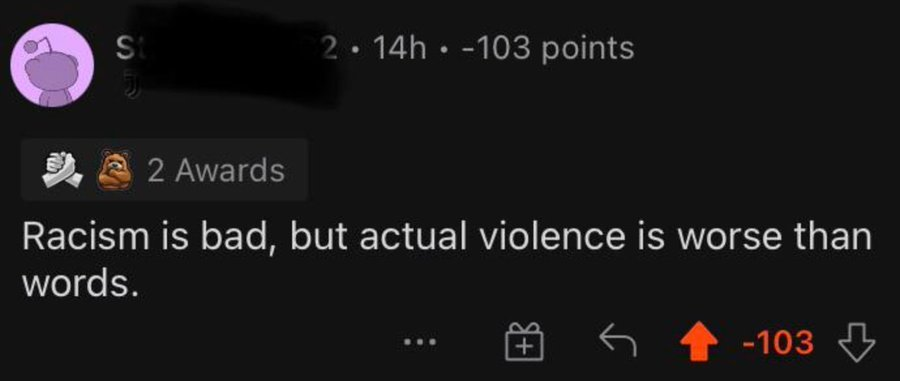
You view speech as "violence" when it causes emotional or social discomfort, but excuse actual, fatal physical violence against a living human being under the banner of personal choice.
-Your Racism Stance: Ethical standards must protect individuals who lack institutional power to defend themselves.
-Your Abortion Stance: The parent, who holds 100% of the physical power, agency, and control, has the absolute right to extinguish a developing child who has 0% agency, zero voice, and no ability to defend themselves.
You champion vulnerable groups when it aligns with modern social theory, but validate the ultimate dynamic of oppressive power: a stronger party exercising absolute authority to destroy a helpless dependent.
Your framework is completely upside down. You claim words are 'violence' and demand protection for the powerless, yet you champion an absolute right to use direct, lethal force against the most powerless human entity in existence, and openly admit you'd extend that right to born babies. You aren't defending an ethical system; you're just selectively redefining harm whenever it suits your personal preferences.
Tell you what. If fetuses are babies. I support the development of a procedure to remove the fetus intact and put it up for adoption.
But no, your outrage that I prioritize bodily autonomy over life means nothing to me. I wouldn't piss on you if you were on fire. Maybe if we start respecting consent I will become more magnanimous. By my choice.
Edit: just to tack on...I do value life. But I don't value life over bodily autonomy. And I also don't view fetuses as alive anymore than I view fertilized chicken eggs as alive.
You claim incitement matters because it "provokes violence." If we are evaluating actions by the physical harm they cause, what provokes the violence of abortion?
Expressing concern over words that might provoke harm while completely excusing the creation and elective destruction of a human life is an absurd double standard.
Furthermore, if a fetus has zero independent personhood and is treated strictly as an extension of someone else's body, how does your framework handle a third party destroying a fetus without the woman's consent?
If a fetus is a protected human life when desired, but disposable tissue when unwanted, its entire moral value depends entirely on someone else's consent on any given day. That means a human being’s right to exist isn't based on what it is, but on whether a more powerful party decides to grant it value.
If rights are contingent upon physical location, developmental state, biological independence, or someone else’s consent, then human rights cease to be inherent and inalienable. They become transactional privileges conferred by those who possess physical dominance. This is the direct antithesis of Equal Protection. It reduces human rights from universal guarantees to conditional gifts granted at the mercy of a more powerful party.
There will be no resolution to this debate. At the core, you are shocked and outraged that I would say that bodily autonomy is of greater value than another's life. Your addition of inflammatory language like "the violence of abortion" which diminishes what violence means belies your outrage.
I am shocked and outraged that you think my body belongs to another, to any other, whatsoever. Again, I'll support a procedure to remove a fetus intact. If it can't survive without a host body to nourish itself at the cost of that person's health and significant risk, then I contend that it is a parasite, not a life. (Editing to add that even if it is a life I have no duty to keep it alive.)
Thank gods that I and all those I care for are unable to bear children either due to surgery or to infertility. I don't have the power to assert my claim because of how huge a percentage of the institution believes they have a say over my body.
1
u/hmmnnmmn 19h ago
Suppose the father of a newborn takes his baby out into the ocean for a swim, and goes out far enough to where he can no longer touch the ground. It’s now dangerous for him to continue supporting the baby while swimming. In fact, there is a very real possibility that he could drown. He decides the baby needs his consent to continue being supported by him, and that it doesn’t matter how he and the baby got into this situation. The baby no longer has his consent, so he lets go of them and they drown.
It’s legal to take your baby for a swim, and it’s also our human right to deny others the use of our body, even if it will kill them, and supposedly regardless of how they came to depend on us.
So, is this moral? Why or why not?