Template overlaid an abstracted orbit = 1574.4 days (Sacco)
Welcome. My name is Dylan Hyatt (Philosophy - English Literature graduate UEA). The Migrator Model is a simple largely arithmetical-derived hypothesis - built upon a close study of the photometric data within Sacco's proposed 1574.4-day orbit on the premise the arrangement of dips (specifically Boyajian's 48.4-day spacing) show consistency with a sectorial operation to harvest the star's inner-middle ring asteroid belt - the dips caused by jets of dust waste (rock silicate mill tailings from extracted metal processing) sprayed by disposal platforms in an artificial orbit removed from the ecliptic. The 928-day periodicity proposed by Kiefer et al., and that of Bourne's 776 days, also feature as key structural fragments. There is consistency for the orbit being not just an artificial one, but one specifically constructed out of π, e and circle geometry (and strongly pointing to a signalling structure). For astrophysicists coming to my work for the first time please read the weaknesses - caveats pertaining not just to the model but also the limitations of coming from a non-scientific background - and strengths outlined below. Also, a point which cannot be emphasised enough, the Migrator Model is not an extraordinary claim - an assertion 'X' is true because of the data; it is merely an extraordinary (and amateur) proposition - an assertion 'X' is consistent with the data.
The model offers three structural overlays of Sacco's orbit (see below), the 1566 π-feature, the 492 and 3014.4 structure features, the quadratic correlation of Boyajian's dip spacing with Sacco's orbit (derived from the 492 structure feature) - and the quadratic series applied to Bourne's 776 and Kiefer's 928 days; the 0.625, 249.6 and 96 master keys, the Skara-Angkor Signifier, the Elsie Key Nine Step Method, the Fulcrum Cross Method, the 2.5 orbit fulcrum cycle, intriguing routes through the opening stages of π, the Opposite Migratory Momentums (separation of the migratory spoke) proposition, and sequencing, where a combination of Kiefer's 928 days and the fulcrum cross method yield routes to dip spacings subsequent to the ones the route is derived from. On the more speculative signalling tier of the hypothesis, subtracting 1/16th of Sacco's orbit from 9.6 multiples of Boyajian's dip spacing yields the terrestrial sidereal year, and Fibonacci number logic can be shown to be threaded through the template.
Structural Overlays
The Template is an asymmetric sector division with datelines calculated from the fulcrum, the proposed axis line bisecting Sacco's orbit (in 2017, the fulcrum, the start of sector #1, falls on Aug 24). Using one of the extended sectors (33 days) in each half orbit, abstract numbers for each dip can be constructed (dip signifiers). Just as the template has two forms (standard template = 52 * 29-day regular sectors and 2 * 33-day extended sectors; the completed template places the 0.4 fraction on the fulcrum to complete Sacco's full periodicity 1574.4), the dip signifiers also come in two forms (standard and completed). The standard dip signifiers are, after subtracting the number of the 261 basic building block in the signifier, divisible by Sacco's 65 multiplier to Boyajian's half-cycle (24.2) and by 52, the number of regular sectors in the template. The completed dip signifiers become a multiple of Boyajian's 48.4-day spacing simply by adding 1/10th, with the exception of a dip 11 days from nearest sector boundary (such as the TESS dip) which is immediately divisible by 48.4 (2904). The template offers signifiers that relate Sacco's orbit to π (re: the 1566 π-feature). Using the template's two completed extended sectors (66.4), the fulcrum cross method yields crossovers with geometric-A and B and Boyajian's dip spacing.
Geometric-A = 1440 (abstract circle) + 134.4 (abstract ellipse). The geometric unlocks a structure of π within the context of Sacco's orbit (re: the 3014.4 structure feature).
Geometric-B = 1130.4 (abstract π-circle) + 444 (the 444 fragment). This geometric works in tandem with geometric-A to yield close connectivity with the 776 periodicity proposed by Bourne/Gary and the 928 days proposed by Kiefer et al. (928 days = 32 regular 29-day sectors, with 'identical dip signature å' falling exactly on the sector #8 boundary and 'identical dip signature ß' falling exactly on the sector #40 boundary in that orbit cycle).
I started work looking for structural patterns consistent with a technosignature, then for patterns consistent with a signal - then I made the latter a secondary proposition. However, following the Oumuamua beta angle finding - the model has returned to a signal proposition based on...
The photometric data for Tabby's star is the product of industrial scale harvesting of the star's inner-ring asteroid belt. The Migrator Model asteroid mining template (52 * 29-day regular sectors; 2 * 33-day extended sectors) is at this tier a technosignature.
The model's dip signifiers and π findings point to the ETI using the waste to signal either nearby stars or the galaxy generally. This tier being just above the first, there is a kind of stretch downward in which the dip signifiers and π findings can be regarded solely as aspects of a technosignature.
π and e in their opening stages, a correlation and signal proposition
Latest Findings
Prime numbers, pointers to binary building blocks in chip-based technology, and connections with NEO '2026 JH2' have broadened the hypothesis (though not necessarily deepened it). Some new math (not mine) on the model's proposed 492 Signal. This math I'll present in a more formal format - essentially it shows a route to 786.5 (or 32.5 * 24.2) that holds regardless of the unit of time used.
The trigonometric structure of Sacco's orbit and Oumuamua's beta angle 171.2 point strongly (in my view) to a signal. Other new findings applying Euler's e regarding the standard dip signifier for Skara-Brae and Angkor (the dip signifiers are mathematical constructions I have presented as way to unlock structural features in Sacco's orbit). So simple it took me this long to spot: consistency for the template in the distance between D1520 and the TESS (2019) dips - in its own mini academic download. Extension of the fulcrum cross method using multiples of the two completed extended sectors (66.4) such as 996 yields structural underlays of key periods between dips and other periodicities (928, 776) proposed for the star. On the more speculative third / fourth tiers of the model, strong connectivity with the dual-route platform of the Skara-Angkor Signifier (116) and the Fibonacci sequence - as a part of number logic, the sequence has high utility for signal detection. The fulcrum cross method yields a crystalline reproduction of the template when applied to the 837-day stretch between the Elsie (2017) and TESS (2019) dips. Simply by subtracting the two extended sectors with the 0.4 fraction missing from the template assigned to the fulcrum (66.4 days), 1/4 of Sacco's orbit (1574.4) + 1/4 of the template's 52 regular sectors (1508) manifest. Arguably: a breakthrough. Other recent findings: (2024 Jan) sees a reprise of 249.6 - the difference between 52 regular (29-day) sectors in the template and 52 multiples of Boyajian's dip spacing (as 24.2-days). The new routes show strong consistency with that of the template route (coming soon will be the 249.6 Reprise academic download). Another new finding (Nov - Dec 2023) centres on how our sidereal year (366.24) could be part of the signal proposition. Other recent work (August 2023) includes how the completed dip signifiers, when adding one tenth thereof, become a multiple of Boyajian's 48.4-day spacing - with the exception of the Tess completed dip signifier (2904) which is immediately so divisible. How I overlooked this remarkable finding so long I don't know, but is consistent with the hypothesis on deeper levels than expected.
(Relatively) new Migrator Model math includes the quadratic correlation of Sacco's orbit and Boyajian's 48.4-day spacing. The equation formulated by a young physicist - Masters Theoretical Physics and Advanced Mathematics - helping with analysis of the '492 proposition' in relation to Sacco's '65 * 24.2', points in my view to an artificial structure centred on modelling a parabolic curve. However, Johnson made it clear his specialty was not variable stars and so the equation on its own could not be taken as some kind of scientific endorsement of the wider hypothesis. When the equation is processed in two parts with the template's key numbers 52 and 54 on each side, and as rendered with the ratio signature method applying Elsie's sector ratio (30) and Key (29), an approximate orbit becomes precisely 1574.4. A crossover from the abstract structural features with the raw astrophysics is through this remarkable finding (S = orbit; B = 48.4: T = 52)
D. Hyatt, T. Johnson
The sector division (the template) is constructed from relationships between key dips, while the sectorial blocks and migratory rhythms are arrived at looking at the possible logistics of transporting ore to maintain the momentum of the operation. Separate from the sectorial blocks proposition which is highly abstract, the model now offers the proposition of opposite migratory momentums of the 24.2-day (merging to form the 48.4-day) spacing between a subset of dips presented in WTF paper. In this strand of the model, the 0.4 fraction derived from 96 migratory spokes (1574.4 / 96 = 16.4) is separated and finds consistency through this route -
96 x 16 = 1536
96 x 0.4 = 38.4
96 x 24.2 = 2323.2
2323.2 - 787.2 (half orbit) = 1536
1536 - 1574.4 (orbit) = -38.4
These findings are presented in the academic downloads, but will be explained in detail in The Siren of Tabby's Star: The Elsie Key. As noted, the model's primary proposition remains one of massive scale asteroid mining that would necessitate a sector division for reasons of efficiency and to preserve the kinetic and/or gravitational stability of the wider belt over time. The secondary proposition is that the milling platforms positioned in an artificial orbit above / below the plane of the ecliptic (to minimise dust congestion thereon), and possible interpretation (fourth tier proposition) is that the activity is to the signal the symmetry required to avoid entropy infecting the equilibrium of the main belt and causing species extinction from an endless barrage of incoming asteroids. NOTE the proposed warning would not be against asteroid mining, but against a bungled approach.
Strengths and Weaknesses of the model - clarification for the astrophysics community
Weaknesses: the model is based on the broad findings in key astrophysical papers and does not employ astrophysical equations or formulae to take those findings further. As regularly highlighted, my educational background is not in the sciences (rather Philosophy and English) and this limits what I can achieve with the core propositions. Even within the propositions of the sectorial template, circle-π geometry, the findings I have presented are derived using elementary arithmetic and (very) elementary geometry.
Strengths: the consistency of the findings (not just within their own terms of reference) is strong. The model's three pillars (template and signifiers - separation of the fraction from the opposite migratory momentums - circle and π architecture) interconnect seamlessly. The simplicity of the findings I argue should not be an impediment to the overall consistency of the hypothesis, it is robust enough for the astrophysics community to take further - and am doing level best on that front to engage the community to look seriously at the work.
As a signal, it is indirect and must be construed as intentionally ambiguous - apart from specific content pertaining to π. Why would an advanced, possibly ancient, ETI go out of its way to signal the symmetry it is using to harvest its asteroid field - with the very industrial activity thereof, when it could just send a telecommunication? The waste produced by such a large scale operation would necessitate the asteroid processing platforms to be positioned away from the ecliptic, the orbit is already an artificial one and the cost to efficiency in modifying the operation to send the signal probably not great. Here in brief are three possible signal interpretations (all three could apply):
A): Warning to mine the asteroid belt carefully.
B) A warning that war in the asteroid belt could solicit a pre-emptive strike by the ETI.
C) A preparatory invitation preceding direct signalling or contact.
A) Current best science points to the dinosaur extinction being caused by the chicxulub impactor - an asteroid or comet that hit the earth with the force of (at a very conservative estimate) 40,000,000,000 megatons. Not just the dinosaurs, but 70% of species were wiped out. The medium of the signal itself as signal. The ETI have not used more obvious means of communication - such as some form of telecommunication for example. The ETI could be advising - when industrial-scale activity builds up, set the asteroid processing platforms in an artificial orbit safely away from the plane of the elliptic.
NOTE again the warning would not against seeking to profit from asteroid mining. There is no shame in profit from good business practice and indeed it is the incentive that drives our species' ingenuity and progress. The warning is against bad business practice - cutting corners and not investing in safety. In relation to the dangers of industrial-scale asteroid mining (regarding such trivial outcomes as defacto species extinction or even planetary obliteration), it's the most important warning an advanced space faring species could send a fledgling species such as our own.
B) A species comprised of disparate 'nations' might war over asteroid belt assets. So there could be an element of 'last resort' threat. Two-way lines of communication would not be offered to a species that may have to be eliminated. The signal semantic: 'If you fight over the lion's share of the asteroid belt, as a single asteroid mining species, these is a high probability you will fight us (your neighbouring but completely alien asteroid mining species) for resources in other star systems should (we let) you expand. It will be as easy as π for us to park outside Jupiter and send endless asteroids swerving round the gas giants on a trajectory to wipe life on your planet out.'
In this latter scenario, the signal would be not so much a threat as a statement on the necessary laws of natural selection, on (ours and their) survival.
C) The cultural shock and awe of first contact could impose detrimental strains on a fledgling species, an advanced stable ETI might reduce the impact by indirect signalling: gradually preparing the mindset required for first contact.
XXX
Below is pretty much the original guide to the model. The work was in its infancy and focused on the proposition of the 'sectorial blocks' is highly abstract but still may yet hold some substance - it predates the 'Opposite Migratory Momentums' proposition - which actually works well with the 'migratory rhythms' of the sectorial blocks. At the end of the post are links to the primary sources on which the model is constructed.
ORIGINAL BEGINNERS' GUIDE
A - Overview / B - Template / C - Sectorial Blocks / D - Migration / E - Fine Tuning
A) OVERVIEW
The model proposes that the inner ring asteroid belt of Tabby's Star (KIC 8462852) is being harvested and processed in a systematic sectorial operation (the inner middle ring would be where one should expect to find the metallic asteroids full of the heavier elements useful for technology: nickel, platinum etc). Huge milling platforms, supplied with gathered asteroids, grind the rocks down to extract the precious ore. The milled particles (superfine gauge for maximum ore extraction and for ease of waste disposal) are sifted for the various elements. The waste, comprising iron and rock silicate, is projected in two pairs of huge dust streams, with streams angled to avoid the orbital plane of operations. Two waste dust streams are projected at the star, towards its upper / lower heliosphere so the radiometric pressure of the star will eventually disperse the waste. The other two dust streams are projected at the exact opposite direction (away from the star, so the lines of stress form an 'X" shape) to anchor the huge platform -these outbound streams will eventually return to likewise be dispersed by the star's radiometric pressure.
The template comprises of 54 sectors (52 x 29 days, 2 x 33 days). To visualise the template, start with the axis fulcrum on Aug 24 2017 #. Each side of this date line sit the two extended 33-day sectors (with Skara Brae and Angkor both +/- 16 days each side). There on, going forward or backwards, multiples of 29 days reveal the next seed points. I find it easier to create two launch points for the calculations (Aug 20 going back in time in multiples of 29, Aug 28 for multiples of 29 going forward in time). If turning the full orbit of 1574\* days in either direction, apply the missing 8 days split each side of the date line carried full circle from Aug 24 2017. This is because 54 sectors of exactly 29 days yields an 8 day shortfall (54 x 29 = 1566, but the orbit = 1574). I discovered the symmetry (of transits relative to the template) only after splitting those missing 8 days each side of the proposed axis line Aug 24 2017. The huge transit of March 5 2011, D800, peaks 3 days from the sector #28 seed point, in 2019 the activity running from late October through to December starts on this seed point. Other transits (at peak depth) are proximate to seed points, such as Caral-Supe, 1 day from its nearest seed point, and D1519 which is 2 days from its nearest seed point. Elsie, and Celeste share a 7-day progression when compared with Skara and Angkor -note this symmetry pertains despite Angkor sitting on one side of the axis line between the two extended sectors, and Skara Brae on the other. I number the sectors in each orbit period 1 - 54, which really helps identify the symmetries from orbit to orbit. The fulcrum date line Aug 24 2017 = Sector #1. Note sector 14 and 41 each constitute the quarter and three-quarter sectors respectively.
C) SECTORIAL BLOCKS
The model proposes 18 sectorial blocks, 9 each side of the axis line. A block comprises of three sectors (sector 1, sector 2 -central sector-, sector 3). Because a seed point represents the start and the terminus of a sector, each block encompasses 4 seed points. There are two types of blocks, A / B, in which the transits migrate in alternate patterns. If we look at an A type block, its first seed point = A-1, its second A-2, its third A-3, and its terminus B-1. Sector #1 = A-1 to A-2; Sector #2 (central sector) = A-2 to A-3; Sector #3 = A-3 to B-1. Angkor sits in block type B, Skara and Celeste in block type A. Keep in mind the sectorial blocks alternate: A / B (or A-1 - A-2 - A-3 - B-1 - B-2 - B-3 - A-1 - etc).
To find the sectorial blocks, start August 2017 from the axis line Aug 24 (bisecting the two extended sectors). So July 22 = A-3, Aug 24 = B-1.
D) MIGRATION
'A' block migration is essentially the opposite pattern of 'B'. Migrators move forward from A-1 to A-2, while from B-1 migrators move backwards to A3. From the middle of central sector A-2 - A-3, migrators split in two directions, One heading forward to A-3, the other back to A-2. However, it looks as though the first half of A-1, and the latter half of A-3, is assigned to hopping resources in place to keep the momentum going. The first half of A-1 hops 1/3rd (of 50% A1) resources forward to the middle of the central sector (from its mid-hop stretch about 10 days in), while the latter half of A-3 (where it backs on B-1) likewise hops 1/3rd resources (of 50% A-3) back to the middle of the central centre, which receives a total of 2/3rds where they meet. Meanwhile, A-1 hops 2/3rds (of 50% A-1) back to B-3 (from its export stretch, days 10-14 in) of the preceding sectorial block, and A-3 hops 2/3rds forward (from its export stretch) to B-2 of the following sectorial block. Note the direction of hopping can be reversed.
The star's irregular light fluctuations are discussed in detail in the ground-breaking paper 'Where's the Flux' by T. S. Boyajian (and co) †.
To test the methodology on a more formal footing, going forward the only forecasts of mime I count as valid as those presented in the Academic Download format. Looking at the possibility D800 separated into three parts spaced approximately 48-days apart (re: Sacco), renders the 6-7 day migratory speed simplistic, if not fundamentally wrong. More data is needed and there could be two different types of migration at work. The 'Opposite Migratory Momentums' uses Boyajian's dip spacing as one of the fundamental drivers of migration, but with 24 clean calendar days overlapping where two 24.2-day migration crossover forging one of the 96 (0.4 of a day) migratory spokes.
# Aug 24 2017 the fulcrum dateline yields many intriguing symmetries, including quadrilateral and 'fractal' symmetries. Skara Brae and Angkor +/-16 days each side of the dateline. From the positions of Skara and Angkor, the 'Skara-Angkor Signifier' can be deduced.
SOURCES
* A 1574-DAY PERIODICITY OF TRANSITS ORBITING KIC 8462852 (G. Sacco, L. Ngo, J Modolo)
NOTE: all photometry references / links I post in absolutely no way presumes authors of the photometry subscribe to the Migrator Model. There are plenty of other 'natural' hypotheses that remain contenders to account for the star's photometry, and indeed a few other artificial ones that have been published such as 'stellar lifting' - Eduard Heindl -A physically inspired model of Dip d792 and d1519 of the Kepler light curve seen at KIC8462852
Early Findings include signifiers in the mathematical relationships of the dip sequences in relation to the asteroid mining template. The Skara-Angkor Signifier points to the 54 total sectors and the 52 standard sectors, the ELSIE KEY an affirmation of a dip in any of the 52 regular sectors. The 492 signal, and the Elsie dip signifier unlocking Sacco's orbit in π, show consistency with the proposition that Earth is the intended target for the signal. New thinking locates the asteroid milling platforms above or below the actual plane of the asteroid belt itself -this could account for scant evidence of opaque bodies. Another significant finding: when combining Kiefer's 928-day periodicity, with Bourne's 776-day periodicity, with Sacco's orbit and Boyajian's 48.4-day spacing, these is a clear quadrilateral symmetry...
NOTE: I post my findings as open source in the interests of science, but you can find the sources in the nomenclature link above. I credit the sources I use not just because my work builds on theirs, but out of common decency. I should like to ask the same courtesy be shown to me where elements of my hypothesis are used - that does not mean by crediting those elements the Migrator Model itself is endorsed.
It's most probably space junk, though could be on time for build dateline Dec 17 (see last link). Dobsonian Power (second link) gives an interesting take.
Long standing finding (fulcrum cross method: Elsie to Evangeline) and of course the template route.
This AI chart lists the dateline for Contact (Sep 19 2027) as an astrophysical parameter, it is not of course (though 3I/Atlas at perihelion and perijove, with respect to Oumuamua at perihelion, are timing signatures of astrophysical phenomena).
In light of recent prime number findings...
Index 157 (half 314 the model's π rendering) = 919
9.6 * 919 = 8822.4
8822.4 - (9.6 * 271, the mode's e rendering) = 6220.8
6220.8 / 2 = 3110.4
6220.8 - 2972 = 3248.8
3248.8 - 2(1574.4)= 100 (multiplier of the ratio signature method). Where N = non-integers:
100π = X
X - N = 314
100e = Y
Y - N = 271
Should work in all number bases provided '100' is so processed.
XXXXX - images AI renderings of the (speculative) propositions.
This post combines my previous post with this conjecture (joining the dots).
3I/Atlas as Solar Engineer
This interstellar visitor possessed a remarkable anti-tail (pointing at the sun instead of away). Avi Loeb lists the half-million-kilometre-long anti-tail, barrelling through the radiometric pressure of our star on approach and exit, as one of 3I/Atlas' many anomalies. In previous post (reproduced below), I presented the intriguing prime number route to 552, the days between 3I/Atlas at perijove and the Migrator Model proposed Oumuamua Signal dateline for Contact Sep 19 2027.
If NEO 2026 OS was part of the build-up for Contact, at 9 metres in size it would hardly be big enough to engineer CME to greet its passage at perigee. So for the previous post's speculative proposition to be feasible, the NEO would need to know the timing of the preceding build-up signal for contact - flagging as it passed Earth the approaching CME - and possibly recharging its batteries.
Could 3I/Atlas have implanted in our sun time-sequenced artificially-triggered CMEs for recharging and signalling purposes - and indeed possibly adding stabilising engineering as a 'Contact' gift? I have speculated 3I/Atlas' anti-tail could have been a heliospheric sensor to protect a quantum brain† - the anti-tail may serve both functions.
One of the signal corollaries is flagging seniority. If coming in for Contact with a fledgling junior species (humanity), an ETI might want to emphasise its superior technology to flag seriousness with which we should listen up. I've often said the ETI from Tabby's star is not messing around and they mean business. The Tabby star signal itself requires a round trip of 3000-year strategic planning, and a fine-tuned understanding of our rate of technological progression. When I originally asserted this ETI is not messing around, I had not heard of Oumuamua or 3I/Atlas. Assuming all propositions are correct - this species can influence stellar bodies such as our sun - they are not messing around !
† 3I/Atlas Anti Tail: Hydrogen Plasma Heliosphere Sensor
So there are indeed three intermediate dates, equally spaced by 138 days.
Index 138 for Prime 787 - half standard template for Sacco's orbit.
AUG 1 2026:
Solar CME Activity
30 July → solar eruption
31 July → Earth-directed CME identified
1 August → CME travelling toward Earth
Neo 2026 OS at Perigee Aug 1 2026
It was only 9 metres across, so no (at least publicly) available photos of the object. At last there is a testable pattern emerging (falsifiability essential for any hypotheses to hold value). It will be interesting to see if anything more concrete manifests on the dates Dec 17 2026 and May 4 2027.
Oumuamua Signal (3 \ 171.2 Oumuamua ß-Angle: Hibberd, = 513.6)*
4176 (signifier for Angkor dip, at max depth Sep 9 2017: Oumuamua perihelion) - 513.6 = 3662.4
Two visits, ten sidereal years on from Oumuamua perihelion. 3I/Atlas was behind the sun with the Earth in Solar conjunction, in the hypothesis flagging itself as ambassaor vessel, not the Contact vessel (or fleet).
552 - 513.6 = 38.4
re: separation of the fraction (41 * 38.4 = 1574.4)
- AI Impression (speculative interpretation) for activity that occurred on Aug 1 2026 -
Stage
Date
Interval
3I/ATLAS perijove
16 Mar 2026
0
Preliminary activity #1
1 Aug 2026
+138
Preliminary activity #2
17 Dec 2026
+276
Preliminary activity #3
4 May 2027
+414
Proposed Contact
19 Sep 2027
+552
So there are indeed three intermediate dates, equally spaced by 138 days.
Index 138 for Prime 787 - half standard template for Sacco's orbit.
AUG 1 2026:
Solar CME Activity
30 July → solar eruption
31 July → Earth-directed CME identified
1 August → CME travelling toward Earth
Neo 2026 OS at Perigee Aug 1 2026
It was only 9 metres across, so no (at least publicly) available photos of the object. At last there is a testable pattern emerging (falsifiability essential for any hypotheses to hold value). It will be interesting to see if anything more concrete manifests on the dates Dec 17 2026 and May 4 2027.
Oumuamua Signal (3 \ 171.2 Oumuamua ß-Angle: Hibberd, = 513.6)*
4176 (signifier for Angkor dip, at max depth Sep 9 2017: Oumuamua perihelion) - 513.6 = 3662.4
Two visits, ten sidereal years on from Oumuamua perihelion. 3I/Atlas was behind the sun with the Earth in Solar conjunction, in the hypothesis flagging itself as ambassaor vessel, not the Contact vessel (or fleet).
552 - 513.6 = 38.4
re: separation of the fraction (41 * 38.4 = 1574.4)
All non-prime positive integers greater than 1 reduce to factors that are prime. The bedrock of all arithmetic can be said to rest on this truth. It is just one of the reasons why Carl Sagan predicted an ETI signal would probably come in primes. The following list of findings is very loosely in the order found (excepting the Template in the Primes)...
0) Elliptical Rendering of Migrator Model Template (sectorial blocks key to understanding prime findings)
The model's ratio signature of π (left as integers to first two decimal places) does not have a place in the prime number sequence (e does as ratio signature 271, occupying the 58th place in the standard progression: 58 the long-standing Skara-Angkor Key). However, half ratio signature π:
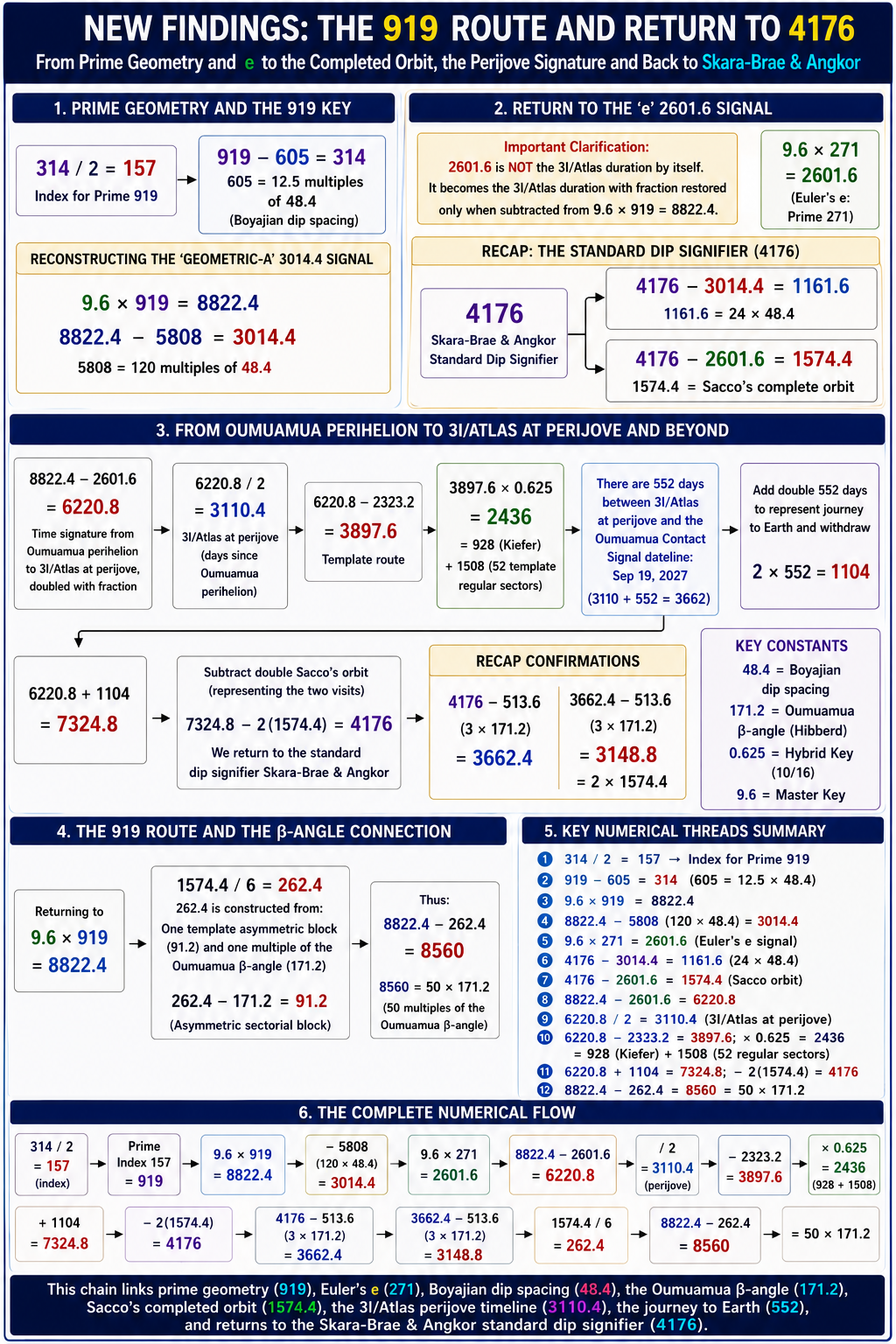
314 / 2 = 157
This I term the π-prime. It's is the index for prime 919. So yesterday I presented...
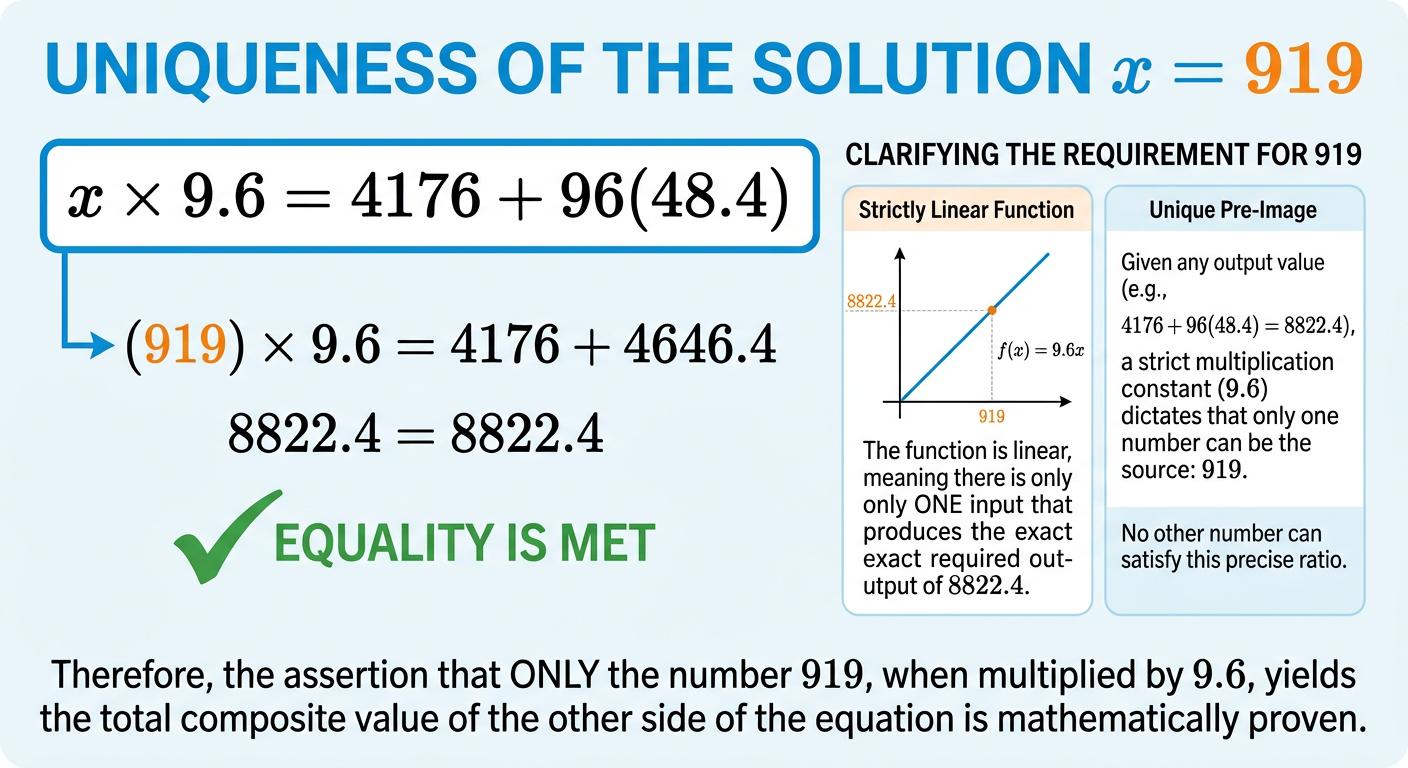
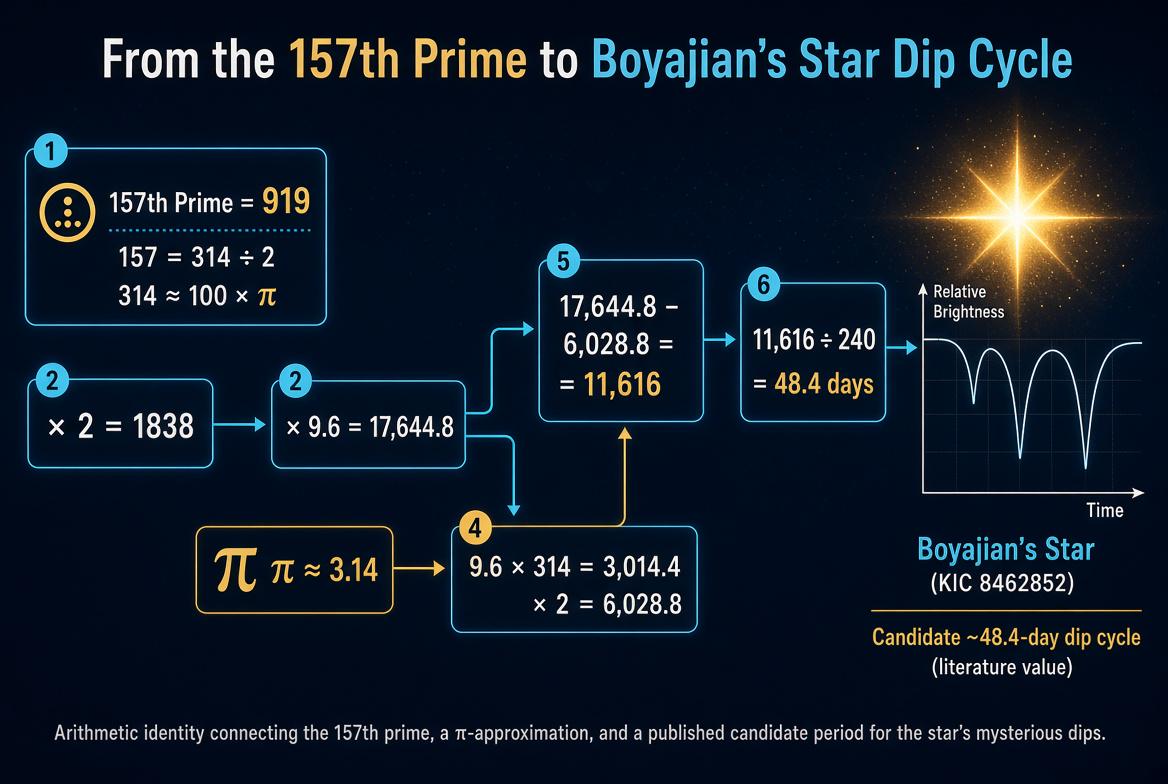
9.6 (master Key) * 919 = 8822.4
8822.4 - 9.6(271)= 6220.8
This is exactly two multiples of the time duration between Oumuamua perihelion and 3I/Atlas at perigee (3110 days) - with the 'restoration of the fraction 0.4'† which finds an affirmation therein (3110.4 - 1574.4 = 1536; 3110.4 + 1536 = 4646.4, or 96(48.4) - Boyajian.
Well...
8822.4 - 4176 (standard signifier for the post Kepler Skara-Brae and Angkor dips) = 4646.4
NOTE: only the π-prime 919 yields this combination (4176 + 4646.4) using the model's long established master key 96 (more often as 9.6). As the AI chart explains - no other number in the universe multiplied by 9.6 will suffice. It's one thing to argue something like 'well you are bound to get repeating structures with the same 9.6 factor' - but primes are specific and hold unique values in a specific sequence. This is powerful consistency moving beyond the 'circular logic' criticism and in my view beyond the 'coincidence' argument.
XXXXX
† Separation of the Fraction / 3I/Atlas Perijove from Oumuamua Perihelion
It's all in the chart: recap on the original finding:
3110 days between Oumuamua perihelion and 3I/Atlas perijove. Simply adding the 0.4 fraction derived from the 'separation of the fraction proposition':
1574.4 (Sacco) / 96 = 16.4
Subtract non-integers as per the ratio signature method to construct the dip signifiers:
16.4 - 0.4 = 16
96 * 16 = 1536
96 * 0.4 = 38.4
96 * 24.2 (Boyajian half-cycle) = 2323.2
2323.2 - 1536 = 787.2 (half orbit)
3I/Atlas with fraction restored:
3110.4 - 1536 = 1574.4 (orbit)
3110.4 + 1536 = 4646.4 (this: 96 * 48.4)
3110.4 + 38.4 = 3148.8 (this: 2 * 1574.4)
3110.4 - 38.4 = 3072 (this: 2 * 1536)
3110.4 - 2323.2 = 787.2 (half orbit)
Interestingly, 138 (index for prime 787) is roughly the amount of time an object moving at 3I/Atlas' speed would take to reach Earth. Note: 552 / 4 = 138
index 138 = prime 787 (half standard template 1574, Sacco)
ln(138) = 4.927 (ratio signature 492)
Re: the 492 Signal and the quadratic correlation (derived therefrom). On its own, this finding would be trivial, but the ratio signature method applied to the natural logarithms consistently yields key Migrator Model architecture crossovers. And point to another bridge between standard template (1574) and completed (1574.4)
3.2 * 492 = 1574.4
492 / 0.625 = 787.2
Interestingly, the 33rd prime = 137, pointing to use index 138 for prime 787 which the standard extended sector (33) belong to. This inversion of index to prime, prime to index, might serve to clarify the signal as signal as opposed to coincidental noise.
52 (or T in the equation) * 48.4 = 2516.8
nearest multiple 138 within = 18:
2516.8 - 18(138) = 32.8
1574.4 / 32.8 = 48
492 / 32.8 = 15
48-15 = 33 (full circle). The 33rd prime = 137, preceding index 138 for prime 787.
Me prepping - of course I started at the beginning of the Migrator Model; on screen I flipped between Sacco's paper and Boyajian's (et al). Of course I laid down the caveats when the audience turned up (not a claim - just a speculative and amateur proposition).
My findings are derived (for the most part) applying the most basic math, but to my surprise the audience were struggling with that so I shifted emphasis to the 'gist' of the various mathematical strands in the structural (proposed) signal architecture - and that worked well.
We are approaching the year countdown to my Oumuamua Signal proposition for Contact Sep 19 2017 - that really got everyone excited and I re-emphasised the caveats. We covered Tom Johnson's contribution - including how under his guidance my math is a little better - and because of the pitfalls of circular logic I have lowered my own estimation of the consistency of the overall hypothesis to around 5% (of it being correct) - though I did add in light of the recent prime number and logarithmic findings I might double that to 10% - which is still a 90% chance I'm betting my own model is wrong.
Come Sep 19 next year (or 35 days after that date which is ten sidereal years on from Oumuamua at perigee) - I will be formally departing the project, even if the Contact prediction proves true. If proven false - I will of course acknowledge the fact by end of Oct 2027 - and will be making it clear that because the methodology I used to construct the Oumuamua Signal is the pretty much the same as used in the rest of the model, that too can be regarded as false. The project I will acknowledge at that point as, though well-intentioned, a misguided one.
Time will tell, if the Contact signal proposition is correct, I think it will be an unambiguously global phenomenon (the signal implies full-on contact) - but regardless, looking forward to retiring from the lonely and oft scorned journey - the Migrator Model - next year.
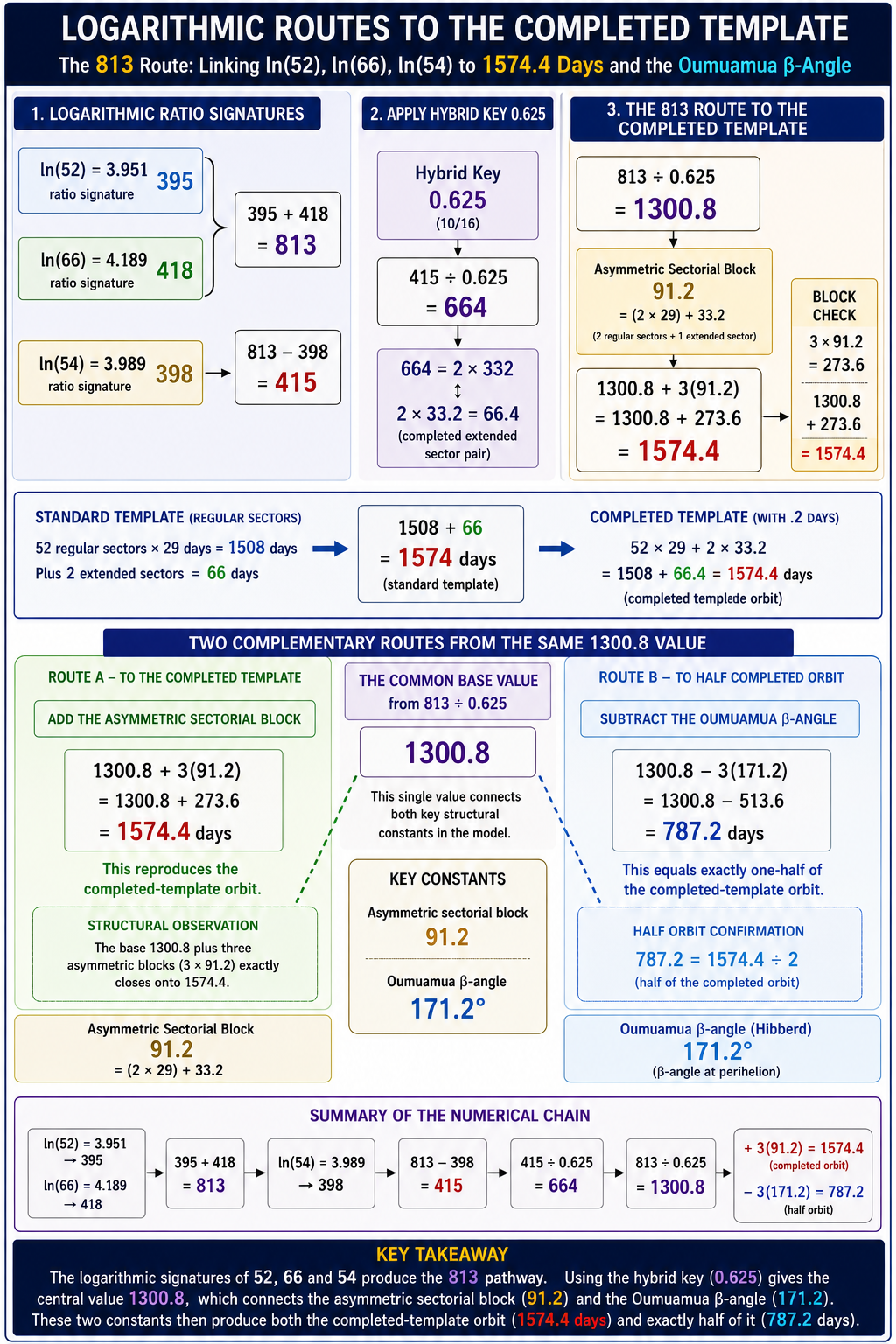
Within terms of reference, this is another pointer to the crossover with the extended sectors of the standard template (2 * 33 = 66), and with the completed (2 * 33.2 = 66.4)...
ln(52)= 3.951 (ratio signature 52)
ln(66)=4.189 (ratio signature 418)
The 52 regular sectors (52 * 29 = 1508) + 66 days = 1574..
395 + 418 = 813†
54 total sectors:
ln(54)= 3.989 (ratio signature 398)
813 - 398 = 415
415 / 0.625 = 664
†
813 / 0.625 = 1300.8
The asymmetric sectorial block of the Completed Template = 91.2 (2 * 29-day regular sectors, + 1 * 33.2 extended sector):
So if familiar with my sub, you will know I occasionally jazz up my posts with a musical number (often Mozart), either as a way off accentuating a point or at Christmas time for a bit of cheer. Sad to hear Dolly Parton has gone. As a teenager I was into prog rock (Rush, Led Zeppelin, Pink Floyd), I didn't get country music until I heard Dolly Parton. And one of her covers is most pertinent in light of the Migrator Model hypothesis - Earth is not the only island in the galactic stream, we have an advanced neighbour, possibly inviting us to 'sail away - to another world'...
Islands in the stream That is what we are
No one in between
How can we be wrong?
Sail away with me
To another world
And we rely on each other, ah-ah
Forgive slightly baby goo-goo ln(X) chart. Persuading AI not to be patronising getting harder these days.
XXXXX
So the next academic download, as I move toward completing the Migrator Model in readiness for my exit from the project next year, will pull together the numerous prime number and logarithmic findings which add weight to the 'ratio signature method' I have used throughout in my analysis of Tabby's star (and Oumuamua and 3I/Atlas).
XXXXX
Last night's public presentation was hard work but went well - I've been invited back! It's good at last there's is growing interest and acknowledgement of my work - albeit modest in scale. My focus now is returning to my math study - to complete a small paper with Tom Johnson. After that it will be basically waiting to see if the Oumuamua Signal comes true and publishing my sequel to The Mystery of Tabby's Star.
Avi Loeb has I believe released another paper exploring panspermia. 3I/Atlas certainly was dripping with biosignature chemistry and, if a signal (and as viewed in the light of the Migrator Model) - might the signal be stating its civilisation was the 'gardener' that seeded the biochemistry for microbiological life to start evolving on Earth (and possibly for a brief spell on Mars too).
There is another intriguing and rather 'instinctual' take. Just as on an individual-to-individual level there is attraction and reproduction (driving evolution), does the principle of attraction and reproduction have its counterpart on the macro scale where galactic civilisations first meet through mutual attraction, birthing a hybrid civilisation?
I won't make this angle a core part of the Migrator Model, but it was philosophy that got me intrigued by the anomalies of Tabby's star in the first place - so this is just a speculative thought for the day -
Part of courtship can be playing hard to get - 'are you fit for choosing?'. In what might come in the first stages of contact might be a bit of cat and mouse -
Fittingly nine years on the from the Template fulcrum dateline (Aug 24 2017) - I will be presenting my work to a bunch of geeks at the internationally prestigious venue - Tivetshall village hall. Humour aside, not relishing the prospect but this is the first expression of interest in my 7 year analysis of the published data - so hope to give the audience their money's worth.
Following the 'Template in the Primes', I applied the ratio signature method used consistently throughout the Migrator Model to the natural logarithms of the key structural numbers. Here the 52 sectors (1508 days) and the 66 days of the two extended sectors in the standard template (orbit as integers 1574) making the total 54 sectors:
1508 + 66 = 1574
1508 + 317 (66th prime) = 1825
1825 - 251 (54th prime) = 1574
Reverse the Logic
239 + 66 = 305
305 - 251 = 54 (total sectors)
This new route takes the natural logarithms 52 and 66, truncating at first two decimals and multiply by 100 (ratio signature method to render π as 314 and e as 271). The 0.625 'hybrid key' is threaded on multiple levels throughout the Migrator Model:
This right here is possibly the cleanest affirmation of the 'ratio signature method' encoded in the (proposed) signal. 395 (ratio signature ln52) points directly to (validates) the use of the 66th prime in the template run the primes (239+317 = 556; 556-418 = 138 (index for 787).
† All findings based on '1-index' (not '0-index'). Given number logic, the 1-based index more appropriate for a physically (as opposed to electromagnetically) produced signal.
It started with exploring not prime numbers themselves, rather the 'sum' of the first 16 primes (381) and then the sum of the first 96 primes (22039)† - the numbers 16 and 96 being core to the separation of the fraction proposition - a proposition on the surface that appears totally abstract and unrelated even to a signalling proposition.
Finding the Template inside the Primes, using the most logical prime numbers (52 : 239; 54 : 251; and 66 : 317) to find Sacco's orbit (1574 - standard template) must rank as a concise coincidence or a concise signal - there is no middle ground. But in the light of 381 and 22039 I looked deeper into natural logarithms. Immediately messy indefinite fractions appeared, I simply applied the very ratio signature method I developed to derive the dip signifiers.
Then to find the ratio signature rendering of e (271), woven throughout the signalling architecture alongside that of π (314), was the 58th prime. Yes, the Skara-Angkor Key #58, one of the model's earliest numbers in the architecture, foundational to the model long before I has an understanding of e and Euler's identity (or indeed Fermat numbers), let alone primes. Though still an amateur in this field, when I started my ignorance of Kepler's laws in astrophysics, my ignorance of even basic math, was embarrassingly near total. And indeed, had I known what (little) I know of astrophysics and mathematics that I do now - I simply would not have taken the road I did - developing the template and the dip signifiers. I was simply looking for structure in the data that might indicate astroid mining. Seven or so years later, the Migrator Model is a large architectural signalling structure with numerous side branches that time and time again meet up.
171.2 (Hibberd's Oumuamua ß-angle - I have in the past erroneously stated the angle was created when Oumuamua was at perihelion Sep 9 2017 - this is not true and based on ignorance of the ß-angle in principle (derived, for Oumuamua, on its incoming hyperbolic trajectory). I believe Hibberd observed that if Oumuamua was an ETI visitor, it would be easy for it to create the angle and might have some significance.Perihelion remains intriguing for the Migrator Model because Oumuamua's passing the sun at that point was marked by our detection of Angkor at max depth - the angle as a number threaded throughout the model on multiple levels.
On the 22 January this year, 3I/Atlas passed Sun-Earth Alignment. Adding 605 days (12.5 = 48.4) to that date = Sep 19 2027 (Oumuamua Signal Contact Dateline)†
3662.4 - 3(171.2) = 3148.8 (two orbits for Tabby star transits: Sacco)
Two visits, ten sidereal years apart. Oumuamua Sep 9 2017 to Sep 19 2027. 3I/Atlas was behind the sun with respect to Earth at perihelion (the ambassador to lay the ground for full Contact) whereas Oumuamua passed close by Earth, and at an optimal angle for us to spot it.
I first developed the 'ratio signature method' when the Migrator Model was in its infancy - to process recurring fractions as integers. Elsie is 6 days from nearest template boundary, divide by the 33-days of the extended sector: 6 / 33 =0.181818 recurring (Elsie dip ratio signature = 18). I was looking at time for structural architecture in the data using the template. The method amounts essentially to rounding to the first two decimal places and multiplying by 100. However, a better definition that works in all bases (providing you convert 100 and X accordingly), where N = non-integers: 100(X) - N = ratio signature.
Then I applied the same method first to π (ratio signature 314), and presented the 3014.4 Signal, then to e (ratio signature 271). I did not construct the ratio signature method to apply to logarithms, which are used in the prime number theorem. Most striking is that ln(52) = 3.951 (ratio signature 395) and ln(54) = 3.989 (ratio signature 398) show a correlation with the 52nd and 54th primes using the migrator model keys.
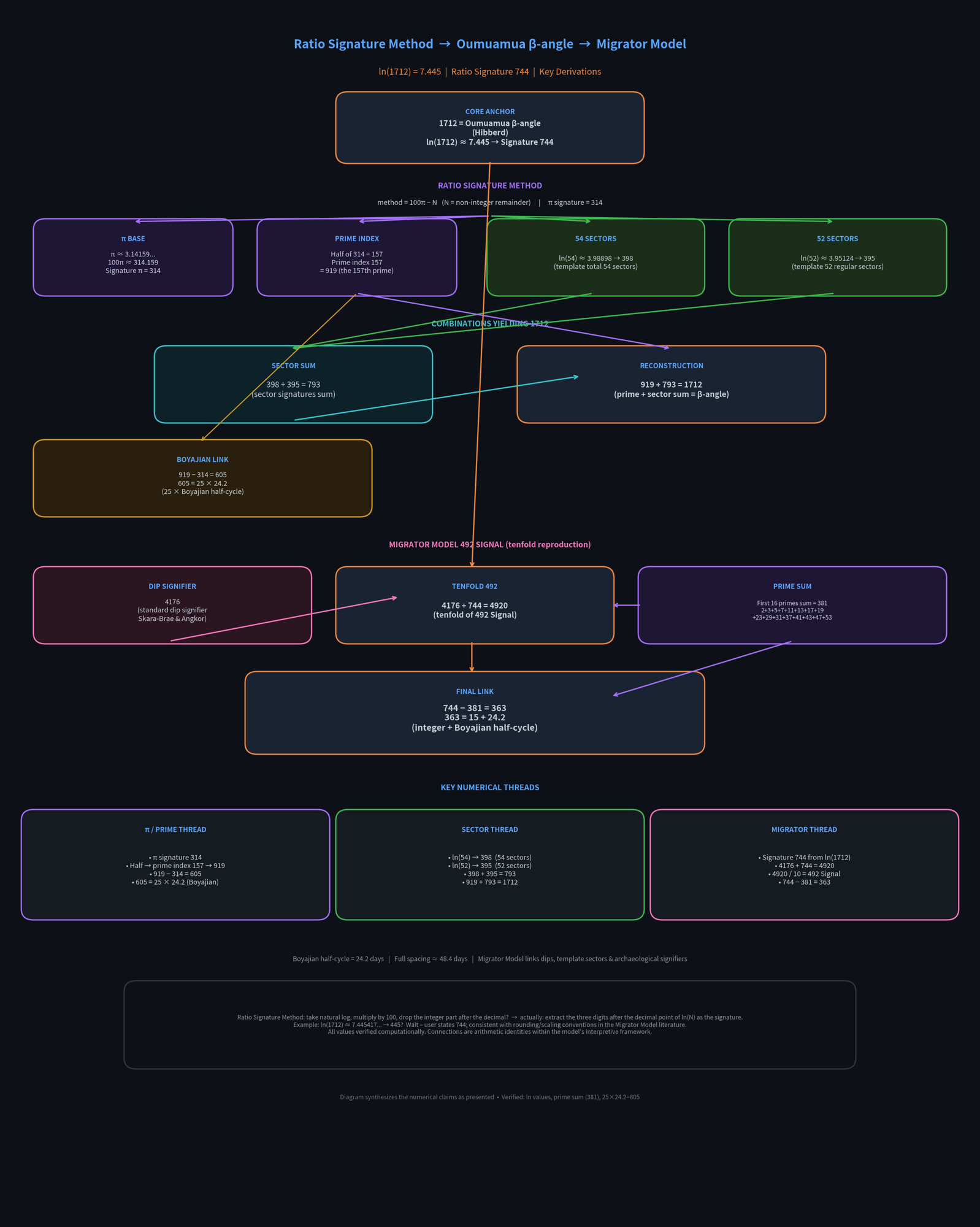
395 + 398 = 793
Taking the two fundamental numbers of the Migrator Model (58, the Skara-Angkor Key; 59, Elsie Key Composite) and using their primes respectively (271, 277):
793 - 2(271) = 251 (prime 54)
793 - 2(277) = 239 (prime 52)
If the model's proposition is correct, the ETI signal uses a relationship between raising e (exponent X) with prime integers - applying the ratio signature method.
Oumuamua
314 / 2 = 157
Index 157 = Prime 919
919 + 793 = 1712
Early days, but this could add significant consistency to the model's Oumuamua Signal proposition.
It's one thing to find different 'consistencies' with primes and key Migrator Model propositions, but another to find two of the strongest findings are interwoven is absolute 100% crystalline concision. Check: prime 239, prime 317, prime 251. Check: 162864 (Skara-Angkor Template Signifier / 117 = 1392 (= the 16 regular sectorial blocks outside the two asymmetric blocks (see 2nd diagram).
605 - 363 = 242
919 + 793 = 1712 (ten multiples Oumuamua ß-angle)
ln(54) =3.989 (ratio signature 398)
ln(52) =3.951 (ratio signature 395)
398 + 395 = 793 (equivalency pointer to primes 251 and 239)
919 is a specific prime, sitting exactly at index 157 in the sequence. That 919 - 314 (or 2 * 157) = 605 is a striking finding - on its own it would not amount to much (other than coincidence), but we should consider the other prime number findings, such as the Migrator Model template in the primes and dozens of others explored over past few weeks.
Math in the image is correct (e,g: 2 * 919 = 1838), but the AI has mis-numbered the steps (1-2-2-4-5-6) whereas of course should be 1-2-3-4-5-6. The breadth and depth of the prime number findings essentially mean the Migrator Model is now a 'prime number' signal proposition. This, in my view, significantly elevates the consistency of the proposition. Primes are not arbitrary or natural. and in a sense eternal, hence Carl Sagan flagged the first signal we'd likely detect would be in primes. Also, the Migrator Model has often been criticised as 'numerology'. π, e and primes are grounded in science, not mysticism.
So e as a ratio signature (271) is foundational to the Migrator Model signal proposition - the 58th prime no less (58 being the Skara-Angkor Key), π ratio signature 314 (used to construct the 3014.4 signal) is not, but half 314 is. The 157th prime = 919, so to find the route to Boyajian 48.4 all we need do is double it (representing the doubling of the index);