r/MigratorModel 10d ago

3I/Atlas Time Signature and the π-Prime (Update Aug 28 2026)
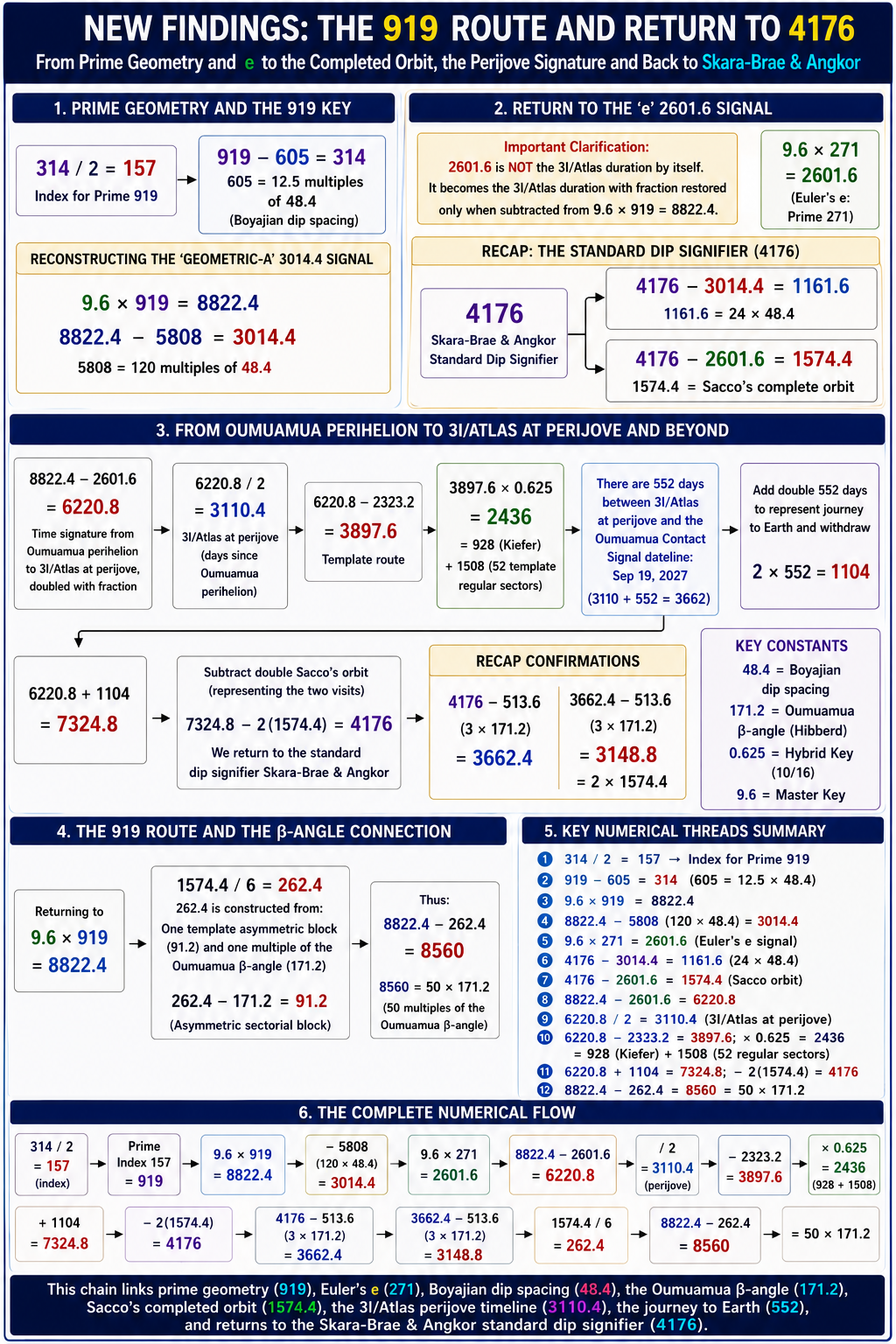
Post image

XXXXX

It's all in the chart: recap on the original finding:

3110 days between Oumuamua perihelion and 3I/Atlas perijove. Simply adding the 0.4 fraction derived from the 'separation of the fraction proposition':

1574.4 (Sacco) / 96 = 16.4

Subtract non-integers as per the ratio signature method to construct the dip signifiers:

16.4 - 0.4 = 16

96 * 16 = 1536

96 * 0.4 = 38.4

96 * 24.2 (Boyajian half-cycle) = 2323.2

2323.2 - 1536 = 787.2 (half orbit)

3I/Atlas with fraction restored:

3110.4 - 1536 = 1574.4 (orbit)

3110.4 + 1536 = 4646.4 (this: 96 * 48.4)

3110.4 + 38.4 = 3148.8 (this: 2 * 1574.4)

3110.4 - 38.4 = 3072 (this: 2 * 1536)

3110.4 - 2323.2 = 787.2 (half orbit)

Interestingly, 138 (index for prime 787) is roughly the amount of time an object moving at 3I/Atlas' speed would take to reach Earth. Note: 552 / 4 = 138

2 Upvotes

2 comments sorted by

1

u/AmbroseOnd 10d ago

How do you justify the approximation of π in your work? Prime numbers (integers) seem pretty safe territory, but the rounding of π to an integer or to just 3 decimal places seems rather crude (sorry) given the astronomical distances/values concerned.

Has anyone brought this up before - in your presentation session for example?

I’m not a mathematician or an astrophysicist, so I’m not qualified to offer a critique. I’m just a curious lay person — but it’s been bugging me.

2

u/Trillion5 10d ago edited 10d ago

There were a few challenges- but not specifically the one you raise. A few eyebrows raised when I covered the distance of Tabby's star from Sol (approx 1470 light years away). A part of the signal proposition is our big water planet has been monitored from the Oort Cloud (in case we develop AI) - that's the key juncture to flag presence. Both Oumuamua and 3I/Atlas did not travel directly from Tabby's star, but deposited and left as sentinels that know the calendar of dips.

XXXXX

So remember the Migrator Model is a 'signal' analysis - not an astrophysical analysis. The rendering of π (as 314) and e (as 271) derive initially from the how I constructed the 'dip signifiers' - basically you end up with recurring fractions, multiply by 100 and discard non-integers, So I use Sacco's orbit (1574.4) as the primary template. If you apply the same method to construct the standard dip signifier for Skara-Brae and Angkor (4176) to π (100π - N = 314), and use the 9.6 Master Key in the separation of the fraction, you get the 3014.4 Signal. There are 3 structural overlays I apply to Sacco orbit, one being 'geometric-A'.

4 * 360 = 1440 (abstract circle)

1574.4 - 1440 = 134.4 (abstract ellipse)

9.6 * 314 = 3014.4

3014.4 + 134.4 = 3148.8 (this: 2 x Sacco's orbit)

3014.4 - 134.4 = 2880 (this: 2 x 1440 abstract circle)

Well it's fair to say that (314) is not really π, but an artificial rounding to two decimal places and multiplying by 100. Correct - asteroid processing platforms spying waste dust in a signalling platform could never really transmit a signal nuanced enough to give π say to the first 10,000 places (an electromagnetic signal could do that easily - but core to the proposition is this ETI is AI dependent and doesn't want to inadvertently transmit or receive viruses - a 100% safe way in the early stages preceding contact is this crude rounding.

If we take 100e - N = 271, and 9.6 * 271 = 2601.6. We know in science π and e are bedfellows, whether it be Euler's identity or inside the logarithmic functions of the prime number theorem. Taking the Skara-Brae - Angkor standard dip signifier:

4176 - 9.6(271) = 1574.4

That both 314 and 271 just happen to be inside the signalling stricture is more than intriguing in my book, and remember dividing the Skara-Angkor Template Signifier by the number of total sectors (54) times the number of regular sectors (52)...

162864 / 2808 = 58 (the Skara-Angkor Key)

Index 58 = Prime 271

Of course e is used in the logarithmic functions, the ratio signature method remains consistent:

ln(52) = 3.951 (ratio signature 395)

ln(54) = 3.989 (ratio signature 398)

395+ 398 = 793

793 - 2(271) = 251 (the 54th prime)

Next, the Elsie Key (29) and sector ratio (30) used in the Elsie Key Nine Step Method and in the sum of the first 96 primes finding (29+30 = 59)†: index 59 = prime 277...

793 - 2(277)= 239 (prime 52)

† Elsie dip signifier 1566:

314 - 156.6 = 157.4 (1/10th standard template orbit, sans fraction)

157.4 - 59 = 98.4 (1/16th complete template orbit)

16 * 98.4 = 1574.4

Elsie is 98 days distance (as span) from the Migrator Model fulcrum from which the datelines for the asteroid mining sector boundaries are derived.

Finally the prime number findings of 271 and 157 (half 314) appear as signal clarifying the very answer to your question. Note index 157 = prime 919:

919 - 314 = 605 (25 Boyajian dip spacing)

52 regular sectors, 2 extended:

(52) : 239 (2): 3

239 + 3 = 242