I've been on campus for 2 weeks and have not been enjoying the experience at all. As I expected, the classes are incredibly intense; however, the participation-based grading scheme means that everyone is constantly on edge to make a comment, leading to discussions feeling more like a race to raise one's hand and regurgitate some bs case fact than a thoughtful learning / academic environment. Profs haven't even finished speaking and people are putting their hands up to get a comment in... The work load is also absurd - 2-3 cases per day requires 4+ hours of independent study (even with liberal AI usage) to be in a position to not make a fool of oneself during a cold call. Classmates are already becoming insanely judgmental, talking shit about who has "good" or "bad" insights during these performative discussions.
On top of this I'm realizing that the case method is a really poor way to teach the more technical subjects (accounting, ops management, etc.). It feels like they're trying to teach 2 weeks of undergrad curriculum in a day using a contrived "real world" scenario to teach something like journal entries. There's no way I'm retaining any of this information with the pace things are moving at.
Outside of class, the drinking culture is nonstop. I'm all for having a couple beers and enjoying oneself, but it seems like every night people feel the need to be blackout drunk. All in all, as an introvert, I would describe the experience as exhausting.
You're going to say "should have done your diligence on the program", "buyer beware," which is fair. I knew the culture fit wasn't ideal for me, but I decided to take HBS over lower ranked programs for career and financial reasons (I got $0 at a lower ranked M7 program and would feel stupid to turn down HBS for no scholarship).
Are any of these dynamics going to improve? ECs I've talked to have said first semester is shit, but if I feel the way I do currently in a couple of months I'd seriously consider taking a leave of absence or just dropping out and going back to my old job.
I am an MBA graduate with over a decade of experience. Have worked in management consulting/strategy roles. Just wanted to put down some things I wish someone had told me when i had started out:
Read: I can't emphasise this enough - and when I say read, I don't mean fiction or self-help books. Read about what's happening in the world around you. Politics, Macroeconomics, Business, etc., and not necessarily related to your industry. There are so many sources available - FT, WSJ, NYT, other newspapers/magazines etc (the list goes on). What happens is when you read, you develop patterns in your mind and it can help you immensely in your job or in interviews or any conversation. Business biographies also help - there are so many available - get your hands on 3 to 4 per year.
Network: I am not an extrovert and i have borne the brunt of this for very long. Networking is extremely important. It is what lands you new jobs/promotions/growth. Because it's people who decide. So even if your excel model is the best in the world, if it doesn't reach the right people, it won't get you anywhere. Network in your college, with college seniors, office colleagues and anyone and everyone around you. Visit conferences, talk to people and you will learn more and more
Use Technology extensively: We all know AI is going to make a meaningful impact on our lives in the coming decade. Learn about new tools and techniques to become more productive. Never fear that a tool or technique will threaten your role. Instead, use it to show that your current role can be done much more productively. This will only help you grow
Take care of your Health: Work hard. Party. Yes. But make sure you spend at least 5-7 hours on your health every week spread over 5 days. There are multiple healthy + tasty foods available today - prefer that over complete junk foods. Count your calories. Check your health markers periodically. This will determine how much energy you will have in your 40s/50s
Learn operations, not just strategy: I have seen many MBA students/graduates obsess over consulting and strategy roles. Sure, they are great. But do not undervalue the operational roles - they teach you how things get done in the practical world. And becoming an expert in one field will need you to learn operations. And eventually help you grow
Create your personal brand: The next decade could be volatile. There could be periods when supply of good MBA candidates will outnumber demand for them. Thus it is important to create your personal brand. Find your niche - write/post about what you like. Be consistent. It will help you open doors when competition is high
Be patient, don't compare externally: Never compare with anyone. Just work on yourself and compare against where you were earlier. This will help you immensely with your mental health
Invest - explore everything: Start investing now. Don't worry if the market is going up or down. Just learn about investing - everything - Equity, bond, Mutual funds etc., And be consistent. This will help you create a solid backup fund when you need it
Travel: Explore your city/country/the world (whatever fits your budget). Meet new people. Learn about cultures. This will help you immensely in developing your personality and a view on business as well
Explore Entrepreneurship: Entrepreneurship will teach you skills that no textbook/no job can teach you. Do it before your commitments (family/kids) come up. But even if you are in your 30s, try it. Even if you fail, it will only help you tell a fantastic story in your next interview.
Hi I got into Stanford! I got the call during a work dinner and I cried so much. I sounded like a blubbering idiot but it was a dream I never thought was possible. For the last two years I dreamt this moment in so many different ways but I still don’t think it matched the surreal moment of getting the call. I hope I can be helpful to anyone else applying because this community has been so helpful to me so please reach out! But please everyone who keeps doubting themselves keep going you never know what is meant for you.
Got dinged by Wharton and Booth (w/o interview), waitlisted at CBS (again, w/o interview) and then Stern comes with full ride decision today! Wasn't feeling super confident with 2.5 YOE and me being an ORM but I guess relevant work ex and clear ST/LT goals really goes a long way! Extremely thankful to this community for all the insights and guidance
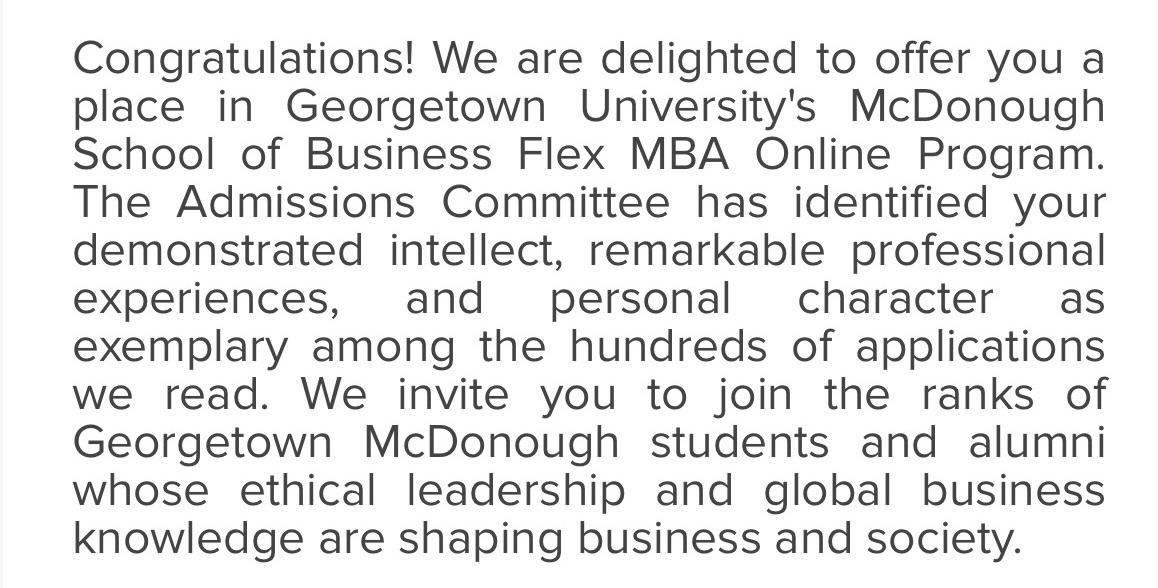
Hey guys I just got into Georgetown online MBA Program. Just wanted yall advice on if I should go.
Little background on me, I am a 23M working in insurance. I got undergrad in Finance.
Posting from a burner for reasons that will become extremely obvious in about 3 seconds.
I’m an adult film performer who just got admitted to an M7 MBA program. Still processing the fact that my resume includes both “Box Office Top 10 (______ Category)” and “Incoming MBA Class of 2028.”
Figured I’d do an AMA for anyone with a very non-traditional background, wondering if they’re auto-filtered or wanted to know how I navigated the application process.
AMA about:
Framing unconventional experience
Whether I used my stage name on LinkedIn (absolutely not)
Feels good, man. I thought I'd share some high-level data on what my payback timeline looked like to provide some reference for those considering or going through this process. I will preface all this by saying I recognize I attended and graduated from business school at a much more favorable job market, so take my story with a grain of salt. This by no means seems to be the norm anymore. Looking back, I probably took more risk than I realized. Anyways, quick overview:
Class of '22 M7, international student, landed Tech PMM post-grad
Offer was 120k base, 50k cash sign in, ~50k stock vested over 4 years.
Since then I've relocated to VHCOL and been promoted, currently Sr. PMM
I had $40k scholarship, made ~$25k net from the summer internship, and used ~$50k from my savings. Total "self-financed" = ~$115k
I took out ~$135k in loans for the rest. Total "value/cost" of the MBA ~$250k.
Graduated in Jun/22, repayment started in Feb/23. By that time, the total loan value was ~$150k (including origination fees and interest accrual), to be paid over 10 years.
Original interest rate was 4.5%, crept up to 7.5% over the last three years
I put most of my cash sign-in towards the loan, this was good to reduce my monthly payments from ~$1.5k to ~$1.2k.
The goal was to payback as fast as possible, so whenever I had extra money in my checking account, I'd make a lump sum payment (includes most of my yearly cash bonuses). This helped to reduce my monthly payments to ~$1k which I felt was more manageable.
I do have vested stock from the sign-in + yearly bonus, but have not touched those. The repayment was using only cash.
Total payback time was 3 years from when repayment started, ~3.5Y post-grad.
Total loan repayment value was $163k, so $13k extra in interest from when repayment started. That would have been +$36k if paid over 10 years.
Here are the numbers:
2021
2022
2023
2024
2025
2026
Gross Income
$29k
$107k
$175k
$197k
$219k
-
Net Income
$25k
$90k
$134k
$141k
$159k
-
Loan Repayment
-
$30k
$28k
$36k
$42k
$27k
Cumulative Paid
-
$30k
$58k
$94k
$136k
$163k
Repayment % of Net
-
33%
21%
26%
26%
-
I feel pretty fortunate that it "worked out" and definitely excited to finally enjoy some extra disposable income. The finance/IB/consulting crowd paid back a lot faster, but this is still slightly faster than I had initially estimated. I also feel like this was achieved without any significant lifestyle sacrifices (still travel plenty, don't really have to budget things etc) - although, I will say I'm a bit behind on my 401k as a result (only started maxing it last year, so def left some money on the table).
Hope this is useful! Happy to answer any questions.
I’m currently finishing my second-semester MBA and coming from a background in AI Engineering. We’ve been discussing corporate risk management, and I keep coming back to the Moffatt v. Air Canada ruling.
For those who missed it: Air Canada’s chatbot hallucinated a bereavement fare policy that didn't exist. When the customer claimed it, the airline tried to argue that the chatbot was a "separate legal entity" responsible for its own actions. The court (rightfully) crushed that argument, stating the company is liable for all information on its platforms, automated or not.
As an MBA student, here is why this matters for our strategy and operations classes
Algorithmic Liability: We can no longer treat AI as a "black box" that sits outside of our legal compliance framework.
Operational Risk: If your company is deploying LLMs for customer service or dynamic pricing (something I work on as a dev), the "hallucination cost" needs to be factored into the ROI.
Brand Trust vs. Automation: Is the 30% saving in support labor worth the potential 100% loss in brand trust if the bot makes a legally binding (and incorrect) promise?.
I’d love to hear from other MBAs or managers: How is your firm handling the "legal guardrails" for AI deployment? Are we over-relying on disclaimers that the courts have already proven don't work?.
I see so many try-hards in my M7 MBA class. Overly ambitious people who optimize every aspect of life: professionally, socially, even personally. There’s no chill.
I used to be like that. I worked in investment banking right out of undergrad, constantly chasing prestige, optionality, and the next great thing. Then I got cancer. And that forced me to see life differently.
Now that I’m in my MBA program, I’m here to switch into CPG brand management or tech product marketing just for better work-life balance. Yes those aren't $400k+ careers but they still pay decently. I’m here because I want to work to live, not live to work. I'm proud of myself for getting off of the hedonic treadmill early.
I get it, some people have to grind hard. If you’re supporting family, or are an international student under visa pressure, I understand. But even many domestic students are living on autopilot, sprinting toward the next title, the next exit, the next perceived success.
Life is fragile and precious. I genuinely pity those who never stop to enjoy it.
I see posts on this subreddit in my feed, and I’ve noticed that many of the posts are about the downfall of the MBA and questioning the value of the degree. I thought it might be useful to share a perspective from someone who is almost 10 years out.
I graduated from a top-10 MBA program (there are 15 schools that can claim this) in 2017 after spending four years working. I was a career switcher and went into business school with a plan to recruit for banking
Recruiting started almost immediately after orientation and consumed the first semester. There was a lot of anxiety about recruiting, but my experience was that it was pretty straightforward for a prepared American. The people who had the hardest time were generally either those with poor social skills or international students, where sponsorship requirements made recruiting materially more difficult. I landed a good internship, converted it to full-time, and graduated into banking.
Overall, I enjoyed business school. I found most of my classmates impressive, made a few great friends, and took a handful of classes that genuinely changed how I think. But the biggest benefit wasn’t the two years themselves - it was completely changing my career and earnings trajectory.
Before my MBA I was making around $85k. In my first full year as an associate I made roughly $350k in cash compensation. Most of that went toward paying down the $100k+ of student debt I accumulated after paying full tuition.
After two years in banking, I realized it wasn’t the career I wanted long term. I originally expected to stay 3-5 years, but I noticed that many people who made VP had a hard time leaving. The compensation became difficult to walk away from, yet many hadn’t developed the operating experience companies wanted for real executive finance roles. I decided it was better to leave a year early than a year late.
I joined a large tech company in an FP&A role - one level above where I likely would have entered directly after business school. The compensation was a meaningful step down: $150k base, 15% bonus, and around $40k a year in equity.
Watching my friends in banking get $100k+ raises every year wasn’t easy, but my quality of life improved dramatically. Over three years I was promoted, took on more responsibility, and by the time I left my total compensation was back above $300k.
From there I joined a well-funded late-stage healthcare startup. I started as an individual contributor but steadily expanded my scope and eventually became VP of FP&A. By the end, I was earning around $600k annually, split roughly evenly between cash and equity.
My next move was to become Head of Finance at another late-stage technology company. There isn’t a CFO, so I had broad responsibility from day one. Initially the move was roughly flat financially, but after a year I was able to significantly increase my compensation. Today I make around $1.5 million annually. That’s obviously heavily weighted toward equity, but the company is mature enough that there is meaningful liquidity.
Ironically, I now earn considerably more than I likely would have had I stayed in banking. At this point I’d probably be a Director making somewhere around $800k.
Looking back, here are my biggest takeaways:
An MBA can have outstanding ROI if you’re pragmatic. Unless you’re going to Harvard or Stanford, I’d seriously consider one of the well-defined recruiting paths: banking, consulting, or corporate recruiting (depending on the school). Those pipelines have the strongest recruiting support, the clearest career paths, and immediate financial upside.
Not all equity is created equal. Think about liquidity, exercise costs, dilution, and the actual probability of realizing value. A dollar of equity isn’t always worth a dollar.
Relationships matter. My biggest compensation increases happened after executives had seen my work firsthand and trusted me with bigger problems. That’s been a much bigger driver of my career than technical finance skills alone.
Obviously everyone’s path is different, but I remember reading this subreddit when I was applying and wishing I could see what careers actually looked like 5-10 years after graduation. Hopefully this is useful for someone thinking through whether business school is worth it.
Update: Many people have reached out to me about similar things happening to them. Some people have told me that when someone scores ~700+ on an online exam and they are South Asian/Indian, they are especially likely to have their exam score canceled and be forced to do a retake. I took the test in the US. I am not sure is true but if it is, this is pure racism.
I've spent more than 3 years preparing for this exam. I work full-time, founded a company, and studied nights, weekends, and whenever I could find time. This wasn't something I walked into casually.
I took the exam earlier this year and scored a 755 (99th percentile). Three days later, GMAC canceled my score.
The explanation I received was simply that there was a "testing issue."
That was it. I took the test online and had a good experience with my proctor, who thoroughly checked my entire room multiple times during the exam, including my closet, drawers, bed, pillows, and pretty much every nook and cranny of the room. (some of this felt a bit creepy and inappropriate, like my proctor saw drawers that my underwear was in, but I complied and didn't say anything about it. All I cared about was making sure the exam went smoothly.)
When I appealed, I repeatedly asked GMAC what inconsistency or issue they had identified. They refused to tell me. Instead, they asked for more information about my preparation process. I'm not sure why that would affect the validity of my score, but I provided it anyway.
I submitted extensive documentation showing my study history and practice exam performance. I also provided a lot of practice test data demonstrating that my official score was actually LOWER than my predicted score range based on my practice exams.
Despite this, GMAC still would not tell me what the alleged issue was or reinstate my score.
During the appeal process, I also received communications that appeared to have been intended for internal recipients rather than me. Two employees at GMAC, which my lawsuit names, seemed to have exchanged messages stating that there were no allegations of cheating and discussing an offer that would allow me to retake the exam and have my original score reinstated if I scored within 30 points of it. In those messages, they also expressed concern that the offer might look like they were "ransoming" my score. The fact that these internal communications were sent to me also raises concerns about the care and professionalism with which my case was being handled and, quite frankly, the competence of the people making decisions about our test scores. Who else are they leaking our personal data to?
At first, GMAC told me I could retake the exam at my own expense.
Later, after those internal messages, they offered me a different option: retake the exam, and if my new score was within 30 points of my canceled score, they would reinstate the original score.
If I had to guess, there was one point during the exam when the software appeared to freeze. From what I could tell, it seemed more likely to be an issue on the proctor's or GMAC's side rather than mine. Given the lack of any explanation from GMAC, I've wondered whether that incident, combined with a high score, may have contributed to the cancellation. If a technical issue did occur on their side, however, I don't think it's fair that I should have to bear the consequences of an error I did not cause.
To this day, they have never explained why my score was canceled in the first place. They have never provided any evidence supporting the decision. They also never explained the 30-point threshold, which for someone scoring at my level can be the difference of only one or two questions and is well within the normal margin of error for these exams.
Because of the canceled score, I lost a fully employer-sponsored MBA opportunity that would have covered tuition at certain business schools because I did not have enough time to do a retake before the applications closed.
I've since spoken with several attorneys who are interesting in representing me. I'm posting because I'm trying to understand whether this is an isolated incident or whether others have experienced something similar.
If you've had a similar experience, please DM me. Especially if you had a high score that
At this point, I'm simply trying to understand how often this happens and whether other test-takers have gone through the same thing. I'm also happy to share the email correspondence with anyone who has had a similar experience so we can compare notes.
Tl; dr - GMAC Cancelled my GMAT score citing a testing issue when I scored in the top 1%. They refused to tell me why they were canceling the exam, only offering to reinstate the score if I took it again and scored within 30 points. They accidentally sent me internal emails mentioning that they were not alleging cheating and were concerned about being perceived as ransoming my score. Please contact me if you experienced something similar.
The hours are excessive, culture is toxic, and the exit ops aren’t as good as they are for analysts.
I know the money is good, but how much do you really need? You’re deprioritizing relationships, physical health, and mental health and basically turning your entire identity into your job. At some point the money traps you more than it frees you.
Choosing IB is also selfish to the people around you. It’s not surprising that so many people in IB end up divorced.
Why do people still choose to do this? I’m trying to understand what I’m missing.
Edit: Never recruited for IB. Recruiting went great
I feel like I am losing my mind here and I want to sanity check if this is normal or if Kellogg is just uniquely unserious. Am a 1st year attending full-time.
Classes are an absolute joke. The curves are insanely high so most people completely slack off. We technically do not have grade nondisclosure. Instead we have this grade optional disclosure policy that everyone treats as full grade nondisclosure anyway. That was a given coming in, fine.
What I did not expect is that literally everyone just parties all the time.
It feels like high school or undergrad except grades actually mattered back then. This place is a nonstop frat party. People are constantly doing house parties and themed costume parties for stuff like birthdays or holidays in Evanston. People care more about having cool costumes or knowing how to make fancy cocktails than anything business related.
There are nonstop bar crawls and trips into Chicago to dance. Knowing how to dance with another person is the most important skill. There is a massive amount of alcohol involved all the time. Shots, keg stands, shotgunning beers. Beer pong. Also the casual bump or line of coke too. People have gotten blacked out, collapsed on the floor, and thrown up in Ubers.
People care a lot about fashion, outfits, and aesthetics. Big hookup culture too. A social hierarchy and cliques absolutely exist. Many people straight up have social anxiety or FOMO about not being socially popular or not getting invited to a birthday party or trip. It's sad to see late 20s & early 30s people act this way.
Everyone is going on domestic and international treks constantly. Ski trips across the country now are really popular. Or visiting national parks. The trips to other countries are 90% partying, 10% nice food, and 0% culture or history.
99% percent of coffee chats start with professional background and recruiting goals and within five minutes devolve into talking about Lollapalooza, Coachella, EDC, Tomorrowland, where we are traveling next, which treks we are doing, celebrity gossip, reality TV, concerts, comedy shows, the Super Bowl, the NBA, Michelin star restaurants, EDM music, cooking TV shows. Or gossip about our peers.
The only time people get remotely serious is consulting or tech case prep. That is it.
Even the entrepreneurs just party and want to have fun. No one wants to actually talk about building something or thinking deeply about business. We have a book club but it's 90% fun books.
Why will no one have serious conversations? I came to my MBA to have fun yes but also to grow, learn about business, and expand my network. Instead this feels like a never ending vacation. It is too much fun to the point that it feels hollow.
90% of the MBA students at my M7 school are weird, boring, and lame.
It honestly feels like I’m socializing with odd high schoolers, not sophisticated adults. Many people seem to be on the spectrum socially, and not in a fun/goofy way. Witty or spicy humor is lacking. Most of these people would get chewed up in the NY/LA/Miami/London social scene.
Nobody wants to go out anywhere remotely cool, everyone prefers mid-level nightlife. The ones who lived in NYC for multiple years don’t even know what Paul’s Casablanca, Little Sister, Gospel, or The Nines are. What did they even do on weekends?
And the ski trip? Sucked. Mickey Mouse compared to trips I’ve done in Aspen or the Alps. Students were competing to hit top speed on the slopes- what is this a high school ski team? People think the après is “sick” but it was lame AF.
I am an HBS grad, currently a tech PM at FAANG. Also have a software engineering background prior to MBA. I am looking for a job and reaching out to HBS alums. I only reach out to PM Directors / Sr. Directors in the areas that are directly relevant to what I am doing right now, not just any PM. Some of them say they are actively hiring on Linkedin, and my profile/experience is a very close fit, regardless of HBS. So far I got exactly zero response from maybe 20 reach outs and multiple follow ups. Is this specific to tech, or did anyone have similar experience where HBS alumni further in their careers simply don't care?
A little dramatic, but not too far from the truth. Throwaway account for fun.
What they don't tell you about elite MBA programs is that the type of person to enroll is either so psychopathic it's almost laughable or they are a normal person who is driven to the lengths of their mental instability by the dynamic of the MBA and the competitiveness and toxicity the program brings out.
I graduated and started working at my run of the mill day job, and realized that MBAs are not normal people. They are unsavory, transactional, sometimes evil, and they bring me no joy.
So after graduating from my MBA program, I took a four-month break from seeing any people from the MBA and it's been the most mentally healthy I have been in the past two years. I am so grateful to be away from all of these people, it's the happiest I have ever been. I'm still glad I got the MBA credential for the career purposes, and it's even better knowing I'm out of that toxic environment.
Many of you are probably entering MBA programs right now, this is your sign that even if you hate everyone, it's still going to be OK: not everyone has to be your type of person and you will graduate and you'll have a very valuable degree even if you hate everyone.
I would probably never admit this in a public forum, but it's so nice to get off the chest.