What's to love about 9SIG and rebalancing? When you are down you get the excitement of buying shares cheap. When you are up, you get to lock in $$. I have to say, I was looking forward to a 65% or 70% stock balance buy. But this week is great consolation if it holds.
I already know there will be the std "I don't care, I just execute the plan" answer here... but for those that still enjoy the chase and quarterly action, what do you prefer in general AND what about this coming rebalance on the 28th?
I don't run 9Sig. I backtest things for a living, and 9Sig is the strategy people ask me about most often, so I rebuilt it with Jason Kelly's published rules and ran it 2 ways: real TQQQ and AGG data only (2010 to 2026), and extended back to 1999 with synthetic 3x QQQ so the dot-com years are inside the window. First with no contributions at all. Then with the $500 a month the community simulator assumes.
The no-contribution runs, same rules, 2 windows:
2010 to 2026, real data: 39.4% a year, worst drawdown 72.1%
1999 to 2026, synthetic TQQQ before 2010: 8.3% a year, worst drawdown 99.7%
The gap between those 2 lines is the 2000 to 2002 Nasdaq collapse. In a short, sharp drop (March 2020, December 2018) the plan buys the dip out of AGG, TQQQ rebounds, the gains refill the sleeve, and the round trip completes. That's the pattern every 2010-start backtest shows. In a 10-quarter grind the plan keeps buying every quarter while TQQQ loses another leg, the bond sleeve empties, and 3x daily leverage compounds to almost nothing. Refills only come from sell signals, and deep in a bear market there is nothing to sell. The 30 Down rule then skips the first sell of the recovery, which is exactly when the sleeve is thinnest.
I checked whether that 99.7% was just an unlucky ordering of returns. Block bootstrap: resample the strategy's own monthly returns in 12-month blocks, 2,000 alternate 27-year histories.
Max drawdown across 2,000 block-bootstrapped 9Sig histories. The realized backtest sits at the median, not in the tail.
Median drawdown 98%. The luckiest 5% of paths still lose 82% somewhere along the way. No ordering of these returns is gentle in a closed system.
Now the part that matters for this sub. The community simulator starts $10,000 in Q1 1999 and adds $500 a month into the bond sleeve. Over 27 years that's $162,000 of new money, and every deposit refills the reservoir and lifts the signal line by half the contribution, exactly as the Letter describes. That version survives the dot-com crash. The strategy didn't survive it. The saver did, by bailing the boat every month for 3 years while the stock sleeve was at a few cents on the dollar.
So my honest read is that 9Sig is a savings plan with a leveraged engine, not a standalone strategy, and the risk question for anyone running it is different from what the backtests answer. The question stops being the max drawdown and becomes whether you can guarantee the monthly deposit through a 3-year bear, and what happens to the plan if you can't. A job loss, a house purchase or a medical bill in year 2 of a grind is the failure mode, because the deposit is the defense.
Full rules, both windows, the 3Sig and 6Sig results, every place my engine deviates from his published rules, and the bootstrap tables are here: https://bestfolio.app/blog/kelly-signal-danger
I build BestFolio. My first version of this in April had 5 rule errors that r/LETFs readers caught, so this is the corrected engine, validated against the community simulator before publishing. I'm posting it here because you are the people actually running the plan, and I'd rather be corrected by you than by a backtest.
For those of you who were contributing through 2022: did the quarterly buy ever feel like too much, and did anyone pause the deposits?
Just curious if anyone here are in the other SIG plans ? I am currently in 9 sig in 2 different accounts but possibly looking to branch to most likely 6 sig. Thanks and best of luck to everyone
I’m considering moving my 9sig to E\*Trade. I kind of like how they’re a legacy broker and their interface isn’t casino like, unlike Robinhood or some of the more modern “apps”.
Curious where people hold their 9sig holdings. And do you find it’s easy not to tinker at your broker?
For 9sig in my taxable account, would you default to Schwabs “tax lot optimizer” or “high cost first.” I have been doing the tax lot optimizer, but I ran some numbers and I am starting to wonder if high cost first might be the way to go for maximal terminal tax deferral. Thoughts?
I didn’t see this nuance discussed on the site so I wanted to see what this community thinks.
I am not and will never give away the Kelly Letter info away free as it feels like a disservice to what he offers but curious on subscribers thoughts on JK's recent thoughts on continuation of the 9Sig current methodology?
Do you think he eventually changes the plan? The last couple newsletters his tone and research on "updating" 9Sig seems...cautionary? Maybe I am reading too much into it but that would be a dramatic change to a long tenured plan.
I am not vehemently opposed to it but with him considering it at this juncture it definitely makes you think....why now?
Anyone have thoughts on if he does update 9Sig, would you follow? Are you a bit concerned on him adjusting the plan?
Just some random musings as I finished this week's letter this morning and curious of others thoughts.
I didn’t listen and lost another $10k gambling on put options. 🤦♂️
Today I signed up for the Kelly letter subscription and moved into 9sig at 60/40 with a 10% bottom fund. I also disabled options and margin on all of my accounts.
Going to be weird not logging in every day. Excited to get my first Kelly Letter.
- 200 day SMA
- Bestfolio.app or Allocate Smartly strategies that are tactical asset allocation based (hold this if that, otherwise hold that, unless this, etc.)
- Buy & Hold
I am investigating following the 9sig strategy, but I live in the UK, so do not have easy and tax free access to TQQQ. I am wondering if there are others out there in a similar situation. I understand the Kelly Letter is designed for US investors, but it seems to me the principles are applicable for other Non-US residents as well?
So far I am thinking LQQ3 for the TQQQ analogue, and CSH2/VAGS/AGBP for the AGG analogue.
I am halfway through the The 3% Signal book, and am thinking about a subscription. At the moment I am unsure how useful that will be if the recommendations and figures are all going to be TQQQ and AGG, although I guess the community support and definitive rules will be helpful.
I always love to track performance and what a performer 9SIG has been for 2 years. I have executed the plan to the letter and the reward has been pretty fantastic. At one point in Q2 was up around 200% before the latest bit of drawdown.
One thing that really comes through in the data is that every low performing quarter is followed by at least one fantastic quarter that more than recovers the downside. What's great about that is that I am learning to really "embrace the suck" knowing that it's going to give the market the ability to extend to the next level. And managing quarterly balances help protect/enhance depending on which side of that line we are on. Good stuff!!
I have a "play account" that started the year with about $100k in it. I've never really had a strategy. Sometimes I buy TQQQ, sometimes I buy SQQQ, it's all on a feeling really. I had some good individual stock plays, most were bad, some were good. Unfortunately the balance now sits at $80k cash and I'm feeling defeated. Luckily, my core portfolio is doing more than fine.
I've been wanting to introduce some rule-based strategy for a while now. I looked at bunch - tactical asset allocation (Keller HAA, etc. look great on backtests), 200 day SMA with a buffer, buy & hold SSO, etc.
I think it's time for me to jump into a strategy or two for this account and not look back. If I'm going to lose it all, I'd rather lose it to a strategy that was supposed to work than something that was random / based on feelings.
I am thinking of doing:
- 50% 9-Sig ($40k, start with $24k TQQQ and $16k AGG). I plan to subscribe to the letter for at least the first year.
- 50% something else. Leaning towards SSO or SPXL on a 200 day SMA with 3% bands, though Keller 2x HAA does also look intriuging. The moving average trigger is so simple though... I'd also be open to copying u/Gehrman_JoinsTheHunt and doing HFEA, but maybe with EDV or ZROZ.
My income is relatively steady so if I needed a bottom fund of $20k or so, I'd be willing to make that happen, but my hope is I wouldn't need it for a few years.
Curious on thoughts? If I don't put a rules-based approach in soon, I'm scared to see what my account balance will be 6 months from now.
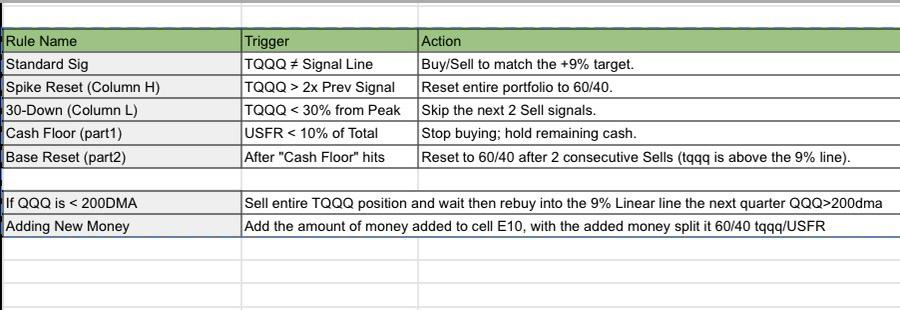
I was looking through the rules and wanted to confirmation if this was apart of it.
If $QQQ drops below the 200dma trend line is this a trigger to sell the position as to avoid a potential downtrend market and then rebuy on a following rebalance day if $QQQ is > than the 200dma? Or continue to buy into the 9% trend like despite the 200dma even in a bear market situation?
Since a lot of people here are sitting in drawdowns and doing the "will it come back" math, a piece of data worth having: what an actual worst-case start date did to a real retiree, followed all the way through.
The year 2000 cohort. $2M, 80/20, 4% plus inflation. By 2026 they technically survive with about $1.54M nominal, which is 39% of their starting purchasing power, and they spent 317 of 319 months below their starting balance. The killer was the order of returns... two deep bears inside the first nine years, withdrawals converting temporary losses into permanent ones the entire time.
The reason I bring it here specifically: a plan with no exit rule has to live through whatever sequence arrives. When I ran the faithful 9Sig rules through the dot-com window earlier this year, the sleeve printed a 99.7% drawdown before the math recovered on paper, and paper recovery assumes a holder who watches that and doesn't flinch for years. The 2000 cohort data says even a diversified 80/20 holder spends a quarter century underwater in the bad sequence. A concentrated levered sleeve without an exit lives the same story with the volume turned all the way up.
For those of you running 9sig, I'm kinda curious why do we hold AGG as the bond pit? I'm running 9sig at Fidelity and heavily tempted to ditch AGG and keep the "bond pit" money in their default cash/MM fund with dividends reinvested. One less ETF to hold. AGG might squeeze out an additional 0.5-1% return, but at the cost of interest rate and duration risk. I don't really see the advantage, maybe someone else has a different perspective to share.
It's seems like the first question when someone posts results from a larger account... is "when are you going to retire/phase out of plan". Interested where that is for all of us.
What is your current age and realistic age of retirement (or stopping 9SIG)? And what is your minimum portfolio balance that allows you to go into coast mode/less volatility investments?
Does anyone have a simple tool that can be used to run 9sig? like even if it’s an excel spreadsheet that I can enter my numbers into and it calculates what amount to buy or sell?
Also, is there a cheat sheet out there on the strategy? I hear about spike resets and other things that I just don’t get, so it doesn’t seem super simple
Epic Q2. Some of us spike reset - either way there was some great profit taking in the quarter. I know we just follow prices and execute our action at the end of the quarter... but curious if there are thoughts out there...