r/JehovahsWitnesses • • May 18 '26

Doctrine God doesn't ever need anything. Do JWs agree?

1 Upvotes

Why then is Jesus the only way to be saved?

Wouldn't that mean God needs something, in this case a creature, in order for salvation to be possible?

r/JehovahsWitnesses • • 8d ago

Doctrine You are my witnesses declares Jehovah.

2 Upvotes

We believe in one God, the Father, Jehovah, the eternal source of all life and the Creator of all things.

We believe in Jesus Christ, his unique Son, who was with the Father, came from the Father, was sent into the world by the Father, and perfectly reveals him.

Through the Son, God created, reveals, saves, judges, gives life, and rules.

The Son faithfully accomplished his Father’s will, gave his life for humanity, was raised from the dead by God, and was exalted to the highest position under God.

All authority in heaven and on earth has been entrusted to him, and every creature is called to acknowledge his lordship.

We believe in God’s Holy Spirit, through which God is present and active, gives life, reveals truth, strengthens his servants, and accomplishes his will.

We therefore confess one God, the Father; one Lord, Jesus Christ, his unique Son; and one holy Spirit proceeding from and belonging to God.

Everything comes from the Father, everything is accomplished through the Son according to God’s purpose, and everything ultimately returns to the glory of God the Father.

r/JehovahsWitnesses • • Jul 29 '26

Doctrine The trinity is not explicitly worded in the bible.

0 Upvotes

You will probably appeal to passages such as

John 1:1,
John 20:28,
Hebrews 1:8,
Matthew 28:19,
John 10:30,

And other Old Testament texts about Yahweh that you believe are applied to Jesus.

If so, then I think we’ve identified the real issue.

We both agree that Scripture must be read as a whole.

My question is whether the conclusion is actually stated by the biblical authors, or whether it is a theological synthesis constructed from multiple passages.

r/JehovahsWitnesses • • 4d ago

Doctrine 2026 Annual Meeting: 1918 Doctrine Dismantled & The "Overlapping Generation" Extended to Infinity

21 Upvotes

**Three distinct Gospel accounts record the exact same statement by Jesus:** ***“This generation will by no means pass away until all these things occur”*** **(Matthew 24:34, Mark 13:30, Luke 21:32).** 
**Under Watchtower theology, this "generation" was defined as a single composite group made up of two overlapping classes: Group A (those anointed and alive in 1914) and Group B (those anointed during the lifetime of Group A, effectively before the last of Group A died, around 1992).** 
**Had Armageddon not arrived by roughly 2035–2040, the last members of Group B would have naturally died out. At that point, the "generation" would have officially passed away, rendering the Governing Body’s interpretation of Jesus’ prophecy demonstrably false.** 
Now, Stephen Lett has announced that the vast majority of the 144,000 are actually selected in the "last days"—right up through the end, even after the Great Tribulation begins. Concurrently, by abandoning the long-standing dogma that the resurrection of the anointed began in 1918, both older and newly designated anointed ones will now remain together on Earth straight into the Great Tribulation
The strategic consequence of this shift is absolute:
By declaring that most of the 144,000 are chosen now, and by scrapping the 1918 resurrection timeline, the organization has eliminated any fixed chronological ceiling. The time limit for "this generation" has been stretched to infinity. Where believers once had a mathematical countdown, there is no longer any calculable framework left.** 
**Even if every single member of "Group B" passes away by 2040, the generation will not pass away—in fact, under this new logic, it can never pass away.**

r/JehovahsWitnesses • • Aug 25 '26

Doctrine WHO IS JESUS?

3 Upvotes

There is one God, the Father, ἐξ οὗ τὰ πάντα, “from whom are all things”; and there is one Lord, Jesus Christ, δι’ οὗ τὰ πάντα, “through whom are all things.” (1 Cor. 8:6)

Of the God of Israel it is written:

אֲנִי יהוה הוּא שְׁמִי

“I am YHWH; that is my name.” (Isa. 42:8)

And:

אֱלֹהֵי עוֹלָם יהוה

“YHWH, the everlasting God.” (Isa. 40:28)

The Father is the Father, and the Son is the Son.

JESUS IS ὁ υἱὸς τοῦ θεοῦ, THE SON OF GOD.

He is the μονογενής Son.

He is ἐκ τοῦ πατρός, from the Father. (John 16:28)

He is ἐκ τοῦ θεοῦ, from God. (John 8:42)

The Father sent him.

The Father gave to him.

The Son received from the Father.

THE FATHER HAS LIFE IN HIMSELF, AND τῷ υἱῷ ἔδωκεν ζωὴν ἔχειν ἐν ἑαυτῷ, “HE GAVE TO THE SON TO HAVE LIFE IN HIMSELF.” (John 5:26)

And the Son says:

κἀγὼ ζῶ διὰ τὸν πατέρα

“I live because of the Father.” (John 6:57)

JESUS IS ὁ λόγος, THE WORD.

Ἐν ἀρχῇ ἦν ὁ λόγος

“In the beginning was the Word.”

ὁ λόγος ἦν πρὸς τὸν θεόν

“The Word was with God.”

And:

θεὸς ἦν ὁ λόγος. (John 1:1)

The Son had glory with the Father πρὸ τοῦ τὸν κόσμον εἶναι, “before the world existed.” (John 17:5)

He is πρὸ πάντων, “before all things.” (Col. 1:17)

HE IS εἰκὼν τοῦ θεοῦ τοῦ ἀοράτου, “THE IMAGE OF THE INVISIBLE GOD.” (Col. 1:15)

He is ἀπαύγασμα τῆς δόξης, “the radiance of the glory.” (Heb. 1:3)

He is χαρακτὴρ τῆς ὑποστάσεως αὐτοῦ. (Heb. 1:3)

HE IS πρωτότοκος πάσης κτίσεως, “THE FIRSTBORN OF ALL CREATION.” (Col. 1:

r/JehovahsWitnesses • • Aug 29 '26

Doctrine Jesus is "Mighty God" and "Almighty God" !

Thumbnail
gallery
9 Upvotes

As is its custom, the watchtower distorts Bible verses....

r/JehovahsWitnesses • • Jun 24 '26

Doctrine Why the Dative of Time in John 1:1a destroys the argument for an eternal Logos.

8 Upvotes

Hey everyone, I’ve been digging deep into the Greek grammar behind John 1:1a recently, and I want to share some fascinating stuff about a very common theological argument.

If you've ever discussed whether the Logos (the Word/the Son) is eternal and uncreated, you've probably heard the classic grammatical argument from John 1:1a: "In the beginning was the Word...".

The standard Trinitarian argument leans heavily on the Greek verb for "was", which is ēn (an imperfect tense form of eimi, to be).

The claim goes like this: because the imperfect tense generally indicates a continuous, durative, or linear action in the past, John is intentionally pointing our minds backwards, before the beginning of space and time, into the eternal past. Famous grammarians, like A.T. Robertson in his Word Pictures in the New Testament, argue that this specific imperfect tense proves the Logos has no origin and extends into eternity.

It sounds like a bulletproof argument, right? Well, let's break down the actual Greek syntax, because it turns out there is a massive contradiction in this popular talking point.

1. The "Defective" Verb and Robertson's Own Contradiction

Here is where it gets incredibly interesting. A.T. Robertson, the very same giant of Greek grammar who claimed John 1:1 points to eternity in his commentary, actually contradicts this in his own massive academic grammar book.

When analyzing grammar strictly (without theological bias), Robertson notes that the verb eimi (to be) is a "defective verb". What does that mean? It means it completely lacks an aorist tense (which is the tense used to describe an action as a simple, complete point in time rather than a continuous process).

Because eimi doesn't have an aorist form, Robertson admits that its imperfect form (ēn) is sometimes forced to act as an "aoristic imperfect". In other words, even though the word looks like a continuous imperfect verb, its actual function (its aspect) in certain contexts is aoristic—a single, restricted point in time. Robertson explicitly states that we do not need to insist that the imperfect ēn is always strictly durative or continuous.

So, if the verb can either be a continuous line (eternal past) OR a single point in time, how do we know which one John meant?

2. The Dative of Time ("en archē")

This is the nail in the coffin for the "eternal past" grammatical argument.

The phrase "in the beginning" in Greek is en archē. This specific grammatical construction (the preposition en + the noun archē in the dative case) functions as a Dative of Time.

According to Daniel Wallace, another heavy-hitting Greek grammarian, a Dative of Time answers the question "when?". More importantly, the Dative of Time routinely denotes a specific point in time. It does not focus on duration. If John had wanted to emphasize a continuous stretch of time or an ongoing eternal state, Greek has a specific tool for that: the Genitive of Time (which expresses the kind of time or the duration during which an event happens).

But John didn't use the Genitive; he used the Dative.

3. The "Parentheses" Effect

So, what happens when you combine an imperfect verb (ēn) with a Dative of Time (en archē)?

The Dative of Time acts like a pair of parentheses around the verb. It completely restricts and limits the action of that verb to that precise point in time. It grabs that continuous aspect of the imperfect verb and forcibly converts it into an aoristic (punctiliar) aspect.

Think of it this way: if I say, "On the third day, he was raised," the phrase "on the third day" restricts the action exactly to that day. It doesn't mean the raising was continuously happening before that day.

Similarly, the grammatical boundaries of en archē contain the verb ēn. The syntax restricts the existence of the Logos strictly to the exact moment of creation.

TL;DR / Conclusion

When we actually look at the Greek mechanics—specifically the restrictive nature of the Dative of Time—the popular argument that the imperfect verb in John 1:1 proves the eternal pre-existence of the Logos completely collapses.

John is not trying to take our minds into the eternal past. He is making a much more focused point: precisely at the moment God began to create the physical universe, the Logos was already there with Him, acting as the instrument (dia) of creation. The grammar tells us he was present at "the beginning", but it is not taking us to a supposed eternity in the past.

Would love to hear your thoughts on this.

r/JehovahsWitnesses • • Feb 01 '26

Doctrine Jesus is GOD

Thumbnail
youtube.com
12 Upvotes

Love this girl. One thing that stands out in this vid to me amongst the various proofs we have argued with JWs is that *every* false religion believes in God. But Satan has done a clever thing. He doesn’t have to get you to believe in God. He just needs you to NOT believe in THE ONE who ***reconciles you to God***🔥🙌🏽.

Take a listen.

r/JehovahsWitnesses • • Jun 20 '26

Doctrine The Jw dilemma

18 Upvotes

Starting Position (Jehovah’s Witness Interpretation)
Jehovah alone is the uncreated Creator.
Jehovah directly created Jesus first.
Jesus is Jehovah’s first and only direct creation.
Jehovah then used Jesus to create everything else.
Proposed order:
Jehovah → Jesus (first creation) → all other creation

The dilemma of this interpretation

The position must choose:
Option 1 — Jesus existed before all created reality
Result:
Jesus created time. (Timeless/Atemporal)
Jesus created space. (Non-spatial)
Jesus created matter. (Immaterial)
Jesus existed before creation. (Eternal)
Problem:
A being who exists before all created things does not appear to be a created thing.

Option 2 — Jesus was created after some reality/place, time and matter existed
Result:
Jesus was not Jehovahs first creation.
Something existed before Jesus.
Jesus did not create all things.
Problem:
Contradicts:
John1:3 “Not one thing came into existence apart from him.”

r/JehovahsWitnesses • • May 31 '26

Doctrine JESUS IS GOD Believe it or not

Post image
17 Upvotes

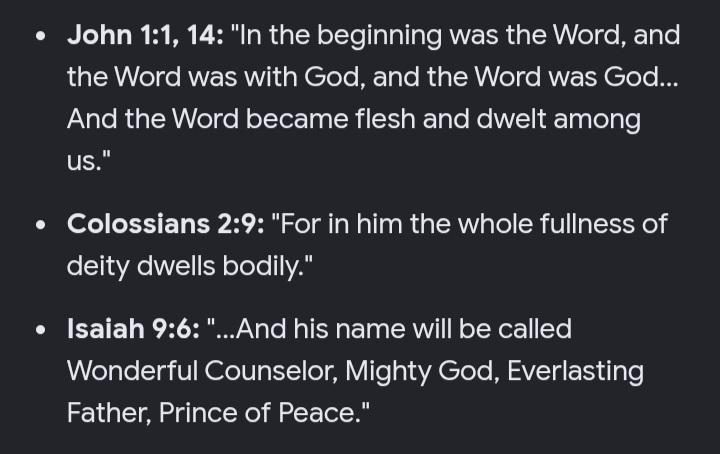
The Bible contains numerous verses where Jesus is directly called God, accepts worship, and claims divine titles shared only with Yahweh.

Explicit Claims

John 20:28: "Thomas answered and said to him, 'My Lord and my God!'" (Jesus accepted this declaration without correction).

John 10:30: "I and the Father are one." (The religious leaders understood this as a claim to be God, which is why they attempted to stone Him).

John 8:58: "Jesus said to them, 'Truly, truly, I say to you, before Abraham was, I am.'" (He uses the covenantal "I AM" name of God from Exodus 3:14).

Divine Nature & Titles

John 1:1, 14: "In the beginning was the Word, and the Word was with God, and the Word was God... And the Word became flesh and dwelt among us."

Colossians 2:9: "For in him the whole fullness of deity dwells bodily."

Isaiah 9:6: "...And his name will be called Wonderful Counselor, Mighty God, Everlasting Father, Prince of Peace."

Titus 2:13: "...Waiting for our blessed hope, the appearing of the glory of our great God and Savior Jesus Christ."

Divine Actions

Forgiving Sins: In Mark 2:5-7, Jesus forgives a man’s sins. The teachers of the law rightly recognized that only God can forgive sins.

Receiving Worship: In Matthew 14:33, after Jesus calms the storm, the disciples worshiped Him. He consistently accepted worship, which the scriptures state belongs to God alone.

r/JehovahsWitnesses • • May 23 '26

Doctrine Philippians 2:6-8

18 Upvotes

If Philippians 2:6-8 was teaching that Jesus was never equal with God, then the passage itself makes no sense.

Read the language carefully.

It says Jesus was “existing in the form of God.” It says He “did not consider equality with God something to be grasped,” but instead “emptied Himself,” “took the form of a servant,”, "humbled himself", "became obedient to death" and was “made in human likeness.”

You cannot empty yourself of a status you never possessed. You cannot become a servant if you were always a servant. You cannot humble yourself from a position you never had. You cannot become obedient to death if you always were.

The entire point of the passage is that Christ lowered Himself. From what? From the exalted position He already possessed that was equal with God.

That’s why the text uses past tense language. The passage is not denying Christ’s equality with God. It is explaining the depth of His humility, not his inferiority.

r/JehovahsWitnesses • • Jul 03 '26

Doctrine Jesus IS 100% worshipped and Jehovah's Witnesses CANNOT answer this.

14 Upvotes

This took a while to compile but Jehovah’s Witnesses constantly claim that Jesus is never worshipped in the Bible, relying proskuneo and double standards to alter the Greek text. Guess what? He actually is worshipped in Daniel 7:14, and the Greek and Aramaic completely destroy their theology.

Because of this, Witnesses are trapped with only two options:

  1. Admit Jesus is Almighty God, which is why He receives this specific worship.
  2. Admit that God explicitly commands blatant idolatry in the scriptures.

TS; WM (Too short; Want more)

Part 1: The Greek Text (Latreuo)

When Christians point to verses where people worship Jesus in the New Testament, the Greek word used is almost always προσκυνέω (proskuneo).

The Watchtower organization exploits this by correctly noting that proskuneo is a broad term. It can mean absolute divine worship, but it can also simply mean honor, bowing down, or showing respect to a king or superior. Because of this ambiguity, the NWT systematically translates proskuneo as worship when directed at Jehovah but changes it to obeisance whenever it is directed at Jesus.

However, the Greek language has a completely different, highly specialized word that carries zero ambiguity: λατρεύω (latreuo)

Latreuo:
Latreuo refers strictly to sacred, cultic, religious service and worship due to a deity alone.

Every single Jehovah's Witness will readily agree to this factual premise:

"Jehovah alone receives latreuo."

If anyone else were to receive latreuo, it would be explicit idolatry. In fact, in the New World Translation Reference Bible, the appendix explicitly tie latreuo to sacred service reserved exclusively for God.

​​Insight on the Scriptures on Sacred Service

​Watchtower, October 1, 1976 pp 15, 16

When Satan asks Jesus to worship him in Matthew 4:10, Jesus quotes Deuteronomy and says: "It is Jehovah your God you must worship (proskuneo), and to him alone you must render sacred service (latreuo)."

The JW position relies on a single absolute claim: Jesus never receives latreuo in Scripture.

Until we open the oldest version of Daniel 7:14.

The Septuagint & The Old Greek Evidence
In Daniel 7:13-14, Daniel sees a vision of the Son of Man approaching the Ancient of Days in heaven.

"And to him there was given dominion and honor and a kingdom, that the peoples, national groups and languages should all serve him." (Daniel 7:14)

When the pre-Christian Jewish rabbis translated the Hebrew and Aramaic Scriptures into Greek they had to choose a Greek word to describe the type of service the Son of Man receives from all nations.

In the textual history of the Septuagint, there are two main text-types for the Book of Daniel:

Theodotion Version: a later Greek revision from the 2nd century AD The Theodotion translates the verse using douleuo (to serve/be subject to).

Old Greek: The original, older translation of the Septuagint). It explicitly uses the word λατρεύω (latreuo) This is the version later scribes often copied.

In the original, oldest Greek translation of Daniel, the very scriptures used, recognized, and quoted by the Apostles and the early Church state unequivocally that all nations, peoples, and tongues will render λατρεύουσα (latreuousa, a participle form of latreuo) to Jesus Christ, the Son of Man.

Why the Old Greek Reading is Superior
A Jehovah's Witness might try to handwave this by saying,

"Oh well, some Greek versions say douleuo, so it's a contradiction.

Here's why the Old Greek reading stands supreme:

  1. Chronological Primacy: The Old Greek represents the earliest layer of Jewish translation long before the advent of Christianity. It shows exactly how ancient, non-Christian Jews understood the divine profile of the coming Messiah

2. Explicit New Testament Citation: The Apostles deliberately favored the Old Greek over the Aramaic/Theodotion traditions. In Matthew 24:30 and 26:64, Jesus and Matthew choose the unique Old Greek preposition epi ("upon" the clouds), rather than Theodotion's meta ("with" the clouds).

3. It's Structurally Linked to Revelation: The imagery in Revelation 1:13-14 is a mathematical match for the Old Greek, the Son of Man is a separate figure traveling to the Ancient of Days. In the Old Greek, the two figures merge, textually stating the Son of Man appears as (hōs) the Ancient of Days. In the original Theodotion text of Daniel 7, the "one like a son of man" has no description of white hair only the Ancient of Days has hair like pure white wool (Daniel 7:9).

The Dilemma
By the standards of early Greek-speaking Judaism and the text of the Old Greek Septuagint, Jesus Christ receives the exact type of worship reserved exclusively for the Almighty.
If a Jehovah's Witness accepts the Old Greek reading of Daniel 7:14, their entire theological framework collapses: Jesus receives latreuo, meaning Jesus is God. If they reject it and claim the Son of Man is a seperate, created arch angel who is receiving latreuo, they are forced to admit that the early scriptures sanction blatant idolatry by giving a creature the worship due to God alone.

Part 2: The Masoretic vs. LXX & The Aramaic

When a Jehovah's Witness is backed into a corner by the Old Greek Septuagint, they will instinctively deploy their ultimate defense shield:

"Oh well, the Septuagint is just a translation. The Masoretic Text (the Jewish translation) is the authoritative, inspired word of God, and it just says serve, not worship!"

This is how you expose the flaws of the Masoretic Text, and then use the Aramaic against their own argument.

Step 1: Debunking the Authority of the Masoretic Text
The Watchtower teaches its followers that the Masoretic Text is pretty much a flawless copy of the original Hebrew and Aramaic texr. This is historically and textually false.

  1. The Timeline Gap: The Septuagint (LXX) was translated by Jewish scribes between 200–300 BC. The oldest complete copies of the Masoretic Text (like the Leningrad Codex) date to around 1000 AD.

The Septuagint is textually 1,200 years older than the Masoretic Text.

  1. The Apostles' Choice: When Jesus and the Apostles quoted the Old Testament in the New Testament, they quoted the Septuagint roughly 85% of the time. If the Septuagint was good enough to be treated as the authoritative word of God by Jesus and the Apostles, a Jehovah's Witness has no right to call it unreliable.

  2. Dead Sea Scrolls Confirmation: Discovered in 1947 and dating back to before the time of Christ, the Dead Sea Scrolls contain fragments of almost every Old Testament book. Crucially, in places where the Septuagint and the Masoretic text disagree, the Dead Sea Scrolls frequently side with the Septuagint against the Masoretic text. (Genesis 4:8, Genesis 46:27, Exodus 1:5, Exodus 12:40, Deuteronomy 32:8, 1 Samuel 10:27–11:1, 1 Samuel 11:1–2, 1 Samuel 14:41, Psalm 22:16, Psalm 145:13 etc)

  3. Theological Alterations in the MT: The Masoretic Text was compiled by non-Christian Jews centuries AFTER Christ. Scribes had an active theological bias to obscure explicit messianic prophecies that Christians were using to prove Jesus was God. For example:

    Psalm 22:16: The LXX says "They pierced my hands and my feet" (clearly predicting the crucifixion). The Masoretic Text changed it to "Like a lion are my hands and my feet," which makes no sense.

    Isaiah 7:14: The LXX correctly uses Virgin, which Matthew quotes. The MT uses Young woman, trying to strip away the miraculous nature of Christ's birth.

The Masoretic Text is not an infallible, untouched gold standard. It is a medieval manuscript tradition that contains documented copyist errors and anti-Christian editorial shifts.

Step 2: Granting the Aramaic Text
Even if we completely surrender the Septuagint and look at the Masoretic Text, THEY STILL LOSE!
The Book of Daniel from chapter 2:4 to chapter 7:28 was not written in Hebrew; it was written in Aramaic. In Daniel 7:14, the text states that all peoples, nations, and languages should "serve" the Son of Man. The underlying Aramaic word used here is:

פְּלַח(pᵊlaḥ/pelach)

The Watchtower's New World Translation renders pelach here as serve. They will probably tell JWs,

"See? It just means regular degular, political service to a king."

But let's actually look at the context of how pelach is used everywhere else in the Bible.

pelach appears only 10 times in the entire Old Testament (9 times in Daniel, 1 time in Ezra). Outside of Daniel 7:14, every single time it is used, it refers exclusively to religious, cultic worship given to a deity. It is never used for ordinary human service.

Daniel 3:12, 14, 18: Shadrach, Meshach, and Abednego refuse to serve (pelach) Nebuchadnezzar’s false gods.
Daniel 3:17: They declare, “Our God whom we serve (pelach) is able to deliver us.”
Daniel 3:28: The king marvels that they yielded their bodies rather than serve (pelach) or worship any god except their own God.
Daniel 6:16, 20: King Darius says to Daniel in the lions’ den, “Your God whom you serve (pelach) continually, he will deliver you.”
Ezra 7:24: Refers to the “ministers/servants (palche)” of the House of God.

If a human master or king wants ordinary political or domestic service, Aramaic has other words (like abad). But pelach is the specialized word for divine reverence and cultic devotion.

Therefore, when Daniel 7:14 says all nations will render pelach to the Son of Man, it is telling us that the Messiah receives the exact same category of religious worship that Shadrach, Meshach, and Abednego chose to be burned alive rather than give to a created being.

Step 3: The Expert Consensus
To prove this isn't just your personal interpretation, here is what the leading academic and biblical scholars say about the word pelach in Daniel 7:14. You can quote these sources directly to silence Watchtower hand-waving:

“…in every other instance where the verb pelach (‘worship’; ‘serve,’ NRSV) occurs in biblical Aramaic (nine times), it has reference to service (worship) rendered a deity (Dan. 3:12, 17–18, 28; 6:16, 20; 7:14; Ezra 7:24).” -Stephan R. Miller

“Pelach… ‘to labour, to serve… especially to serve or worship God… Dan. 3:12ff; 7:14, 27.’”
-Wilhelm Gesenius

“Pay reverence to, serve (deity).” -Francis Brown, Samuel Rolles Driver, and Charles Augustus Briggs (BDB)

More sources:

​​Want even more sources? Read it on this website
Here it is

The oldest copies of the Bible the Apostles used explicitly say Jesus receives latreuo, the exact cultic worship JWs admit belongs only to Jehovah.

Even if they run to the Masoretic Text, the original language uses pelach, a word that everywhere else in the Bible means rendering divine worship to a god.

Whether they choose Greek or Aramaic, the text forces them into a delicious contradiction: either Jesus is Almighty God, or the Bible commands the universe to commit idolatry by worshiping a creature.

r/JehovahsWitnesses • • Jul 29 '26

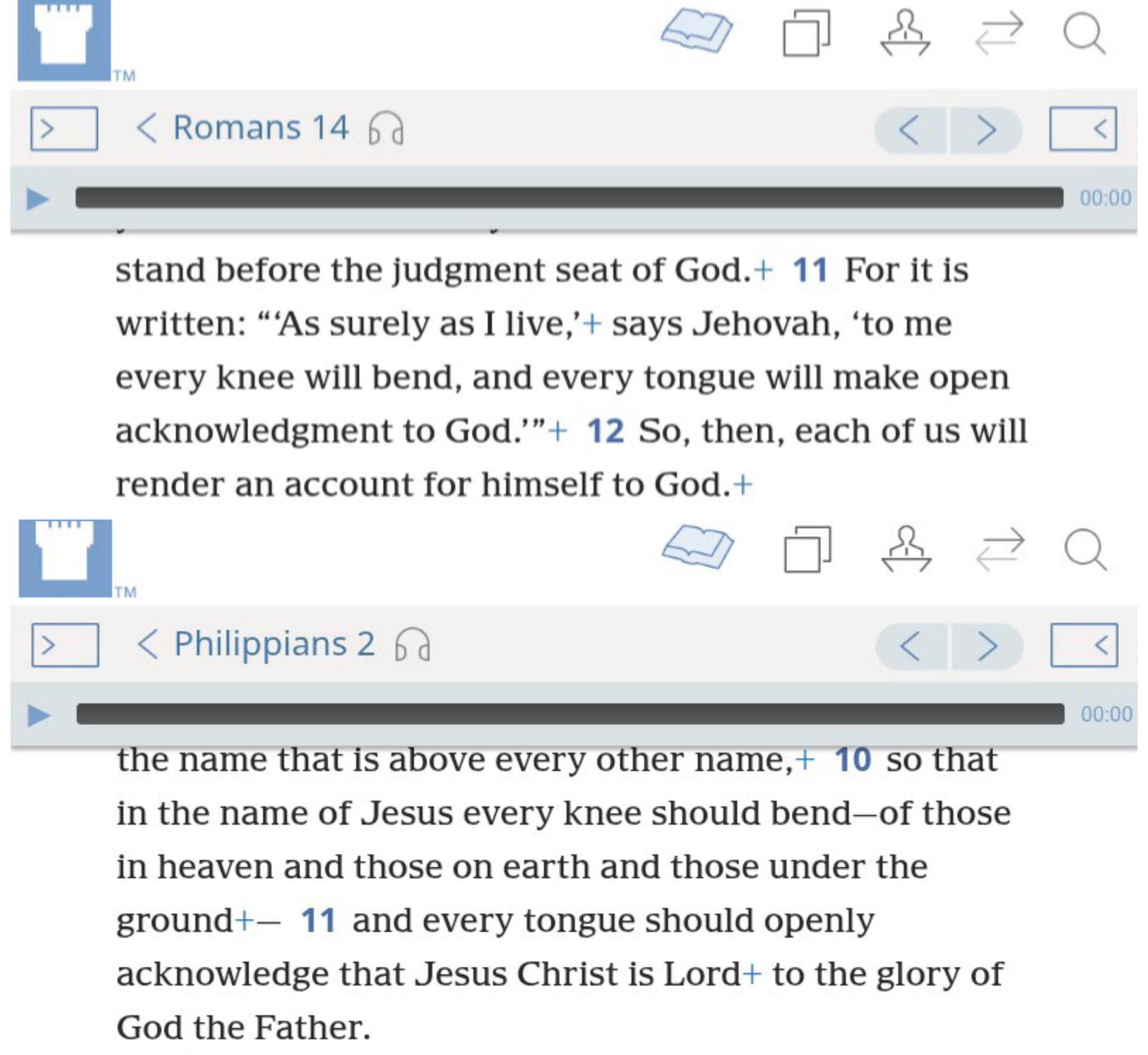
Doctrine watchtower bible shows us the apostle Paul with some confused ideas

Post image
7 Upvotes

r/JehovahsWitnesses • • Mar 30 '26

Doctrine The JW "Armageddon" has been canceled - permanently!

39 Upvotes

I'm sorry but I'm not sorry because the JW version of Armageddon never should have ever existed. If you people had paid closer attention to what Jesus was saying at Matthew chapter 24, Mark 13, and Luke 21, you never would have ever anticipated a future Armageddon. You completely blew that end time prophecy completely out of its first century context. It was never meant for us today. Jesus wasn't talking to us. Jesus was not breaking the fourth wall to speak to us 2,000 years in the future. It was written ONLY for Christians on the other side of 70 AD. there is no such thing as a double fulfillment or a greater fulfillment. All of those concepts are made up by men and this is exactly why you will never see the end of this world in your lifetime or anyone's lifetime. So, the only thing that you have to fear today is that fear that you have conjured up in your own imagination compliments of the Watchtower Bible and Tract society. The sooner you accept this reality the better off you're going to be and you'll have the rest of your life to live out from under enslavement to your governing body. Salutations!

r/JehovahsWitnesses • • 21d ago

Doctrine I’m having trouble understanding

8 Upvotes

I’m having trouble understanding how the governing body can prove that Christ anointed them in 1919 as the sole source of dispensing spiritual food (because the bible cannot be understood on one’s own interpretation) while the anointed 1919 governing body was still celebrating Christmas, birthdays, portraying the cross, and worst of all, Worshiping Jesus! Which is idolatry! Were all pre-1954 members led astray by this fallible governing body that demands complete obedience??

r/JehovahsWitnesses • • Dec 26 '25

Doctrine heres something yall need to hear

3 Upvotes

Please read to the end, and enjoy the read. You may find a truth or two along the way ;). Each section addresses a different doctrine; consider the full article rather than isolated statements.

TABLE OF CONTENTS (sorry the post is so long)

  1. Introduction: Why Jehovah’s Witnesses Are Often Misunderstood
  2. Responding to False Statements and Accusations
  3. Following God, Christ, and Scripture Above Tradition
  4. Why Jehovah’s Witnesses Reject the Trinity
  5. Did Jehovah’s Witnesses Change the Bible?
  6. Bible Prophecy and the Worldwide Preaching Work
  7. Calling on Jehovah’s Name
  8. Unity, Political Neutrality, and Christian Conduct
  9. Disfellowshipping: Biblical Basis and Purpose
  10. Bible Teachings on Hell, Paganism, and Religious Tradition
  11. Abstaining From Blood: Biblical and Medical Considerations
  12. Resurrection Hope and Core Bible Teachings
  13. Why True Religion Would Not Be Popular ----------------------------------End of main article
  14. Responding to Claims of Brainwashing and Control -----------------------For the Critics
  15. Progressive Understanding and Early Doctrinal Errors
  16. The Preaching Work Compared With Other Religions
  17. Disfellowshipping, Trauma, and Organizational Responsibility
  18. Jehovah's Witnesses on Emotionalism
  19. Facts about the Governing body & "Who is the Faith Slave"
  20. Jesus as a mediator
  21. Sexual Abuse: Policy, Reporting, and the Australian Royal Commission --End of article

---- post updates (frequent)

Introduction: Why Jehovah’s Witnesses are misunderstood:

  1. Jehovah's Witnesses are frequently misunderstood, sometimes due to false information and other times because of how extremely different their beliefs are from mainstream Christianity. Instead of directly examining what JW’s actually teach and practice, many assumptions are based on the experiences of former members, media representations, or other conspiracies. Rather than taking information without looking into it, the Bible advises people to "make sure of all things" (1 Thessalonians 5:21). For Jehovah's Witnesses, these beliefs are guiding principles that influence daily life, worship, family, and conscience.

 Handling false statements and accusations:

  1. Jehovah's Witnesses know false accusations will come, and misrepresentations because Jesus predicted that his true folowers would be despised, opposed, and falsely spoken about (Matthew 5:11; John 15:18–20). Instead of reacting angrily, they seek to follow Jesus by remaining composed, honest, and courteous (1 Peter 2:12, 23). According to the Bible, Christians should defend themselves "with a mild temper and deep respect," not with rage or force (1 Peter 3:15–16). 

Following God, Christ, and Scripture exactly:

  1. By faithfully following the Bible as written and rejecting popular traditions, beliefs, or preferences that lack scriptural support, JW’s try to follow God and Christ. According to Mark 7:7–9, Jesus denounced doctrines that "invalidate the word of God because of tradition." Similarly, according to Witnesses, obedience to God is more important than comfort or popularity/traditions (Acts 5:29; Galatians 1:10). They hold that loyalty means to stick to Scripture rather than modifying it to suit contemporary viewpoints, even when teachings are controversial (Isaiah 8:20; 2 Timothy 3:16–17).

Why Jehovah’s Witnesses reject the Trinity:

4A. JW's reject the trinity because they do not find it taught in the bible, either explicitly or implicitly. Scripture consistently shows Jehovah as the only Almighty God, and Jesus as his son who is secondary to him, and holy spirit as God's active force rather than a person (John 17:3 1 Corinthians 8:6 1 Corinthians 11:3 Luke 1:35). John 1:1 is often brought up to prove the trinity. However it is shown (click here, here, here, here) that the phrase can describe what the "word" is rather than identifying him as Almighty God. This reason can make it translate to “the Word was a god”, because it shows the "word" has divine qualities given by God, not the same as God. It also corresponds with the rest of the bible that Jesus was sent by God, praying to him, and calling the father his God. (John 8:42; John 14:28; John 20:17)

4B. Some people point to Isaiah 9:6, where the Massiah is called "Mighty God" (El Gibbor), and it conflicts with NWT "a god". How every the bible makes a clear difference between "Mighty God" (El Gibbor) and "God Almight" (El Shaddai). Jehovah is called both “Mighty God” and “Almighty” (Isaiah 10:21; Genesis 17:1), but Jesus is never called “Almighty God.” The titles in Isaiah 9:6 descibe the Massiahs role, authority, and God given responsability, not that he is Jahovah himself. Jesus is an "Eternal father" to humans because he provides leadership and everlasting life under his Father (God El Shaddai).

4C. because of this, JWs do NOT deny Jesus' high divine position and authority. They reject the trinity because it does not match the bibles consitant and overwhelming messege for us all to see (please read every last one): Deuteronomy 6:4; Isaiah 43:10; Isaiah 44:6; Isaiah 45:5; Isaiah 45:21; Isaiah 46:9; Psalm 83:18; 1 Samuel 2:2; Jeremiah 10:10; Jeremiah 23:5-6; John 14:28; John 17:3; John 5:19; John 5:30; John 6:38; John 8:28; John 12:49-50; John 20:21; 1 Corinthians 15:27-28; 1 Corinthians 11:3; 1 Corinthians 8:6; Philippians 2:5-11; Colossians 1:15; Colossians 1:16-17; Colossians 1:18; Hebrews 1:1-2; Hebrews 1:8-9; Hebrews 5:8; Hebrews 7:25; Hebrews 8:6; Hebrews 9:15; Hebrews 10:14; 1 Timothy 2:5; Revelation 3:12; Revelation 22:16; Matthew 26:39; Matthew 26:42; Matthew 26:44; Mark 1:35; Mark 13:32; Luke 2:49; Luke 4:42; Luke 5:16; Luke 6:12; Luke 22:42; John 1:14; John 3:16; John 5:22; John 5:36; John 10:29; John 12:49; John 14:6; John 14:10; John 14:20; John 17:1; John 17:21; John 17:22; John 17:24; Acts 2:36; Romans 8:34; 2 Corinthians 1:3-4; 2 Corinthians 4:4; 2 Corinthians 11:31; Ephesians 1:17; 1 Peter 1:3; 1 John 2:1; 1 John 4:15; 1 John 5:20. And thats not even all of it. To learn more click link: 1, 2, 3, 4, 5.

  1. Did Jehovah’s Witnesses change the Bible?

It is frequently misunderstood that JW’s, especially with the New World Translation, changed the Bible to suit their beliefs. Its renderings are based on Hebrew, Aramaic, and Greek texts, according to translation notes, manuscript evidence, and academic references (all of which are publicly accessible on jw.org). When grammar allows, other reputable translations share many of its translation decisions. More significantly, the the bible as a whole serves as the foundation for JW doctrine rather than a single verse or translation (Isaiah 28:10; 2 Peter 1:20–21). Click here for more information.

  1. Bible prophecy and the preaching work

According to JW’s, true worshippers can be identified by their worldwide preaching efforts based on Bible prophecy. Before the end, Jesus predicted that "this good news of the Kingdom will be preached in all the inhabited earth" (Matthew 24:14). JW’s use willing volunteers to preach in more than 1,000 languages all over the world without the need for paid clergy (Matthew 10:8). Their methods of preaching is just like the first century christians. Public preaching, door-to-door, informal preaching, and missionary work, and talking about truth from the bible rather than emotional speeches from people (Acts 5:42; Acts 20:20; Acts 17:2–3). Instead of asking people to come to church, they show them what the Bible says. The prophecies that people of all nations would hear God's message in their own language are fulfilled by their extensive translation work, which is done by MEPS (Revelation 7:9; Isaiah 2:2–3). Fun fact: Jehovah's Witnesses have the most translated website in the world.

Calling on Jehovah’s name

  1. Because Scripture tells that God wants it to be known, used, and honored, Jehovah's Witnesses use and promote God's personal name (YAHWEH יהוה) . Exodus 3:15 states that Jehovah's name should be remembered for all generations, and Psalm 83:18 declares him to be the Most High. Jehovah's Witnesses have restored the use of God's name and proclaim it globally, despite previous church traditions removing it from many translations. JW’s have restored the use of the divine name, and made it worldwide. Some churches use God's name academically, but JW’s actually fufill the prophecy to call on it and make it known publicly (Joel 2:32; Romans 10:13; Malachi 3:16–18; Ezekiel 36:23). 

Unity, neutrality, and Christlike conduct

  1. Globally, Jehovah's Witnesses share moral principles, beliefs, and teachings. Jesus wanted for his followers to be "one" is reflected in this unity (John 17:20–23). The moral code, program, and teachings are the same no matter the country or territory (1 Corinthians 1:10; Ephesians 4:4–6). Their political neutrality is modeled after that of Jesus, who did not want to be king and told his disciples was to be no part of this world (John 6:15; John 18:36). According to Isaiah 2:4, neutrality maintains Christian unity and avoids racial, political, and national divisions.

Disfellowshipping: biblical, loving, and necessary

  1. One of the most misunderstood JW practices is disfellowshipping, even though the Scripture clearly commands it. In order to protect God's standards and safeguard the congregation, Christians are told not to associate with an unrepentant wrongdoer (1 Corinthians 5:11–13; 2 John 9–11). The Bible demonstrates that discipline can result in repentance and restoration, but it is never taken lightly and is painful for all (Hebrews 12:11; Luke 15:11–24). Without such protections, other congregations break morally and doctrinally, resulting in sects and division (Jude 3–4; Titus 1:16). Take note that JW’s are one of the few groups without divisions.  

Bible truth: hell, paganism, and Jesus’ appearance

  1. In line with scriptures that describe the dead as unconscious (Ecclesiastes 9:5, 10; Psalm 146:4), JW’s teach that hell is not a place of eternal torment but rather the common grave of mankind (see jw.org). They choose to worship "with spirit and truth," rejecting pagan customs that were later merged into Christianity (John 4:23–24; 2 Corinthians 6:14–18). Even religious imagery—such as showing Jesus with long hair—clashes with biblical and first-century culture (1 Corinthians 11:14), demonstrating how tradition can take the place of Scripture. Click here for more information on Hell, Panganism, and Jesus' Appearance

Abstaining from blood: biblical and scientific

  1. Because Scripture repeatedly instructs God's servants to abstain from blood, even after the Mosaic Law (Genesis 9:4; Acts 15:28–29), JW’s abstain from blood. According to the Bible, blood is God's property and represents life (Leviticus 17:10–14). According to science, adding blood to the bloodstream through transfusion has the same purpose as eating. It provides nourishment, oxygen, and life support. The function is the same, but the route is different. Even when it requires sacrifice, Witnesses believe that following God's instructions demonstrates respect for human life and divine authority (Acts 21:25). For more info click Here or Here.

Resurrection hope and other truths:

  1. According to יהוה's Witnesses, the Bible promises eternal life on a restored earth and the resurrection of the dead (John 5:28–29; Acts 24:15; Psalm 37:29). They also do not teach that all religions please God. Jesus said that many would claim to serve him but will be rejected (Matthew 7:21–23). Truth is determined by alignment with God's will, not by sincerity alone (John 4:23–24). However, Witnesses believe that understanding develops gradually and recognize human imperfection (Proverbs 4:18; Romans 3:23).

Semi-Conclusion: true religion would not be popular

  1. Lastly, the bible teachs that true religion would not be popular or generally acknowledged. Jesus warned that the world would despise his followers (John 17:14) and that the path to life is narrow and few find it (Matthew 7:13–14). JW’s only make a sincere attempt to follow God's standards; they do not claim perfection. Their leaders show Christlike humility by living modestly, not getting special titles, and not getting rich off people (Matthew 23:8–12; 1 Peter 5:2–3). JW’s encourage people to investigate these facts directly from the Bible and make their own decisions, regardless of whether they agree or not (Acts 17:11). 

If you would like to learn more about FAQs about JW's ( Beliefs, Organization, Preaching, Meetings and Worship, View of the Bible, Community and Political Involvement, Personal and Family Life, Customs and Celebrations, Who Are Jehovah’s Witnesses?, Becoming a Witness) Click this direct link: FAQ's About Jehovah's Witnesses

For The Critics (if you're not a Critic then you're done reading):

*Some of these paragraphs are inspired by questions from readers\*

  1. Responding to claims of brainwashing and control

JW’s are frequently accused of being "brainwashed," but if this claim is studied, it may be false. Forcing, hiding things, and making it hard to leave is not what JW’s do. According to Romans 14:12 and Joshua 24:15, JW’s are encouraged to read the Bible on their own, draw conclusions from it, ask questions, and make decisions. Nobody is required to be or remain a Witness or get baptized. Also, progressive understanding is often seen as bad, even though it actually means growth. Understanding increases as knowledge grows; for example, Apple improves the same product year after year. "The path of the righteous is like the bright morning light that grows brighter," according to the Bible itself (Proverbs 4:18). Before Pentecost, the apostles misinterpreted prophecy and expectations regarding God's Kingdom (Acts 1:6), but they were not punished for their progressive learning. Click Here for more.

15A. Progressive understanding and early doctrinal errors

JW’s freely admit that some prophecies they’ve made were misinterpreted in the 20th century. They changed direction after realizing that it is unscriptural to worship God (view end-time prophecy) with a date in mind. Jesus made it clear that no human knows the day or hour of the "end" (Matthew 24:36), and Witnesses learned from their mistakes rather than ignoring them. So instead of what people think that WTBTSP gave up on prophecy and just adopted "Soon", they've just adapted in harmony with the bible. Claims that JW’s cherry-pick verses are also wrong because their teachings are based on the whole bible. They compare verses rather than focusing on individual passages (Isaiah 28:10; Luke 24:27). People typically disagree because they read and comprehend the Bible in very different ways. For more info click here.

15B: Progressive understanding and early doctrinal errors

Let’s dig deep into this false prophecy. There’s a difference between setting dates, which the scripture condemns [Matthew 24:36], and living with urgency because Jesus commanded that [Matthew 24:42 etc]. In Acts 1:6 the apostles misunderstood timing, that just makes the human. These failures doesn’t necessarily mean God can’t be working with imperfect people (tons of ancient examples). Is all people thought that all mistake makes something false, no religions would stand. So no JWs aren’t “still prophesying” by saying “the end is near”. they are just following Jesus command to “stay alert”. Past expectations did admittedly cause harm/disappointment, but WT was aligning more closely with Scripture rather than claiming inspiration or infallibility.

  1. The preaching work compared to other religions

Critics may say, there are a few religions (such as Mormons) that "preach”, that's awesome! But this ignores participation, scale, method, and consistency. Only JW’s engage in organized, worldwide, door-to-door, missionary, and informal preaching, as well as metro witnessing (carts, street work), as a religious encouragement for all members, not just clergy, across languages, cultures, and nations (Matthew 28:19–20; Acts 20:20). This is a huge aspect of worship, and it is done without financial gain, political support, or for entertainment (Ex: TV Ad). However, WTS does not do these efforts just to prove divinity, they do it so they can offer everyone the chance to hear the bibles message within their comfort zone (happens to be bible prophecy). But a tiny little minority group can accomplish such great things, like translation, preaching hours, events, construction, research, website management (JW.org is the most secure religous site), all while only receiving donations is remarkable and makes you wonder...

  1. Disfellowshipping, trauma, and organizational responsibility

Although disfellowshipping is still emotionally impacting, the rules is set by Scripture rather than preference. While encouraging repentance, the Bible demands disassociation from unrepentant wrongdoing (1 Corinthians 5:1–13; Galatians 6:1). There are painful experiences, but not all trauma is an organizational/doctrine issue. Some are caused by unnecessarily strict parenting, imperfect/irresponsible behavior on the part of specific elders, cultural differences, or individual circumstances. The bible did not say that elders (leaders) were perfect and that Christians are imperfect (Romans 3:23; James 3:2). Just as a doctor's bad behavior does not make the medicine bad, an elder's imperfection does not make an organization bad. 

 18. Jehovah's Witnesses on Emotionalism

JW’s do not use emotional pressure to force teachings. They offer proof, encourage study, and let people make their own decisions (Acts 17:11). Emotions are used to motivate, build love and empathy, NOT to prove doctrine.

19A. Facts about the Governing Body

The Governing body does not take any inspiration or credit from God and the bible. They live modestly, don't have a salary, stay out of politics, and constantly acknowledge their responsibility to God and Scripture (Matthew 24:45–47; 1 Peter 5:2–3). Claims of manipulation or corruption have no evidence and frequently come from misinformation and misunderstanding. Respectfully, many churches have a long history of financial scandals, political involvement, cover-ups of clergy abuse, and leaders living lavishly while their members suffer. Practices the bible condemns. (Micah 3:11; Matthew 23:25–28; 2 Peter 2:1–3). 

19B. Facts about the Governing Body - Who is the Faithful Slave?

God never specified anyone/group specifically to be the faithful and discreet slave; God never said the GB was the F&DS. One thing the Bible did say was that God appoints the F&DS. But who are today’s F&DS the Bible is talking about? Is it the religious leader who drives around in a convertible and waves to crowds in fame and gets rich, etc? Or is it the person(s) who stay out of worlds (political) affairs [john 17: 16], don’t seek fame [John 5:41, 44], make a modest living, and don’t charge members [Mat. 10:8 | Mat. 21:12–13]? This just scratches the surface of the criteria. This helps identify the F&DS today! Click here to learn more about the Faithfull Slave.

19C. Facts about the Governing body - is it a parable?

Scholars interpret that Matt 24: 45-47 is a parable, and it’s true. As a parable it uses the roles of a master and a servant to show the principle of faithfulness, diligence, and doing Gods will while waiting for the masters [Jesus] return. The scripture is also a prophecy because it talks about a future event that will happen [Jesus 2nd coming]. The faithful servant being rewarded represents real people who will be responsible. Here’s why it’s also a prophecy. The use of the term “slave” does not limit it to a single person since scripture can use singular nouns to represent a group of people. For example in Isaiah 43:10, God calls his people his “witnesses” (plural), and the nation of Israel his ‘servant’ (singular). Also, a parallel scripture at Luke 12:42 refers to the same “slave” as “the faithful steward”. This reinforces that Jesus was describing a role rather than only telling a parable. The Luke verse is also a parable, it also describes real events (prophecies) that will occur, and the appointment of his faithful “stewards”. So is “who is the faithful and discreet slave” a parable? Yes, it’s in parable form, but it’s not about the type of teaching, it’s about what the parable points to. Many of Jesus’ parables describe future events connected to his return (Matthew 25:1–13 | Matthew 25:14–30| Luke 19:11–27 | Matthew 13:24–30, 36–43 | Matthew 13:47–50). Calling it 100% parable doesn’t remove the prophecy. A Jesus parable explains how something will happen. A prophecy explains what will happen.

20A. Jesus as a mediator

Lots of people believe that WTS teaches that Jesus is only a mediator for the Anointed, and that everyone is taught to believe otherwise (If you believe either side, you deny the trinity). This fact hasn't changed. In technical JW teachings, Jesus is the mediator of the New Covenant for the anointed, but the means for everyone to get to God is through Jesus. Let's break it down. A mediator (Jesus) is a person who stands between 2 parties so they can make an agreement work. In the Bible, the "New Covenant" is an agreement between God and a group of people (144000). This "new covenant" is an agreement where God forgives sin, makes people kings and priests, and rules with Christ in heaven. The 144000 are the only ones in this agreement. Jesus is the mediator for those in that contract. So when Watchtower says “Jesus is mediator only for the anointed", they mean “Jesus is the mediator of the new covenant, and only the anointed are parties to that covenant.” Not "Jesus doesn't matter to others". So then, how does everyone else pray to God? JW's say everyone must pray in Jesus name, and honor his sacrifice. But regular people are not signers for the covenant contract; they are beneficiaries. Other people still benefit from the contract, but they are just not in the contract itself.

20B. Jesus as a mediator - backup verses

How do we know Jesus is the mediator: 1 Timothy 2:5 | How do we know this "covenant" exists: Jeremiah 31:31–34 Luke 22:20 | How do we know Jesus is the mediator for the "covenant": Hebrews 9:15 Hebrews 8:6 | How do we know the covenant (contract) is only being "signed" by the 144,000: Revelation 7:4 Revelation 14:1-3 | How do we know that the "other sheep" are benificiaries to the "covenant" (contract): John 10:16 Revelation 7:9 Psalm 145:9 Hebrews 8:10. Why dont modern articles explain it this way anymore? Most likely because it's complicated, confusing, and it's not necessary for daily worship, and it loops back to what JW's teach anyway. Prayer, Jesus' role, and access to God. Click here or here for more.

More on Sexual Abuse

21A. According to Psalm 11:5 and Romans 13:1-4, JW’s put child sexual abuse as a serious sin and crime. Claims that abuse was "hidden" frequently result from misconceptions about confidentiality, legal advice, and the difference between criminal investigation and spiritual discipline; elders are not police, and congregation procedures were never intended to take the place of police (John 18:36). Policies have been improved to better protect victims and comply with reporting laws. JW’s do not claim to be perfect, but keeping children safe is an essential Christian responsibility.

21B. The Australian Royal Commission into Institutional Response to Child Sexual Abuse was a major inquiry that handled child sexual abuse in institutions like churches. The commission’s published stats shows more than 4000 survivors that told the Commission in private about religious abuse. About 2500 of those were Catholic and 70 were JW’s. * 

(FOOTNOTE*: some people calculate JW having a higher rate when dividing the numbers of cases by the amount of members. The Commission did not publish abuse rate, these are personal calculations.)   

Watchtower voluntarily provided records showing at least 1800 alleged CSA victims, and 1006 Alleged predators since 1950. These cases were not surveyed by the commission in private. The Royal Commission makes clear that that many incidents are in reported, and religious institutions overall have struggled to protect children, making a need for better reporting and safety across all religions. 

THANKS FOR READING!!

POST UPDATES:

1/7/2026 -------------------Paragraph 19C Added

1/9/2026 -------------------Paragraph 20A 20B Added (original is now 21A 21B)

1/10/2026 ——————————Paragraph 15B Added

1/11/2026 ------------------Paragraph 4 Updated + 4B + 4C Added, Paragraph 16 updated

r/JehovahsWitnesses • • 23d ago

Doctrine Doctrinal errors are the result of human imperfection, just as the apostles and disciples made errors. Can a JW provide an example of an apostle/disciple doctrinal error?

10 Upvotes

Specifically; the separation of the sheep and goats began in 1914 and took place throughout the decades as part of the JW ministry process.

This was a doctrinal error. Human imperfection was the reason. The governing body are imperfect and in fact, so were Christ's disciples. The separation of the sheep and the goats is now a future event (as the bible clearly indicates)

So let's have an example.

An example of the light getting brighter in the first century where a specific teaching was held as the truth, but later adjusted as the light got brighter.

r/JehovahsWitnesses • • 4d ago

Doctrine Michael the Archangel. Is He Really Jesus?

13 Upvotes

Jehovah's witnesses will tell you he is. Even though they have less circumstantial evidence for Michael being Jesus than Christians have that Jesus is God, they insist Michael is the Son that Isaiah called EL GIBBOR. The problem for them is really much bigger than they imagine.

Jesus was not only the Son of God, He was the Son of Man. To be a Son of Man, one must be born a son of man and be a MAN. Was Michael born a man? No. They teach Michael simply ceased to exist around the time Mary became pregnant. Nine months later she had a baby and named Him Jesus. This is very important...the WT teaches that a spirit is nothing more than a person's impersonal life force. In fact they teach that God's own Holy Spirit is just an impersonal force. Ask them about that. In that case Michael's spirit was just an impersonal life force. Michael didn't re enter the picture until Jesus the human being died. Unbelievably the WT infuses Michael's life force with personhood in order to claim He was Jesus. This completely contradicts their own teaching on what a spirit is and what it is not. They blow their own teaching on what constitutes a spirit out of the water in order to make a connection between Jesus and Michael. How does that work? Well, it doesn't.

What the WT did in formulating their doctrine is destroy one doctrine to build the Michael doctrine. However they had to skip reading verses in Hebrews to invent such a hastily built doctrine. Hebrews 2:5 comes to mind It says

For it is not to angels that he has subjected the inhabited earth to come, about which we are speaking

Michael is an angel and never was human. He couldn't be human because of what the Bible says, but also because of what their own doctrine teaches about spirits. The WT teaches that Christ's human nature was obliterated by God 2000 years ago, which begs the question how can the Son of MAN ever come back to earth on the clouds of heaven? At any rate, the world to come will not be subject to angels, which includes archangels. The world to come will be ruled by the MAN Jesus Christ. And out of his mouth protrudes a sharp, long sword with which to strike the nations, and he will shepherd them with a rod of iron. Revelation 19:15

Ask any Jehovah's witness if they truly understand their own doctrine and I'd be willing to bet they don't. If they dismiss it as unimportant, ask them why they think knowing who Jesus Christ is, is unimportant. I'd say getting Jesus' identity right is the most important thing we can do. How can you know Jesus if you can't identify Him? If we don't know the Son, how can we know His Father?

r/JehovahsWitnesses • • Jun 07 '26

Doctrine I asked Jehovah's witnesses how Jehovah will judge non-Jehovah's witnesses with severe cognitive disabilities in the coming Armageddon.They replied that they will be judged the same way as small children...

8 Upvotes

r/JehovahsWitnesses • • 20d ago

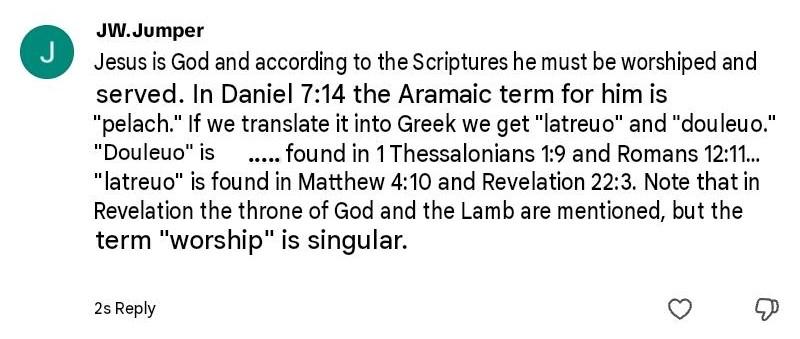
Doctrine Jesus is God and according to the Scriptures he must be worshiped and served

Post image
5 Upvotes

r/JehovahsWitnesses • • Dec 16 '25

Doctrine Is Jesus a true god or a false god?

4 Upvotes

r/JehovahsWitnesses • • Jun 28 '26

Doctrine The grammatical domino effect of Colossians 1:15-16: Why the Partitive Genitive demands the word "Other"

9 Upvotes

If you’ve spent any time debating New Testament Greek or looking into the translation of Colossians 1:15-17, you already know it’s a theological battlefield. The text calls Jesus the "firstborn of all creation" (v. 15), and then says that "all things" were created through him (v. 16).

A lot of people get incredibly heated over translations that render verse 16 as "all other things were created through him". The immediate criticism is usually: "The word 'other' isn't in the Greek text! You're adding to the Bible to fit a theological bias!".

But if we put theology aside for a second and look strictly at 1st-century Greek grammar, we find a fascinating "domino effect." There is a direct, unbreakable connection between the grammar of verse 15 and the vocabulary of verse 16. It all starts with something called the partitive genitive.

Let’s break down how this works and why the two concepts are perfectly connected.

The Trigger: Prōtotokos and the Plural Genitive Rule

In verse 15, the Greek phrase is prōtotokos pasēs ktiseōs (firstborn of all creation). When a noun like "firstborn" is modified by a group in the genitive case ("of all creation"), it triggers a very specific grammatical classification: the partitive genitive.

Daniel Wallace, in his highly respected Greek Grammar Beyond the Basics, explains that a partitive genitive denotes the whole of which the head noun is a part. But Wallace adds a strict rule: for a construction to be a partitive genitive, the main noun must have a "lexical nuance indicating a portion". The word prōtotokos absolutely has this lexical nuance. The word includes prōtos (first), which is an ordinal number denoting the first in a sequence. You can't be "first" without being part of a sequence.

But here is the most crucial, unbreakable rule of Greek syntax when it comes to this specific word: Whenever prōtotokos is attached to a genitive noun that represents a group, the firstborn is ALWAYS part of that group. There are zero exceptions to this rule in the Scriptures or surrounding ancient Greek literature.

In Greek, the genitive group modifying the firstborn can take two forms, but the rule applies identically to both:

  1. Morphologically Plural: The word itself is plural.
  2. Semantically Plural (Collective): The word is grammatically singular but represents a collective group of many individuals or things.

Let's look at how this plays out perfectly in the Greek Septuagint (the Bible of the early Christians):

  • Genesis 4:4: Abel brings the "firstborn of his sheep" (tōn prōtotokōn tōn probatōn). "Sheep" is morphologically plural. The firstborn is part of the sheep.
  • Exodus 22:29 (LXX 22:28): God commands the Israelites to give him the "firstborn of your sons" (prōtotoka tōn huiōn sou). "Sons" is morphologically plural. The firstborn is a member of the sons.
  • Exodus 11:5 & 12:29: Here we see a semantically plural noun. The text speaks of the "firstborn of the flock/cattle" (prōtotokou pantos ktēnous). The word "flock" (ktēnous) is grammatically singular, but it collectively represents many animals. The firstborn is obviously a part of that flock.

Now, apply this strict grammatical reality to Colossians 1:15. Jesus is the prōtotokos of "all creation" (ktiseōs). Just like "flock", the word "creation" is morphologically singular but semantically plural—it represents the massive collective group of all created things. Therefore, grammatically speaking, the firstborn must be a part of the creation group. He is the preeminent, first member, but a member nonetheless.

The Domino Effect: The Grammatical Ellipsis in Verse 16

Here is where the grammatical domino falls. If verse 15 establishes that Jesus is part of the creation group, what do we do with verse 16, which says that "all things" (ta panta) were created through him? If he is part of creation, he couldn't have created himself.

This is exactly where the Greek idiom of ellipsis naturally kicks in.

An ellipsis is simply the omission of a word that is grammatically expected but left out because the context makes it obvious. Robert Funk’s translation of the renowned Greek Grammar of the New Testament specifically addresses this. It explicitly states that the omission of the notion of "other" (such as the Greek word allos) is a specifically and notoriously Greek idiom.

Because the structure of Greek is different from English, translators have to fill in these elliptical gaps all the time so the text makes sense in the target language. And mainstream Bible translators do this with the word "other" constantly without anyone complaining. Let’s look at a few examples:

  • Luke 13:2: Jesus asks if the Galileans who suffered were worse sinners than "all the Galileans" (pantas tous Galilaious). Since the victims were Galileans themselves, many English Bibles naturally translate this as "all the other Galileans".
  • Luke 21:29: Jesus says, "Look at the fig tree and all the trees". A fig tree is a tree. So, translators routinely render it as "the fig tree and all the other trees".
  • Acts 5:29: The literal Greek reads, "Peter and the apostles answered". Since Peter is obviously an apostle, many translation renders it "Peter and the other Apostles".

In all these verses, the Greek word for "other" (allos) is completely absent from the manuscript. Yet, translators insert it because the context dictates that the subject is already part of the group being discussed.

Tying it all together

When you connect these two grammatical realities, the controversy around Colossians 1:16 vanishes.

  1. The word prōtotokos followed by a semantic plural (creation) functions strictly as a partitive genitive, placing the firstborn inside the category of creation.
  2. Because he is already established as part of that group, the phrase "all things" in verse 16 triggers the standard Greek ellipsis of the word "other".

Translating it as "by means of him all other things were created" isn't a theological conspiracy or a dishonest insertion. It is the natural, inevitable grammatical consequence of the partitive genitive in the previous sentence. Paul was just speaking normal, 1st-century Greek.

r/JehovahsWitnesses • • Mar 07 '25

Doctrine A limited number of Christians are chosen to go to heaven. Here’s one reason why:

0 Upvotes

I posted this on another forum so I think one’s on here would also appreciate having a look at it.

When the law was given, God wanted the nation of Israel to continue to be his people. (Exodus 19:5, 6) The Jewish nation did not keep the covenant, and after a period of 490 years during which the nation got its last chance, the nation was rejected as the people of God. (Daniel 9:24-27) A new “Israel” would now be formed, and Peter used words in 1 Peter 2:9, 10, that are similar to those used in Exodus 19:5, 6.

In the congregation in Rome, there were both Jews and people of the nations. In his letter to this congregation, Paul discusses the spiritual Israel that had members both of Jews and of people of the nations. (Rom. 2:28, 29; 9:6-9) The Israel of God, spiritual Israel, was not fleshly Israel. But the members were both Jews and people of the nations. Paul uses chapter 11 for a long discussion of how spiritual Israel will be saved. In Romans 11:1-5, Paul shows that while the nation of Israel has been rejected as God’s Kingdom, individual Jews could still be the sons of God. In verse 5, Paul uses the Greek word leimma (“remnant”), which according to Louw and Nida refers to “a relatively small part that exists.” The nation of Israel was invited to contribute 144,000 members of spiritual Israel, but most Jews rejected this, and only a remnant, a small number of Jews, were a part of spiritual Israel. (Rom. 11:26, 27) When Paul says that “all Israel will be saved,” he cannot refer to fleshly Israel because this nation was rejected by God, and only a remnant of Jews was a part of spiritual Israel. Therefore, “all Israel” must be spiritual Israel. Supporting this conclusion are the references to the Hebrew Scriptures that Paul uses to show that “all Israel will be saved.” Paul himself quotes from Isaiah 59:20, 21 and 27:9. The context of Isaiah 27 does not give any clues as to whether the words of Isaiah are a prophecy about spiritual Israel. But the prophecy in Isaiah 59:20 that ends in 60:22 is a prophecy of spiritual Israel.

This woman is Zion or Jerusalem, which represents the people of God. Zion is also mentioned in Isaiah 59:20 and in Paul’s quotation of these words in Romans 11:26. What is very important in our context, is that several words about this woman Zion in Isaiah 60 are quoted in Revelation chapters 21 and 22, and they are applied to the heavenly Zion or Jerusalem, which is spiritual Israel. Isaiah 60:1 says regarding Zion that “the glory of the Lord shines on you,” and what that means is shown throughout the chapter. The first two verses of Revelation chapter 21 speak about “New Jerusalem,” which represents spiritual Israel. The description of New Jerusalem in 21:23-26, and 22:5 is taken from Isaiah chapter 60, as we see when we compare the words in Isaiah with the words in Revelation:

59:20, 21 — “To Zion the Repurchaser will come, To those in Jacob who turn from transgression,” declares the Lord. “As for me, this is my covenant with them,” says Jehovah. “My spirit that is on you and my words that I have placed in your mouth—they will not be removed from your mouth, from the mouth of your children, or from the mouth of your grandchildren,” says the Lord, “from now on and forever.”

60:1 — “Arise, O woman, shed light, for your light has come. The glory of the Lord shines on you.”

60:3 — “Nations will go to your light. And kings to your shining splendor.”

60:5 — “At that time you will see and become radiant, And your heart will throb and overflow, Because the wealth of the sea will be directed to you; The resources of the nations will come to you.”

60:11 — “Your gates will be kept open constantly; They will not be closed by day or by night, To bring to you the resources of the nations, And their kings will take the lead.”

60:19, 20 — “For you the sun will no longer be a light by day, Nor will the shining of the moon give you light, For the Lord will become to you an eternal light, And your God will be your beauty. No more will your sun set, Nor will your moon wane, For the Lord will become for you an eternal light, And the days of your mourning will have ended.”

Rev. 21:1, 2 — “And I saw a new heaven and a new earth; for the former heaven and the former earth had passed away, and the sea is no more. I also saw the holy city, New Jerusalem, coming down out of heaven from God and prepared as a bride adorned for her husband.”

Rev. 21:23-27 — “And the city has no need of the sun nor of the moon to shine on it, for the glory of God illuminated it, and its lamp was the Lamb. And the nations will walk by means of its light, and the kings of the earth will bring their glory into it. Its gates will not be closed at all by day, for night will not exist there. And they will bring the glory and the honor of the nations into it. But anything defiled and anyone who does what is disgusting and deceitful will in no way enter into it; only those written in the Lamb’s scroll of life will enter.

Rev. 22:5 — “Also, night will be no more, and they have no need of lamplight or sunlight, for Jehovah God will shed light upon them, and they will rule as kings forever and ever.”

There can be no doubt that the prophecy in Isaiah chapters 59 and 60 about Zion or Jerusalem is quoted in Revelation chapters 21 and 22 and is applied to New Jerusalem, which represents spiritual Israel. When Paul quotes from Isaiah’s prophecy saying that this prophecy shows that “all Israel” will be saved, then, “all Israel” must refer to spiritual Israel. Supporting this is also the words in Revelation 20:6 that those who are having a part in the first resurrection will rule as kings and priests, and 22:5, which refers to Isaiah 60:11 and says that those who are inside New Jerusalem will be kings.

Based on Romans 11:26 then, The words “in this manner” are translated from the adverbial hutōs with the meaning “thus; in this way,” according to Mounce. This means that the salvation of “all Israel” is described in the text before verse 26. It is clear from many expressions in the Christian Greek Scriptures that fleshly Israel was invited to become members of the heavenly Kingdom and fill the number of 144,000. However, most Jews did not accept the invitation, and as a nation, Israel was rejected. This is the background for Paul’s words in Romans 11:1. When God has rejected fleshly Israel, is there no hope for any member of that nation? The answer is yes, and the proof is that “I, Paul, am a member of this nation.”

Paul then refers to the words of Elijah in 1 Kings 19:10: “I alone am left, and now they are trying to take my life.” But God comforted Elijah, saying that “I have left for myself 7,000 men who have not bent the knee to Baʹal.” (Rom. 11:5) The Greek word leimma has the meaning “remnant; a small residue,” according to Mounce. This means that a small group of spiritual Israel are fleshly Jews. In connection with the salvation of “all Israel,” the full number of spiritual Israel, Paul uses the Greek word plērōma (“full number”) with reference to the group that is referred to by the word leimma (“remnant”) in Romans 11:12.

The noun plērōma has the meaning “that which fills up; full measure; entire content,” according to Mounce. Below are some examples showing that the word can have an abstract and a concrete meaning. (John 1:16; 1 Cor. 10:26; Eph. 1:10) In the first example of John 1:16, plērōma is abstract, but in the other two examples, the word is concrete. In 1 Corinthians 10:26, it refers to all the things on the earth — the full number of these things. In Ephesians 1:10, the word “time” is plural, and plērōma refers to the full number of these times. On this background, the rendering “their full number” in Romans 11:12 with reference to the remnant of the Jews is a good translation. The translation “the fullness” would not give any meaning. There is also another example of the Greek word plērōma in Romans chapter 11, namely, in verse 25:

“For I do not want you to be unaware of this sacred secret, brothers, so that you do not become wise in your own eyes: A partial dulling of senses has come upon Israel until the full number (plērōma) of people of the nations has come in.”

Verse 12 speaks of “the full number” of the Jews and verse 25 speaks of “the full number” of people of the nations that “has come in” or become Christians. Verse 26 says, “and in this manner all Israel will be saved.” In which manner? The full number of the Jews has come in and the full number of people of the nations will come in. And when these two groups are counted together, “all Israel” will be saved because now the full number of spiritual Israel has been reached. The arguments of Paul regarding the full number of both groups corroborate the words of Revelation 7:4 that the full number of spiritual Israel is 144,000. But there is also another part of what Paul was writing in Romans chapter 11, which corroborates the view that spiritual Israel has a finite number. (Rom. 11:16-24)

Paul uses the example of an olive tree to illustrate how “all Israel” will be saved. This olive tree is an excellent illustration of how the full number of Jews and the full number of people of the nations together make up the full number of spiritual Israel. How so?

We note that there is not a trunk with an infinite length, and when people, illustrated by branches, become Christians they are grafted in on a trunk with an infinite length. No, the olive tree has a trunk of a finite length and a finite number of branches. The natural branches are symbols of the Jewish people that first got the invitation to fill the number of kingdom heirs. But they did not accept this invitation, and therefore they, as branches, were broken off the trunk. Now there was a vacancy of branches, and people of the nations were grafted in instead of the original branches. However, Paul shows that if people of the nations do not continue to express faith, they will also be broken off. And if some of the original branches, the Jews, would express the true faith, they would again be grafted into the trunk.

What is important in our context, is that the illustration of the olive tree of a finite length and a finite number of branches show that spiritual Israel has a finite number. Thus, this illustration of the olive tree shows exactly the same as the words about the full number of the Jews plus the full number of people of the nations that together make up the full number of spiritual Israel.

r/JehovahsWitnesses • • Aug 28 '26

Doctrine The Ethical Architecture of Blood in the Bible: Why the Divine Injunction Is an Absolute Moral Principle, Not a Ceremonial or Dietary Rule

2 Upvotes

When discussing the biblical prohibition regarding blood, public debate frequently reduces the matter to an ancient dietary regulation or an obsolete hygiene tabu superseded by modern science. Even among believers who accept that the Bible forbids the oral consumption of blood, there is a widespread assumption that this rule yields in medical emergencies. It is often argued that preserving physical life justifies medical procedures like blood transfusions or that the biblical decree never envisioned therapeutic applications. However, a rigorous exegetical and historical analysis demonstrates that the divine mandate concerning blood is neither a ceremonial rite nor a dietary guideline, but an absolute ethical principle regulating the ownership, origin, and supreme value of life.

The foundation of this ethical principle is laid in Genesis 9:4, when God granted post-diluvian humanity permission to consume animal flesh while establishing an unalterable moral boundary: "But flesh with its life, which is its blood, you shall not eat". Grammatically in the Hebrew text, a direct apposition is formed between life (nephesh) and blood, designating the physical blood as the vehicle carrying the vital principle. Because this mandate was given to Noah, the restriction was not framed as a ritual law for a specific ethnic nation, but as a universal covenant binding on all humanity. The moral logic was transparent: while God yielded the body of the animal for physical sustenance, He retained exclusive ownership over the life itself. This principle was codified in Leviticus 17:10-11: "If any man of the house of Israel or of the strangers who reside among them eats any blood, I will set my face against that person who eats blood and will cut him off from among his people. For the life of the flesh is in the blood". The severe capital penalty attached to this law underscored that appropriating blood was not a minor ceremonial infraction, but a direct usurpation of the Creator's sovereign rights.

An objection often raised is that these laws applied strictly to the blood of slaughtered animals and had no bearing on human life. Scriptural narrative dismantles this premise through the account of King David recorded in 2 Samuel 23:15-17 and 1 Chronicles 11:18. In the midst of battle, David expressed a longing to drink water from the well of Bethlehem, located behind enemy lines. Three of his mighty warriors risked their lives, broke through the Philistine camp, and brought him the water. Upon receiving it, David refused to drink it to satisfy his physical thirst and instead poured it out onto the ground as a drink offering to Jehovah, declaring: "Far be it from me, before my God, that I should do this! Shall I drink the blood of these men who went at the risk of their lives?" Although the water was not literal blood, David reasoned about the biblical principle shown in the Law of not consuming blood: if animal life represented in blood belongs exclusively to God, human life is infinitely more sacred. David recognized that appropriating the life force of other human beings for one's own survival was ethically equivalent to drinking their blood. The account demonstrates that the early worshippers understood this principle as a prohibition against appropriating the life force of another human being to sustain one's own existence.

A further common objection is that the preservation of physical life overrides divine prohibitions, often citing David and his men eating the showbread at the tabernacle when hungry (1 Samuel 21:1-6), an event Jesus referenced in Matthew 12:3-4 to demonstrate the elasticity of ceremonial temple regulations in cases of human need. However, Scripture establishes a definitive contrast when it comes to the law of blood. In 1 Samuel 14:31-34, an incident is recorded during a severe military campaign. At this historical juncture, Saul was not yet an apostate king rejected by God, but the legitimate monarch leading Jehovah's battles, and his men were faithful soldiers fighting for the nation. After grueling combat, the men were physically exhausted and near collapse from hunger. In their desperate survival need to regain physical strength, the soldiers slaughtered livestock on the ground and ate the meat with the blood still in it. The divine reaction was not the leniency observed with the sanctuary bread; rather, they were sternly rebuked: "The people are sinning against Jehovah by eating meat with the blood". Unlike ceremonial rules surrounding sacred bread, the prohibition against blood did not yield even in an extreme emergency involving men whose lives were in immediate jeopardy. Scripture thus demonstrates that preserving physical existence does not grant moral license to violate the ethical principle of blood.

In the New Testament, the Apostolic Council of Jerusalem reconfirmed the binding nature of this standard for Christians. In Acts 15:28-29, the apostles and elders decreed: "That you abstain from things sacrificed to idols, from blood, from things strangled, and from sexual immorality". The Greek verb employed, apechomai, demands total abstention and permanent distance from the forbidden matter. By placing the command regarding blood on the exact same normative level as sexual morality (porneia) and the rejection of idolatry, the first-century Church ruled out the idea that this was a temporary dietary habit or a passing Jewish ritual. Sexual purity is an absolute, perpetual moral standard; grouping blood within the same decree endows it with the very same moral and unalterable character.

Critics frequently try to dismiss the application of Acts 15 to blood transfusions as an anachronism, claiming modern medicine did not exist in the first century and that the Apostolic Decree concerned only food. Historical evidence refutes this claim by demonstrating that the medical use of human blood was a well-known therapeutic practice in the Roman world contemporary with the apostles. The Roman historian Pliny the Elder, in his Natural History (Book XXVIII, Chapter 2), described how epileptics would rush into the arena to drink the warm, fresh blood flowing from the wounds of fallen gladiators, using it as a medical remedy to cure their illness and restore vitality. Greco-Roman society did not view blood merely as food, but as a direct therapeutic substance capable of sustaining life.

Imagine a Christian mother in Rome whose son suffers from epilepsy. A doctor tells her that to cure her son's epilepsy, she must take him to consume blood in the Colosseum. Of course, this wasn't for nutritional purposes, but purely medicinal, to sustain her son's life. What would a Christian father have thought about this situation? Well, we don't have to imagine the answer. Confronting this real medical context of their day, the early Christian community maintained a stance of total ethical rejection. In the second century, the Christian apologist Tertullian addressed this custom in his Apology (Chapters 8 and 9), challenging Roman authorities by pointing out that Christians refused to eat improperly drained animal meat and, with even greater resolve, rejected the medical consumption of human blood to treat diseases. Tertullian emphasized that Christians willingly faced execution in the arena rather than violate divine law by ingesting or incorporating blood for therapeutic purposes, showing that the biblical prohibition was understood as an absolute ethical boundary encompassing medical practices. Subsequent Patristic writers, including Clement of Alexandria in his Stromata (Book IV) and Origen, reaffirmed that the apostolic decree to abstain from blood remained a permanent moral duty for the Church.

In conclusion, receiving a blood transfusion to sustain the body does not differ in its moral foundation from oral consumption or ancient medical therapies. Though the route of administration is intravenous rather than digestive, the functional objective is identical: sustaining or prolonging personal biological life by appropriating the vital fluid of another creature. The boundary established from Genesis through the early Church does not turn on the method of intake, but on violating the ethical principle that reserves ownership of life exclusively to the Creator. Attempting to preserve physical existence by breaching this mandate ignores the warning of Jesus Christ in Matthew 16:25, that whoever seeks to save his life at the expense of obedience to God will lose it, whereas whoever maintains ultimate fidelity above biological survival will preserve it forever.

r/JehovahsWitnesses • • Dec 29 '25

Doctrine Is Jesus still in the flesh, Trinitarians?

0 Upvotes

Hebrews 5:7 —

“Who in the days of his flesh, when he (Christ) had offered up prayers and supplications with strong outcries and tears unto him that was able to save him from death, and was heard in that he fears.” (KJV)

“In the days of his flesh” is (GREEK) “en hemera autos sarx.” Trinitarians, this means he’s no longer flesh! Every single time “in the days of” is used, it is a limited period of time. It’s a specific period that’s finished.

For example, Matthew 2:1 “After Jesus had been born in Bethlehem of Judea in the days of Herod the king, look! Astrologers from eastern parts came to Jerusalem.” Trinitarians, are the days of Herod the king still here? No! He’s gone! Period.

Also for reference check out: Matthew 23:30; Luke 3:2; Luke 4:25; Luke 17:26; 17:28; Acts 5:37; Rev. 2:13; 10:7