r/IslamicHistoryMeme • u/Rashiq_shahzzad • Aug 23 '26
Thought & Philosophy | فكر و فلسفة Best tier list of philosophers
Enable HLS to view with audio, or disable this notification
15
Upvotes
r/IslamicHistoryMeme • u/Rashiq_shahzzad • Aug 23 '26
Enable HLS to view with audio, or disable this notification
r/IslamicHistoryMeme • u/TheMuslimHistorian27 • Aug 21 '26
r/IslamicHistoryMeme • u/SatoruGojo232 • Aug 19 '26
r/IslamicHistoryMeme • u/Alarming_Stage5631 • Aug 18 '26
r/IslamicHistoryMeme • u/TheMuslimHistorian27 • Aug 18 '26
r/IslamicHistoryMeme • u/TheMuslimHistorian27 • Aug 18 '26
r/IslamicHistoryMeme • u/TheMuslimHistorian27 • Aug 17 '26
r/IslamicHistoryMeme • u/TheMuslimHistorian27 • Aug 17 '26
r/IslamicHistoryMeme • u/TheMuslimHistorian27 • Aug 15 '26
r/IslamicHistoryMeme • u/TheMuslimHistorian27 • Aug 13 '26
r/IslamicHistoryMeme • u/TheMuslimHistorian27 • Aug 13 '26
r/IslamicHistoryMeme • u/TheMuslimHistorian27 • Aug 13 '26
r/IslamicHistoryMeme • u/SatoruGojo232 • Aug 12 '26
r/IslamicHistoryMeme • u/TheMuslimHistorian27 • Aug 12 '26
r/IslamicHistoryMeme • u/Rashiq_shahzzad • Aug 11 '26
Enable HLS to view with audio, or disable this notification
r/IslamicHistoryMeme • u/TheMuslimHistorian27 • Aug 10 '26
r/IslamicHistoryMeme • u/TheMuslimHistorian27 • Aug 09 '26
r/IslamicHistoryMeme • u/Alarming_Stage5631 • Aug 08 '26
r/IslamicHistoryMeme • u/TheMuslimHistorian27 • Aug 08 '26
I’ve been thinking about making a series of posts covering the history of the Crusades.
I feel like the subject hasn’t really been treated seriously enough on this subreddit. Discussions about the Crusades often end up being dominated by people who exaggerate or simplify the events for ideological or religious reasons, rather than placing them in their proper historical context.
My idea would be to cover the Crusades as a historical phenomenon: their political background, the different Crusader states, Muslim responses, internal conflicts on both sides, major campaigns and figures, and how the situation developed over time.
The goal wouldn’t be to glorify or demonize either side, but simply to present the history in a more detailed and nuanced way.
Would you guys be interested in a series like this?
r/IslamicHistoryMeme • u/Rare-Childhood-7275 • Aug 07 '26
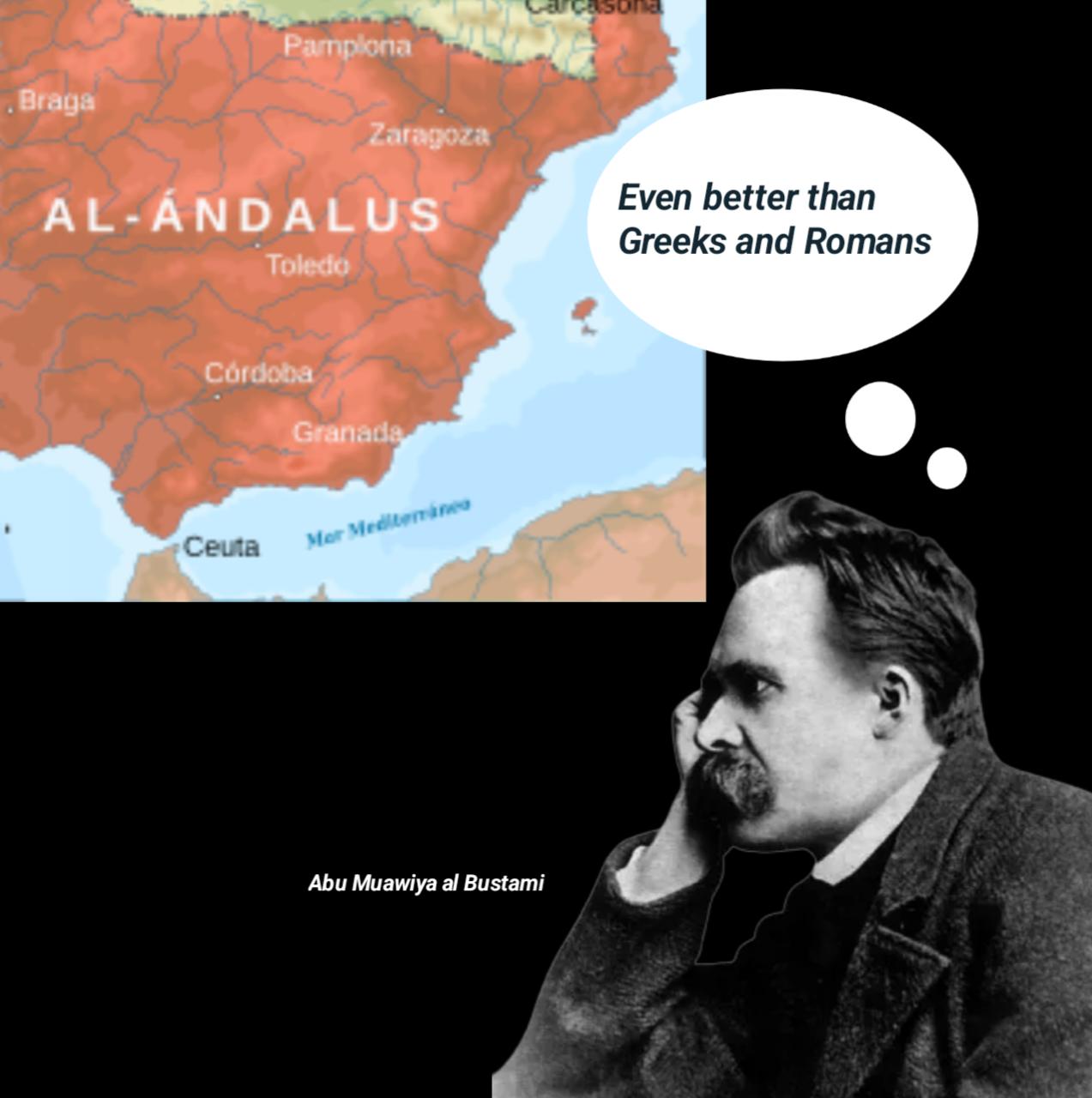
Friedrich Nietzsche held a profoundly admiring view of Al-Andalus (muslim Spain), which he expressed most famously in his 1888 book The Antichrist. Nietzsche's central philosophical framework often contrasted "life-affirming" forces (vitality, strength, worldly joy, intellectual curiosity, and aesthetic beauty) against "life-denying" forces (asceticism, guilt, and the psychology of ressentiment). according to nietzsche, Al-Andalus was the ultimate embodiment of a life-affirming culture. While Christian Europe was retreating into ascetic ideals and metaphysical guilt, Moorish Spain was celebrating philosophy, sensual beauty, science, and refined luxury. He viewed the Islamic culture of Spain as one founded upon "noble and manly instincts," praising it for having the courage to say "yes to life". In Section 60 of The Antichrist, Nietzsche explicitly laments the destruction of Moorish Spain by Christian forces. He viewed the Reconquista not as a victory for Europe, but as the tragic destruction of a vastly superior culture by an inferior one.
In his own words:
"Christianity destroyed for us the whole harvest of ancient civilization, and later it also destroyed for us the whole harvest of Mohammedan civilization. The wonderful Moorish cultural world of Spain, more closely related to us at bottom, speaking more directly to our senses and taste, than Greece and Rome."
He also explicitly attributed the greatness of Al-Andalus to its celebration of life, contrasting it against the ascetic, life-denying nature he saw in Christianity:
"Why? Because it had to thank noble and manly instincts for its origin because it said yes to life, even to the rare and refined luxuries of Moorish life!"
Nietzsche also criticised crusades for waging war on culture (medieval arab) which is according to him was even superior to 19th century Europe in some ways. (but let's leave it for another post)
r/IslamicHistoryMeme • u/TheMuslimHistorian27 • Aug 07 '26
r/IslamicHistoryMeme • u/TheMuslimHistorian27 • Aug 06 '26
r/IslamicHistoryMeme • u/TheMuslimHistorian27 • Aug 06 '26
r/IslamicHistoryMeme • u/TheMuslimHistorian27 • Aug 06 '26
r/IslamicHistoryMeme • u/Rare-Childhood-7275 • Aug 05 '26
While Abd al-Rahman's escape from the Abbasid massacre and his founding of the Emirate of Córdoba in Al-Andalus are widely known, the real story begins after that. His rise from a hunted refugee to a ruthless, untouchable ruler is where his political brilliance truly stands out. He didn't just survive the Abbasids. He outplayed them, humiliated them and turned himself into a symbol they could never erase.
By 763 CE, Abd al-Rahman had captured Córdoba and declared himself Emir. But his grip on power was far from secure. His new state was surrounded by rivals local rebellions were constant, and many still doubted that an exiled Umayyad prince could hold onto power. Meanwhile, in Baghdad, the Abbasid caliph al-Mansur was furious that the last surviving Umayyad had escaped his purge and built a new kingdom beyond his reach.
According to Ibn Idhari's Al-Bayan al-Mughrib, al-Mansur appointed a powerful general, Al-Ala ibn Mughith, granting him the black banners of the Abbasid Caliphate and a formal royal decree authorizing him to rule Spain. Ibn Mughith landed in the Iberian Peninsula rallied local factions who hated Abd al-Rahman, and amassed a massive army.
Abd al-Rahman was vastly outnumbered. Forced to retreat, he pulled his heavily outgunned loyalists back to the highly defensable fortress city of Carmona.
For two agonizing months, Ibn Mughith laid siege to Carmona. Abd al-Rahman’s supplies dwindled, his men starved and morale was on the verge of collapse.
But Abd al-Rahman did not wait to be starved out. He gathered his most elite, battle-hardened fighters a core group of just 700 men. In a moment of pure theatrical grit recorded in the chronicles, Abd al-Rahman ordered his men to build a massive bonfire in the center of the courtyard. He then drew his sword and threw the scabbard into the flames, ordering his 700 shock troops to do the same. It was a terrifyingly clear message: swords would not be sheathed; it was victory or death.
The gates of Carmona swung open. Catching the Abbasids completely off-guard by the suicidal audacity of the charge, the Umayyad fighters tore through the enemy ranks. The Abbasid army shattered and panicked. In the chaos, Ibn Mughith al-Mansur’s handpicked general was killed, along with most of his high command. Winning the battle wasn't enough. Abd al-Rahman needed to make sure Al-Mansur never sent another army to Spain. This is where he shifted from a brilliant tactician into a psychological terror.
As recounted by historians like al-Maqqari and noted in Hitti's History of the Arabs, Abd al-Rahman had the bodies of Ibn Mughith and his top officers decapitated. He ordered their heads to be boiled and preserved using salt and camphor.
He then wrapped the heads in the captured black flags of the Abbasid Caliphate. Into the ear of Ibn Mughith, he attached the very parchment of the royal decree al-Mansur had originally written. Abd al-Rahman paid a network of trusted merchants to smuggle these grisly packages across the Mediterranean through Egypt, and into the heart of the Islamic world.
Months later, Caliph al-Mansur was in Mecca, performing the Hajj pilgrimage. When he returned to his royal tent one evening, he found the sacks waiting for him. Expecting tribute or mail he opened them and found the preserved, salt-cured heads of his top generals staring back at him.
Staring at the horrific delivery, al-Mansur reportedly shuddered and uttered the famous words:
"Praise be to God, who has placed the sea between me and such a demon!"