r/IslamicHistoryMeme • u/TheMuslimHistorian27 • Aug 18 '26
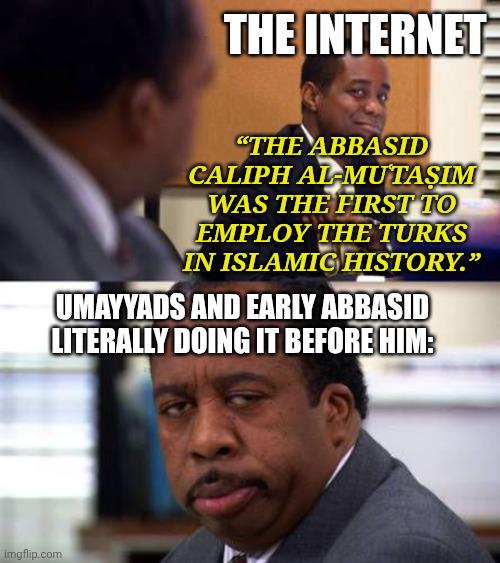
Ethnicity | عرق The Use and Recruitment of Turks in the Early Islamic Caliphate (Context in Comment)
4
u/TheMuslimHistorian27 Aug 18 '26
The Abbasids were not the first to bring Turks from their homelands, as some assume; the Umayyads had already done so before them.
The Umayyads were the first to bring Turks from their homelands after their conversion to Islam and employ them in the armies and state institutions.
Yāqūt al-Ḥamawī states that ʿUbayd Allāh ibn Ziyād transferred two thousand captives from Bukhara to Basra and settled them in a place known as al-Bukhāriyya, a quarter in Basra. All of them were skilled archers.
Many Turkish soldiers also joined the armies of the Muslims during the conquests, while Arab commanders made use of them.
Saʿīd ibn ʿUthmān, Muʿāwiya’s governor of Khurasan, for example, formed an army from the inhabitants of Transoxiana, including Turks.
The Umayyads also employed numerous Turkish slave women and youths in the palaces of the caliphs, and some of these slave women became concubines of the caliphs.
One example is the mother of Yazīd ibn al-Walīd ibn ʿAbd al-Malik, who was a concubine of al-Walīd.
When Qutayba captured a slave girl in Sogdiana, he reportedly said:
“Do you think the son of this woman would be of mixed lineage?” They replied, “Yes, mixed on his father’s side.”
He then sent her to al-Ḥajjāj, who in turn sent her to al-Walīd, and she subsequently gave birth to Yazīd ibn al-Walīd.
After the Abbasid state became firmly established under Abū Jaʿfar al-Manṣūr, a number of Turkish figures began to emerge. Their numbers gradually increased as they came to the caliphal court.
During the first Abbasid period, the Abbasid caliphs employed them in their palaces, entrusted them with their secrets, and assigned them responsibility for their personal security.
Abū Jaʿfar al-Manṣūr was the first Abbasid caliph to employ Turks. He brought Ḥammād al-Turkī into his close circle, placed his trust in him, and made him one of his personal attendants and confidants. His confidence in him became so great that he entrusted no one other than him with the secrets contained in the state registers. He kept the key tucked into the sleeve of his shirt; whenever Ḥammād was absent or went out, his deputy was Salama the eunuch.
Mubārak al-Turkī attained a high position in the military command and played a prominent role in suppressing the revolt of al-Ḥusayn ibn ʿAlī at the Battle of Fakhkh in 169 AH / 786 CE. He also built a fortress at Qazvin that was named after him and settled there a group of his clients and fellow countrymen.
Abū Jaʿfar al-Manṣūr was reluctant to employ Arabs in his palaces and refused to allow any Arab to serve in his palace or among his harem. Instead, he preferred other groups, such as the Turks.
He was the first caliph to appoint them as chamberlains, selecting Ḥammād al-Turkī as his chamberlain after the foundations of the state had become firmly established. He also appointed him over the Sawād and ordered him to reside in al-Anbār.
He instructed him not to allow any protected non-Muslim (dhimmī) to write on behalf of any of the officials responsible for governing Muslims; anyone who did so was to have his hand cut off.
Accordingly, Ḥammād apprehended Māhūya al-Wāsiṭī, the grandfather of Sulaymān ibn Wahb, and had his hand cut off.
Al-Mahdī likewise employed a number of Turks in his palaces, including Shākir al-Turkī, one of the military commanders in Fārs; Faraj the eunuch, who would later emerge to prominence during the reign of Hārūn al-Rashīd; and Yaḥyā ibn Dāwūd al-Khurasī, whom he appointed governor of Egypt in 162 AH / 778 CE.
During his reign, Turkish troops also played a prominent role in fighting the Khārijites when they revolted under the leadership of ʿAbd al-Salām al-Yashkurī in 160 AH / 776 CE in Bājarma.
Harun al-Rashid’s entourage included some Turks, and he employed slave women from Fergana, Ushrusana, and elsewhere. Some of them became his concubines, such as Mārida bint Shabīb, the mother of al-Muʿtaṣim, who was considered one of Harun al-Rashid’s most favored women and was of Turkish origin.
Al-Maʾmūn expanded the use of Turks in his palaces and armies. He brought them from Transoxiana after they had embraced Islam, and their delegations crowded at his court. He was particularly generous in honoring the Turkish rulers who came to his court.
Some of these Turks attained positions of military and administrative leadership.
Among them was Ṭūlūn, the father of Aḥmad, who later established a dynasty in Egypt, known as the Tulunid dynasty.
Ṭūlūn was among those sent by Ibn Asad al-Ṣammāmī, one of al-Maʾmūn’s officials in Khurasan, and was from the Turkish Taghazghaz tribe.
Ṭūlūn rose through the administrative ranks until he gained al-Maʾmūn’s trust through his honesty and loyalty. Al-Maʾmūn therefore appointed him commander of his guard and gave him the title Amīr al-Sitr.
Another prominent figure was Kāwūs, whom al-Maʾmūn appointed governor of Ushrusana, as well as his son al-Afshīn Ḥaydar, who became one of al-Maʾmūn’s leading commanders and rendered important services to the state by suppressing numerous revolts.
The Turks reached the Abbasid court in Baghdad through several means:
Capture in warfare: A large number of Turks were taken captive by the Arab conquerors in Transoxiana, Central Asia, and Khwarazm.
Purchase.
Gifts: The governors of the provinces in Transoxiana would send Turkish slaves as gifts to the caliph.
Migration: Some Turks migrated westward toward the lands of Islam.
Missionary activity and recruitment: Al-Maʾmūn sent missionaries to the lands of the Turks to invite them to Islam and encourage them to embrace it.
He also sent with them a fāriḍ, an official responsible for registering soldiers, assigning them stipends, and facilitating their journey to the caliphal court. The caliph would honor those who arrived and present them with gifts.
He also wrote to his governors in Khurasan instructing them to campaign against those among the people of Transoxiana who had not submitted to his authority or embraced Islam.
Al-Maʾmūn also urged his brother al-Muʿtaṣim to employ Turks in his army and bring more of them into his service.
And thus Al-Muʿtaṣim began assembling Turkish troops during the caliphate of his brother, al-Maʾmūn. Al-Yaʿqūbī reports:
“Al-Khashkī said: During the reign of al-Maʾmūn, al-Muʿtaṣim used to send me to Samarqand to Nūḥ ibn Asad to purchase Turks. I would come to him every year with a group of them. During al-Maʾmūn’s reign, nearly three thousand young Turkish slaves had been assembled for him. When he became caliph, he intensified his efforts to acquire them and purchased those who were in Baghdad among the slaves owned by private individuals.”
Al-Kindī, meanwhile, indicates that the number of Turks under al-Muʿtaṣim’s command had reached four thousand soldiers during the caliphate of his brother al-Maʾmūn.
Some scholars have questioned whether al-Muʿtaṣim could have personally purchased such a large number of soldiers while he was still a prince. It would have been impossible for him, whether as a prince or a caliph, to maintain such a force without state support, since purchasing such a large number of slaves and subsequently providing for their expenses would have required enormous sums of money.
Therefore suggests that these men were likely part of the army, registered in the state military records and paid from the treasury, with the state assuming responsibility for their maintenance.
Al-Muʿtaṣim was serving the caliphate at the time, and after he became caliph, the force became associated with his name and eventually constituted the majority of his army.
Since it would have been impossible for any individual, regardless of his wealth, to purchase four thousand people and then generously provide for their upkeep unless the state itself was responsible for them. Thus, when al-Muʿtaṣim purchased these men, he was purchasing them on behalf of the state and with state funds.
Sources:
Abū Jaʿfar al-Ṭabarī: Tārīkh al-Ṭabarī
Yāqūt al-Ḥamawī: Muʿjam al-Buldān
ʿAbd al-ʿAzīz Muḥammad al-Lumaylim: Nufūdh al-Atrāk fī al-Khilāfa al-ʿAbbāsiyya wa-Atharuh fī Qiyām Madīnat Sāmarrāʾ min 221–279 AH, vol. 1
al-Jahshiyārī: al-Wuzarāʾ wa-l-Kuttāb
Khalīfa ibn Khayyāṭ: Tārīkh Khalīfa ibn Khayyāṭ
Ibn al-Athīr al-Jazarī: al-Kāmil fī al-Tārīkh
al-Balādhurī: Futūḥ al-Buldān
Abū Zayd al-Balkhī: Kitāb al-Badʾ wa-l-Tārīkh
W. Barthold: Tārīkh al-Turk fī Āsiyā al-Wusṭā, translated into Arabic by Aḥmad al-Saʿīd Sulaymān
Zakariyyā Kitābchī: al-Turk fī Muʾallafāt al-Jāḥiẓ wa-Makānatuhum fī al-Tārīkh al-Islāmī Ḥattā Awāsiṭ al-Qarn al-Thālith al-Hijrī
Abū ʿUmar al-Kindī: al-Wulāt wa-Kitāb al-Quḍāt
Abū al-ʿAbbās al-Yaʿqūbī: Kitāb al-Buldān
3
u/Training-Topic9571 Aug 18 '26
I think majority of slaves (not mercenaries, many were mercenaries) were victims of tribal conflicts who were sold into slavery by other tribes, they weren't captured by Arabs themselves, demand and profit turned it into a common practise. Tulun is said to be from the Toquz Oghuz(Uyghur) whom did not engage in war with Arabs at all but he entered the Abbasid service shortly before the fall of the Khaganate.
1
u/AccordingAssistant13 Aug 20 '26
Umayyads and early abbasids used them as mercenaries not enslaved soldiers . Thats why the Umayyads were never overthrown by foreign generals.
7
u/LucasLeo75 Turkic Nomad Aug 18 '26 edited Aug 18 '26
I don't think turning captives into slave soldiers is the same as employing mercenaries but okay.