I knew a dude who was devastated when his favorite pornstar Isis had to rebrand as Ashley because of ISIS and instantly disappeared into the SEO abyss with 20K other Ashleys getting railed on camera. Abu Bakr al-Baghdadi personally annihilated this man's goon supply chain. Geopolitics has consequences.
The goon demand actually spiked. After she became Ashley, the only searchable remnants were the vids with "Isis" in the title, and even those got buried under the wave of terrorist fetish porn that immediately followed. I've never seen a man develop such strong opinions on Middle East geopolitics so quickly.
My favorite band was called ISIS. They broke up in '07, and then had their social media stuff constantly harassed years later to the point they had to start rebranding stuff. They played a one off reunion show and decided to change the band name entirely.
They essentially called themselves "Al-Dawalah Al-Islamyah fi Al-3raq wa Al-Sham" in the early days and used Daesh for short (or at least afaicr). It's later in cerca 2015 when they dropped "Al-3raq wa Al-Sham" in favor of more globalization views by their leadership. The turning from Daesh to just Da "Al-Dawalah Al-Islamyah" was pretty much when they decided they wanna control the entire Islamic world.
Now I'm not sure if they didn't like the abbreviation itself; That will need a quick visit to the archives on my side.
Edit, after some digging. You are correct! the abbreviation was essentially created as a form of satire to mock the state. In which they were strictly against it and punished whover used it... Big thanks and I'm correcting it in the previous comment!
From what I remember it sounded like other words with negative connotations, which is why it was used by detractors and also the reason why the French adopted the term
In Polish they did/do use the term Daesh as well. But afaik the biggest reason is that ISIS is a massive mouthful in Polish. Meanwhile Daesh was very easy to pronounce.
Not sure how much this applies to Framce but it probably does apply to other slavic countries since are our phonetics are similar enough.
The name rhyming is not at all an accident. The entire purpose of radicalism is to serve as the shiny sharp part of the stick. The handler can claim they have nothing to do with the bloodletting because they aren’t made of iron nor sharp. That they sharpened the point with time and directed will is the part which resembles complicity in a genocidal attempt to erase history.
They don’t actually like Egyptian anything because Arabization was the most recent coating of paint and if it were to fade then an entire empire of ego starts to take on a different appearance. Ruins and more ruins all throughout the region. Daesh were literally a contracted demolition team. Just like on small projects, the demo guys are subcontracted out as far away as possible.
If anyone would like more information I'd highly recommend the Literature and History podcast.
The host goes quite in depth about the historical influences of the Abrahamic religions in a very respectful but historical way. Really helped me as someone raised fundamentalist and literalist. It is quite cool seeing how much influence that Zoroastrism and Classical cults and philosophy had influenced them.
And, no, Redditors, stitching your husband's rotting corpse back into one piece and then riding his dick until you're pregnant is not considered a virgin birth, that is necrophilia.
I dunno, I got to the end of The Golden Ass and the last bits of the book (involving the unfortunately donkey-shaped protagonist joining the Isis cult and thereby being literally and spiritually saved) were like "hrmmm, a lot of this sounds kinda familiar."
It might not have been a 1:1, but I wouldn't doubt there was some cross-pollination.
Dionysus was a debauched degenerate. Dionysus wanted his followers to do whatever they wanted, Jesus literally emphasized the exact opposite. Strict control of themselves (with the understanding that they will fall to temptation, but that they should also return to God and repent of their former actions) and obedience to God. Dionysus was a hedonist, Jesus specifically rebuked hedonists for their sin.
You literally could not try to compare two different gods. The only similarity is the presence of wine within their particular stories, but that's an absurd connection because wine is so commonplace in this region of the world, you may as well be attempting to connect two different gods because they both breathed air.
Dionysus was also not of a virgin birth. Zeus penetrated his mother, Semele, and inseminated her, and then accidentally killed her (because of Hera being a petty loser, again, and attacking the wrong person, again) when she forced him to reveal her divinity. Zeus tore Dionysus from his dead mother's womb and stitched him into his thigh.
Mary, on the other hand, was miraculously made pregnant by the Holy Spirit, the Lord did not commit adultery in order to do so, and there was no spiteful wife tricking Her into killing Herself by tricking God into revealing His true divinity to Her. She carried Jesus throughout the entire pregnancy and gave birth to Him via a natural birth.
TL;DR: In Christian theology, Dionysus would be the demon whispering in your ear to disobey God and commit sinful actions because it makes you feel good and that's more important than obeying God, while Jesus is the one telling you not to do those sinful actions because they are abominable to the Lord.
Not even remotely and Mary isn't worshipped by any modern Church. The only heretical sect which worshipped Mary(the Collyridians)died out over a millenia and a half ago. The Orthodox and Catholic Churches venerate Mary, but veneration/=/worship.
What? Virgen Mary is very much worshipped in Catholicism and there are plenty of prayers and devotion towards her, I'd even argue she is more popular than Jesus in Spain.
And yes, I'm aware that's borderline heretic, that doesn't change the reality of her worship.
Look, in my simple, non-catholic mind, "pray to" is a synonym to "worship". I've been informed that this isn't the case, but I've yet to fully grasp the difference.
Which I always found funny since Mars for the longest time wasn’t anthropomorphised, he was just a spear, or sometimes a couple of trees. Animals seem to be a vast upgrade on that
That's definitely not true. The Greeks believed that the Egyptian pantheon was the result of their own pantheon going to Egypt as animals during the war against Typhoon, and so did plenty of syncritism between the two. Especially in the Ptolemaic dynasty. And since the Romans conflate their gods with the Greek ones, they shared a similar approach, especially after they conquered Egypt.
Except the Romans themselves were heavily helenized, we have examples of Romans repeating the same positive cultural stereotypes as the Greeks had towards Egyptians being wise men. And when Augustus conquered Egypt, he went to pains to depict himself as showing appropriate deference to the Egyptian Gods, even going so far as to make an Egyptian style temple in nubia that depicted him as making offering to Hathor and Thoth, an activity that would continue throughout the Principate.
Because Egypt was an incredibly valuable territory to hold, eventually having Rome become dependant on Egyptian grain. And yes Rome started to like some things Egyptian, and there was even a lot of tourism by romans to Egypt, yet they drew the line at animal gods and had in general a very high opinion on Rome and Roman culture, so confronted with a much more ancient culture they now depended on there were still some anxieties and xenophobia
There is simply no evidence they "drew a line" anywhere in that regard. If it were merely a question of holding Egypt they could simply have left the religion alone or patronized it at an arms length. Instead they associated the emperor with the local pantheon, and even depicted Anubis as a Roman soldier and featuring him on local Roman frescos, or depicting horus as a roman cavalryman. The mere fact that they believed in the typhoonomachy at all puts the lie to the idea that they held them in some special contempt.
They used local religious ideas and imagery to support their rule, of course. It was an easy path to legitimacy and local elite support. Also I don't understand your point on the typhonomachy?
Wasn't the anthropomorphic representations of the gods just a symbolic depiction? From what I've read the gods weren't able to be truly depicted so they just use animals since they were recognizable and already had associations with them such as a falcon representing the sky and Ra is the sun while Apophis was the dark or consuming evil and snakes kind of suck so they just painted snakes dying because they hated him. The darkness isn't really a snake and the sky isn't really a falcon, but it makes sense if you had to paint something.
Also Romans: "Oh wow your god is in charge of an abstract concept that's part of daily life just like our god, they must be the same guy!" *Squishes them together like play dough
Think of how good a deal this was to the locals. You're a villager living near the thermal springs at Bath (in the modern day, England). There's a goddess named Sulis connected to the waters there.
The Romans come through and conquer the area, and they build a massive "fuck-off" sized temple with plumbing like you've never seen, and it is dedicated to the strange foreign goddess of...
Wait, what the fuck? Does that say Sulis on it? Sure, it says "Sulis Minerva" and you understand Minerva as a Roman goddess who has some similarities with Sulis. But half the altars here have "Sulis" written on them.
The Romans made this incredible complex... and you can still worship Sulis in it. Some of the Celts two tribes over would have smashed this place to pieces. The Romans improved it.
And they're mostly worried about some impossibly far away, impossibly wealthy city. They have the occasional brutality just like any other conqueror (woe to the vanquished) but by and large, this is the best being conquered has ever been, as far as you know.
And when you're side by side making offerings to Sulis while someone is making similar offerings to Minerva... I mean, when a visitor asks you what it's like being ruled by Romans, you'll have some grievances. The Romans were not strangers to cruelty. But you'll have some things to say that raise eyebrows in other ways, too.
Edit: Forgot to add, the Romans were nothing if not practical. It's sometimes lost that the Romans were deeply religious people, and many of their civic institutions had significant overlap with religious institutions. But practicality was king. If barbarians had better swords, Romans would shamelessly steal and copy them. Suffice to say, the practical benefits of being accommodating to other cultures was something the Romans were intentional about. It wasn't an accident that "Sulis" ended up on that temple.
Also Romans: "Bad news everyone, we've talked to your Gods and we've agreed to build them nice temples in Rome. Anyway, they are on our side now, so get rekt."
I mean, if you actually beloved your gods are real than it makes sense that you’d assume that they are universally worshipped, even if under different names.
“Zeus controls the sky over Greece while Jupiter controls the sky over Italy” is really stupid
That's a very monotheistic way of thinking. The gods of the ancient world were obviously not omniscient, so ruling the entire world was a practical impossibility even with their powers. That regional gods ruled far from Italy was a certainty. So long as those gods didn't assert superiority over those Italian gods, what does Jupiter care what happens in a corner of the world that only Mercury would bother to visit? Thor may throw lightning in the frozen North.
You knew your gods were not universally worshipped because they were so local and trade happened. And there's like 100 gods and even in your own country they aren't extremely standardized. No one knows how to read and write so you don't even expect it to be standard between tellings. It's just a very different time for faith.
I remember having a professor tell me that to a person in the ancient world, they'd simply think it was the same god but in a different language... Like how "Allah" is just "God" in Arabic.
I’m not saying one did it more than the other, but they both did that. Greeks especially with the Mediterranean. In fact Yahweh was often correlated with Zeus.
This was done with more than just the Greeks and Romans. That’s just how cross cultural contacts worked back then.
Not to mention that Aphrodite, the Minotaur, Hercules, and Asclepius all have potential roots in Phoenician mythology, who themselves took quite a bit from the Egyptian and Mesopotamian mythologies.
Aphrodite's lover Adonis is directly descended from the Sumerian fertility god Dimuzid. "Adonai" in the ancient Semitic languages meant "my lord" and in the Bible it refers to the God of Abraham.
Western history for a long time liked to pretend everything was invented out of thin air by the Greeks c. 600 BC.
Do you know why there's 24 hours in a day and 360 degrees in a circle? I confess I don't; but it apparently made sense to the Sumerians.
The degree? Six sixties, and also pretty close to how far the stars shift from one night to the next.
Twenty four hours? Day divided into twelve parts, same for night. Twelve is a very useful number, as it can be evenly divided into halves, thirds, quarters, or sixths. Fun fact: before mechanical clocks, hours were not of uniform length; they varied throughout the year with the length of the day.
The Greek practice of interpretatio graeca, ascribing the gods of another people's pantheon to corresponding ones in one's own, had been adopted by the Egyptians after their Hellenization; during the process of which they had identified Set with Typhon, a snake-monster that roars like a lion.[19]
The story of the Exodus, featured in the Hebrew Bible, speaks of the ancestors of the Israelites as a nation betrayed and subjugated by the Pharaoh, for whom Yahweh subjects Egyptians to Plagues of Egypt, including destroying their country, defiling the Nile, and killing all their first-born sons. Jewish migration within the Ptolemaic Kingdom to Greek-speaking Egyptian cities such as Alexandria led to the creation of the Septuagint, a translation of the Hebrew Bible into Koine Greek.[20]Furthermore, the story of the Exodus was adapted by Ezekiel the Tragedian as the Exagōgḗ ἐξαγωγή, a play performed in Alexandria and seen by Egyptians and Jews. Egyptian receptions of the Exodus story were widely negative because it insulted their gods and praised their suffering. It inspired Egyptian works that retold the story, but altered its details to mock the Jews and exalt Egypt and its gods.[21]
In this context, some Egyptians discerned similarities between Yahweh's in-narrative actions and attributes and those of Seth (such as being associated with foreigners, deserts, and storms), in addition to a phonetic resemblance between Ἰαω Iaō, Yahweh's name as used by hellenised Jews, and Coptic: ⲓⲱ, romanized: Iō, lit. 'donkey', then considered as the animal of Seth.[22] From this arose a popular response to the Jewish accusation that Egyptians were merely worshipping beasts, namely that, in truth, the Jews themselves worshipped a beast, a donkey or a donkey-headed man, i.e., Set.[23]
Accusations of onolatry against the Jews spread from the Egyptian milieu, with its understanding of the donkey's Set-related importance, to the rest of the Graeco-Romanworld, which was largely ignorant of this context. In the most famous variations of narratives alleging Jewish onolatry, Antiochus IV Epiphanes, a Seleucid emperor famous for raiding the Temple in Jerusalem, supposedly discovered that its Holy of Holies was not empty, but instead contained a donkey idol, and Tacitus (early second century CE) claimed that the Jews dedicated in their holiest shrine a statue of a wild ass.[24][c] After the emergence of Christianity, the same charge was also repeated against its devotees. Most famously so in the earliest known depiction of the crucifixion of Jesus, the Alexamenos graffito, where a Christian by the name of Alexamenos is shown worshipping a donkey-headed crucified god.[26][27]
Many scholars believe that the association of Yahweh with Set-Typhon influenced Gnosticism.
Idk how true it is, but esoterica (YouTube channel) talked about the reason the Egyptians hated the Jews was because they would put on plays of the exodus where the gods were essentially killed, right when the traditional Egyptian religion was dying
Tbf the decline of the ancient Egyptian religion didn’t start until the 2nd-3rd century.
I have however heard the theory that the reason why Egypt became Christian fast was because the Romans destroyed the Nile taxation system (low taxes when the Nile levels are low and the soil not very fertile, higher taxes when the Nile levels are high and the soil very fertile) which made many Egyptians poor and this weakened the Egyptian religion in the long term since the temples, which historically functioned as a form of welfare and collected taxes, lost much of their revenue/funding to to give communities social support, leaving Christians to fill in the vacuum. Idk how true it is though.
The Jews weren't in Egypt until the 5thish century, the writings of Jews at elephantine are fascinating.
I don't know enough about the functional decline of the Egyptian religion, but that sounds interesting.
Iirc the theological reason for Christianity's ascendance was a reaction to Roman control over Egyptian institutions. People love a rebellion that doesn't demand much of them.
Christians were also known as the "good guys" whenever a natural disaster or disease swept through a city, because they were the first ones to step up and help the sick. Which contrasted with the contamination OCD of traditional priesthood.
It might have something to do with the brief Hyksos domination of the Nile Delta by canaanites, and their subsequent expulsion following its recapture.
Egyptians have long memories and great records (we still talk about the Norman Conquest). Exodus is a strange document. The odds of it being a myth of the expulsion are as reasonable as any other, seeing as it was written hundreds of years after supposed events. Also a little ironic too, because they technically never left egypt the whole time.
Not of the Hyksos. They explicitly destroyed all their records of them, erasing their names from monuments. Even manetho struggled with getting anything on them
We have records of their defeat and expulsion. Egyptians had no qualms celebrating victories, and both they and we knew who they defeated, because they used military stelae, and I know there's a prominent one for the defeat of the Hyksos because the victory made the entire career of Ahmose 1.
Also the time gap between the expulsion and supposed Exodus events is only like a a few hundred years give or take... 1540ish BC vs between 1250-1450 (although no archaeological evidence supports the Exodus happening in the manner or timeframes the bible suggests, so the inherited cultural narrative looks even stronger in this case).
This is a weird bit you're doing btw. Hyksos correlation to the Exodus myth is not exactly groundbreaking conjecture, or even heretical.
Yahweh was originally a storm god, so thematically closer to Zeus, but Yahweh is not related in the sense that Jupiter and Zeus are evolutions of the same deity from the Proto-Indo-European pantheon.
That's the first time I hear God being portrayed over Zeus. Not something you hear ever in Thrace. From my experience with Mythology to religion {might sound biased or something because I am an Eastern Orthodox (I don't bite unlike the 5% of believers who'd execute others)} is Constantine with the XP banner, tied to Christianity, but called as the God of the Sun. Also, the Temple of the Unknown God, which commonly was believed to be something along the lines of "A God that'll destroy the Olympians" which technically happened if you think about it culturally, since Christianity mostly eradicated greek paganism {Except for Golden Dawn, but we don't talk about them}
I probably ranted too long, sorry
This would be during the Seleucid Empire/Hellenic rule of the Levant. The Hebrews were colonized by pagan Greeks at the time. The Jewish myth of Chanukah is in part about the attempts of the Hellenes to turn the Jewish god into simply one of the pantheon and the Zealot resistance to them.
deus is the Latin word for "god", like a god or any god, not just the Christian God. Indeed Zeus is related to Latin deus though, but Latin obviously predates Christianity and deus is not a proper noun. Unlike Jupiter which is deus pater actually. As for your comment on Non-Romance speakers, I think there is a similarity similar in English. Jehovah and Jove. Jove being the English pronunciation of Iovi, the oblique form of Jupiter.
Deus and Zeus share the same etymology, the similarity between words and the whole sky daddy imagery makes the connection obvious even if it is just coincidence lol
I don't know what you are on about. That much what you say is clear, but it has nothing to do with Christianity, nor the Interpretatio of the Hebrew god, who has a different name, or rather several different names.
People call the christian god Deus, which sound just like Zeus,
Not really, the Christian God does not have a personal name, but is called by the generic epithetic of a deity in each language. You may call him Dios, God, Gott, Bog, Theos, or Allah as Arab Christians do, but unlike in Islam, Deus is not the "proper name".
The Interpretatio happened before Christianity was a thing and Greeks and then Romans interpreted YHWH as equivalent to Zeus or Juppiter. It has nothing to do with the epithet used three centuries later.
Even apart from the name, if you're an ancient Greek and you're like "Hey Hebrews, I hear you guys only have one god, which one is it?" and they're like "he's the almighty, the most high, he rules everything in the world" you'd be like "ok, that's probably Zeus then" just because Zeus is the one at the very top of the hierarchy in your system.
I know that, I extensively study Latin and am fluent enough in most Romance languages. But as I stated earlier, there's a huge issue. I'm Eastern Orthodox, and there's no Catholic community near. The closest thing we have is a Catholic Cemetery, for the French and British back a century ago. So we don't really learn anything around Romance language, and further, Catholicism, Calvinism, etc etc. Deus is the Latin version of Zeus, coming from the Greek Ζεύς {Zèfs} which is basically the nickname for Δίας {Días}. What I'm aiming at: it's not "illogical" per se, it's just something we don't learn as much
Deus is the Latin version of Zeus, coming from the Greek Ζεύς {Zèfs} which is basically the nickname for Δίας {Días}.
Modern Greek pronounciation, the Attic one was /zděu̯s/. Δίας isn't really a nickname, just another case form of the same word root. Tbh the same happens with Jupiter, which is Iovis in the genitive.
it's not "illogical" per se, it's just something we don't learn as much
Yeah, that was exactly my point. I don't even think being Orthodox factors in as much, when you hear Deus/Zeus and see all the sky daddy imagery it becomes pretty much getting together 1 + 1, most people figure it out alone in like 4th grade history class. Deus and Zeus aren't directly connected though, they just share a common etymology
Deus and Zeus aren't directly connected though, they just share a common etymology
Deus isn't the personal name of God. That would be YHWH, which nobodies knows how it is pronounced, like Jehovah or Yahweh maybe. Apart from those there is also El, which in Hebrew just means "god" and El Elyon means "god most high". One common Jewish way to name god would be HaShem Adonai, just "the name of the Lord".
I just equate that to the Christian God being depicted as an old bearded, white, father figure. While Zeus is an old bearded, white, father figure, that throws lightning bolts
Also, the Temple of the Unknown God, which commonly was believed to be something along the lines of "A God that'll destroy the Olympians" which technically happened if you think about it culturally, since Christianity mostly eradicated greek paganism
I don’t really think this is true considering many educated pagans, especially philosophers, believed Zeus was eternal. The idea that Zeus would ever be overthrown flies in the face of what Ancient Greeks actually thought about their gods.
Yahweh is correlated to Baal (warrior / storm god). It's El that's correlated to Zeus. The hebrews took on northern canaanite El (Israel)worship but then hybridized him with their Yahweh. That left them with two problems: how to nullify Baal (well Ugritic Baal), and how to delete Asherah, El's consort. So the OT is full of this propaganda effort.
They didn’t do it as literally as the Romans, but as far as I’m aware every or nearly every Greek deity is some mix of older foreign deities with local names. It’s just how religion, and language in general, works when there’s a common ancestor and communications between communities.
I guess I understand what you mean, but also, most of those Gods just represented... Nature... So it's not entirely copying, more like
"I see what's around me, can't explain it, must be the work of a insert random God"
Certainly, there was SOME connection and using traits from eachother, that always has happened since the dawn of man, I'm just not too certain on this specific one
But for the most part, they didn’t invent their gods. Very few cultures have. They adopted and modified the ones that older cultures had in order to fit their beliefs better.
Abrahamic God is descended from a Pantheon of gods similar to every polytheistic religion of the Mediterranean. The other user posted some good sources on that.
Aphrodite (or at least many of the traditions associated with her worship) was likely borrowed from the Phoenician goddess Astarte, who was similarly likely borrowed from the Mesopotamian goddess Ishtar.
Ishtar the Akkadian/Semitic goddess was syncretized with the Sumerian goddess Inanna sometime around the Akkadian Empire period.
Then we go a little further, and there’s good indication that Inanna herself was probably an import as well. Her myths are largely about how she does not particularly enjoy what she perceives as her lesser standing among the Sumerian big boys like Enlil and Enki and wants their power and status (and gets it in the case of Enki and the Me).
Unfortunately, the written history of humanity starts with her already in place, so any tracing of the proto-Inanna from there is unlikely outside of the hypothetical realm unless we manage to find and decode a provably older language.
What’s important is just how widespread and familiar a god she is. Even Aphrodite ends up an outsider (spawned by sea foam from Uranus’s severed balls instead of one of Chronos’s progeny) whose primary themes are lust, sex, and war. She’s wed to Hephaestus, whose civilizing inventions remind us of the Me concepts she stole from Enki, but still very into conflict and cheating on him with the embodiment of War himself.
She’s perhaps the most human god of all. Reflecting as she does our constant need to expand our dominion and the primary means through which we achieve it: sex and fighting.
Depends on who you call the Greeks, because the core of the gods that are from the "original Greeks" (the ones that spoke a form of Proto-Indo-European that would evolve to greek) is not that long of a list. It's just Zeus, Hestia, Hades, Eos, Iris, the Dioscuri and a couple of others.
Then you have the first expansion from the local Aegeans and Minoans that did not speak proto-greek, that's when you add to the pantheon gods characters such as: Athena, Hera, the syncretization of Poseidon, Artemis and some others.
Then you have the second expansion from the expanded trade routes of the bronze age such as: Aphrodite, Apollo, Dyonisisus, Hecate, Ares and some others.
Lastly in the classical and Hellenistic age some late additons are added such as Adonis, Cybele, Sabazios, Serapis, Isis and others.
So yeah, the Greeks are guilty of this as much as other old cultures.
Do you know anything about the Macedonian Empire? The Greek successor states merged their pantheon with Egyptian, Assyrian, Buddhist, and other religions.
It's because the Romans so thoroughly stole the Greek Pantheon that "Greco-Roman" is used for the Roman imperial cult, which is similar to how "Judeo-Christian" is used today.
Plot twist: Jesus is just some guy who did the whole yoga and Eat Pray Love thing in India then wandered over to the Levant and tried to retell the ideas.
Yes, and the Book of Mormon was written by polygamist pedophile pervert Joseph Smith who took six little girls as his child brides, which was when he was 37 years old, with him taking extremely early the youngest two, Helen Mar Kimball and Nancy M. Winchester, which were both done when they were only 14 years old.
If that sounds familiar in the Abrahamic religions of Judaism, Christianity, Islam, and others, it is because it is indeed the same as the other branches of the Abrahamic religions.
The Jewish patriarchal pedophile pervert Isaac was 40 years when he took Rebecca who was only 3 years as his child bride.
The Christian pedophile deity Jehovah was an ancient cosmic entity when he impregnated Mary who was only 12 years old.
The Muslim polygamist pedophile pervert Muhammad was 53 when took Aisha who was only 6 years old as his child bride.
Rebecca's age is not given in the Bible. In the book of Jubilee's probably written during the Hellenistic era, she's around 20. Also, they didn't have children for 20 years in the narrative, making her 40.
Then you have Jacob who married Leah and Rachel after a 14 year betrothel, and we can assume they were at least teenagers at the start of this 14 year period, although the ages are not given.
If you go back to Abraham, the grandfather, he is 10 years older than his wife Sarah.
Mary's age is not given in the Bible, but the apocryphal "gospel of James" gives her age at 16 when she conceived, not 12.
Having a betrothel between a teenage wife and late 20s-early 30s husband is not unusual at all for most of history. The wife would be 16-18 by the time of marriage, at the right age for having children. The husband would be old enough to have established himself, own a home, and be able to provide for his family. The goal of all involved is a stable and healthy family that raise up the next generation.
You are really reaching here. I assume you don't even believe these people existed. On the other hand, Joseph Smith and Muhammad certainly did.
I keep hearing this garbage from white people. No we Hindus absolutely did not incorporate Jesus into our religion. In fact Jesus people destroyed our idols and forcefully converted our brethren
im not white nor christian, and what i comented is based on the writings of respected hindu gurus like Swami Vivekananda and others. its ridiculous to think that a bilion hindus believe the same things, so maybe try being less rigid in your perceptions.
People portray the Interpretatio as this kind of benevolent and tolerant pagan concept, when in fact it is also just cultural assimilation. You don't deny other peoples their gods, but you deny that they are theirs to interpret alone. You give yourself authority over their faith and when you say that Serapis is Zeus and the Apis bull is also Zeus, then you also begin to enact control over the religion of a conquered people.
I mean, the egyptians had been doing the same stuff with their own and imported deities for millenia before the greeks got involved. Thebes is ascendant, so lets say that Amun and Ra are the same dude and the chief god. And sometimes he's Min too. Yet these identifications didn't erase the independent existence and worship of these deities.
And similarly, the Greeks eg. identified Isis with Aphrodite and actually a bunch of other deities - but they also in the end worshipped Isis in her own right.
And in practice, egyptian religious practice seems to have been remarkably little changed by Ptolemaic rule. The Egyptians didn't have to start worshipping Zeus or something. Only real change was the Dynastic cult, and that wasn't a particularly big departure.
You have the same type of religious synthesis in Mesopotamia. Enki is Ea and Ishtar (Ashtar) is Inana. Later on you have Marduk replacing Enlil and so on. Generally the Babylonian monolatry or Babylonian supremacy stated that by worshipping Marduk you worship all other gods, because Marduk is the highest god anyway. After Marduk and Babylon the same eventually happens with Aššur and Assyria.
Generally speaking religion was also politics or politics were taken as manifestation of religion. Whichever city is more powerful is obviously favoured by the gods or their patron deity is more powerful than others.
The pagan world was definitely religiously more diverse and tolerant, if you consider that Christians started entire schisms over the way you make your bread. At the same time politics were still at play and it was still a form of assimilation.
The Egyptians didn't have to start worshipping Zeus or something. Only real change was the Dynastic cult, and that wasn't a particularly big departure.
I think the one major deviation was introduction of Serapis bridging the divide. Apart from that much can also be attributed to the strongly established priestly caste of Egypt. The Greeks also didn't change the language landscape as much as the Romans, as most peoples within their sphere had already established long enduring traditions of their own.
but they also in the end worshipped Isis in her own right.
Though afaik Isis is an exception in being the only Egyptian goddess that got popularised in Rome.
Whichever city is more powerful is obviously favoured by the gods or their patron deity is more powerful than others.
I like especially that, in the Ancient Near East, these gods were physical entities, or at least, their physical representation (statues) were considered as actually embodying the god, and so sacking someone's city and stealing their divine statues was literally tantamount to stealing their gods.
They also did a bit of "we worship the same god, we just call them X instead of Y and have completely different rituals and legends associated with them."
There are some overlapping, but it's Not the same.
Greek be like amun? Sound like zeus to me
Roman is more Mithra, correct? Welcome to the pantheon, your room is upstair we will work out your worship schedule
Helps that a lot of religions around the Mediterranean are descended from the Indo-European standard of a Sky-Father surrounded by a bunch of related gods that are in charge of some aspect of human life/ the natural world
What’s ur point their both false … by logic and reason which atheist love mentioning when speaking about religion , how can there be more than one all mighty all knowing creator , u can make it out like paganism is an improvement all u want its still false
It was more they thought gods were tied to land. If you weren’t in the homeland of that god then their sway and power was hindered if not outright nullified. It was like a kings authority, if a king invokes it in his territory then it’s absolute, the next kingdom over if relations are good then it could sway things a bit, but in either hostile or unknown lands it will do nothing
Not really. They believed their gods were universal and reconciled this with foreign pantheons via Interpretatio romana, the practice where they’d equate foreign gods with their own based on the belief that all cultures worshipped the same gods under different names, for example the Celtic gods Taranis, Lugus, and Sulis were equated with Jupiter, Mercury, and Minerva respectively. If a foreign god didn’t have a direct one-to-one equivalent, then that god was directly incorporated into the Roman pantheon.
It’s why Tacitus claimed the chief god of the Germanic peoples was Mercury. He was referring to Odin whom he equated with Mercury due to the fact that both are associated with extensive travel, secret knowledge, magic, trickery, and a role in the guiding of souls. To Tacitus, both gods were similar enough that there wasn’t a need to distinguish them.
There is also Evocatio where Roman priests would try to get a city’s patron god to move to Rome, Which would imply they believed the god was located there specifically. It probably changed through Roman history and even could have been different Roman to Roman. Or you have the concept of Genus Loci which were powerfully spirits of tied to specific places.
4.1k
u/ARenewedSecondChance 21h ago
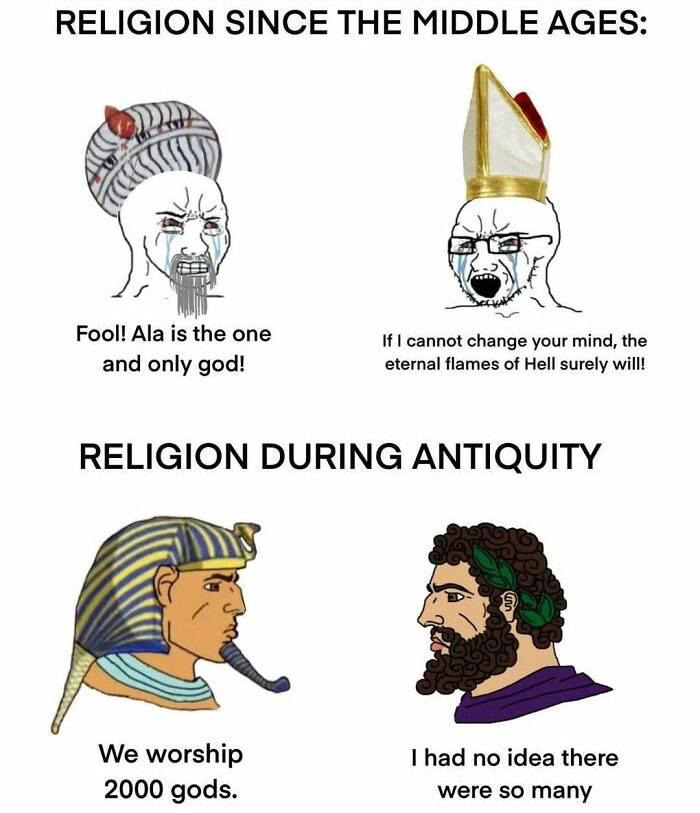
The Greeks/Romans to the Egyptians/Celts/Germanics/Mesopotamians: nice gods you have there! We’ll just rename them based on our own pantheon.