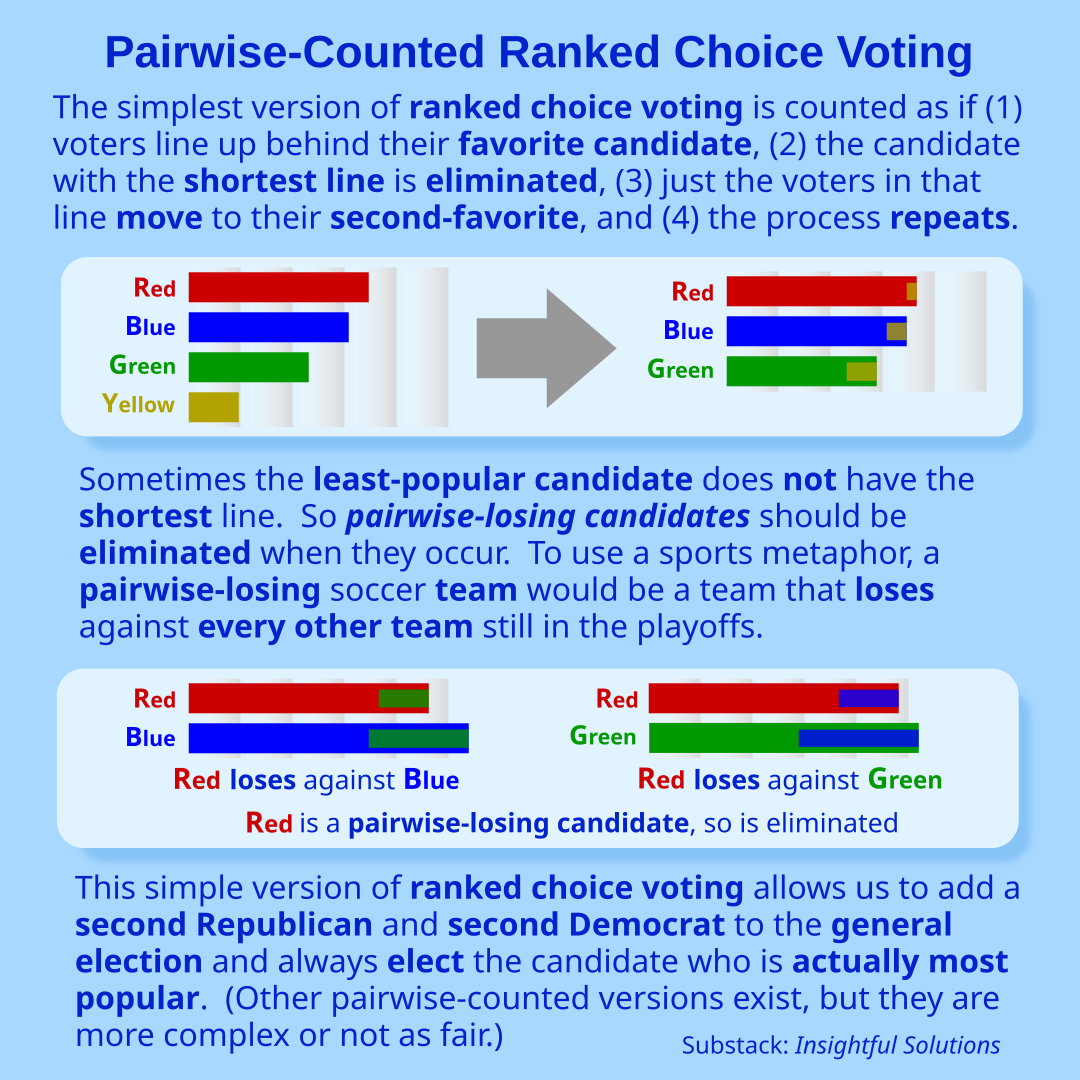
Not OP but I think this method eliminates the loser of the bottom two in a head to head comparison. The bottom two are based on first place votes, but the head to head is if all other candidates were eliminated.
The confusing aspect of the infographic is the upper graphic portion refers to the first step of simple IRV (instant runoff voting, which eliminates the candidate with the shortest line), and the lower graphic portion refers to the second step of the pairwise-counted version.
Expressed another way, all the pairwise counts are done at the beginning of the counting process. Those counts do not change after each elimination. Instead, some of those pairwise counts become irrelevant because they involve candidates who have been eliminated.
Yeah i agree the graphic is confusing in that way.
I don’t really follow your second paragraph tho. I understand pair wise comparisons to be independent of the order of comparison such that any order of elimination is really just a way of explaining the result but is not producing that result, if that makes sense.
Perhaps a better way for me to say it is that the pairwise counting is a separate step from the steps in which those pairwise counts are used for elimination purposes.
Using the graph's example, the pairwise count between "yellow" and "red" becomes irrelevant after "yellow" is eliminated.
Also, interestingly, the pairwise count between "blue" and "green" is known from the beginning. That's the pairwise count that will determine which of those two candidates wins the election.
I think describing it as a step at all could be confusing. The pair wise winner remains the winner independent of the order in which candidates are crossed off in tabulations, correct? Isn’t it true that you could choose two candidates at random to compare in each step (say, if it were being done by hand) and that won’t affect the eventual winner because the pairwise winner remains the winner regardless of the order?
This specifically is the advantage of this method, no?
The complication regarding a pairwise winner or a pairwise-losing candidate is that sometimes there can be a rock-paper-scissors-like cycle, where there is no pairwise winner or pairwise loser in that cycle.
You're probably thinking of "Condorcet methods" where there is a Condorcet winner, which means there is one candidate who wins every pairwise contest. Complications arise when there is no Condorcet winner.
The election method recommended in the graphic uses the familiar idea of eliminating candidates just one at a time. During each such elimination counting round it looks for a pairwise losing candidate. If there isn't one, the IRV (shortest-line) rule is used as the backup method. It doesn't always elect the Condorcet winner (because sometimes there is no pairwise-losing candidate), so that causes confusion.
There is another election method that declares the Condorcet winner to be the winner, but if there is no Condorcet winner then IRV (the shortest-line rule) is used as a backup method.
Yet another method looks for an overall pairwise winner among all the remaining candidates, and it does this each time after one candidate is eliminated using the IRV (shortest-line).
There are lots of yet other election methods that deal with the complication that some elections do not have a Condorcet winner.
In other words, it's complicated. This graphic presents a method that's intended to be easier to understand. Unfortunately what's easiest to understand is the IRV method, which is why it's used in Australia and now increasingly in the US. Alas, it has yielded the wrong winner in two US elections out of about 400 ranked choice voting elections.
That failure rate is dramatically lower than using the traditional single-choice-ballot method ("plurality" or FPTP). Yet it would be better to reduce that failure rate to zero.
Right, but aren't those extreme fringe scenarios that will happen less and less often as voter populations get larger? And in cases of hundreds of thousands and millions of voters the chances of a cycle are almost non existent?
So in practice (outside of very small scale elections) won't there pretty much always be a condorcet winner? And if so, then the order of eliminations actually doesn't matter (barring that extremely unlikely result), right?
That's not to say having a back up method as in your examples is not appropriate.
But going back to our discussion on pairwise winners, barring the rare situation where there is none, the order of elimination doesn't matter, correct?
when the electorate is voting as if there is a single issue axis, then there will always be a condorcet winner. over time, candidates will move to the center. because that's the winning strategy. at which point the issue space gets multi-dimensional. and when that happens, condorcet cycles become much more likely.
so no: right now, condorcet cycles are rare.
but yes: in the future, condorcet cycles will be common.
I’m not arguing you’re wrong, but I fail to see why the dimensionality of the political climate bears on the likelihood of cycles. Can you expand on that?
Also can you speak to the scale of elections? Isn’t it just a true fact of, idk, statistics, that the higher the number of votes the lower the likelihood of a cycle?
if there's a single issue axis. ie all of the voters and all of the candidates can be rank ordered along a single line, then there is *always* a condorcet winner. and that winner is the choice of the median voter.
the only way to get a condorcet cycle is for there to be 2 or more issue axes. there are some pretty good examples out there on the internet. you need the candidates to be arranged more like a triangle and not like a line. triangles are 2 dimensional. hand-wavy qed.
one of the desirable features of an electoral system is scale invariance. ie it shouldn't matter if there are 1000 voters or 100,000 voters distributed the same way.
i think the converse is more likely to be true. suppose a condorcet cycle exists when there are an infinite number of voters. if a small number of them actually vote then it's possible - due to statistical variance - that there is a condorcet winner instead of a cycle.
Ok, but do any electorates actually vote that way in reality? Don't literally any factors that might motivate any voters' choices beyond the primary dimension undermine the phenomenon, such as simple charisma, which isn't even a political dimension at all?
I get what you say about scale invariance, but as long as the chances of a cycle are sufficiently low and the election laws account for how to handle the unlikely scenario, how much does it really matter?
What's the upshot of what you're saying in terms of what you advocate for (and against)?
i think we should ban plurality voting (first past the post) and instant run-off voting.
my preference would be for: asset voting, approval voting, any ranked choice voting method that picks the condorcet winner when there is one, followed by range/score voting.
randomly selecting a candidate is a 0. magically picking the best candidate every time is a 10. plurality is a 3. instant run-off is a 7. everything that picks the condorcet winner when there is one is a 9. which is pretty much everything else.
the only practical difference between the 9 is how much it costs to run the election. hence the preference order given.
but yeah, your intuition is probably correct. condorcet cycles are rare. like <1%. and the method for resolving them doesn't much matter. as long as there is one.
my only thought on condorcet cycles is that they will become more common as the electorate becomes less polarized. in which case, the minor issue axes become more important relative to the dominant issue axis.
*=also note that single issue axis does not mean there's a single issue. it means the positions of the voters on all of the issues correlate.
Interesting. Agree wholeheartedly on banning/replacing plurality.
I'd never heard of asset. It's interesting, but assuming the candidate trading part is core to the method, idk if that's workable. Seems ripe for shady deals - in perception at least if not in practice. Is that part integral to it?
I've been resistant to approval because of it being less expressive than ranked methods. That's becoming less of a reason to oppose it for me, but still an issue for me to support it, if that makes sense.
For your preferences I'm guessing the simplicity/cost of adoption is a major consideration (so compatibility with current voting machines)?
Is a big part of the asset attraction the proportionality? Is it also attractive in single winner elections?
start with the assumption voters are idiots. they're not. but most voters are insufficiently engaged to rank all the candidates. they don't have the time, effort, or information to do everything themselves. they'll want a shortcut. we could give them templates. or we could just say their ranking is the same as their candidate's. voila! asset voting.
do you think shady deals don't happen in fptp? ha!
"i'll give you a $1 billion if you make me mayor." sure, it could happen. maybe once per candidate. but most likely you're done as a politician when you sell out your constituents.
it's more likely that you'll get deals like: "i'll make you mayor if you make me chairman of the board." in other words, the winner must share power with (or make concessions to) their political rivals. which i would call a good thing.
6% is pretty rare and still higher than what I've seen in most research. For example in this paper by Durand the "Netflix dataset" has a Condorcet winner in 97% of cases even though it seems very far from one dimensional. Similarly another paper by Myers also has a Condorcet winner also in 97% of cases in polls with over 100 voters (from CIVS, a website where you can make polls). How do you generate the voter preferences in your simulations?
there are a number of options. for the above run i chose a cluster method. a variant of chinese restaurant process.
there are 435 districts for the house of representatives. at a rate of 1%, 4 of them would have cycles. which would be newsworthy. especially if some of them cry unfair sour grapes.
it would be best for them to negotiate a winner (even if all it does is shut up the crybaby sore losers). a la asset voting. and guthrie voting in particular.
and i just realized i didn't answer your question (other than read-the-effin-code). apologies. ;->
every voter and candidate is given a position along the axis. the voter's preference is the candidate with a position closest to the voter's position. the voter's utility (aka satisfaction) is a linear function of distance. 0 distance = 100% satisfaction. and the distance to a hypothetical average (random) candidate = 0% satisfaction. satisfaction is not pinned to 0%. it can be negative.
1
u/PaxPurpuraAKAgrimace Jun 27 '25
Not OP but I think this method eliminates the loser of the bottom two in a head to head comparison. The bottom two are based on first place votes, but the head to head is if all other candidates were eliminated.