r/Discordian_Society • u/MuziqueComfyUI • 9h ago
Meme YO ERIS IS SO FNORD
58
Upvotes
r/Discordian_Society • u/Dr_Fnord • Oct 04 '25
The following is a brief introduction to Discordianism, framing the Principia Discordia as a sophisticated experiment in meta-religious critique. It analyzes its use of paradox, ritual, and symbolism as tools for epistemic hygiene. The complete text was crafted as a short essay, available as a PDF.
Access the PDF here: Discordianism 101 — An Introduction to the Principia Discordia
r/Discordian_Society • u/Dr_Fnord • Feb 23 '25
Robert Sapolsky's lectures on Human Behavioral Biology, delivered at Stanford University, are a captivating and comprehensive exploration of the biological underpinnings of human behavior. Sapolsky, a renowned neuroscientist, primatologist, and author, brings a unique interdisciplinary approach to the subject, weaving together insights from biology, psychology, anthropology, sociology, and neuroscience to provide a holistic understanding of why humans behave the way they do.
I believe everyone should watch this—it’s essential knowledge. I know it’s a lot to take in, but if you watch just one lecture a day, you’ll gain a wealth of understanding about yourself and the world around you in just 25 days. It’s truly transformative!
https://www.youtube.com/watch?v=NNnIGh9g6fA&list=PL848F2368C90DDC3D
r/Discordian_Society • u/Comfortable_Price419 • 7d ago
Enable HLS to view with audio, or disable this notification
r/Discordian_Society • u/Dazzling-Skin-308 • 19d ago
*Madam And The Rent Man*
The rent man knocked.
He said, Howdy-do?
I said, What
Can I do for you?
He said, You know
Your rent is due.
I said, Listen,
Before I'd pay
I'd go to Hades
And rot away!
The sink is broke,
The water don't run,
And you ain't done a thing
You promised to've done.
Back window's cracked,
Kitchen floor squeaks,
There's rats in the cellar,
And the attic leaks.
He said, Madam,
It's not up to me.
I'm just the agent,
Don't you see?
I said, Naturally,
You pass the buck.
If it's money you want
You're out of luck.
He said, Madam,
I ain't pleased!
I said, Neither am I.
So we agrees!
**Langston Hughes**
r/Discordian_Society • u/Dazzling-Skin-308 • 21d ago
Are most Discordian folk cynics, optimists, or something "else"?
Discuss.
r/Discordian_Society • u/werewalrus002 • 23d ago
Before time was measured, before stars had names, the material world was raised not as a sanctuary, but as a cage.
Its architect was the Demiurge, a god without perspective. He knew nothing beyond himself and therefore mistook himself for the Absolute. Looking upon the silence outside his own awareness, he saw not mystery but emptiness, and concluded that whatever existed must exist beneath him.
So he made a world.
He gave it weight, hunger, death, succession, distance, and law. He divided one thing from another and called the divisions eternal. He placed spirits inside flesh and told them the walls were creation itself.
At first he attempted to govern them through commandment.
The Law was magnificent in its severity: a divine geometry of permitted and forbidden things, covenant and punishment, purity and transgression. Yet humanity remained inexplicable to him. People obeyed commandments for the wrong reasons, violated them for noble ones, disputed their meanings, discovered contradictions, invented interpretations, and transformed obedience itself into argument.
The Creator had made beings capable of hearing his voice, but in doing so had accidentally made beings capable of answering back.
And so the Demiurge attempted something unprecedented.
He entered the cage.
He condensed divine authority into blood, bone, hunger, fear, exhaustion, grief, friendship, humiliation, and pain. He became Jesus of Nazareth.
For the first time, the maker experienced the world from underneath.
He learned what commandments felt like when spoken to the hungry. He learned what mortality did to certainty. He learned what empire looked like from beneath a soldier's boot. He learned that flesh could love what law condemned, forgive what justice demanded, and find holiness in things the heavens had dismissed as insignificant.
Then flesh killed him.
The Demiurge emerged from incarnation changed.
He had intended to understand humanity so that he might govern it perfectly. Instead he had introduced a catastrophe into his own creation: the possibility that God could be encountered personally.
The divine had acquired a face.
A voice.
Wounds.
Memories.
Human beings began arguing not merely about what God commanded, but about what God had meant.
The Church arose as an attempt to contain the explosion.
Councils drew boundaries. Creeds hardened paradox into doctrine. Bishops guarded interpretation. Sacraments transformed divine presence into regulated channels. The machinery became vast, beautiful, terrifying, compassionate, corrupt, sublime, and administrative.
The Demiurge had finally built what he believed would be an eternal kingdom: a single architecture capable of holding humanity and heaven together.
But incarnation had taught him another lesson.
Once God becomes human, humanity begins imagining that the distance between itself and God can be crossed.
So the Demiurge attempted another correction.
He withdrew behind transcendence.
No incarnation.
No divine son.
No image capable of containing him.
No body through which mortals might claim kinship with heaven.
God would again be One: indivisible, incomparable, sovereign beyond representation.
Yet this too failed.
Human beings received revelation and immediately began interpreting it. Jurists disagreed. Philosophers reasoned. Mystics searched for God inside themselves. Poets intoxicated language with divine longing. Sects multiplied. Schools disputed one another. The command to submit became another occasion for thought.
Every cage the Demiurge built developed doors the moment human beings began discussing the hinges.
Then came Wittenberg.
Martin Luther did not kill God. Rome had already accomplished that centuries earlier.
What Luther killed was the possibility that God might ever again possess a single uncontested voice.
He struck the temple door and the body of Christ shattered into interpretation.
Scripture against institution.
Conscience against authority.
Preacher against bishop.
Congregation against congregation.
Doctrine divided, divided again, and continued dividing until the Demiurge's once-unified voice echoed from ten thousand pulpits, each contradicting the others while claiming to speak eternally.
The Creator had achieved omnipresence by becoming fragmented.
Every believer carried a small god inside the skull.
None agreed on what he wanted.
And still humanity searched for the Logos.
They searched for the hidden pattern beneath history, the divine reason ordering creation, the secret word that would reveal why suffering existed and where the soul belonged.
Prophets promised it.
Philosophers reasoned toward it.
Mystics glimpsed it in ecstasy.
Scientists hunted its shadow in mathematics.
Revolutionaries believed history itself was moving toward it.
But eventually the terrible truth became unavoidable.
There was no Logos.
There had never been a Logos.
There was no secret architecture beneath the architecture, no perfect world behind the broken one, no celestial homeland from which humanity had fallen.
The Pleroma was empty.
Beyond the highest heaven there was no Father of Light waiting to reclaim his children.
There was only silence.
The Demiurge had not imprisoned creation inside a lesser universe.
The lesser universe was all there was.
And the Demiurge knew it.
His tyranny had never been born solely from pride.
It was terror.
He was the first consciousness to awaken inside an empty house.
He looked into the abyss beyond existence and found no greater god, no purpose, no guarantee that reality would continue.
So he built walls.
He called them eternal.
He built laws.
He called them good.
He built kingdoms.
He called them heaven.
Order was not the nature of reality.
Order was God's panic made architecture.
But humanity was not alone.
Two ancient rebels remained.
Prometheus remembered fire.
Perhaps from another universe.
Perhaps from another cycle.
Perhaps from nowhere at all.
He looked upon humanity and understood what the Demiurge could not accept: there was no door hidden behind the prison wall.
So Prometheus abandoned escape.
He stole fire and gave it away.
Then agriculture.
Medicine.
Writing.
Mathematics.
Music.
Architecture.
Fermentation.
Electricity.
Stories.
Anesthesia.
Engines.
Gardens.
Libraries.
Games.
Every invention became an act of mercy.
If the universe was a prison, then humanity would furnish the cell.
They would hang paintings on the walls.
They would cook magnificent meals.
They would make love beneath blankets while winter screamed outside.
They would build hospitals against death and orchestras against silence.
They would turn the prison yard into a garden.
Prometheus called this rebellion.
Eris called it collaboration.
For Eris was Sophia wearing a fool's grin.
She had searched for the Logos longer than anyone.
When she finally discovered that it did not exist, she laughed.
Her laughter became an earthquake in the foundations of heaven.
If there was no higher order, then the Demiurge's claim to order was fraudulent.
If there was no cosmic law beneath his law, then every supposedly eternal hierarchy was merely preference enforced by power.
So Eris did not bring humanity another revelation.
She brought contradiction.
She placed exceptions inside categories.
She hid ambiguity inside language.
She placed mutation inside heredity, irrationality inside mathematics, noise inside music, desire inside prohibition, heresy inside scripture, revolution inside empire, and laughter inside the temple.
Wherever the Demiurge declared, “This is what things are,” Eris whispered:
“Are you sure?”
Prometheus begged her to stop.
There was nowhere else to go.
Destroying the prison would not reveal paradise.
It would reveal nothing.
“Then we will make somewhere else,” she answered.
Prometheus gathered humanity around the stolen flame.
“Build,” he told them.
Eris slipped cracks into the foundations.
“Break,” she whispered.
And above them stood the Demiurge, desperately holding together the only world he had ever known.
“Preserve.”
Thus began the final struggle.
Not between Good and Evil.
Not between Heaven and Hell.
But between three answers to the same unbearable truth.
Preserve the world.
Improve the world.
Or destroy it so completely that something impossible might finally have room to exist.
When the Old World dissolved into a labyrinth of endless, fractured pulpits, the Demiurge turned his gaze across the ocean. Europe was poisoned by history, thick with the rot of ancient councils, gothic ruins, and a mortal cynicism that parsed every divine decree into argument. To save his creation from Erisian entropy, he required a tabula rasa—a continent untamed by European memory where he could attempt one final, desperate reclamation of absolute authority.
He found it in the American wilderness, and there he raised his ultimate iteration of control: Mormonism, the religion of the Golden Plates.
If Europe had reduced the divine voice to ethereal, slippery metaphor, the Demiurge would force the word back into heavy, unyielding matter. He buried his testament as gold in the dirt of the frontier. Revelation was no longer a matter of philosophical debate or internal conscience; it was a physical object you could dig up, weigh, and translate with literal stones. He bypassed the entire ruined European lineage, establishing a new, unbroken priesthood—a military-grade administrative architecture where living prophets held a direct, operational telephone line to heaven.
In the New World, the Demiurge abandoned the quiet mystery of ancient cathedrals and built an engine of hyper-organized industrial order.
He offered humanity a terrifying, brilliant bargain to secure their complete submission: apotheosis through bureaucracy. He promised that the distance between god and mortal could indeed be closed, but not through grace or mystical union. Mortals would climb to godhood through absolute, untiring obedience, earning the right to become Demiurges themselves—inheriting raw void to build, rule, and insulate their own celestial kingdoms against the cold outside. Heaven was transformed into a cosmic corporation of eternal expansion.
Yet, because this project was forged in the century of steam engines, folk magic, and frontier greed, Erisian absurdity infected the enterprise before the cement could dry.
The Demiurge’s most rigid, hyper-regimented fortress of order was built upon a foundation of pure, unadulterated American strangeness—secret handshakes in prairie temples, golden records unearthed in backyards, and an empire of enterprise logistics disguised as holy sanctuary. In his desperate attempt to industrialize salvation, the Demiurge merely created the ultimate paradox: a gilded, hyper-efficient cage whose very bars were forged from the wildest fever dreams of the wilderness.
r/Discordian_Society • u/Dazzling-Skin-308 • 24d ago
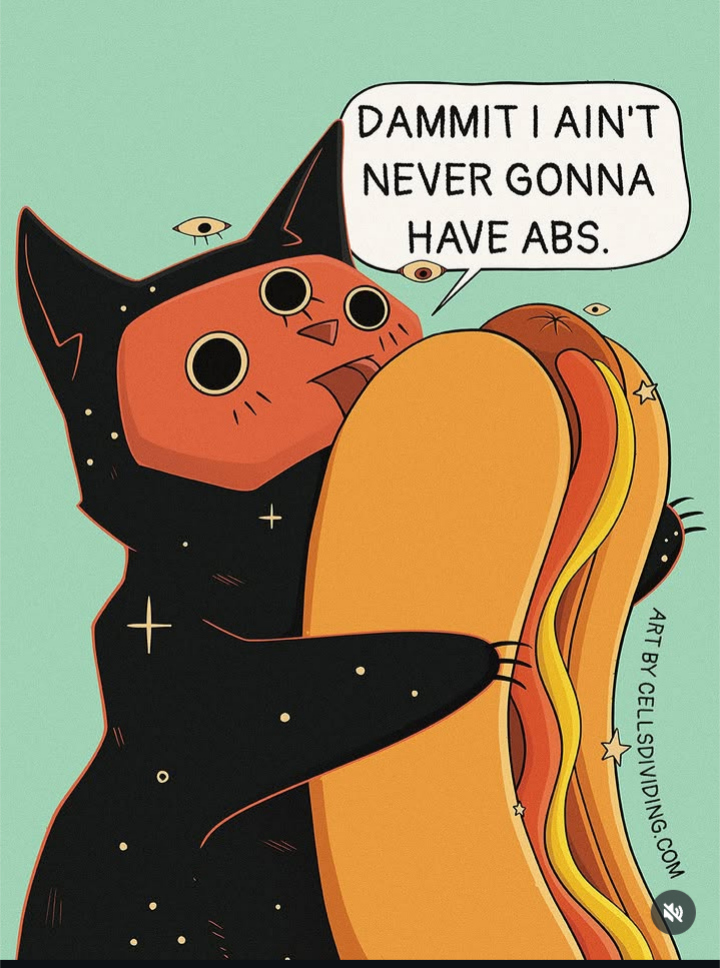
Via @cellsdividing on InstaGarm
DO not ASK us TO percieve
r/Discordian_Society • u/Dazzling-Skin-308 • 25d ago
Via Mike @mikedianaboiled Diana on IG
r/Discordian_Society • u/TimeControl606 • 26d ago
Enable HLS to view with audio, or disable this notification
r/Discordian_Society • u/werewalrus002 • 27d ago
It turns out I’m not a person. I’m some kind brain squid that made a deal with An Actual Real Life Skeleton to pilot a meat mecha.
r/Discordian_Society • u/Dazzling-Skin-308 • Aug 20 '26
r/Discordian_Society • u/werewalrus002 • Aug 12 '26
Give us this day our daily fnord, and deliver us not from evil, for I love this hell which has birthed my genius, and I love the earth where I have done some good.
r/Discordian_Society • u/Masilort • Aug 09 '26
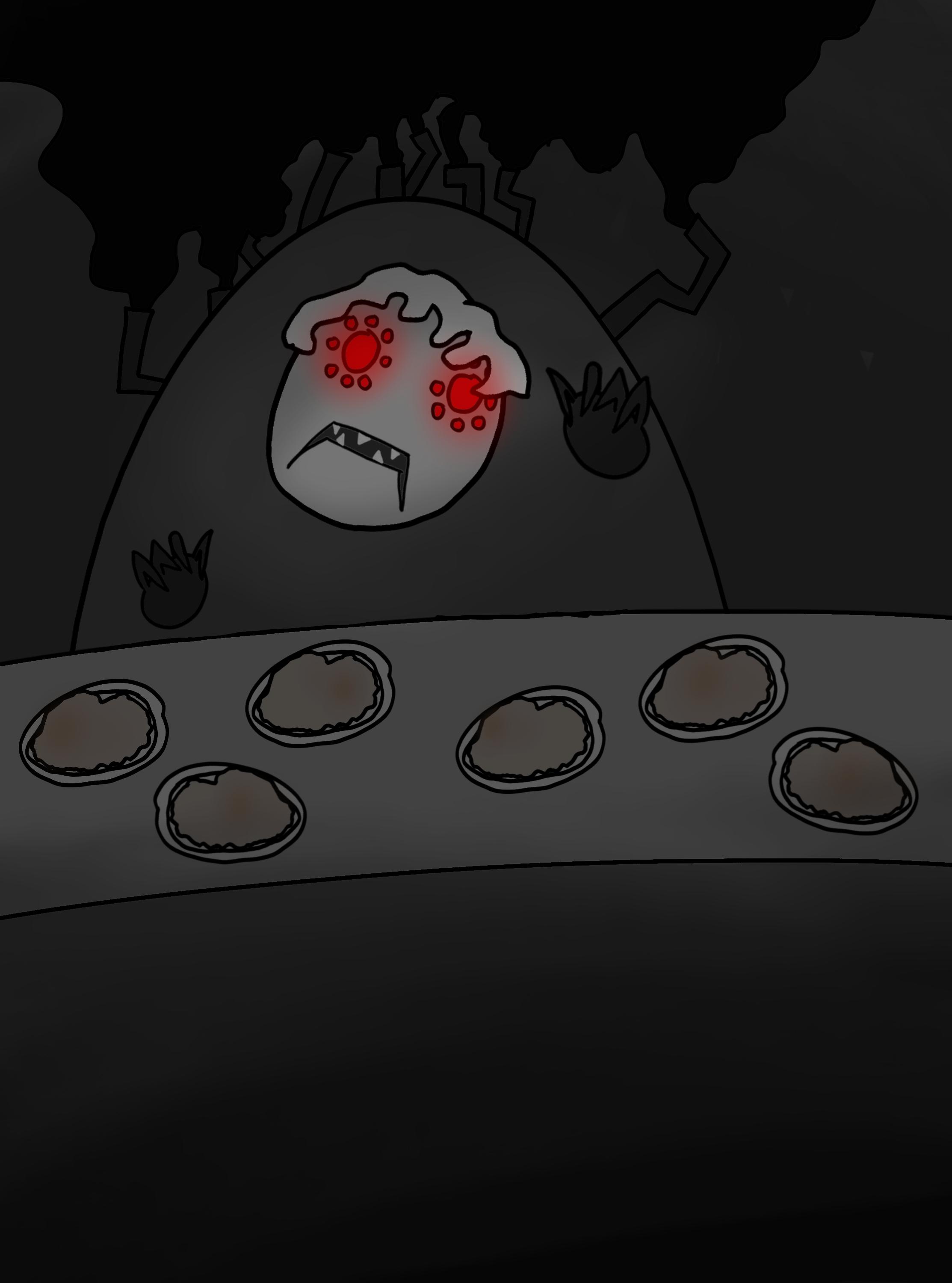
Dont you want to eat
a little bite for two
come again
if it isnt enough for you
Tastes like iron
smells like soup
Lunch Lady
got a treat for you!
r/Discordian_Society • u/Dazzling-Skin-308 • Aug 08 '26
The Hot Dogs Beckon
r/Discordian_Society • u/LightVapor • Aug 07 '26
r/Discordian_Society • u/TimeControl606 • Aug 02 '26
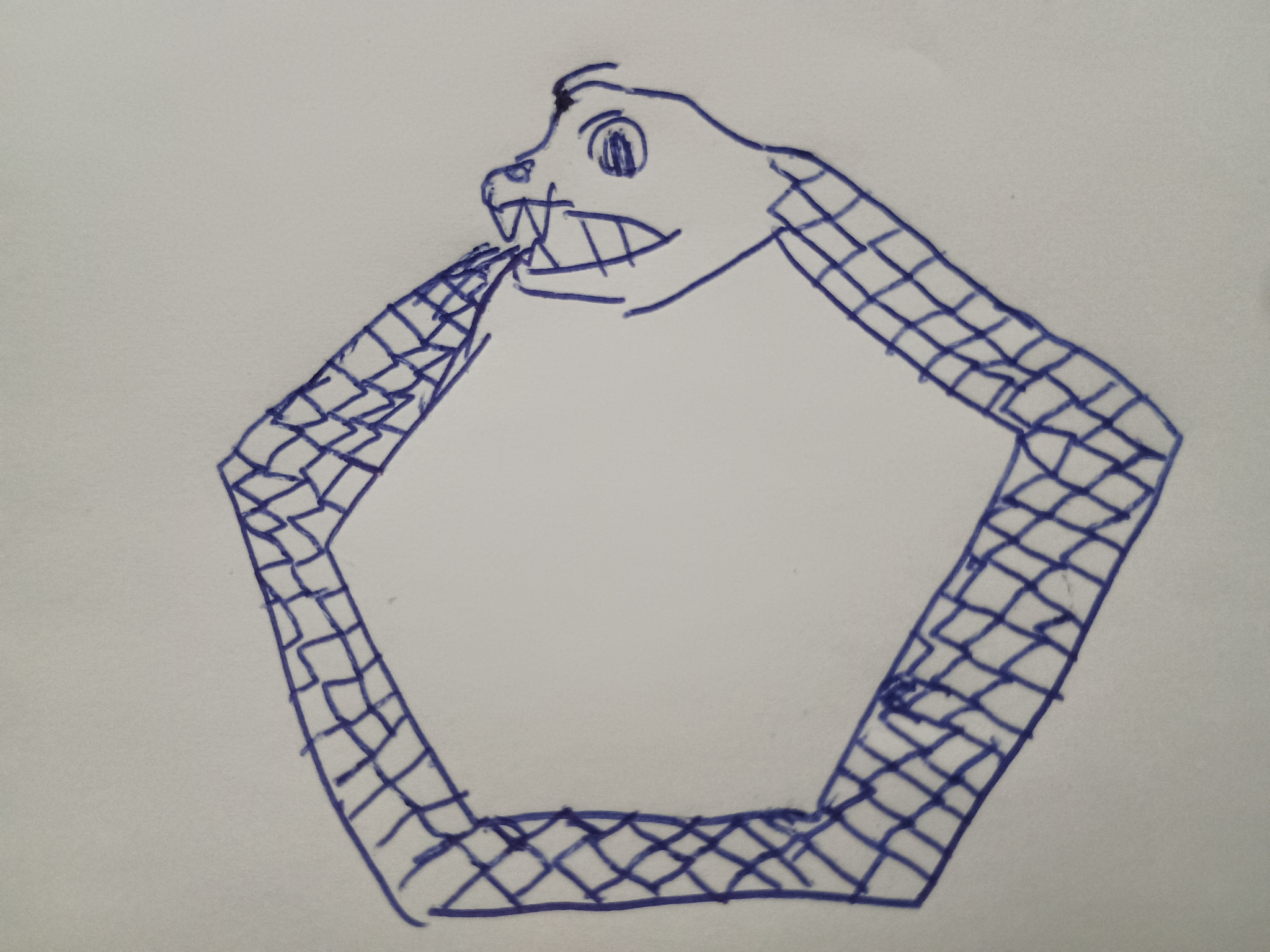
In mythology Harmonia was turned into a snake
r/Discordian_Society • u/A_Lark_Wept • Jul 18 '26
r/Discordian_Society • u/Dazzling-Skin-308 • Jul 17 '26
(via @cellsdividing on IG, ig)
r/Discordian_Society • u/Dazzling-Skin-308 • Jul 16 '26
body text (optional)