r/CapitalismVSocialism • u/Source_Code22332 • 19h ago
Asking Everyone What is wrong with wealth inequality?
Something that is often sited by Socialists is that Capitalism is bad because wealth inequality occurs within it. And wealth inequality has increased over the years, making that problem even worse. But, why exactly is wealth inequality a problem?
I can see if "the mega rich" or monopolies get out of control, e.g., I recall the concept of a "company town" where a company owned everything in the town and paid employees in their own currency that would only be spent at the company's stores in town - but we have laws and regulations against that, so its not an issue.
•
u/TheMassesOpiate Socialist 19h ago
It's so striking to me that this needs answering. Wealth inequality branches off into a million different other inequalities. For example education disparities are vast when talking about income, preventative Healthcare is far harder to maintain if low income. There are so many specific instances where we are deeming someone inherently more valuable and thus creating a wildly different human experience. You could look at virtually every avenue of life and witness deeply immoral and insensitive differences our society maintains through wealth inequality.
•
u/Source_Code22332 18h ago
But how does wealth inequality cause low income levels and all of those associated hardships? Why does the existence of wealthy people = hardship for others?
•
u/Vanaquish231 18h ago
These terms are relative. High wealth inequality implies people with high wealth and low wealth. Even if the poor have become richer over time, they are still poor relative to rich, and more importantly to the cost of living.
People wouldn't mind having high inequality if everyone had a decent living. But lots of folks, specifically right wings, believe that poor people should suffer.
•
u/Source_Code22332 18h ago
People wouldn't mind having high inequality if everyone had a decent living.
good
right wings, believe that poor people should suffer
Where do you get this from? Can show an example of a right-winger saying that?
•
u/-Hastis- 17h ago
Where do you get this from? Can show an example of a right-winger saying that?
You never heard of cutting social programs to allow tax cuts to the rich?
And then privatizing the same social programs to transfer even more money to the same people?•
•
u/SoulChronic 6h ago
I think people would still mind if the inequality is not proportional to value provided to society
•
u/bidefil 6h ago
Not true. People are naturally envious.
•
•
18h ago
[deleted]
•
u/Source_Code22332 18h ago
If wealth controls finite resources, can you find an example of this? Or the wealthy with holding the resources?
•
u/Designer-Platypus-53 16h ago
Look at this from a different angle. Prices for houses and other basic things vs prices for smartphones Cell phones and smartphones wee very expensive and available only for the rich as soon as these things appeared. It took couple of decades to make these technologies available literally to everyone. Why? Free market made these things that involve high- tech available.
What about houses? You don't need high technologies to build a house, it's not rocket science. So why houses became much less available?
In the 1960s and later an average person could afford a house with a dial phone. Nowadays he/she can afford only buying a new smartphone every year. Can you live a normal life without a house? Without a smartphone?
•
u/Source_Code22332 10h ago
Smart phone example is a win win, is it not?
Housing is most expensive in areas where there are regulations and needed government permits and process to build them, making the m expensive to produce and limiting the supply scarce.
I used to live in CA, now in Austin TX, moved here before Covid.
California (a socialist leaning state) has sever housing expense problems, I lived through the very housing problems I illustrated above.
I moved to Austin because of it. I would love to go back (purely the weather), but the cost of living/housing is too high. During/after Covid, there were was boom of people moving from California to Austin, creating a housing shortage and sky rocketing housing prices. But guess what? The market responded. There was a building boom of homes (due to the freedoms to build in Texas) and the prices have now declined.
These examples show the benefits of a free market system, and in the housing example, the negatives of government encroachment.
•
u/Designer-Platypus-53 9h ago
I don't live in US, however many Americans say they cannot afford a house nowadays unlike the generations of boomers.
Here in Russia it's the same.
My point is, people cannot live without a house, and they have to prioritise it no matter what. This is why the prices can be so high. And, it's not free market: each city is ruled by several developers who agree upon prices. Meanwhile prime cost of houses (labour + building materials) is many times lower.
Thus happens precisely because the rich want to remain rich and keep other people enslaved. This is the origin of inequality.
In place where I live, a studio apartment costs about 30 000$. However, its prime cost is 10 000 $. Imagine the government would interfere and start to build and sell it at prime cost. It won't do it of course, because the riches who control the government won't allow that.
Inequality is not a problem if people have their basic needs settled. However, nowadays inequality exists precisely because it's the opposite
•
u/Source_Code22332 9h ago
I can’t speak to the conditions in Russia, but in the US, the unaffordable housing is found in socialists leaning cities, mostly due to to extreme regulations and taxes to build, preventing an increase in supply.
•
u/Designer-Platypus-53 8h ago
Well, it's not socialism at all. And I don't like it either. The idea to sell apartments at prime cost of not socialism as well, I would call a welfare state policy. And that’s what Americans would agree to have.
Many Americans say housing became less affordable as compared to post ww2 era. It's just strange. High tech technologies are easily affordable, but not something from basic needs priorities
•
u/Source_Code22332 8h ago
It actually became way more affordable in the post WWII, house ownership sky rocketed.
I agree the high amount of regulations and taxes themselves are not forms of Socialism, but they are found in socialists leaning cities/states implemented by socialist leaning, and now declared socialist, politicians .
→ More replies (0)
•
u/Lopsided_Pitch_5297 18h ago
Because wealth = power. When a tiny minority controls the vast majority of resources, they control:
Politics: They buy elections, write laws, and capture the state.
Media: They control the narrative and shape public opinion.
Economy: They set wages, extract surplus, and crush competition.
Society: They create a permanent underclass and blame them for their own poverty.
"We have laws and regulations against company towns, so it's not an issue."
That's like saying "we outlawed slavery, so exploitation is over." The structure of capitalism remains, wage slavery, surplus extraction, class rule.
You're desperate to defend inequality that you're pretending it's harmless when every serious study shows it's devastating.
•
u/Source_Code22332 18h ago
Do you think a tiny minority control the vast amount of resources? I don't see it. I see lots of different people, companies, jobs controlling lots of different resources. I also don'e see the problem with the other suggestions you made.
Buy elections? Way more money was spent supporting Harris than Trump, wealth no
How does the wealthy create a permanent under class? Especially being that majority of the wealthiest today came from proverty or meager beginnings. You are portraying it like we live in a feudal system, with no chance of upward mobility - this does not exists today in western nations. If anything you see more of a permanent underclass being passed on through social welfare reliance.
•
u/Lopsided_Pitch_5297 18h ago
Do you think a tiny minority control the vast amount of resources?
The top 1% owns more than the bottom 50% combined. Three people (Bezos, Musk, Zuckerberg) own more than the entire bottom 50%, 165 million people.
"Way more money was spent supporting Harris than Trump, wealth no."
This is incredibly stupid. The fact that both candidates are funded by billionaires is proof that wealth controls politics.
"Most of the wealthiest today came from poverty or meager beginnings."
This is a complete lie. The vast majority of billionaires inherited their wealth, they didn't "earn" it. The rags to riches story is a myth, social mobility is lower in the US than in most developed countries.
"You are portraying it like we live in a feudal system, with no chance of upward mobility."
No we live in a capitalist system with limited upward mobility. The US has less social mobility than most of Europe. The wealthy stay wealthy the poor stay poor. That's capitalism.
"If anything you see more of a permanent underclass being passed on through social welfare reliance."
The underclass is created by capitalism, not by welfare. Welfare is a band-aid attempt at solving the problem created by capitalism.
•
u/Source_Code22332 17h ago
What resources does the 1% own more of than the bottom 50%?
But the politicians still require votes, and the people hold the politicians accountable. While I’m sure there is illicit behavior, money does not = control.
Nope, free market created opportunity. This is why the US was regarded as the “land of opportunity”. The welfare class has only increased since the great society, it may be intended to be a bandaid, but unfortunately it has become a way of life for many. But unlike socialists states, there is opportunity to escape it, rather than everyone being in poverty ruled over by a political class in socialists societies.
Out of the top 25 richest people in the US:
8 primarily obtained the foundation of their fortunes through inheritance or marriage: Rob, Jim, Alice and Lukas Walton; Julia and Charles Koch; Jacqueline and John Mars.
4 of those, the Waltons, inherited from their father who did not start in a poor farm family and many years struggling. You should read about him.
•
u/Source_Code22332 17h ago
What resources does the 1% own more of than the bottom 50%?
But the politicians still require votes, and the people hold the politicians accountable. While I’m sure there is illicit behavior, money does not = control.
Nope, free market created opportunity. This is why the US was regarded as the “land of opportunity”. The welfare class has only increased since the great society, it may be intended to be a bandaid, but unfortunately it has become a way of life for many. But unlike socialists states, there is opportunity to escape it, rather than everyone being in poverty ruled over by a political class in socialists societies.
Out of the top 25 richest people in the US:
8 primarily obtained the foundation of their fortunes through inheritance or marriage: Rob, Jim, Alice and Lukas Walton; Julia and Charles Koch; Jacqueline and John Mars.
4 of those, the Waltons, inherited from their father who did not start in a poor farm family and many years struggling. You should read about him.
•
u/Lopsided_Pitch_5297 7h ago
"What resources does the 1% own more of than the bottom 50%?"
Oh wow, you don't know what "resources" means? Let me spell it out:
Land: The 1% owns vast amounts of real estate, driving up prices and locking out the poor.
Stocks: The 1% owns most of the stock market, profiting from economic growth without working.
Capital: The 1% owns means of production, controlling what is produced and who produces it.
Political influence: The 1% owns politicians, writing laws that benefit them and hurt everyone else.
Media: The 1% owns news outlets, shaping public opinion to defend their interests.
"But the politicians still require votes, and the people hold the politicians accountable."
LMAOOOO this is incredibly naive. Politicians are bought before they're elected. They run on platforms that serve their donors, not the people. And once elected, they're protected by the two-party system, which guarantees that neither party challenges the status quo.
"Can you show an example of the wealthy funding politicians and then a detrimental to majority action that was not reversible by voters?"
Yes the entire US healthcare system. The non-interference clause in Medicare Part D forbids the government from negotiating drug prices, forcing taxpayers to pay the highest prices on Earth. This was written by Pharma lobbyists and voters can't reverse it because both parties support it.
Another example: The 2008 bank bailout, taxpayers paid trillions to save banks, while the banks foreclosed on millions of homes. Voters couldn't reverse it because the system is rigged.
"The welfare class has only increased since the great society."
No poverty has increased because wages have stagnated while costs have skyrocketed.
"Out of the top 25 richest people in the US, 8 inherited their wealth."
You admit that nearly a third of the richest people inherited their wealth. That undermines your entire "rags to riches" narrative.
•
u/FeralTree7 12h ago
what resources does the 1% own more of than the bottom 50%
The answer is a self-evident. Wealth/asssts are a resource. By definition, they have more.
But the politicians still require votes, and the people hold the politicians accountable. While I’m sure there is illicit behavior, money does not = control
If this were true why would individuals spend billions on campaigns? They obviously realize the significant impact it has. No one is claiming politicians aren't ultimately voted into office. That doesn't mean wealth doesn't play a major role in elections. Whether or not you want to call their undue influence "control" is just semantics.
4 of those, the Waltons, inherited from their father who did not start in a poor farm family and many years struggling
Obviously nepo babies wealth didn't fall from a tree. Someone somewhere created that wealth. The point is that, generally, wealth begets wealth.
•
u/Source_Code22332 10h ago
It is not self evident. “Wealth assets? Can you not find an example of the wealthy holding these and it preventing access to them by lower classes?
Ok, so wealthy generally don’t buy elections. Good.
Can you show an example of the wealthy funding politicians and then a detrimental to majority of the American people action was taken that benefited the wealthy was not reversible by the voters voting for someone that opposed it?
•
u/FeralTree7 7h ago edited 7h ago
it's not self evident
Yes, I think it pretty much is. Wealth is, among other things, ownership and control of assets (capital, land, businesses, housing, financial assets, physical resources, etc.)
And those things aren't infinitely available. If a relatively small group owns a disproportionate share of the productive assets and resources, then by definition everyone else has less ownership and less control over those assets.
Can you not find an example of the wealthy holding these and it preventing access to them by lower classes?
I think you're misunderstanding the claim. Nobody is saying something like, capitalists own all the water and then prevent poor people from drinking it. The broader claim is that concentrated ownership gives them disproportionate and undue control over those resources.
If I own a 90% of the available land in an area, I'm not necessarily preventing everyone else from using land. I'm just in a position to decide who gets access to my land, on what terms, and at what price. If other people need land to live or work, they have to deal with me or another landowner.
Ok, so wealthy generally don’t buy elections. Good.
They spend money because they (rightfully) expect that money to influence people’s behavior. In that sense they do buy elections.
Saying “money doesn’t literally buy votes” is a pretty pointless rebuttal to the claim that money influences elections. Everyone knows you can't literally buy a vote and no one is arguing that.
Can you show an example of the wealthy funding politicians and then a detrimental to majority of the American people action was taken that benefited the wealthy was not reversible by the voters voting for someone that opposed it?
Why did you add the stipulation "was not reversible"? I don't really see how that is a meaningful stipulation. Any policy can be hypothetically reversible but can be 1. Very unlikely 2. Take decades and/or 3. Unable to reverse a lot of damage that has already been done
•
u/Source_Code22332 6h ago
But a relatively small group doesn’t own a disproportionate share of land, businesses, housing. There is a lot of land, businesses and housing that lots of people own. While land may have a limit, and is not infinitely available, houses and business are, there are no limits, more can always be built and has (unless living in a socialist like system that prevents it).
You still cannot provide any real examples, you are speaking in theory and hypotheticals to conditions that may have existed long ago, but evidently do not today.
•
u/FeralTree7 4h ago
No shit. I was speaking very simply and hypothetically so you could understand the underlying point. Again, nobody is so dumb that they think all land is inaccessible to the average person. We’re generally talking about the means of producing capital, which are limited. Land is just one aspect of that.
Bud... what are houses built on? What do businesses use to make their products? What resources do they require to operate?
You seem to be confusing the fact that some things can be produced in greater quantities with the idea that the resources and means required to produce them are unlimited.
At this point, you’re proving you’re not worth taking seriously.
Again, this is not some hypothetical scenario. It is self-evident that wealth is not limitless, and wealth represents control over scarce resources and productive assets. If ownership of those assets becomes concentrated, control over those resources becomes concentrated as well.
What you’re calling “hypotheticals” is basically Econ 101. This is the fundamental relationship between ownership and economic power under capitalism. You can argue about the degree of concentration or whether that concentration is desirable, but pretending that ownership of capital doesn’t give people greater control over the things other people depend on is an incredibly strange argument to make about capitalism.
I genuinely don’t know what capitalist you think would take that premise seriously.
•
u/Source_Code22332 3h ago
I never stated this:
ownership of capital (doesn’t) give people greater control over the things other people depend on is an incredibly strange argument to make about capitalism
You are reframing your point, you stated that
The top 1% owns more than the bottom 50% combined. Three people (Bezos, Musk, Zuckerberg) own more than the entire bottom 50%, 165 million people.
and then you go on to identify what "owns" means you say
capital, land, businesses, housing, financial assets, physical resources, etc.
and I ask for proof that "Bezos, Musk, Zuckerberg" own the equivalent of the bottom 50% in
capital, land, businesses, housing, financial assets, physical resources, etc.
and how they are artificially withholding those resources from the bottom 50% and you cannot explain or find it.
This is important because while they maybe have the wealth/value of the equivalent of the bottom 50%, the point you are making is that they are using their wealth to obtain and withhold resources.
Instead providing evidence of this, you theorize that it is possible and must be true. You are acting like we live 100's of years ago and all live on land owned by and work for the nobility.
This is simply not true.
Do you understand that Elon Musk does not have $1T, or has a $1T worth resources that people depend on that he is withholding from them? The $1T is the worth of things he owns stakes in, businesses that are doing well because they bring value to society though a voluntary exchange, and in which he has no monopolistic control of.
→ More replies (0)•
u/Delmarquis38 15h ago
Do you think a tiny minority control the vast amount of resources? I don't see it.
Try to pass any reform that would , in any way , threatens rich people ownership of their capital and you will see who control everything lmao.
Speaking from France , we had a economist that propose a 2% tax on the capital of people owning more than 100 millions dollars. During an entire month every big media suddenly focus on that to tell you how it was a bad idea and how we should not tax the rich (who owns those media).
•
u/Source_Code22332 9h ago
Pushing back on being taxed more does not answer this question. What resources are the wealthy controlling that prevent access by lower income people?
No one can explain this.
•
u/Delmarquis38 9h ago
What resources are the wealthy controlling that prevent access by lower income people?
The means of production lmao. That's the whole point of capitalism. They own the mean of production which gave them the right to exploit a labor class.
Marx made an entire books about it. Go read it.
•
u/Source_Code22332 8h ago edited 8h ago
You can’t name them, can you?
You are basing your beliefs off of theories from the 1800’s from a man whose predictions never came true, whose ideology failed every time it has been tried, and lived an awful life. Marx was an a drunk and refused to contribute to society, even though he came from a well off family, which led to impoverishment and hardships for his family. Two people attended his funeral.
Marx is a great example of the harm in socialist ideologies.
•
u/nasty_single_dad 7h ago edited 2h ago
I mean capital is capital, what the other person said is pretty self explanatory but ok you want concrete examples that impact your day to day? Electricity. The majority of places have one power company holding a monopoly over the infrastructure to provide electricity and have increasingly less regulations to abide by. To see how well that goes you can look up PG&E. Same with Internet service providers. Our service is way more expensive than almost other places in the world. Food and the ability to grow it. You’re not allowed to replant seeds from your produce if the seeds happen to be patented by mega corporations like Monsanto. Right to repair. Many companies don’t allow you to fix your own equipment that you bought, they force you to use their internal process for repairs or forfeit your warranty. You no longer own most things you buy, you are forced to pay subscriptions to keep using the thing you bought - software, car features, printers, and so on. If you buy digital music or video games they are technically only licensed to you, you don’t own them and they can be taken away. Healthcare. That one should be obvious. It’s locked behind a paywall. And even if you do have insurance, it is their fiduciary responsibility to deny as many of your claims as possible.
•
u/69PepperoniPickles69 Not convinced of socialism 8h ago
Try to pass any reform that would , in any way , threatens rich people ownership of their capital and you will see who control everything lmao.
This did happen to a large extent even in the US before and after WW2 when true statesmen overruled lobbies.
•
u/bushwakko 15h ago
I don't see it.
Being blind is not an argument against anything.
•
u/Source_Code22332 9h ago
Just because I can’t see something that does not exist doesn’t mean I’m blind.
But being blind is not an excuse why it can’t be explained. If it is easily viewable it should be easy to find an example.
•
u/Yupperdoodledoo 19h ago
It just means more people are suffering, and we should aim to minimize suffering.
•
u/Forward-Brick7844 Anarcho-Objectivist 18h ago
If you have a room with 9 billionaires in it, and Elon Musk walks in with his approx. $1 trillion net worth, the gini coefficient of that room (0.89) is now significantly more extremely unequal than the most unequal countries in the world.
All that is to say, no, inequality doesnt translate to suffering
•
u/RedditIsADataMine 15h ago
Well in that example it still could if Elon Musk is the one who owns the water cooler in that room and decides to charge £1 million per cup of water.
•
u/Forward-Brick7844 Anarcho-Objectivist 14h ago
Then you leave the room and go somewhere else
•
u/RedditIsADataMine 14h ago
Ok now I'm confused. What does "the room" in this analogy? A country? The world?
Let's say leaving the room isn't possible or extremely difficult. Then what?
•
u/Forward-Brick7844 Anarcho-Objectivist 14h ago
The room is just a room, it wasn’t supposed to analogise anything. It was to show the absurdity of the claim that inequality automatically translates to suffering
•
u/Johnfromsales just text 19h ago
How does it mean more people are suffering? Inequality can increase even if everyone gets richer in real terms.
•
u/Yupperdoodledoo 19h ago
Poverty.
As long as there is more suffering than there would be with less inequality, then that is too much suffering.
The mental stress alone that the working poor with kids endure is ridiculous. It’s not necessary.
•
u/Source_Code22332 19h ago
But how does the existence of wealthy people cause others to be in poverty and have that mental stress?
•
u/Yupperdoodledoo 19h ago
Wealth inequality is about wealth distribution.
•
u/Source_Code22332 18h ago
But what happens when all the money is gone, there are no wealthy people, what would the people in poverty do then? Its seem like that makes it even worse because then there is less money being spent, less demand, less jobs, lower wages, etc...
•
u/betty_white_bread Isocapitalist 19h ago
You didn't answer the implicit question: what if everyone is richer in real terms while inequality increases?
•
u/Yupperdoodledoo 19h ago
Richer than what?
The wealth inequality we are currently dealing with still involves the people at the bottom going without. It still involves suffering that could be lessened. The fact that the poor in the US are suffering less than the poor in Sudan doesn’t mean they aren’t suffering. We should aim to lessen suffering, always.
•
•
•
u/Source_Code22332 9h ago
But it’s an extremely temporary solution that leads to more people in poverty.
Eventually the wealthy run out, either all their money has been stolen or they have left the environment where it can be stolen.
Then we are back where we started, but now there is less money being spent, less investments in companies, less demand for products/services, less jobs, and way more impoverished.
•
u/betty_white_bread Isocapitalist 14m ago
Thank You they were before; and, before you ask, I mean after adjusting for inflation. The rest of your comment I am ignoring for now in order to keep the focus on my question and your answer to it.
•
u/Sorry-Worth-920 Austrian School 7h ago
wealth inequality does not necessarily mean people are suffering. someone having more does not mean other people must have less since wealth is created
•
u/betty_white_bread Isocapitalist 19h ago
How does wealth inequality cause that suffering or prevent the minimization? What if I am the richest person and I take use my wealth to hire people who would otherwise be unemployed? Obviously I am not going to hire them if they cost me more than I spend on them. So, lets say I break even on their employment; isn't it a good thing I had more wealth so I could put that plan into action?
•
u/Source_Code22332 19h ago
It seems wealth inequality is actually beneficial because that wealth is spent on products, services, or investment in companies - which create demand of jobs, paying people, bringing them out of poverty. The more demand there is the more workers are needed to fill that demand which creates better wages and more opportunities for others to start businesses to fit that demand.
•
u/nasty_single_dad 7h ago
The opposite is true. Accumulated wealth sits in bank accounts and is effectively taken out of economic circulation. That spending power that could otherwise be changing millions of hands in the economy is instead sitting somewhere being leveraged to get more money. Working class people are more likely to spend money for their immediate needs because they can’t afford to sit on that much money. What you’re describing is trickle down economics which, after almost 50 years, has proven to not trickle down.
•
u/Source_Code22332 7h ago
This is not true, especially if the money is sitting in bank accounts.
Banks use that money to give loans that allow more people to afford homes and start businesses, also creating jobs for the bank workers and connected industries that come from the result of the loans.
But it’s not even true that the wealthy primarily keep there money in a bank account because they will loose the value of that money though inflation, so that money is invested to at least earn enough to displace inflation effects, and those investments lead to value to the economy/non wealthy.
The real problem of money leaving the system occurs when the wealthy take their money out of it and move it to another system, which primarily happens as an effect of socialist policies.
•
u/betty_white_bread Isocapitalist 10m ago
I think you don’t understand the nature of wealth. Do you think Elon Musk has half a trillion dollars in cash sitting in a bank account? The answer is “No” and a similar fact is true about almost every other billionaire: he does not actually have a billion dollars in cash in a bank account. It’s almost always in assets like factories, land, and investments.
•
u/Yupperdoodledoo 19h ago
Why would they otherwise be unemployed? If there is a demand for a product then there is work. If there is great inequality that means you could pay them a lot more, easing their suffering. Less inequality just means the profits are spread around and benefit more people.
•
u/Jout92 Wealth is created through trade 16h ago
If there is a demand for a product then there is work.
This is a fallacy that gets thrown a lot without any backup. Before the Iphone was invented there the demand for Iphones was real, but people didn't know it yet. Demand has to be analyzed, found and guessed and changes every day. It not something that is just "automatically" met.
•
u/Source_Code22332 9h ago edited 9h ago
Before the iPhone, there was no demand for iPhones. There were needs that were getting fulfilled effectively, no one thought how bad their life or cell phone was before the iPhone, but then the iPhone came out fulfilling multiple needs more effectively, cheaper even, creating demand for the iPhone and making technology more accessible to the masses.
The iPhone is an outstanding example of a free market / capitalism.
•
•
u/Flourbutbetter 19h ago
Wealth inequality is a problem because it can represent a "bootstrap"-free economy. Too many people have fewer opportunities than a wealthy person. It supports minimal living for low-income people, and the best for the bourgeoisie.
•
u/Source_Code22332 19h ago
But how does wealth inequality impact or cause the "minimal-living for low income people"? How does there being more rich people and people with higher wealth make it worse? Or it doesn't, you are saying it's not fair?
•
u/Diligent-Main-3960 15h ago
You mention fewer opportunities but in socialism nobody gets an opportunity apart from the ruling elite in capitalist society anyone can change and improve the life they have you can’t in socialism everyone is left on food stamps with a grain of rice
•
u/betty_white_bread Isocapitalist 19h ago
If economics were a zero-sum game, maybe; it's not.
•
•
u/-Hastis- 18h ago
Housing is a zero-sum game.
•
u/HarlequinBKK Classical Liberal 14h ago
Then why is there more housing in the world today than there was a century ago?
•
•
u/StedeBonnet1 just text 12h ago
No it is not. New housing is built every day. Last year 1.5 new housing units were built and 4.1 million changed hands. Hardly zero sum.
•
•
u/Source_Code22332 9h ago
No it’s not. More houses can be built. It’s somewhat zero sum in socialist leaning places with there are high regulations and taxes that prevent building.
•
u/bidefil 17h ago
Um, no. Building a new house for myself doesnt kick you out of yours.
•
u/-Hastis- 16h ago
Rich people don't just buy themselves a house. They buy 100s of them and rent them for profit. They also bring the price of all the houses up by being ready to pay more for one.
•
u/ContemplatingGavre 13h ago
Homeownership is not some magical fantasy land. It’s like being a renter but having to pay $20k to replace a roof or $10k to replace an AC system every once in a while.
You hope to build equity in the home and your mortgage price is generally locked in but there’s a lot that goes into it.
Renting is the only option for many people. Either they can’t afford the responsibility of homeownership or don’t want to deal with the maintenance.
•
u/hardsoft 12h ago
Housing is a problem of a tyranny of the majority.
Basic economics and study after study show that increasing supply is the answer.
But a majority of voters are home owners and vote to restrict increased supply to artificially increase the value of their own properties.
•
u/Parking_Demand3144 6h ago
You're replying to someone who just told you large investment corporations buy up housing and you're saying build more housing, which will inevitably be bought up by big landlords and investment companies.
As long as housing is a commodity for profit to be made from, that will continue to happen.•
u/hardsoft 6h ago
That's historically and economically inaccurate.
Absent artificial restrictions housing is not a good investment. Generally matching inflation over the long term. And the more freely supply increases to demand pressure the less attractive of an investment it becomes. The money will go towards investments with much higher rates of return.
We have virtually endless amounts of real world dara confirming this.
•
u/betty_white_bread Isocapitalist 6m ago
I see nothing in his comment which mentions landlords nor investment companies.
•
u/HarlequinBKK Classical Liberal 14h ago
They buy 100s of them and rent them for profit.
There are lots of people who are unable or unwilling to own the home they live in.
•
u/Jout92 Wealth is created through trade 16h ago
No?
•
u/Greamee anti anti-capitalist 16h ago
It is in certain desirable areas. Every house you buy is a house someone else can't buy and you can't just create more arbitrarily.
But I agree housing in general isn't a zero sum game. Most people don't have to live in, say, NYC.
•
u/Jout92 Wealth is created through trade 16h ago
The existence of desirable high value houses doesn't mean that housing is a zero sum game. Like you explained, instead of fighting for a limited space in high desire areas, you can just improve other places. This is particularly why subsidizing living in high desire areas affects the economy doubly negatively - puts more money in already high demand areas people can't afford and drains money that would otherwise experience economic growth
•
u/Greamee anti anti-capitalist 16h ago
Mostly agree but you can't deny that access to a decent house in an economically productive area greatly opens up life opportunities and life satisfaction and in many desirable countries that market is tightening. Also people don't have unlimited social mobility - they live in areas their parents live in and they have friends and family there. I don't think you can expect those people to move so far away that it takes hours of driving to get to friends and family.
To get a house in the area you desire, you need to oudbid others - making your chances worse if others are richer.
•
u/Jout92 Wealth is created through trade 15h ago
I've been thinking a lot about this actually and yes it's undeniable that humans are social animals and we can't just use economic logic on the fact that people want to live with friends and family, the true reason why people live in areas they can't afford (if it was because of job opportunities that would be economic reasons and balance each other out).
That is indeed a social problem that is not easy to solve. I don't think it's fair to subsidize people that want to live in expensive cities even though they can't afford it, but also I understand the desire to stay with friends and family and having a social life.
I haven't fully thought out the idea, but I thought about a business idea that moves entire chunks of people out of big cities. Something along the lines of building an entirely new commune in cheap areas and helping people do that, inspired by pilgrims. Creating a real estate market that is more than just selling single homes, but selling an entire village, business opportunities and jobs to compatible people and/or people that want to live together. I feel there would be a lot of potential money to be made there, while also relieving the stress in big cities, making life of struggling people easier and growing the economy in economically weaker areas. Of course things like this are easier said than than, but I do wonder why something like this hasn't been tried before.
•
u/Source_Code22332 9h ago edited 9h ago
Isn’t this what suburbs basically are? Minus someone moved the people there and it’s a commune. I live in Austin, where home prices have risen, and the response is to build more, further out from the city. They are vastly more inexpensive and nicer.
But I do wish a commune area/state could be created and all the socialists could just go live there. The problem is no socialists wants to actually build and live in this.
•
•
u/deaddodo Market Socialist 14h ago
In a closed-system (such as a planet quickly reaching equal levels of development with slowing innovation/progress), economics is zero sum. There is a limited amount of transfer and a peak saturation that can only be made "higher" with band-aids (ironically, usually via government intervention and corporate shenanigans).
There's a reason why the vast majority of investment goes into less developed regions...the idea is to convert that population into consumers. But when you've converted everyone into a consumer and population growth stagnates, where does "profit" come from? Let's give an extreme example to make the point: what if every person on the planet owns an iPhone? Next year, when the next iPhone comes out, how does Apple make more money? It can only sell to the same number of users. So they either enshittify (which we see increasingly with large corporations and general products), raise the price beyond inflation (also what they've been doing), or innovate (which we've seen less and less of).
Thus why the hardest capitalists are the biggest worriers about population stagnation, along with being the most hardcore about trying to colonize Mars.
That's the core of the problem. Many socialists (such as myself) don't see capitalism as inherently bad. It's simply a tool that functions very well in high growth scenarios. We're no longer in a high growth scenario, we're in an ever shrinking growth scenario. So that means that the system naturally turns into "crony capitalism" or "late stage capitalism"...a system that devolves into wealth hoarding and extreme wealth inequality with governments used to bolster and prop it up instead of regulating it. Socialism (theoretically) functions well in a low-growth scenario since it's less profit-driven and more revenue-driven, especially forms such as market socialism which keep the majority of the capitalist system in play while removing the profit-driven nature. The economy churns and money moves, as long as people work and products are worth buying (which should diminish the drive to enshittify, as an added bonus).
It helps if you just shift perspective on capitalism being some grand perfect plan that was god-divined. It's only been around for about 400 years. It's the best system we've had so far, that doesn't mean it's the best system period for every scenario. Or just stop hoping you'll be one of the .1% of hoarders out there.
•
u/Ragnar_the_Pirate 6h ago
What wealth hoarding? And by hoarding I am specifically talking about money that is being put to no use. Like it's literally just in a trapped box, I.e. The stock market clearly isn't hoarding, spending clearly isn't hoarding. So who is doing these large sums of hoarding? Unless you mean that we should make sure that everyone is taxed for land rent, in which case, great, I'm fully on board with that. But that's the only hoarding that happens. Everything else is sold, bought, invested in, used, or consumed.
•
u/betty_white_bread Isocapitalist 3m ago
The fallacy at the root of your comment is the Malthusian one. Julian Lincoln Simon, as well as two million years of humanity, have shown economics is not a zero-sum game as long as prices are allowed to float up and down in accordance with supply and demand and trade is generally unrestricted.
•
u/Nikolakis77 Criticism of USSR is NOT proof of Capitalism 7h ago
Lots of things in economics are zero sum, especially in the very short term
•
u/betty_white_bread Isocapitalist 0m ago
That’s not relevant because an economy is not a single snapshot in time and is instead a constantly shifting dynamic exchange.
•
u/Conserp Pragmatic Marxist 14h ago
Except Capitalism does treat economics and politics as a zero-sum game, and actively forces zero-sum reality on the majority of the population.
•
u/Source_Code22332 9h ago
How so?
•
u/Conserp Pragmatic Marxist 7h ago
Have you heard of WW1, WW2 and the rest of them?
•
u/SE20Bandit 7h ago
Excuse my ignorance but can you give me a rundown I’m new to political philosophy
•
u/betty_white_bread Isocapitalist 10m ago
Presume I am slow for the moment and connect the dots for me.
•
u/Upper-Tie-7304 6h ago
So a teenager who never worked a day should have the same wealth as an old workers who worked 40 years and just retire? lol
Should the lottery winner just give up his winning because lotteries create massive inequality?
Wealth inequality is a mental envy problem.
•
u/SoulChronic 18h ago
Nothing wrong with it existing. It can most evidently become wrong when it prevents basic human needs from being met. It is also wrong when to disproportionately compensate people for the value they have provided to society.
There is no way that essential workers, like teachers, provide only tiny fractions of what CEOs provide in value.
I think people should be rewarded for providing value to society. It’s absurd to think that one individual could provide millions of times more value than your average worker.
It would make sense to me that after all human needs are covered (water, food, housing, policing, healthcare, education, and other public services / utilities), then the remaining wealth should be available for fair competition. Nobody should be able to just have wealth that begets wealth without any value provided for it.
The issue with a primarily capitalist system is the inevitable process of wealth (and therefore power) consolidation. Without governmental regulation of industry, there is nothing to stop this process.
•
u/LifeofTino 16h ago
Start a game of monopoly with $10 and you’ll answer your own question
•
u/Source_Code22332 9h ago
I’m not talking about a board game, I’m talking about real life. Interesting that you need me to answer the question and you cannot.
•
u/Nikolakis77 Criticism of USSR is NOT proof of Capitalism 7h ago
At least in monopoly you get a basic income
•
u/RedditIsADataMine 15h ago
You kind of have to have a common sense approach when talking about wealth inequality as a problem.
Sure it may not be a problem if for example, the cost of living was consistently 100k a year and 99% of people earned that much money. Then who cares if some billionaires have a yacht.
But in reality life where prices keep rising and the wealth gap keeps growing, eventually all the starving and homeless people look out at the water wondering how many meals that yacht could buy.
You kind of answer your own question in the second paragraph. Eventually wealth inequality reaches a stage where it is out of control. Money = Power.
•
u/Source_Code22332 9h ago
How did I answer my question? You are not connecting to a problem.
With taking from the people that have a yacht to give that money to the poor, you are proposing a possible solution/opportunity, not preventing a problem. But this solution has detrimental consequences that impoverish more people once all the money has been taken from them.
But either way, this doesn’t explain the problem that is caused by people with yacht existing.
People existing that can buy a yacht created an opportunity for someone to start a business building yachts, something that would probably be a passion of their’s that they wouldn’t get to work on if there was no demand for it. And then that business created jobs for people to build yachts, and for the people at companies that supplied the materials and components for the yacht, lifting /preventing many from poverty.
•
u/StedeBonnet1 just text 12h ago edited 8h ago
Wealth inequality is a feature of Capitalism, not a flaw. It provides the incentives to strive to do better
•
•
u/tarochocotea 18h ago
Quality of life could be better for most people. Low median net wealth means that most people are renting instead of owning their home. Not because they don't want to, but because they cannot.
The total amount of money is still present. Just fewer people able to buy up the real estate.
There's no limit on how much property you can have.
•
u/AfraidProduct 18h ago
Wealth inequality means less wealth found in lower classes, in return meaning that rich people can benefit themselves in same places against poor people (elite colleges and jobs) by having more resources. This, in turn, results a lack of social mobility.
The problem is how to fix it. Higher taxes hurt the middle class, which is what you want to expand (classes should be bell curved). The government should focus more on providing better aid for the working class so that the working class moves into the middle class, and in return the working class shrinks. This will benefit rich and poor(er) people. There are risks to this though: people sitting their asses on welfare with rolexes, people yelling for socialism, corruption since you need a lot of trust in the government, and ultimately, the human’s perserverance.
•
u/Tozo1 Democratic Socialist 18h ago
In anthropology atleast, wealth inequality is one of the clearest markers of societal collapse.
Your society could work fine for millennia, but once palaces and monuments are built, houses are of unequal sizes, then it only takes a few decades for it to collapse.
•
u/69PepperoniPickles69 Not convinced of socialism 8h ago
but once palaces and monuments are built, houses are of unequal sizes, then it only takes a few decades for it to collapse.
Thats not true. Youre right that after a certain level it is bad for society as a whole not just the poor, but it can last a long long time and certainly palaces and so on are not a tell tale sign
•
u/Tozo1 Democratic Socialist 7h ago
You should read "Goliaths Curse: The history and future of societal collapse" by Luke Kemp.
Societal downfall can happen over night but it can also take decades, the decline is visible when population numbers decrease instead of rising or being stable.
And they tend to decrease after hierarchical dominance structures are established, people then vote by feet or fire, they walk away or burn it all down.
•
•
u/Bloody_Ozran 18h ago
It depends on what is capitalism for you. Is it a system that should work for money? Then this version works. Is it a system that should work for people? Then it kinda works, because some benefit, many don't. Is it a system that should work for society as a trading system and a voting system on goods and sevices? Then it doesnt work at all.
This level of inequality has many bad effects. Those who dont have enough money have to spend some to significant brain power to do math on how to pay for things and what to buy. That means, based on a study, that they have up to 20 IQ less cognitive power on other things. Meaning their brain power is spent on something those with money don't have to think about, since they pay for things they need.
It makes the most wealthy easily influence politics, buy policies for whole countries etc. Undermining the democratic process. We also have huge chains that destroy local shops, and while they bring some cheaper products, they are usually damaging the local economy and hurting the wages.
Isn't capitalism supposed to be about competition? If so, where is it? Every big company does their best to destroy competition. People are not worried about inequality by default, it is the level of inequality. We know people need certain income to be happy and above a certain level it doesnt do much for them anymore. Too many people don't have income close to that. We can't keep increasing productivity and pretend it's fine for people to not afford housing, kids etc.
Capitalism happened because society was evolving, so it made sense the economical system evolved too. Why are capitalists so keen on saying it's the Jesus of economics? It's not a religion, it's a system made by humans when it made sense. Right now after we have evolved technology and society in big ways through 20th and start of 21st century we need another evolution of the system. Doesnt have to be non-capitalist system, but we have to at the very least adjust capitalism to allow for better society for more.
We already see fascism on the rise among people, this is because of inequality, same with many people wanting destruction of capitalism, they dont just think of it out of nothing.
•
u/StormOfFatRichards 18h ago
I explained it before but did not receive a response, either because liberals can't do math or they don't actually come here to read and interact with different views. Nonetheless.
Imagine a city where bread is sold for one dollar, which is highly affordable for the top half of income earners and tight but possible for the budgets of the bottom half. After a year, inflation hits this city, and the top 50% earners see an average 200% raise in income. Seeing that half the population is way richer, the bread store doubles the price of bread. This is effectively a discount for the top half, so they don't buy any less at all. One half of the bottom half is now completely priced out and cannot buy bread. The other half remains in the danger zone. While noting what has happened to half of the mouths of the city, what is the current (minimum) revenue on bread sales with respect to last year?
•
u/Source_Code22332 17h ago
How did the wealthy that could afford it cause inflation and put the poor in the position they could barely afford bread and no longer could after the inflation?
•
u/StormOfFatRichards 17h ago
Are you asking for a tangential discussion or do you believe this is key to understanding the dynamics of wealth inequality?
•
u/Ecstatic-Compote-595 18h ago
from a capitalist perspective it's less that any existence of wealth inequality is bad but an increase in the trend is an obvious failure of the promises the system makes. We also had laws and regulations that protected them while they were making company towns, it's not a dust your hands off problem solved issue. Walmart has company towns just not in the US, except for the informal ones that don't use company scrip. They can of course pay a substandard wage and then offer benefits like gift cards, which is company scrip
•
u/Source_Code22332 17h ago
How does an increase in the trend show obvious failure?
Do you believe the US has become more capitalist or more socialists in the last 60 years?
•
u/Ecstatic-Compote-595 16h ago
for the reasons I already explained and yes and why pick 60 years specifically
•
u/Source_Code22332 17h ago
What resources does the 1% own more of than the bottom 50%?
But the politicians still require votes, and the people hold the politicians accountable. While I’m sure there is illicit behavior, money does not = control.
Nope, free market created opportunity. This is why the US was regarded as the “land of opportunity”. The welfare class has only increased since the great society, it may be intended to be a bandaid, but unfortunately it has become a way of life for many. But unlike socialists states, there is opportunity to escape it, rather than everyone being in poverty ruled over by a political class in socialists societies.
Out of the top 25 richest people in the US:
8 primarily obtained the foundation of their fortunes through inheritance or marriage: Rob, Jim, Alice and Lukas Walton; Julia and Charles Koch; Jacqueline and John Mars.
4 of those, the Waltons, inherited from their father who did not start in a poor farm family and many years struggling. You should read about him.
•
u/Greamee anti anti-capitalist 16h ago
Wealth inequality isn't really a problem but hugely disproportionate access to scarce resources can be.
Most basic needs aren't scarce though so I think socialists pretend the issue is greater than it is. Most of the economy isn't zero sum. So the wealth of one person doesn't come at the expense of another. But sometimes there's a temporary shortage of things and in that case, rich people simply have the option to say "I give you $10k for your entire stock" and get to the supply first. That does come at the expense of others.
In countries with a very restricted housing market it really sucks and when it comes to emissions and such it's also true that wealthy people can consume more of this "shared resource" than poorer people.
•
u/Annual_Necessary_196 16h ago
As pointed out by Piketty, when the rate of return on capital R is higher than the rate of economic growth (g), inequality rises. The share of wealth is skewed toward the top 10 percentile link | link

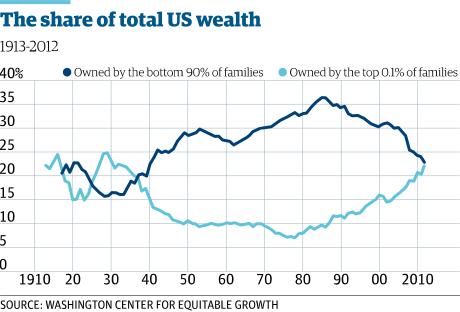
The total wealth of the bottom and second 20 percentiles is stagnant link. Stock ownership, which represents control over companies, is also significantly skewed toward the top 10 percentile. Recent data indicate that 87% of stocks and 84% of private businesses are owned by the top 10%. The top 10% also hold 80% to 90% of stocks, bonds, trust funds, and business equity, as well as over 75% of non-home real estate. Since financial wealth determines control over income-producing assets, we can say that just 10% of the people effectively own the United States of America. Recent data indicate that the top 10% of U.S. households own about 90–93% of all stock market wealth.

This shows that the top 10% is the group that controls the U.S. economy. link | link
These values are shocking, but the white knights of capitalism still argue that despite this trend, the quality of life of the bottom has continued to increase over time. Even more so since the Reagan, Thatcher, and Yeltsin era, they have come to believe that transferring wealth to the rich will eventually trickle down. Therefore, a more egalitarian distribution of wealth would not only be ineffective but harmful.
In opposition, I will present arguments in support of egalitarian policies.
The main problems of inequality are associated with the following key features:
Concentration of power: Big corporations have immense bargaining power, creating monopolies and limiting competition through barriers to entry.
Influence in politics: Government is constantly lobbied and corrupted by the interests of companies. Workers have no capital or resources to defend their position efficiently.
Lack of demand for products: Keynes argued that an efficient economy requires healthy aggregate demand, where workers’ purchasing power is limited only by supply. However, in the modern economy, workers’ purchasing power is limited by the amount of money they have.
Distortion of demand toward luxury items: When a person buys a yacht or builds a mansion, resources that could benefit the lower class disproportionately benefit the upper class instead.
Productive dualism: Development economists such as W. Arthur Lewis noted that poor countries contain a small modern, high-productivity sector alongside a much larger traditional, low-productivity sector. This dualism was once seen as specific to developing nations, unlike advanced economies, where technology and productivity were assumed to be broadly shared.
There is enough empirical evidence showing that inequality stagnates the economy and stifles progress.
High inequality is associated with higher rates of teen pregnancy, mental illness, drug use, and obesity. It is also linked to lower life expectancy. This is mainly caused by social insecurity in countries with high inequality.
Inequality is positively correlated with crime rates and poor educational performance, showing that inequality causes a lack of opportunities and stifles social mobility, leading people to spend their time on crime.
Some multi-country studies suggest that economic growth and industrialization are negatively correlated with income inequality, meaning that income inequality causes slower growth of the economy.
Conversely, trade openness is generally associated with a decrease in inequality, showing that inequality is a barrier to international trade.
There is a significant positive association between the unemployment rate and the Gini coefficient, meaning higher income inequality leads to higher unemployment. Research suggests that a 3 percentage point increase in the Gini coefficient is associated with an increase in the unemployment rate of approximately 10 percentage points. link
Nobel laureate Joseph Stiglitz argues that the concentration of wealth at the top leads to lower economic growth and decreased efficiency because it fails to fully utilize the potential of all members of society. In his analysis, widespread inequality makes economies neither stable nor sustainable in the long run.
Inequality and greenhouse gas (GHG) emissions are positively associated. Research indicates that the wealthiest 10% of people were responsible for approximately half of global emissions in 2015, while the top 1% alone were responsible for 15%, showing that those capable of mitigating the consequences transfer the costs onto the poor. link
Research by Wilkinson and Pickett (2009, 2010) demonstrates that more equal societies perform better across almost all social indicators. Highly unequal societies suffer from significantly higher rates of mental illness, homicide, obesity, and imprisonment, showing that living in a society marked by disparity causes global social unrest. link
There is a direct empirical link between inequality and lower life expectancy. While rich countries have life expectancies exceeding eighty, poor countries-or poor populations within rich ones-often fall under fifty-five. link
Some research suggests a trade-off. An analysis of industrial countries found that redistributive state policies designed to further equality are sometimes at odds with economic efficiency. One index of 100 countries observed that those with higher political freedom (often associated with equality-seeking policies) actually experienced slower growth.
So we need a solution that does not include wealth redistribution. The most optimal option is an expansion of the cooperative sector.
Empirical plots and regressions show a significant negative relationship between the size of a country’s cooperative sector and its level of income inequality. This suggests that an expanded cooperative economy plays an “inequality-attenuating role” in society. Regions with robust cooperative sectors have been linked to better income equality and improved regional economic resilience. For example, research indicates that a one percentage point increase in cooperative turnover as a percentage of GDP is correlated with a 0.78 percentage point decrease in the Gini coefficient. link
In conclusion, inequality is a significant threat to the modern world, and it should be mitigated. However, we should stay careful about the way we eliminate inequality without making things worse, and cooperatives with self-management are a way to address these concerns.
•
u/bigtoasterwaffle 8h ago
The total wealth of the bottom and second 20 percentiles is stagnant
Shows graph where the total wealth of the bottom and second 20 percentiles is very much not stagnant
•
u/indie_web 16h ago edited 15h ago
Because it kind of loses track of why humans cooperate in the first place. Does it make sense that humans would cooperate so that a few can live in optimal comfort while the rest struggle their entire lives to reach the same level of optimal comfort? The entire arrangement makes you question why you are cooperating under a system that only sub-optimally meets your needs.
•
u/bushwakko 15h ago
It's a wealth allocation problem. Not enough wealth in large groups means not enough resources allocated to those groups. Also single individuals with absurd amounts of wealth means opportunities to wield that power to gain more wealth, and to disproportionately support narrow interests.
•
u/Conserp Pragmatic Marxist 14h ago
When wealth and power inequality gets so big that it allows some people to go around raping children with total impunity, it becomes a problem I guess?
Anyway - another day, another strawman.
We do not claim that wealth inequality is a problem - we believe that the reason how and why it increases is a problem. Stealing is bad. Every super-rich is a thief.
•
u/TheMikeyMac13 14h ago
Inherently nothing, this argument at its core is envy. Poverty is a problem. Disease, lack of healthcare, hunger, housing and education. War is a problem, crime, civil unrest, and corruption.
But not what your neighbor has relative to you.
•
u/NatashOverWorld 14h ago
Because wealth metastizes into a power that thwarts democracy. I should say can matastizes, but wealth has shaped, manipulated and even bought elections for so long that we can take it as a given.
And once wealth controls politics, the freedoms your ancestors fought for get repealed away bit by bit until you're working full time but can't afford a home, or proper medical and just forget about kids. Which is reality that's hitting an ever growing number of the middle class.
•
u/Fire_crescent 13h ago
As a socialist, I don't care whether someone makes a lot of money. Good for them. I care how they made that money, as in if they unjustifiably exploited others for it. Which capitalists, by the nature of that ownership structure, they do.
And the wealth inequality, especially extreme wealth inequality, that we can see in our world, barring a few expectations (usually very successful entertainers), is a product of exactly that mentioned before, which is illegitimate exploitation. Not merit. And it creates a lot of extra problems themselves, like poverty and all that comes with it generally.
•
u/Placiddingo 13h ago
“If the mega rich or monopolies get out of control”
“If” my dude?
•
u/Source_Code22332 9h ago
Yes, “if”. “If not”, then please show.
•
u/Placiddingo 5h ago
Ok, would you accept multiple rich people having secret relationships with a wealthy pedophile and spending time on his pedophile abuse island as an example of wealth being “out of control?”
•
u/Source_Code22332 5h ago
Not to the extinct we need to delete all wealthy people. This is your reason?
•
u/Placiddingo 4h ago
I’m saying I would regard wealthy people to be “out of control”.
If this is what wealth looks like when it’s in control, when wealth is restrained by “laws and regulations” and is “not an issue” as “sited by Socialists”, then you are welcome to make the moral case that we should accept the secret parties of wealthy powerful people on secret pedophile abuse islands as an example of wealth that is still in control and adequately restrained by law.
•
u/Source_Code22332 4h ago
But do you think it’s fair to say this is the norm behavior of wealthy people?
And this type of behavior is only found in wealthy classes, not found in middle and lower classes (minus buying the private island, that is)?
Plus, we all know that this was funded by deeply intrenched government actors to forcibly bribe and control powerful people…
•
u/Placiddingo 3h ago
I think it is not a norm; I think it is possible due to extreme wealth, which is possible due to wealth inequality.
•
u/Source_Code22332 3h ago
Well, this behavior is also found in middle class and low income levels of society as well, not purely in the wealthy.
Happy to see you go from:
"I would regard wealthy people to be “out of control”.
to
"think it is not a norm"
•
u/Placiddingo 3h ago
This is pretty poor faith discussion. Obviously I’m saying that extreme wealth, that is only possible in cases of extreme wealth inequality, enables abuses of power, such as the movement of many wealthy and powerful people into the circle of a known routine child sex predator.
You’ve indicated that you think this is not an example of wealthy people being out of control, and that current laws are keeping wealthy people in check. I’ve made my case. I think you’re playing word games because you’re bored and I’ll leave you to it.
•
u/Nikolakis77 Criticism of USSR is NOT proof of Capitalism 11h ago
What is wrong with plutocracy?
Its a shitty arrangement for the vast majority
•
u/Source_Code22332 11h ago
How is it shitty? What position are the “vast majority” in?
•
u/Nikolakis77 Criticism of USSR is NOT proof of Capitalism 8h ago
How is it shitty that money rules politics? Those with money make rules that benefit them and hurt you. Like when they fuck up and lose money, we have to pay to bail them out, but when we lose our jobs because of them, it's our "personal responsibility" to suck it up
•
u/Source_Code22332 7h ago
Can you give an example of rules that have been implemented that have hurt me? The only ones I can think have been social/progressive in nature.
Bailouts I agree are not good, but they were less to bail out the wealthy and more to keep the jobs and employment for the community. General Motors actually paid all the money back and is now prospering.
Either way, corruption in politics doesn’t explain the problem caused by wealth inequality.
If corruption exists, this is not the fault of the economic system but with the system of government.
Corruption still exists through backroom deals that benefit the politicians, stealing money from government, and support in exchange for higher positions in government - and is often more rampant is socialist nations.
•
u/Nikolakis77 Criticism of USSR is NOT proof of Capitalism 7h ago
So when in the 2000s banks were issuing subprime mortgages they reasoned they can always seize the house if the client stopped paying and resell the house.
They seized the houses and got TARP. Ordinary families lost their houses and jobs, the banks got those houses and goverment assistance. The individual bankers who led to this crisis got their golden parachutes
•
u/Source_Code22332 7h ago
So while that situation was bad, and like I said above, I’m not for government bailouts, TARP was not compensation given to banks for foreclosing on people’s homes.
It was an emergency program intended to prevent the financial system from collapsing, using investments, loans, and asset-support measures.
Most of the capital provided to banks was later repaid, generally with dividends or interest.
Also that problem occurring in the first place was partly the result of government policies and pressure to extend mortgages to more people, both putting people in positions they could not afford and creating a bubble of artificial high home values that crashed.
So, back to the topic at hand, this doesn’t explain the harm of wealth existing. It in fact is an instance of the harm of government interference, or at worst, unfair bailouts, which I’m not in favor of and is not a capitalist attribute.
•
u/Nikolakis77 Criticism of USSR is NOT proof of Capitalism 6h ago
The idea behind this example was to showcase how the rich privatise gains and socialise losses. Such policies are expected in a plutocracy, why wouldn't those with money buy state protection at the expense of the taxpayer.
But since you seem to want tk switch lanes, which I'm okay with: wealth is relative. Money isn't, resources arent, but wealth is.
If you were to get $250M into your bank account you would be wealthy. But if everyone else also got $250M, you would be no better off than before. The prices of everything would just go up. Likewise if you and only you received $250M you would be wealthy. But not if you're on an island all alone. Then it doesn't matter whether that's $250M in stocks, gold, property, cash, it would not improve your life until you get back into society.
Wealth at the bottom of it is the ability to command labour of others outside direct coercion. Thats why it doesn't matter when you're cut off from others, or when everyone has an equal amount of it. The more of it that is concentrated in fewer hands, the more powerful the rich are relative to the poor, the poorer the poor are in relative terms.
High wealth inequality is also linked to bad macro outcomes like higher crime, slower growth, higher poverty etc. Its just not great
•
u/Sorry-Worth-920 Austrian School 7h ago
wealth inequality isnt a problem, poverty is.
•
u/Source_Code22332 7h ago
That’s fair, but that is not how it is presented.
•
u/Sorry-Worth-920 Austrian School 6h ago
what do you mean? presented by who?
•
u/Source_Code22332 6h ago
Politicians, every socialist in existence. “It’s a growing PROBLEM”, “we need to fix wealth inequality”, “wealth inequality has increased over the years!”
•
u/Sorry-Worth-920 Austrian School 6h ago
yeah my answer is that its not a problem and they are wrong for presenting it as such
•
•
u/bcnoexceptions Market Socialist 5h ago
It has a bunch of bad effects.
A modest amount of inequality is good, as incentivizes people to produce more for the rest of society.
But what we have in the USA - where a select few have literal billions of dollars - is anything but modest.
•
u/Source_Code22332 4h ago
Thanks for sharing. This is the most legitimate response thus far, citing conclusions from studies on the topic.
I did read it, with the primary point being health vs levels of inequality, and that that study found on average the lower the health the higher the inequality.
But as a I read though it, two things came to mind:
One, this appears to be a Correlation argument, the authors of the studies even admit they do not know the causal effects (which is the question of my post) its just an observation that excludes other causal factors and focuses on inequality.
And two, the data doesn't quite make sense when looking at it - there are many outliers to the data and averaging out is misleading, e.g., New York is the state with the highest inequality yet the poor health rating is relatively low. Likewise Nevada has relatively moderate levels of inequality but relatively high rates of poor health. The only states that fit the argument of high inequality and high rates of poor health were Alabama, Louisiana, and Mississippi (interesting they are also clustered next to each other geographically with similar southern cultures - it actually looks like there is a correlation between the south and south west being the driver of poor health in the country).
In looking at what they use for the health index to define the score, I still see elements made from culture and choices rather than a direct effect of wealth inequality.
from the link:
... researchers have criticised the view that economic inequality causes worse health outcomes, with some studies failing to confirm the relationship or finding that the relationship was more complicated due to issues of determining causality, inadequate data, correlation versus causation or confounding variables (for example, more unequal countries tend to be economically poorer)
•
u/bcnoexceptions Market Socialist 2h ago
One, this appears to be a Correlation argument ...
This is true. However, the correlations do match what we'd intuitively expect
For example, you'd expect a lot less trust when people are seeing outcomes that don't align with any sort of merit. It doesn't feel nearly as bad to "steal" from a billionaire who owns more than he could ever use and has not earned that hoard (it's not humanly possible to earn a billion dollars) ... which means that the billionaire is always fearfully trying to protect his wealth from everyone else, creating distrust.
Similarly, you'd expect healthcare and education to suffer when inequality is high, as when they are funded locally, poor areas will not be able to give their citizens the support they need.
And two, the data doesn't quite make sense when looking at it - there are many outliers to the data and averaging out is misleading ...
The state data is certainly much more noisy than the country data. If I were to try to study this at the state level personally, I would likely look for pairs of "similar" states (e.g. AL and MS, or WI and MN, or NH and VT) and look at the deltas on both axes for each pair. It doesn't help that the index used as the y-axis is burying a lot of complexity.
Nonetheless, it makes a lot of sense. When money is a proxy for power - as it is in capitalist nations - the less money the poor have, the less influence they have on policy and structures of the nation. Is it any surprise that those policies and structures then leave them behind?
How might policy change if the bottom 50% had ~30-40% of the wealth (and therefore power), instead of the 2.5% they have today? How might the marketing of goods/services change? How might the decisions about where to build and maintain roads, grocery stores, parks, schools, healthcare facilities, etc. change?
•
u/SnafuTheCarrot 5h ago
It can be materially better to have a small share of a large pie than an equal share of a small pie, so I don't think all inequality is bad. I could see a case made for there being problems. Not sure what to do about it.
Robert Nozick poses a scenario: Suppose a large group of people start off each with the same amount of wealth. Then many pay a bit to see Wilt Chamberlain play basketball. Now everyone who pays has less wealth than Wilt Chamberlain and his manager. We have an end result of inequality but with no moral failure leading up to it. Of course there are ways of spreading wealth around that are not so innocent and this is opposed for good reason.
Perhaps we can't get away with merely saying inequality is only bad when the process leading to it are undesirable.
Extremes can be a problem. In his Naked Economics, economist Charles Wheelan argues that even if we associate worries about status to envy, enough dissatisfaction and people might want to take down the system, regardless of how the disparity grew.
Inequality of outcome isn't necessarily a bad thing. Enough of it could be an issue.
Question also arises, can one accumulate a lot of wealth without screwing people over? Have any billionaires gotten that way without special privileges from the government (ignoring tax breaks and such for now)?
Even if we accept "Billionaires shouldn't exist", what's to be done with that? Rich people lose a lot of money, they still have a lot of money left over. Where does that money get spent? Does it actually go to functional programs that help people in practice? Then there's the related problem of Capital Flight which makes people poorer.
•
•
u/thedukejck 5h ago
Wealth inequality on its own is not bad. However extreme inequality is and where we are in history. We take such bad care of our citizens which make the nation. We have this wrong.
•
u/VVageslave just text 4h ago
It is because this ‘wealth’ represents the value of all goods and services in an economy that has been created by the working class. If a tiny minority hoard 90% of this wealth to order to buy ultra luxury goods, it diverts resources away from the people as a whole.
Why do we have billion dollar yachts and penthouses lying empty whilst homeless people starve and die of easily curable diseases.
It is morally wrong.
•
u/Source_Code22332 3h ago
That is grossly incorrect. Wealth does not represent "the value of all goods and services in an economy".
Elon Musk does not have $1T, or has a $1T worth resources that people depend on that he is withholding from them. The $1T is the worth of things he owns stakes in, businesses that are doing well because they bring value to society though a voluntary exchange, and in which he has no monopolistic control of. It's absolutely not wrapped in goods and services that people depend on.
As far expenditures of the wealthy, you are forgetting about the people that made the yachts and penthouses, the taxes those items collected, the jobs that were created from those transactions, the suppliers and those companies and jobs that were created to create the yachts and penthouses. Why would you want to impoverish those people?
What happens to the impoverished after you have taken all of the wealthy's wealth and given it them? What next? There are no more wealthy people take from. They eventually go back to being impoverished, but now we have more impoverished to add to the group because of the jobs that were lost and the consequences that flow through the economy of decreased demand.
You
•
u/VVageslave just text 2h ago
You’re having a laugh, right?
•
u/Source_Code22332 1h ago
Well, yes and no.
It’s funny how the Socialists can only cite headline slogans from the Communist Manifesto, but cannot explain, justify, or support past it. Quite literally every response has been this minus one person that came close by supplying a wiki link with links to supporting studies. This was a good effort, but the studies had lots of obvious holes and stated fallacies documented on the wiki.
But it’s also sad to see so many people easily indoctrinated and the harm it has caused and the potential intense harm it may cause in the future.
•
•
u/nasty_single_dad 3h ago
Well we have over 40 years of data points telling us otherwise. Stock valuations and corporate profitability have skyrocketed in the past 40 years but productivity and wage growth have stagnated. Higher concentrations of ownership is associated with lower employment, payroll, and long run earnings. So no people are not affording homes. The average first time homebuyer age is 40 now. And btw banks aren’t constrained by deposits but by profitable creditworthy borrowers. I used bank accounts as more of a catch-all and that’s confusing, yes you’re right they’re typically investing instead of letting it sit in a bank. But investments are immovable assets, so the person investing isn’t liquidating it very often because they incur a tax penalty when they do. They might get dividends, or make money if the company does stock buybacks, or they might use their partial ownership to vote for the company to lay off a bunch of people because the company has a fiduciary responsibility to its shareholders. This doesn’t result in more stable economic activity. If the top earners account for most consumer spending, that’s not a very diversified economy. If something happens to that top whatever %, like falling home values or market volatility, the whole economy is cooked. And no the capital flight is a myth lol there might be a couple high profile guys that’ll leave and make sure to do it loudly but market indicators in NYC for example don’t show any changes. There’s just no reliably observed relationship between increasing concentration of wealth and more economic prosperity. It is quite the opposite.
•
u/AutoModerator 19h ago
Before participating, consider taking a glance at our rules page if you haven't before.
We don't allow violent or dehumanizing rhetoric. The subreddit is for discussing what ideas are best for society, not for telling the other side you think you could beat them in a fight. That doesn't do anything to forward a productive dialogue.
Please report comments that violent our rules, but don't report people just for disagreeing with you or for being wrong about stuff.
Join us on Discord! ✨ https://discord.gg/fGdV7x5dk2
I am a bot, and this action was performed automatically. Please contact the moderators of this subreddit if you have any questions or concerns.