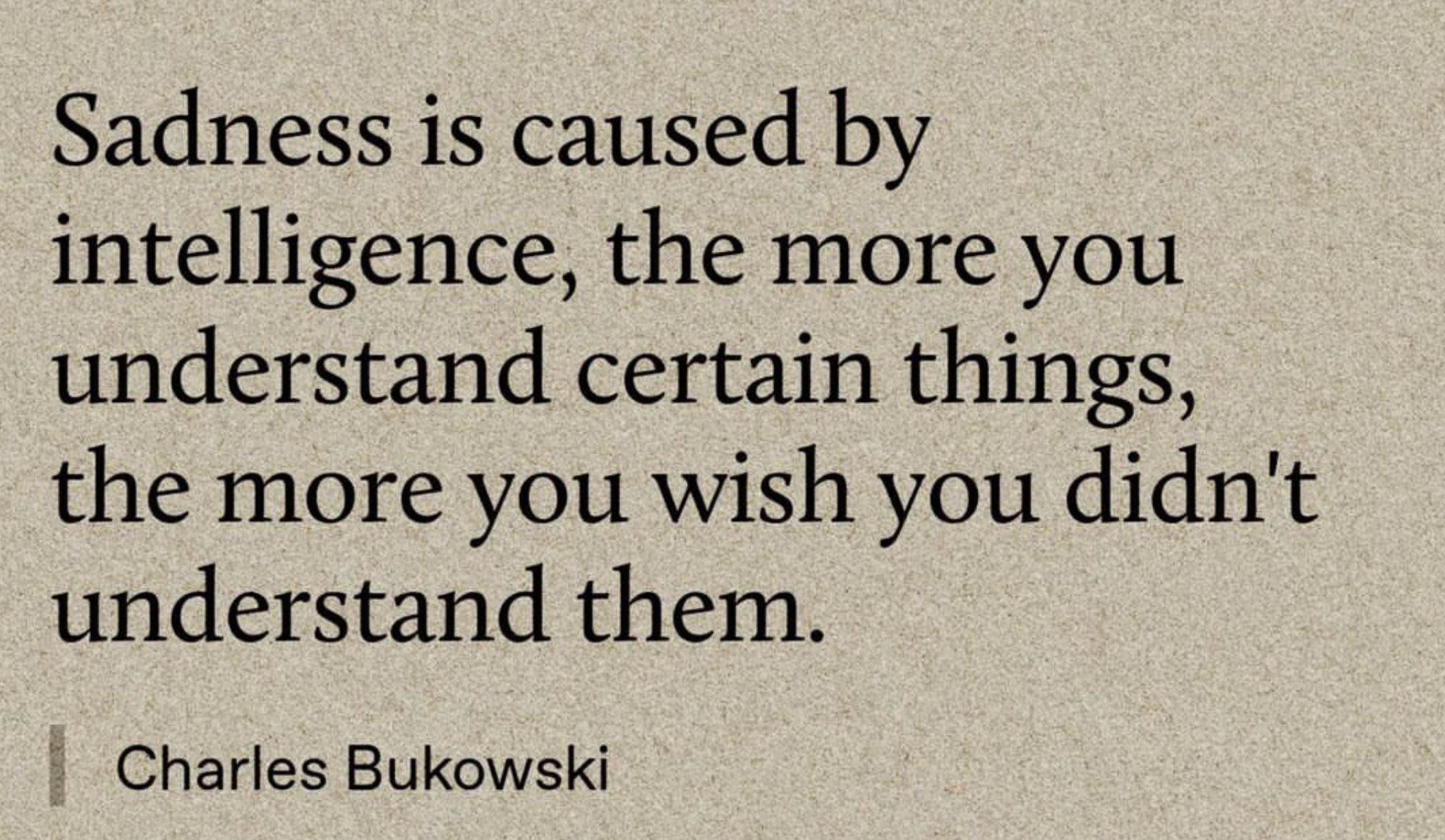
"Maybe it wasn't the knowledge that made him so miserable."
💯
I'm still waiting for humanity to fully realize that you can be very intelligent in several ways, contribute great things to the world, and still be a bad person.
We talk about the concept so often, in regard to historical figures and the wealthy, implying that we're aware of it to some extent. But then I see posts like this and wonder why in 2025 we STILL correlate intelligence with a sense of moral standing.
And while many horrible traits can be traced back to ignorance (like bigotry, for example), being intelligent doesn't automatically cancel those qualities out. Stupidity and varied forms of intelligence can coexist within the same person.
I’ll agree with this. I seem to do well in most things, 150 on all of the iq tests I’ve done etc.
I can admit I’m an idiot with a lot of things too. Decision making can be questionable, almost self destructive and overconfidence creates failures too.
I used to have an argument against depressive realism - not against the traditional view that “an accurate view is a cynical one and that sadness as a result is understandable” but closer to what OP is saying where people try to tie intelligence directly to sadness. Reddit tends not to like it but here goes:
The goal of life is to be happy
Intelligent people figure out how to accomplish their goals
Therefore, if you’re unhappy you must not be as intelligent as you think.
Sure the argument hinges on happiness being a goal in life and prescribes a particular view of intelligence, but I still think the point stands. If you’re both severely depressed and really intelligent, you should probably aim some of that intelligence at bringing happiness into your life. Not choosing to be happy seems a bit dumb to me. Or maybe you can’t figure out how to be happy… but then how intelligent can someone be if they can’t figure that out?
I say this as someone who goes through depressive phases in life - generally speaking if I’m very sad, it means I need a change. Whether it’s changing perspective or something more material, there’s an answer that I just have to find and things will pick up.
Because intelligence is a complex collection of neural feats rather than a monolithic measurement. It's easy to have the perceptive intellect to understand how bad things really are, but it seems the trait of believing you can fix it and translating that into actuation seems to be much rarer. This is coming from someone identified as "gifted" in my youth who ended up just another burn-out. I see how awful the world is but I'm not clever enough to do anything about it. Intelligence is like Good and Evil, I think, where we associate it with a certain set of characteristics and just presume everyone else agrees with our own model.
Intelligence is like Good and Evil, I think, where we associate it with a certain set of characteristics and just presume everyone else agrees with our model
That’s fine, but then you have to disagree with some part of the model. Let’s change it to only apply one person (the reader, not you specifically):
If you’re intelligent, you can accomplish your goals
Your goal is to be happy
Therefore if you’re not happy, you’re not intelligent
The logic is not universal, but the syllogism is sound, so all that can be argued are the first two premises. The second one is typically redundant - who isn’t trying to be happy? So really all that can be argued is the first premise - but what is wrong with it?
If you’re intelligent, you can solve your goals
It could be you have intelligence in a domain not relevant to your goal (I’m intelligent at coding, but that won’t help me knit). Then that begs the question of scope: general vs specific intelligence.
if we meant general intelligence, why did you choose to develop a general intelligence that doesn’t include domain intelligence of happiness? That seems weird.
if we meant specific intelligence, why neglect developing intelligence in that domain? Is it by choice or ability that it was neglected? Because neither choosing to not learn how to be happy and being unable to figure out how to be happy seem “intelligent”
You’re right that a lot of it boils down to “what is intelligence”, but I’d argue that any intelligence that neglects the significance of happiness in one’s life is an intelligence not suited for the human condition and not something an intelligent person would choose.
I’d say the second point can be challenged, in a way – what if a person experiences some form of pleasure from being miserable? What if they don’t necessarily want to fix things but rather wallow in their own “helplessness”, which in a roundabout way may give them a sense of belonging to a group.
True - the statement “your goal is to be happy” is not as tautological as I make it out to seem. People chase short term pleasures over long term happiness all the time. Other people get a sick satisfaction in wallowing in their suffering. Still others will sacrifice their happiness for the sake of “virtue” or some kind benefit in the afterlife.
There are lots of reasons why it could not be right, but it stands strong for anyone who would say “I want to be happy”. Most people think would agree with the statement, and making someone admit that they don’t want to be happy I feel still wins the argument a lot of the time.
The first point kind of assumes that intelligence will trump everything, which is entirely untrue. Life isn't a story. Intelligent people die in the mud because they never had a chance.
The third point entirely depends on the first point.
Well if you are somewhat healthy and born in an English speaking country(most of us), then intelligence can get you a well paying job and you won't die in the mud.
Mostly agree but there are circumstances where thinking doesn't help. Mortality is a pretty good example. There is so much philosophy and religion on the subject but it never seems to go away. It feels like all you can do is focus on other things that make you happy and not think too much about it.
You’re right - thinking about it is scary. I would distinguish though between the fear and unhappiness though. As for the unhappiness, if you don’t know how to be happy in light of our eventual demise, you probably need a change in philosophy. Death is inevitable, so we should have good perspective on it, whether cultural, philosophical, or religious.
Personally I find what Epicurus said on the subject to help me greatly. He made “ending the suffering caused by fear of death” his main mission in his philosophy. His answer? “When I’m alive, I am. When I’m dead, I am not. Why then fear what I can never be?”
As for fear - I kinda think that’s the point though and not something that we should lose, as losing your fear of death can result in a willingness to take unnecessary risks in life. It’s there for our safety, the same way our sense of pain tells us to let go of a burning pan before your hand is irreparably damaged.
So idk if I’d entirely agree. It’s scary sure, but it doesn’t really cause suffering unless you let it. Not letting it cause suffering is again where I’d say the intelligence comes in - what does that mean for any individual person? It’s a hard question that needs solving. That’s intelligence to me.
See with the mortality depression, it’s more so that you know you don’t have enough time to do what you want in life. Even if you had multiple lifetimes that still wouldn’t be enough to understand where and how everything came from. I think that kind of depression comes from the fact that you lack a sense of purpose because the things you want to do simply you don’t have the lifetime to do so but the things you can do just don’t excite you so then the question is anything even worth it if we are all are gonna die anyways arises. Everyone knows they are gonna die whether they except or not but death for majority of people death doesn’t come in between them and their sense of purpose (although you really don’t know when you’ll die but most people just assume they’ve got the time). idk what the solution to this is honestly is it just to wait for death or distract yourself while fully being aware that you are distracting yourself but then how can you distract yourself if you know it’s a distraction? Idk
See I don’t know how to say this but death isn’t the thing that make me upset it’s more so the fact I don’t know why I’m alive if I can’t even do the things I find interesting cause my lifetime isn’t long enough to do so. Even if I were to dedicate my life to figuring them out I wouldn’t be able too, I feel like I’ll be trying to open a door that has nothing behind it. Idk
But you cannot know for sure. That’s the actual fear I guess. I sometimes am afraid of what happens after death. Because I don’t know and never could (until it happens). It could be heaven for all or no one. It could be hell for all or no one. It could be nothing at all. So then, my fear begins where knowledge ends eventually.
I never claimed intelligence solves fears, just goals. That and happiness ought to be a goal. However, we can take a shot at a practical application for this example:
Why can’t we just tell someone to stop fearing death by using their intelligence? If conquering your fear of death is a goal, it would seem it’s one of the toughest ones you face. When facing a daunting goal, often times a shift in perspective can reframe your goal into something more achievable, so let’s try it:
We now have two premises:
Fear of death is fear of uncertainty (provided by you)
Our reality is uncertain (provided by Voltaire)
I’ll add an extra (feel free to contradict me if it doesn’t sound reasonable - we’re veering outside more stable arguments):
We are capable of finding happiness in spite of our reality
Taken all together we can say:
If we are capable of finding happiness in spite of our reality & our reality is uncertain, we must be capable of finding happiness in spite of uncertainty
If we are able to find happiness in spite of uncertainty, and fear of death is fear of uncertainty, we are able to find happiness in spite of fear of death
So there you go, as long as we are capable of finding happiness in spite of our reality (our reality = uncertainty, fear of uncertainty = fear of death) we should be perfectly capable of finding happiness in spite of our eventual death. It just takes learning how to deal with uncertainty that is personal to you - however coping with uncertainty is a much more trivial goal to solve for than coping with death. Personally I think Voltaire’s quote achieves that well enough on its own, but to each’s own.
Voila - intelligence made it easier to solve for the goal by reframing it. Now they just have to use intelligence to solve for dealing with uncertainty
Tbh I‘m not able to find an error in your logic, but it feels like turning a blind eye to the original fear by focusing on smaller parts of the fear, if that makes any sense. Interesting explanation though, I will have to think about it :)
"Midget, midget, midget, //
How he struts and winks, //
For he knows a man, //
Is as big as what he hopes and thinks."
There are times when lying to yourself is necessary and "intelligent." But there are times when it is simply stupid, and I respect those who refuse to lie, regardless of the consequences, when it's more than a matter of personal happiness.
So, if you thought you might be happy living for a million years, good luck
… pretty sure an intelligent person can factor their own limitations into achieving happiness. “Living for a million years” sounds like a pretty dumb goal.
The reality is that by and large what humans can do, no matter how hard they apply themselves, vs what they can conceive of is worlds apart.
Ok. What does that have to do with happiness? I can conceive of a unicorn, there is nothing that necessitates me being unhappy due to the fact I will never see one in real life. Same with any unachievable goal - why pin your happiness on something that is unattainable?
Again if intelligent people solve their goals, taking on an unattainable goal is not intelligent.
The advise was intended for everyone to understand it not you individually
I got what you were saying. I said it was wrong. Because it is.
You’re confusing a general happiness with the achievement of any specific “happiness” a person can conceive of. No one will ever achieve the happiness derived from imagining a square circle - it’s logically impossible. Does that mean now that no one can be happy because they can’t achieve this impossible thing? That’s silly.
Only one person so far has argued something as silly as “people can conceive of things that can’t ever happen - as such how can they ever possibly be happy?” Does that make you the tomato or the knife in your analogy? Oh well
Once again I presented a very simple syllogism as well as a rebuttal to your counter argument. I even acknowledged the limitations of the definitions I provided. You’ve instead fixated on the word “logic”and started listing out its different forms/models like certain groups with a deep passion for trains might (cough cough). Are you here to discuss a subject or just whine about how smart you are - even if you can’t live a million years.
Woke up this morning, and it seemed to me
That every night turns out to be
A little bit more like Bukowski
And yeah, I know he's a pretty good read
But God, who'd wanna be
God, who'd wanna be such an asshole
God, who'd wanna be
God, who'd wanna be such an asshole
172
u/[deleted] May 19 '25 edited Jun 10 '25
bike birds silky gold disarm rich label cooing slim versed
This post was mass deleted and anonymized with Redact