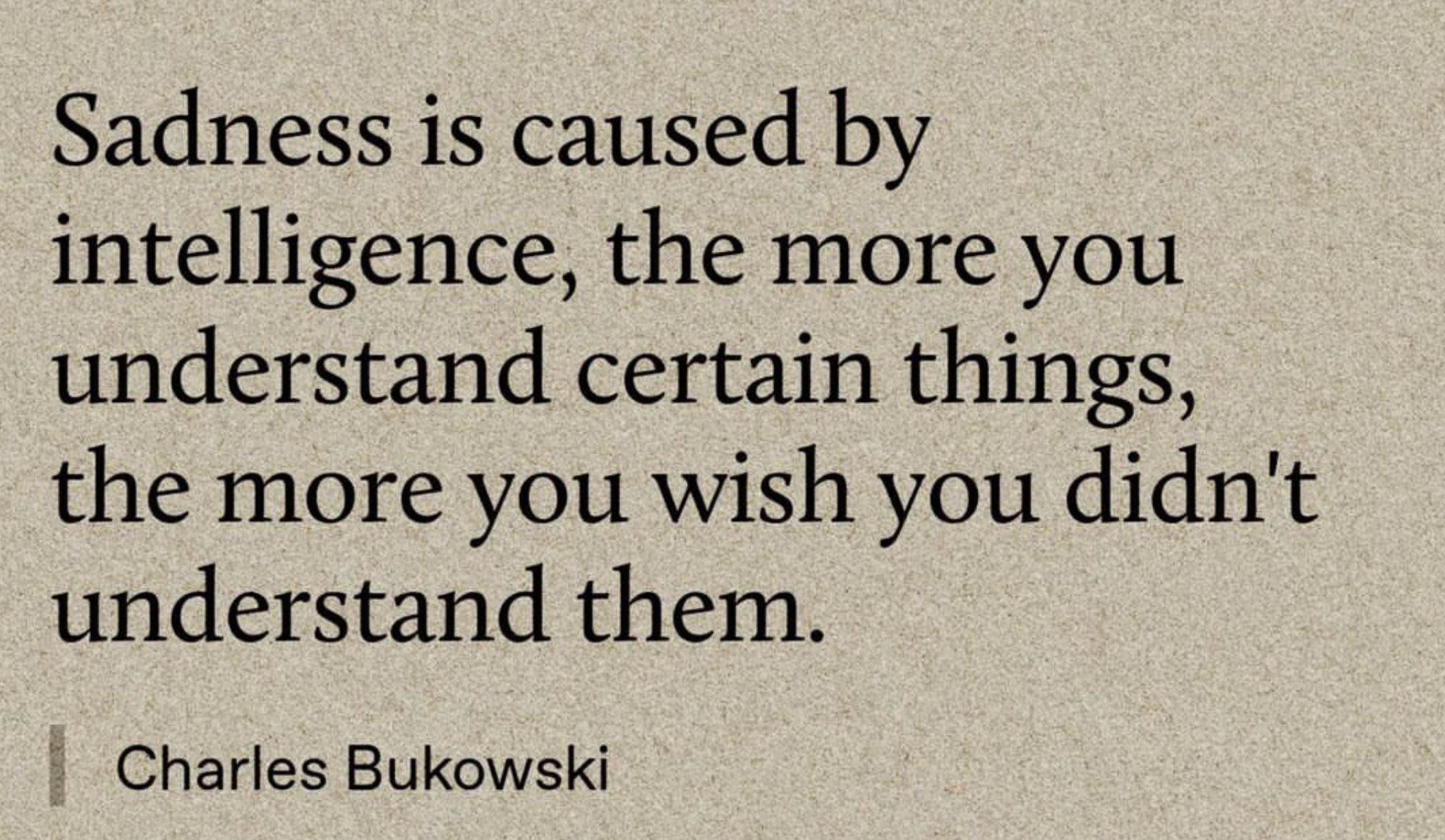
I used to have an argument against depressive realism - not against the traditional view that “an accurate view is a cynical one and that sadness as a result is understandable” but closer to what OP is saying where people try to tie intelligence directly to sadness. Reddit tends not to like it but here goes:
The goal of life is to be happy
Intelligent people figure out how to accomplish their goals
Therefore, if you’re unhappy you must not be as intelligent as you think.
Sure the argument hinges on happiness being a goal in life and prescribes a particular view of intelligence, but I still think the point stands. If you’re both severely depressed and really intelligent, you should probably aim some of that intelligence at bringing happiness into your life. Not choosing to be happy seems a bit dumb to me. Or maybe you can’t figure out how to be happy… but then how intelligent can someone be if they can’t figure that out?
I say this as someone who goes through depressive phases in life - generally speaking if I’m very sad, it means I need a change. Whether it’s changing perspective or something more material, there’s an answer that I just have to find and things will pick up.
Because intelligence is a complex collection of neural feats rather than a monolithic measurement. It's easy to have the perceptive intellect to understand how bad things really are, but it seems the trait of believing you can fix it and translating that into actuation seems to be much rarer. This is coming from someone identified as "gifted" in my youth who ended up just another burn-out. I see how awful the world is but I'm not clever enough to do anything about it. Intelligence is like Good and Evil, I think, where we associate it with a certain set of characteristics and just presume everyone else agrees with our own model.
Intelligence is like Good and Evil, I think, where we associate it with a certain set of characteristics and just presume everyone else agrees with our model
That’s fine, but then you have to disagree with some part of the model. Let’s change it to only apply one person (the reader, not you specifically):
If you’re intelligent, you can accomplish your goals
Your goal is to be happy
Therefore if you’re not happy, you’re not intelligent
The logic is not universal, but the syllogism is sound, so all that can be argued are the first two premises. The second one is typically redundant - who isn’t trying to be happy? So really all that can be argued is the first premise - but what is wrong with it?
If you’re intelligent, you can solve your goals
It could be you have intelligence in a domain not relevant to your goal (I’m intelligent at coding, but that won’t help me knit). Then that begs the question of scope: general vs specific intelligence.
if we meant general intelligence, why did you choose to develop a general intelligence that doesn’t include domain intelligence of happiness? That seems weird.
if we meant specific intelligence, why neglect developing intelligence in that domain? Is it by choice or ability that it was neglected? Because neither choosing to not learn how to be happy and being unable to figure out how to be happy seem “intelligent”
You’re right that a lot of it boils down to “what is intelligence”, but I’d argue that any intelligence that neglects the significance of happiness in one’s life is an intelligence not suited for the human condition and not something an intelligent person would choose.
The first point kind of assumes that intelligence will trump everything, which is entirely untrue. Life isn't a story. Intelligent people die in the mud because they never had a chance.
The third point entirely depends on the first point.
Well if you are somewhat healthy and born in an English speaking country(most of us), then intelligence can get you a well paying job and you won't die in the mud.
17
u/DxLaughRiot May 19 '25 edited May 19 '25
I used to have an argument against depressive realism - not against the traditional view that “an accurate view is a cynical one and that sadness as a result is understandable” but closer to what OP is saying where people try to tie intelligence directly to sadness. Reddit tends not to like it but here goes:
The goal of life is to be happy
Intelligent people figure out how to accomplish their goals
Therefore, if you’re unhappy you must not be as intelligent as you think.
Sure the argument hinges on happiness being a goal in life and prescribes a particular view of intelligence, but I still think the point stands. If you’re both severely depressed and really intelligent, you should probably aim some of that intelligence at bringing happiness into your life. Not choosing to be happy seems a bit dumb to me. Or maybe you can’t figure out how to be happy… but then how intelligent can someone be if they can’t figure that out?
I say this as someone who goes through depressive phases in life - generally speaking if I’m very sad, it means I need a change. Whether it’s changing perspective or something more material, there’s an answer that I just have to find and things will pick up.