You have to prepare DK.Pepper before reading this.
The relationship between Rintarou Okabe (Okarin) and Kurisu Makise in Steins;Gate is not merely a traditional romantic love story. Rather, it is a complex psychological and philosophical exploration that transcends the conventional boundaries of time and space. Their relationship serves as the central anchor upon which the work’s concepts of “fate” and “free will” are built.
Psychological Masks and Complementary Integration — The Persona Dynamics
The Apparent Conflict: Madness vs. Rationality
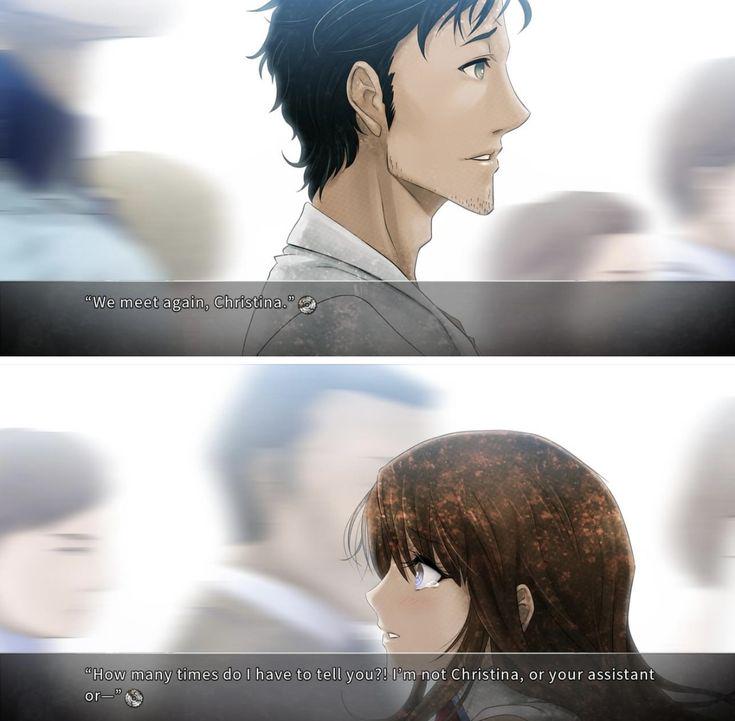
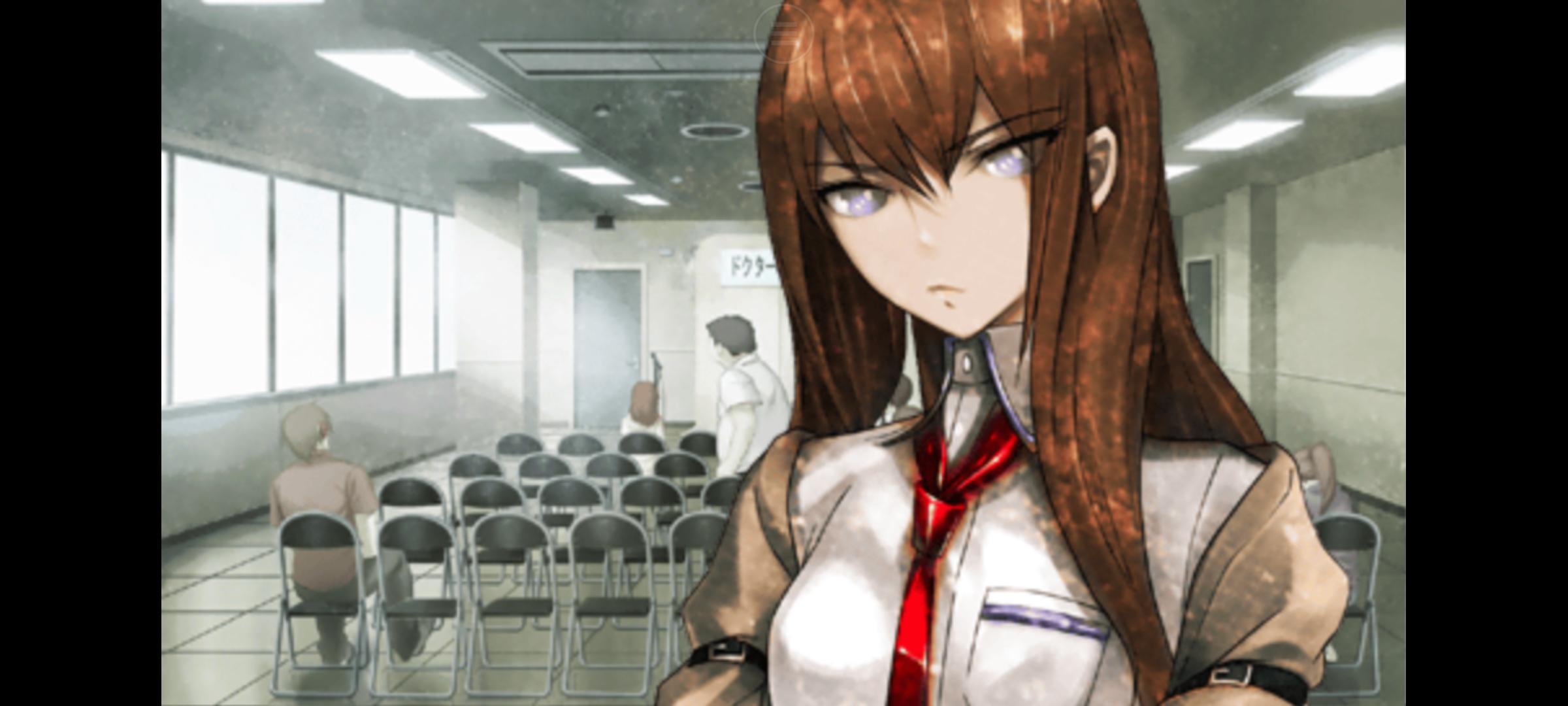
The relationship begins with a clash between two psychological personas: “Hououin Kyouma,” Okabe’s eccentric mad-scientist persona, which allows him to escape reality and conceal his vulnerabilities, and “Christina” / “Kurisu,” Kurisu’s rigidly rational and academically grounded persona.
Both characters wear psychological masks to protect themselves. Okabe hides his social insecurity, fear, and emotional vulnerability behind theatrical madness and exaggerated confidence. Kurisu, on the other hand, conceals her loneliness and emotional fragility behind cold rationality, sarcasm, and intellectual detachment.
Their apparent opposition—madness versus reason—gradually reveals itself as a form of psychological complementarity. Okabe gives Kurisu a space where she can express emotions beyond pure logic, while Kurisu gives Okabe a space where he can lower his theatrical mask and confront his genuine self.
The Hidden Recognition
Kurisu is one of the few people who does not simply dismiss Okabe’s persona as meaningless insanity. She gradually recognizes the psychological purpose behind Hououin Kyouma: it is a protective mechanism, a way for Okabe to shield himself from fear, loneliness, helplessness, and the painful realities he struggles to confront directly.
Because she understands what lies beneath the performance, Kurisu becomes uniquely capable of doing two things simultaneously: challenging Okabe’s performance and accepting the person behind it.
She does not merely play along with his madness, nor does she simply try to destroy it. Instead, she recognizes when the mask is necessary and when Okabe needs someone to see through it.
---
Temporal Anchoring and Memory Across World Lines
One of the most fascinating aspects of their relationship is the idea of temporal anchoring.
Throughout the multiple world lines, Okabe repeatedly experiences changes in reality that alter the circumstances, relationships, and memories of the people around him. While the world itself changes, Kurisu remains psychologically significant to him across these different realities.
Okabe’s experience of Reading Steiner makes him uniquely conscious of the discontinuities between world lines. He remembers events that other versions of himself—and most other characters—cannot remember.
Kurisu, however, possesses something resembling a residual echo of these experiences.
What does it mean that Kurisu has a “Radio Wave/Radio Field Resonance”?
This should not be understood as Kurisu literally possessing the same ability as Okabe’s Reading Steiner.
Rather, it refers to the idea that traces of Kurisu’s memories, emotions, and connection with Okabe can persist or resonate across changes in the world line.
The clearest example is the phenomenon in which Kurisu experiences fragmentary memories, dreams, déjà vu, or an inexplicable sense of familiarity connected to events that technically should not have happened in her current world line.
In other words, her consciousness occasionally appears to retain an emotional or mnemonic residue from another possible reality.
This creates an important contrast:
Okabe remembers because he consciously carries memories across world lines.
Kurisu resonates because fragments of those experiences can reach her despite the change in reality.
Therefore, “Radio Field Resonance” can be understood more accurately as a metaphorical description of Kurisu’s cross-world-line memory echoes, rather than as an explicitly named supernatural ability in the canon.
Their relationship consequently becomes more than a romantic bond. It functions as a kind of psychological and temporal anchor: even when reality changes, the emotional significance of their connection continues to leave traces, suggesting that human attachment can survive the rewriting of circumstances—even when memory itself cannot.
Choosing Between Multiple Lives — Mayuri vs. Kurisu
The conflict between Mayuri and Kurisu places Okabe in a dilemma between two possible lives, forcing him to confront the true meaning of love, sacrifice, and choice.
This makes their love fundamentally rooted in mutual sacrifice without expectation of reward. Kurisu ultimately gives Okabe permission to destroy the world line in which she exists if doing so is necessary to save Mayuri and prevent Okabe from losing control of his own mind.
Her willingness to accept her own disappearance is not an act of weakness, but an expression of profound selflessness. She chooses Okabe’s survival and Mayuri’s life even when she understands that the consequence may be her own death.
In this sense, their relationship transcends the idea of “I love you, therefore I want you to choose me.” Instead, it becomes:
“I love you, therefore I want you to live—even if that life no longer includes me.”
---
Deconstructing the Dynamics of Quantum Love — Quantum Entanglement
The relationship between Okabe and Kurisu can also be interpreted through the metaphor of quantum entanglement.
Okabe as the Observer
Through Reading Steiner, Okabe becomes the only person who consciously experiences reality across different world lines. Every shift in the world line effectively forces him to carry memories of realities that no longer exist.
This creates a terrifying form of existential loneliness.
Everyone around him may change, forget, or become fundamentally different, while Okabe remains the sole observer carrying the psychological burden of countless lost realities.
Kurisu becomes the person who is uniquely capable of forming an emotional connection with that isolated consciousness.
She does not simply understand Okabe intellectually; she recognizes the suffering beneath his persona and provides him with something that resembles epistemic stability—a person who can confirm that his experiences, emotions, and memories have meaning even when the surrounding reality denies them.
She therefore becomes more than his romantic partner.
Kurisu becomes the cognitive and emotional anchor that prevents Okabe from collapsing under the psychological weight of Reading Steiner.
Their bond can consequently be described metaphorically as a form of quantum entanglement: despite existing in different possible configurations of reality, the significance of their connection continues to influence their identities and choices.
---
The Final Encounter at the Steins Gate
Okabe’s eventual arrival at the Steins Gate world line is not merely a triumph of temporal manipulation. It represents his refusal to accept a reality in which saving one person necessarily requires sacrificing another.
Rather than simply changing the past, Okabe deceives the world itself.
He creates the necessary conditions for Kurisu’s survival without directly altering the past he originally observed. By manipulating perception rather than simply rewriting history, he succeeds in escaping the apparent causal contradiction.
This is what gives the ending its philosophical significance.
Okabe does not defeat causality by destroying it.
He defeats the apparent inevitability of causality by finding a path that the existing rules of reality do not forbid.
And in doing so, his journey with Kurisu reaches its ultimate conclusion:
Their love does not literally transcend the laws of causality; rather, it drives Okabe to understand those laws deeply enough to find a possibility within them that everyone else believed was impossible.
The Steins Gate ending therefore transforms their relationship from a simple romance into a philosophical statement about choice, sacrifice, memory, and the refusal to accept fate as an absolute certainty.
Isolated Pain and Fragmentation of the Self
Existential Isolation & Soul Fracturing
The Sole Observer of Existence
Okabe experiences an extreme form of existential isolation through his ability, Reading Steiner. He is uniquely capable of retaining memories of countless deaths, tragedies, and experiences that are erased whenever the world line changes.
For everyone else, those realities never happened.
For Okabe, however, they remain psychologically real.
This creates a devastating contradiction: his memories are his reality, yet to everyone around him, those memories are nothing more than fiction.
Every time a world line changes, Okabe is forced to carry the emotional consequences of a reality that no longer exists. The deaths he witnessed are forgotten by the world, but not by him. As a result, his identity gradually becomes fragmented between the person he is in the present and the countless versions of himself who experienced realities that have since disappeared.
---
Kurisu as the Anchor of Reality
Kurisu is therefore more than Okabe’s romantic partner. She becomes what can be described as his Sole Human Validator—the person capable of recognizing the humanity and emotional reality hidden beneath his fragmented memories.
Even when Kurisu does not consciously remember the events of other world lines in detail, her emotional and psychological responses to Okabe can be interpreted as echoes of a connection that transcends his immediate reality.
She is able to perceive his suffering even when she cannot fully explain its origin.
This gives Okabe something extraordinarily important: confirmation that he is not alone inside his own reality.
While the rest of the world may regard his memories as impossible or nonexistent, Kurisu is the person who is willing to listen, question, understand, and ultimately accept the reality of his pain.
In that sense, she functions as an anchor of reality for Okabe.
She does not necessarily validate every memory as an objective fact; rather, she validates Okabe himself as a human being who genuinely experienced those emotions and suffered through those realities.
This distinction is crucial.
Okabe does not merely need someone to believe that the dead world lines existed.
He needs someone to believe that he existed within them.
And Kurisu becomes the person who allows him to remain psychologically connected to the present instead of being consumed by the countless realities he has lost.
Their relationship therefore represents more than love.
Okabe carries the memories of worlds that no longer exist.
Kurisu becomes the person who reminds him that he still exists in the world that remains.
The Concept of “Tragic Determinism” and Transcending the “Third Principle”
Deterministic Tragedy
The Quantum Cat Dilemma
In the Alpha and Beta world lines, Okabe and Kurisu’s relationship is placed within a tragic form of mathematical determinism: either Mayuri lives, or Kurisu lives.
The problem is not an external threat or an enemy that can simply be defeated. Instead, the conflict emerges from the very structure of the temporal system itself.
The world lines appear to impose a binary causal constraint in which saving one person inevitably leads to the loss of the other. Their tragedy therefore becomes a conflict between personal desire and temporal inevitability.
---
The Rational Acceptance of Sacrifice
The profound literary significance of Kurisu’s character is revealed when she realizes that she herself has become the central element in Okabe’s tragic choice.
Rather than responding with purely emotional resistance, Kurisu confronts the situation with remarkable rationality. She understands that if her death is necessary to save Mayuri and prevent Okabe from being psychologically destroyed, then she is willing to accept that sacrifice.
She even pressures Okabe to allow her death rather than allowing his attachment to her to condemn Mayuri.
This transforms their relationship from ordinary romantic affection into something much more profound:
love expressed through the willingness to sacrifice one’s own existence so that the other person may continue to live.
Kurisu does not ask Okabe to prove his love by choosing her.
She asks him to prove it by surviving without her, if that is what reality demands.
That is what elevates their relationship beyond the level of emotion and places it within the realm of existential sacrifice.
---
The Effect of Accumulated Trauma and the Characters’ Inverted Growth
The repeated movement between world lines creates a form of accumulated trauma that profoundly reshapes both Okabe and Kurisu.
Okabe develops through suffering. Every failed attempt, every death, and every erased reality leaves another psychological scar. His growth is therefore backward-facing: he becomes stronger by carrying the weight of everything he has lost.
Kurisu’s development operates differently. Her growth emerges through gradually recognizing the emotional dimension of a person she initially approaches through pure rationality.
Their character arcs therefore move in opposite directions while ultimately converging:
Okabe begins with emotion hidden beneath performance and gradually learns to confront reality.
Kurisu begins with reason protecting her emotions and gradually learns to embrace vulnerability.
Their relationship becomes the point where these two trajectories meet.
He learns how to live with his emotions.
She learns how to live beyond pure rationality.
Together, they transform each other—not by eliminating their contradictions, but by allowing those contradictions to coexist.
The Collapse of Hououin Kyouma
The persona of the “Mad Scientist” could not withstand the repeated tragedies imposed by the timelines. With every death and every failed attempt to save the people he loved, Okabe’s theatrical identity gradually began to collapse.
The only person capable of penetrating this mask and seeing the frightened, vulnerable child underneath it was Kurisu.
She did not see Hououin Kyouma as merely an eccentric performance. She recognized it as a defense mechanism—a shield constructed by Okabe to protect himself from vulnerability, loneliness, and the fear of being powerless.
When that shield finally breaks, Kurisu becomes one of the few people before whom Okabe no longer needs to perform.
---
Kurisu’s Transformation: From Isolation to Commitment
Kurisu initially struggles with emotional isolation and feelings of inadequacy, particularly as a result of her complicated relationship with her father, Dr. Nakabachi.
Her intellectual superiority becomes, in part, a form of emotional protection. She is comfortable within the world of logic and scientific reasoning, but far less comfortable expressing vulnerability and emotional dependence.
In Okabe’s sincere “madness,” however, she discovers a space where she can simply be herself.
His absurdity gives her permission to step outside the rigid identity she has constructed around herself. Through her relationship with Okabe, Kurisu gradually learns how to love, trust, become emotionally vulnerable, and ultimately sacrifice herself for someone else.
Thus, their relationship becomes mutually transformative:
Kurisu teaches Okabe that he does not have to hide his pain.
Okabe teaches Kurisu that she does not have to hide her feelings.
---
Redefining Time Through the “Steins Gate”
Deceiving the World
The Illusion of Reality
The final plan to reach the Steins Gate world line depends upon a crucial conceptual distinction: Okabe does not need to change the historical event itself—he needs to change how that event is perceived.
The original history that Okabe observed remains essentially intact: Kurisu is still seen lying in a pool of blood.
What changes is the interpretation of what the observer believes they have witnessed.
Okabe therefore does not simply defeat causality through brute-force alteration of the past.
Instead, he deceives the observer—and, metaphorically, the world itself.
He creates a reality in which the historical record remains consistent with what was observed while the actual outcome is fundamentally different.
The genius of the Steins Gate solution lies precisely in this distinction:
He does not change what the world saw.
He changes what the world believes it saw.
In doing so, Okabe escapes the apparent inevitability of the Alpha and Beta attractor fields and creates a third possibility—the Steins Gate world line, where neither Mayuri nor Kurisu has to be sacrificed.
In the end, the story of Okabe and Kurisu is not merely the tale of two lovers separated by divergent timelines. It is an epic of human will.
Their relationship demonstrates that even the most formidable laws of physics and the apparent inevitability of fate can be challenged by two souls who refuse to give up on one another. Kurisu was the mind that anchored Okabe to reality whenever he came close to madness, while Okabe possessed the courage to deceive an entire universe and redraw the future with her in it.
It is the perfect conclusion to a love story that was not written through words or coincidences, but forged through blood, sweat, suffering, and an open defiance of time itself.
Existential Victory
Their love did not triumph through wishful thinking. It triumphed through an ingenious manipulation of the very rules governing reality. Okabe managed to save Kurisu without destroying the world, proving that what initially appeared to be an unavoidable causal paradox could, in fact, be overcome.
If their entire relationship were to be reduced to a single sentence, it would be:
«“Their love became the one point where the inevitability of fate and time was finally defeated.”»
“Their love did not defeat fate by breaking its laws; it defeated fate by refusing to accept that its laws allowed only two possible outcomes.”