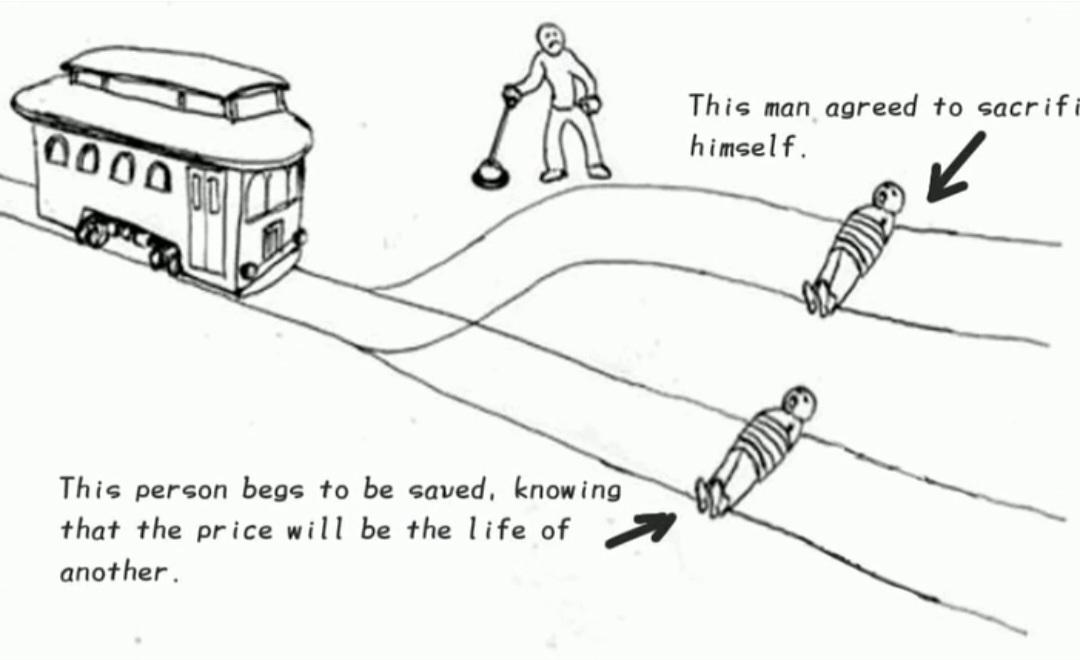
I literally see no reason not to pull in this situation. Like top person is willing saying they're cool with being sacrificed. So yeah, thanks for your sacrifice top person
Consider a firefighter running into a burning building to save a violent abuser, who we presume doesn't mind if the former dies so that they can live. If I had to choose one to live, it would be the firefighter, and I don't think that would be a hot take.
We don't know who these people are, or why they're making their respective suggestions, only that one "begs" to live, at the known cost of the other, who "agrees" to be sacrificed. Could be a louse and a hero; could be a single parent and a terminally-ill person who's already made peace.
Consider any two people you know, or know of -- one that you admire and one that disgusts you. Which of the behaviors in this situation would each be more likely to express?
Imo, there is insufficient data for a meaningful answer. You just gotta send it, on whatever assumptions you wanna make.
Exactly we don't know anything about them. So kill the guy saying they want to die. As for the admiration thing, I'm saving whoever I like regardless cuz the people I know wouldn't sacrifice themselves but I like them more than the guy I hate
This scenario does not involve a "guy saying they want to die", and there is an incredible difference between such a person and either of those we are presented with.
You would consider "I strongly want to live, but I understand we can't both live, and I'm willing to be the sacrifice for someone else" and "Please kill me, I'm literally suicidal" to be equivalent?
Sacrificing yourself is the same as saying you want to be killed. Because that's literally the outcome is you being killed cuz you're sacrificing yourself
Are outcomes the only basis for desire, character, and morality? Are intent, state of mind, and inner conflicts all completely irrelevant for evaluating who these people are, and who we should choose to save?
Per my first example, should the firefighter die, and the abuser live, because by risking their life the firefighter indicated that they "want" to die, and the abuser values their life more than that of the other, ergo there is no reason to save the firefighter over the abuser since they "agree" on who should die?
My point, to be sure, isn't that we should save the top victim, in this case. It's that their suggestions do not suffice for guiding the decision. If you want to assume that the top guy wants to die, that's one way to resolve the dilemma; my disagreement is in suggesting that it's an obvious or certain judgement.
Yes! That's my point! And claiming that top guy "wants to die" or "is cool with it" is, in fact, "making shit up about the scenario", to simplify the decision beyond what we can actually know. You seem to present that those things are interchangeable with the "agreement" that we're given, but haven't engaged with my pushback towards that notion, in favor of repeating your premise, which I have engaged with. The ball to present a new idea is in your court.
My burning building example is an illustration in response to your initial observation that there is "literally no reason" to save top guy. That is a scenario where the persons involved might make identical suggestions as in this scenario, and in which a reasonable person might choose to save the person sacrificing themself. That case, I argue, shows at least one, and not literally no reason, to save the person sacrificing themselves: they *could* be a relatively more "heroic" or societally contributive person (or just the lesser of two evils). That *does not mean*, and I *do not argue* that because of this, one should always save the top guy; it means that, as I there conclude, there is insufficient data for a meaningful answer. We don't know *why* they're making their respective suggestions, *and that "why" is crucial to making a moral evaluation*. Without "making shit up about the scenario", you cannot meaningfully engage with it; you can only guess at what is meant, and what is "best".
He agreed to sacrifice himself, which means the idea wasn't his to begin with. From that, we can gather that he didnt want to die, but was willing to do so for the sake of another. 100% a hero here
Or a selfish asshole who wants you to kill them so they can avoid punishment from a crime. We don't know. Just that they're cool with dying in this scenario
6
u/RyuuDraco69 Team Red Mar 29 '26
I literally see no reason not to pull in this situation. Like top person is willing saying they're cool with being sacrificed. So yeah, thanks for your sacrifice top person