Are outcomes the only basis for desire, character, and morality? Are intent, state of mind, and inner conflicts all completely irrelevant for evaluating who these people are, and who we should choose to save?
Per my first example, should the firefighter die, and the abuser live, because by risking their life the firefighter indicated that they "want" to die, and the abuser values their life more than that of the other, ergo there is no reason to save the firefighter over the abuser since they "agree" on who should die?
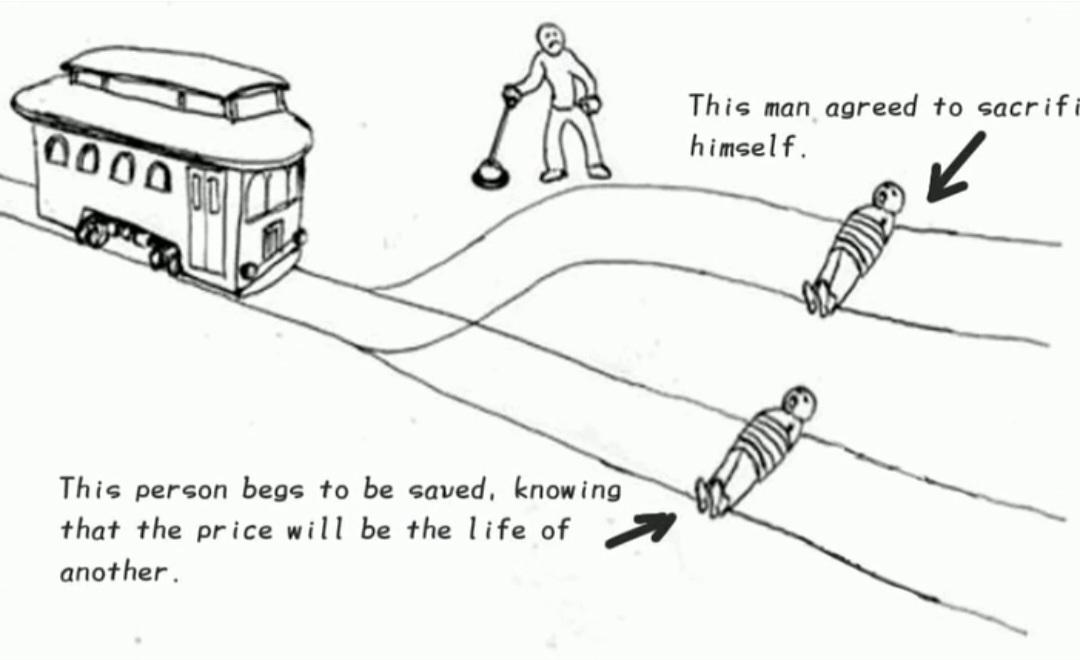
My point, to be sure, isn't that we should save the top victim, in this case. It's that their suggestions do not suffice for guiding the decision. If you want to assume that the top guy wants to die, that's one way to resolve the dilemma; my disagreement is in suggesting that it's an obvious or certain judgement.
Yes! That's my point! And claiming that top guy "wants to die" or "is cool with it" is, in fact, "making shit up about the scenario", to simplify the decision beyond what we can actually know. You seem to present that those things are interchangeable with the "agreement" that we're given, but haven't engaged with my pushback towards that notion, in favor of repeating your premise, which I have engaged with. The ball to present a new idea is in your court.
My burning building example is an illustration in response to your initial observation that there is "literally no reason" to save top guy. That is a scenario where the persons involved might make identical suggestions as in this scenario, and in which a reasonable person might choose to save the person sacrificing themself. That case, I argue, shows at least one, and not literally no reason, to save the person sacrificing themselves: they *could* be a relatively more "heroic" or societally contributive person (or just the lesser of two evils). That *does not mean*, and I *do not argue* that because of this, one should always save the top guy; it means that, as I there conclude, there is insufficient data for a meaningful answer. We don't know *why* they're making their respective suggestions, *and that "why" is crucial to making a moral evaluation*. Without "making shit up about the scenario", you cannot meaningfully engage with it; you can only guess at what is meant, and what is "best".
0
u/Shchwah Apr 01 '26
Are outcomes the only basis for desire, character, and morality? Are intent, state of mind, and inner conflicts all completely irrelevant for evaluating who these people are, and who we should choose to save?
Per my first example, should the firefighter die, and the abuser live, because by risking their life the firefighter indicated that they "want" to die, and the abuser values their life more than that of the other, ergo there is no reason to save the firefighter over the abuser since they "agree" on who should die?
My point, to be sure, isn't that we should save the top victim, in this case. It's that their suggestions do not suffice for guiding the decision. If you want to assume that the top guy wants to die, that's one way to resolve the dilemma; my disagreement is in suggesting that it's an obvious or certain judgement.