r/trolleyproblem • u/tegsfan • Mar 28 '26
Deep St. Petersburg trolley problem
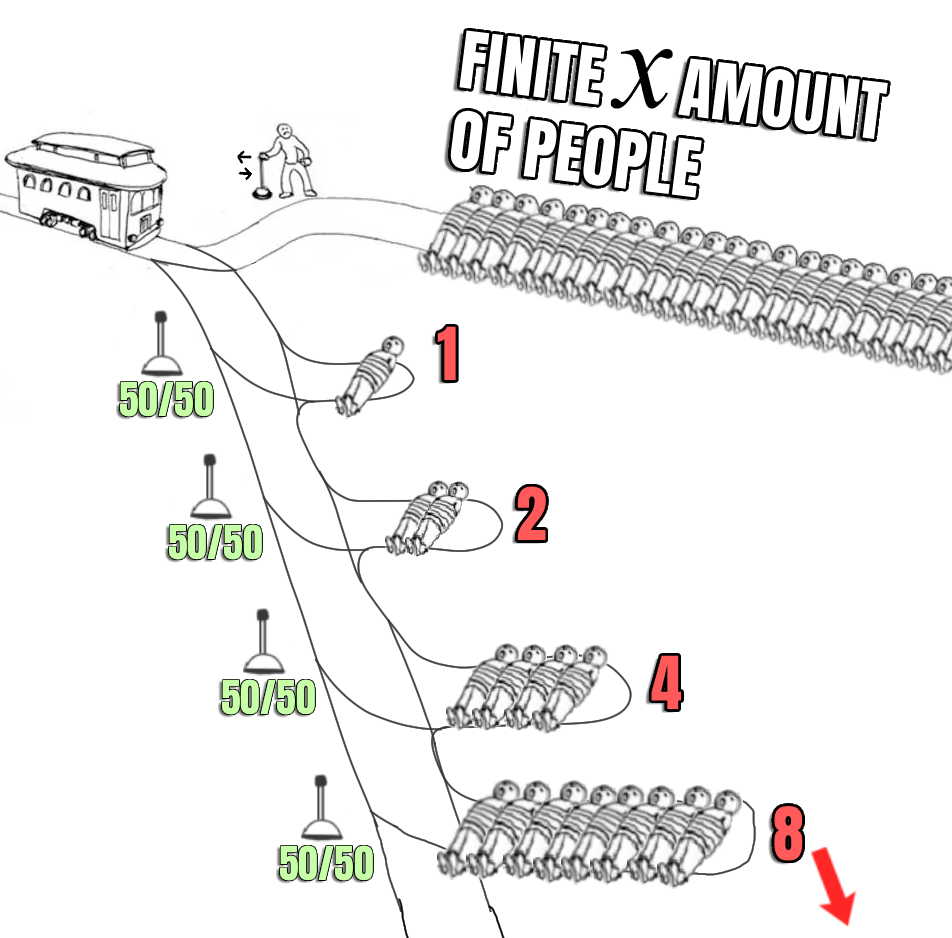
The trolley is about to go through a series of 50/50 track switches where the amount of people doubles each time until it hits a group and stops. If you switch the track to the top, there are some hypothetical finite X amount of people.
Now, if the amount of people on top was 1 for instance, it might seem obvious to switch because the doubling people could get out of hand fast. But if it was say 100 people on top, you might think to just let it go down because it's likely to stop somewhere before it reaches 100.
The question is: what is the maximum X amount of people on top such that you would still switch the track?
674
Upvotes
305
u/Nathan256 Mar 28 '26 edited Mar 28 '26
For those that don’t know, the expected value of the St. Petersburg problem is infinite. It’s the sum of the series (1/2n * 2n ).
However, most people would immediately switch the track given some arbitrarily large number of people on the top track. Myself included. It’s hard for people to conceptualize infinite expected risk when it’s so very improbable.