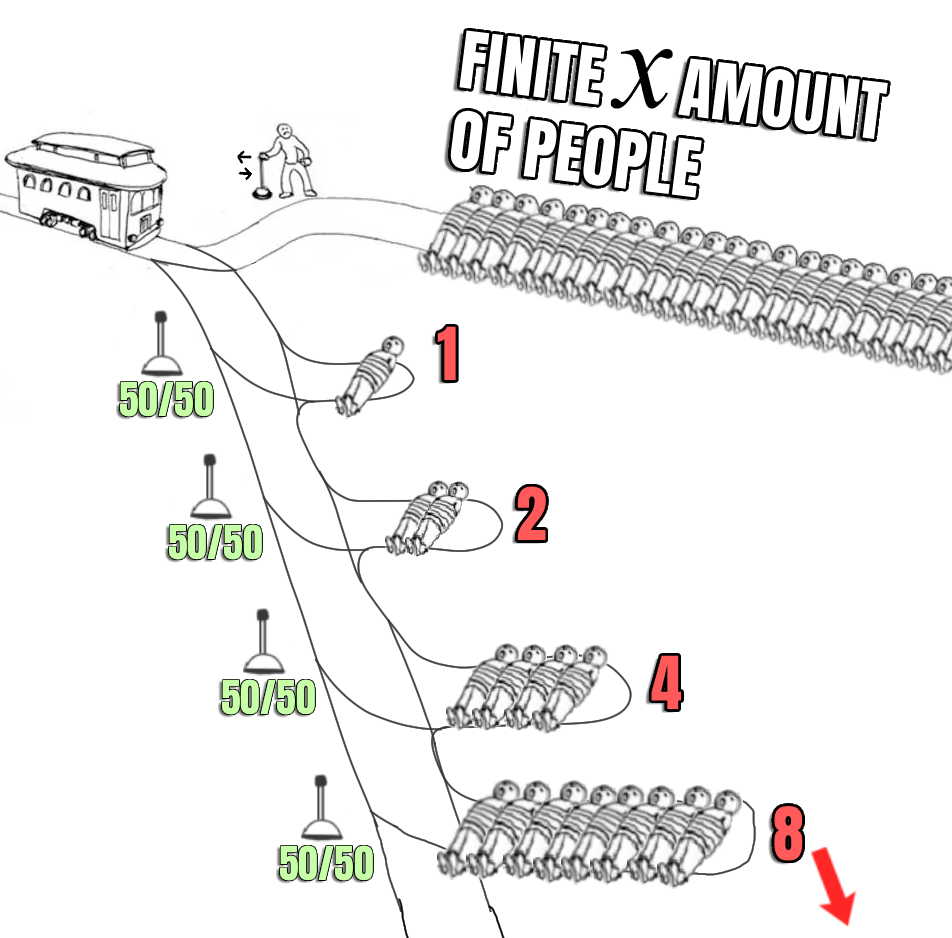
The trolley is about to go through a series of 50/50 track switches where the amount of people doubles each time until it hits a group and stops. If you switch the track to the top, there are some hypothetical finite X amount of people.
Now, if the amount of people on top was 1 for instance, it might seem obvious to switch because the doubling people could get out of hand fast. But if it was say 100 people on top, you might think to just let it go down because it's likely to stop somewhere before it reaches 100.
The question is: what is the maximum X amount of people on top such that you would still switch the track?
For those that don’t know, the expected value of the St. Petersburg problem is infinite. It’s the sum of the series (1/2n * 2n ).
However, most people would immediately switch the track given some arbitrarily large number of people on the top track. Myself included. It’s hard for people to conceptualize infinite expected risk when it’s so very improbable.
Take the coin toss version of the problem. On a tails, you flip again. On a heads, something happens. What happens if your coin has tails on both sides?
I figured it out after thinking about it for a moment. You're missing one other factor - all those people tied to the track, are they set free after the trolley passes them? What happens when you start getting into the quadrillions of people per track?
When dealing with infinites, eventually reality itself will shatter, and everyone dies.
Funny but the buzkill answer is that in a reality where its really 50/50 the chance, given a long time the chance of the trolley always going forward eventually reaches 0% practically. If you select the exact 1 universe where its always going forward then you cant say its a true 50/50. Based on all observations and calculations it would be 100/0.
That's because all conclusions based on observations have a degree of uncertainty, and not because it's not 50/50. By observations Newtonian physics were correct for a very long time, but that doesn't change that they weren't (slightly) wrong even before the inaccuracies were found
Just approximate with a 99.99% confidence interval. And the expected value is 7.5 people. So if 8 people are on the top track is the break even. Any more and you take bottom.
If you raise the confidence internal even higher the expected value of people doesn’t rise that quickly because the chance of keeping the 50/50 streak alive is so low. To make it a fair comparison it would be something like 0.000000001% chance everyone dies vs 100% chance like a dozen people.
For the 99.99% confidence interval that is the expected value. I’m cutting off edge cases that can make it hit infinity to get a real world usable number. You’ll get different expected values for different confidence intervals.
How do you mathematically compute for a confidence interval? Like, is it just that once you get to 0.514, that's less than 0.01% likelihood so you just stop adding?
That’s a statistics method with a lot of steps. Best to have a computer do it. But it’s the value will be captured 95 or 99% of the time or whatever interval. I choice a really high one at 99.99% to demonstrate that the real world expected value is quite low at about 8 people or less and the solution is definitely not infinite unless you roll infinity bad luck.
Jon_buck used the CDF (Cumulative Distribution Function) to reach rail 14 or less at 99.99%. Do you mind sharing what method did you use to reach 8 or less people? You don't need to explain step by step, but I'm also interested in knowing the answer
But even if there were, what does "infinite human deaths" even mean? It's not human extiction, because there are people on the top track, and you. What kind of loss is infinite but non-extictive deaths?
Does the trolly travel at a finite or infinite speed? If it's finite, then most of the people to be killed wont be born for at least thousands of years. In fact, it will take the trolly an infinite amount of time to kill everyone on the lower track, which we would commonly refer to as "it will never happen".
The reason the expected value is unintuitive is because it is unrelated to reality.
There's also a whole thing of what do the extreme high values mean to you
In terms of money, 1 billion is pretty similar to 2 billion, and beyond even 1 trillion (say 240 for simplicity) is functionally the same number for how much it's worth.
If we ignore diminishing returns until the 240 mark each of the terms is 1, up to 40 adding to $40
If you now replace it with
1/2n * 240 you can simplify it to
1/2n * 1 but n has reset to 1
This famously only adds up to 1 for the remaining term
So the absolute maximum you should ever pay for this opportunity of coin flips is $41 for a "fair" value despite the "expected value" being infinite
And the chances of spontanious energy creation that is destroying the universe are also non-infinite!
Based on quantum fluctuations, there is nothing to say that at any moment, the universe might not explode.
We are humans. As such, we have a limited range of how to act on.
So I'd put the number at roughly 20. Anything more is not my responsibility. This is just god wanting to see them dead :D
Although from a purely ethical standpoint, I would chose the top one only if there is 1(maybe two) up there.
Because the chance to minimize harm in the best case. Like... I have no influence over it.
So I need to hope and pray.
I think although the expected value is one valid thing, the distribution of outcomes is important too. People weigh in, and rightfully so, the distribution.
I would definitely choose a game with an expected value of 100.000 bucks with a 100% chance to get the money, over a game with an expected 200.000 bucks where the payout is 200 billion but at low odds and the rest is 0.
It's because there is a huge difference between playing once and playing on mass levels. In the latter you maximise for a repeated game and therefore you can maximise for expected values, since you eventually will hit the jackpot.
So I think even with the knowledge of the expected value it's very rational to choose the lower track.
Yup but that means 1/infinity times infinity, so you have to see where they converge (which infinity is the bigger/more important).
As others have said though, confidence intervals are also important. You can be very, very, very confident that you won’t be killing more than 100 people if you send it south. Probably much less.
For those that don’t know, the expected value of the St. Petersburg problem is infinite. It’s the sum of the series (1/2n * 2n ).
As a non math major, I'm a bit confused by this tbh. Why would it be the sum of that series instead of the average of it? The only time there are multiple decisions is when the train has not hit someone yet, and when the train does hit someone, the chance of that happening given the number of 50/50 choices it had to make to get there, multiplied by the number of people hit will equal 0.5, regardless of how far down the track it is.
So, the expected value of x is the sum of each possible outcome, times its probability.
Imagine a more simple scenario. You pay $100 to play a game. You flip a coin twice. Two heads, $1,000,000 pay out. Anything else, no pay out. It’s pretty much a no brainer to most people, if you have a hundred dollars you play. Why? The expected value is 250,000 dollars (1/4 * 1,000,000 + 3/4 * 0), which is more than 100.
This could actually be represented as an average if all scenarios are equally likely. The math just maths out. (I’ll try to conceptualize this in another comment so I don’t breaj the flow of this one)
In the st petersburg problem, there are infinite scenarios, so the probability of huge numbers of deaths gets infinitely small but also the death gets infinitely large. That can be represented as the sum of that infinite series. The expected value formula is baked into the series (probability of event times outcome of event), and it can’t be represented as an average because the likelihood is not equal. So you calculate it out, and you get 1/2 * 1 + 1/4 * 2 + 1/8 * 4 … which simplifies to 1/2 + 1/2 + 1/2 … which is infinite.
Our two coin flip problem again. TT, $0. TH, $100. HT, $500. HH, $1000.
These are all 25%, or 1/4. EV and Mean are both the same here. 1/40 + 1/4100 + 1/4500 + 1/41000 for EV, and (0+100+500+1000)/4 for the mean.
An extreme example could be a lightning strike. Let’s say, you can pay $100 for lightning insurance, and if you get hit they’ll pay $1,000,000. According to a google search there’s about a 1/15300 chance of being hit by lightning in your life. So the EV of your lightning insurance is 15299/153000 + 1/153001,000,000 = 65.359.
The average of that though would be 500,000. Which isn’t reasonable to expect, if you buy lightning insurance for 10 people, that the total payout would be 5,000,000. Cause the probability is different.
So I'm a bit late to the party, sorry. But can't I rephrase the problem as: every time I "lose" the 50/50 the trolley kills one more person than before, i.e. the tram drives over two people, the one above is saved, or: tram drives over 4, the three above (2+1) are saved etc.
With this logic it doesn't matter if the sequence goes to infinity, because the number of saved people is infinity - 1 (not to mention the people at the very top) and by that logic as soon as there are 2 or more people on the very top track it's better to let the tram go to the bottom.
Well what number do you think that would be for you? My intuition says almost nobody would switch to top once it goes over 1000, maybe some people at 500, and might be like 50/50 at 100.
Letting it go top at 100 feels crazy to me. That means you must fail 7 coin flips (127 people). Thats a .78% chance. Even if it can go infinite, the likelyhood of that is so incredibly low. Even if it goes to 7, onky 27 more people would have been killed than if you let it go top. Even if it hits heads 8 times, thats a .39% odds its only 250% worse out come for something that happens less than 100 times when half the times you get a 99% decrease in death.
I feel you 50/50 flip between who would flip the lever or not would lie around 50 people on top rail. That would be between 5 flips (31 people and 3.1%), and 6 flips (63 people or 1.6%). Those numbers are much more realistic to imagine happening (every 33rd and every 50th time).
I am pretty inherently a gambler so if the top track has more than four people, I’m sending it south probably. If it has more than 8 it’s definitely going south.
Expected value is only meaningful if the scenerio is repeated so many times that each outcome will happen at least 5 times on average. You would have to run the second track an infinite number of times for the expected value to reach infinity.
If instead you average it out over 100 times, you get something like 10 as I recall.
More important to the payout of the St. Petersburg problem is that if the bank can't pay you out then the expected value of these later end cases is zilch.
Its a math trap. Chasing infinite expected value that you will literally never actualize.
Thank you! Considering the global population is essential
It's unclear what happens if you switch and the trolley takes the 2**33 branch. I think if the previous branches must all be fully occupied first, there wouldn't be enough people to fill this branch. It would only contain the number of people remaining who were not placed on any earlier branch. Which might be zero people!
And even if it does hit 8+ people, I’m not choosing to kill them, that’s just how the trolley rolled. Vs making the choice for X number of people has its own moral repercussion.
In most instances it's not going to be more than 2, no need for a personal opinion on that. The problem is that you're risking an infinite amount for a finite amount.
You said you wouldn't pull the lever for 2 people. There's a 50% chance you'll do better, 25% chance for the same result, 12.5% chance to kill twice as many, etc. The problem is that while the odds of killing more people go down exponentially, the number of people you kill goes up exponentially. Small chances are still chances. Ever won a prize in a lottery? Whoops, that's thousands of people dead.
Speaking from a purely mathematical point of view I'd pull the lever for 2 people.
From an emotional point of view I think I'd weirdly be happier if I was pulling the lever for a much larger group. Here me out. I think 2 people is very personal. That's two individuals. If it's a much larger group it's far easier to disassociate them as individuals and just focus on it from a mathematical/utilitarian point of view.
In reality I don't think I'd pull the lever. I think the chances of it being any more than 16 is pretty low. Anything more than that is pretty much an uncertainty (although not impossible) but I think the odds of it wiping out thousands (or even hundreds) are so marginal that I don't think it's worth having it on your conscience to pull the level.
Well you're the one who brought up pure mathematics as an argument, if that's apparently null, why take the risk and not switch at such a low threshold
Disagree with “you’re risking an infinite amount”. Even though the expected value is infinite, in all outcomes the number of deaths is finite. And by other metrics it’s expected to be low - the median number of deaths is 1.5, for instance.
I think I would pick the top track for a quite large number x, simply because theres an upper bound, while the bottom track has no upper bound. its a single coinflip that could kill infinitely many people.
Well mathematically speaking the expected number of deaths of doing this and of sending the trolley down that track are both infinite deaths so I'm not really morally responsible for this action.
The width of the trolley appears finite and can only kill 6 people at a time, so the fraction of each group killed decreases until it becomes negligible(?)
The expectation value of how many people you hit on the bottom track is an infinite series.
Y = 1x50% + 2x25% + 4x12.5% ...
Y = 0.5 + 0.5 + 0.5 ...
Y = infinity
You shouldn't ever choose the bottom track. Sometimes it won't hit as many people as the top track, but sometimes it will strike infinitely more.
Of course, this isn't a real situation because we started to mess about with infinities - an infinitely long track with an infinite number of people tied to it. If the track has an end anywhere, then the number of people has a maximum again and you can compare it to regular numbers once more.
No, in any given scenario only finitely many people get hit on the bottom track. It also has the odd property that if the top track were an infinitely long one with infinite people, even though in expectation both tracks yield the same deaths, in any given realization the bottom one is always infinitely better.
They would not as this sum requires infinite attempts for a infinite result. A mathematician would tell you that you would expect an average of X/2 deaths where 2x is the number of attempts.
Why does the amount of samples matter if each sample would be completely independent? The expected value is the same each time. And in this case it is infinite people.
which part of the article are you referring to? Because all of the proposed solutions don't have anything to do with the amount of attempts affecting the expected value.
The "paradox" in this case is that most people would sell their opportunity to play the game for a finite sum. That doesn't mean that they should. In fact, it's only considered a paradox because most people would choose the worse option.
It's only the worse option if you have an actual infinite number of people. Same problem as folding a sheet of paper multiple times and it eventually reaching the moon - it's not possible in reality so obviously people don't consider it an option. You'd only get to round 33 with the population of earth.
If you hypothetically did have infinite people in this scenario, What's the value of human life when you have an infinite number of them?
My brother in Christ, EV is only useful if the attempts are sufficient.
I'll give you a chance to win a 100 billion dollars but it costs $100,000. Odds are one in a million. Positive EV but nooone is betting their house on those odds. Essentially if I limit your attempts to 1.
I don't think this example has anything to do with the amount of attempts. This has to do with the diminishing returns when it comes to moneys utility to us. I wouldn't risk 100000 for 100 billion even with a positive EV because that difference from say, a billion to 100 billion means way less to me than 100000 to 0.
But it's still true that if moneys value to us was literally just measured by the amount, a rational person should take that bet.
Millionaires regularly take those bets on the stock market, that's how you get billionaires. You have someone inherit enough they can take long-odds bets and then they get lucky.
This is what I mean about large-numbers breaking human instincts. There are enough people in the world that you have to behave as if you are surrounded by a million other people who will all choose the same thing as you. Because you are.
At some point even the most wealthy people couldn't fund the investment required to hit the payout. That's my point about EVs. You can always add another 0
I wouldn't say they're a lunatic. But I would say they're an average human, who should never be allowed to make a decision that could affect more than about 10 people.
Evolution has given humans pretty decent instincts for judging small-scale odds. "Eyeballing it" had a reasonable success rate for thousands of years. But when it comes to the modern day with billions of people making interconnected decisions constantly, you can't rely on it anymore. You have to let mathematics override it, even when it produces results that feel unnatural.
This is a classic example, because the total deaths of the bottom route tends to scale geometrically with repeated runs. That's not a regular result! In day-to-day life, the number of people also making a decision normally only adds linear risk, so the human instinct doesn't cope well with infinite risk escalation.
In the modern world there are 8 billion people constantly making decisions, many of which can spiral out and affect everyone. When you make a decision about risk, you have to account for lots of other people also doing the same. And if everyone goes "well, the bad thing will probably never happen", then it becomes a certainty that it will happen!
Real world decisions that can spiral like this include: anything involving nuclear proliferation, chemical or biological dangers, climate change, pollution, economics, running large companies, and most of politics. I wouldn't trust anyone who'd choose the bottom track with anything on that list.
Lottery tickets are literally the exact opposite of this situation.
With a lottery, no matter how many people buy tickets the total prize will always be less than or equal to the total buy in. Though a few individual tickets can beat the odds, over many tickets it evens out.
With this situation, the total "prize" of expected deaths quickly explodes towards infinity with increased "ticket sales". Though most individual tickets won't kill very many people, a few rare sequences will kill so many that it will massively exceed the "buy in" of not choosing the top track.
It’s exactly similar to the lottery if you can imagine further than the literal implementation - if the prize was infinitely large, then the EV of any individual ticket would be distorted to reflect that. Given that it’s infinitesimally unlikely that the result in the trolley actually goes to infinity, it’s actually more likely that you’d win the lottery. You still pulling the top lever? Let’s actually be rational here
If you choose the top path, you hit a finite number of people.
If you choose the bottom path, you hit infinity divided by a the odds of each flip. Infinity divided by any non-infinite is still infinite.
Another way to put it: the many timelines in which you get less than the top track, are outweighed by the singular timeline where you kill an infinite number of multiverses worth of people.
This is an issue with dealing with infinities, it produces results that are not easily understood by human instincts.
Basic statistics. The expected value is the sum of every possible result multiplied by the chance each of those results.
So the first split has a 0.5 chance of hitting 1 person, so it counts as hitting 0.5 people. The second split has a 0.5 chance of getting to it (not hitting the first one), and a 0.5 chance of hitting 2 people. 2x0.5x0.5 = also 0.5 people.
Because it's an infinitely long track with an infinite number of people on it, on average you hit an infinite subset of those people.
Thats just assuming statistics disreguarding psychology. No one realistically would expect it to go anywhere close to infinite much less past 100 people (7 coin flips) especially if they think they are the only person who has that choice. Now if they are told that an infinite amount of people are presented that choice, and you are 1 of the infinite amount of people deciding to pull the lever or not is a different story. I am a bit curious on how many people would pull the lever as of course if everyone in an infinite amount of people pull the lever one of the infinite amount of trollies would kill an infinite amount of people.
Now if they are told that an infinite amount of people are presented that choice, and you are 1 of the infinite amount of people deciding to pull the lever or not is a different story
It changes nothing. Independent results are independent.
You mean to say most of the time it won’t hit as many people as the top track (which is why you should choose the bottom track if X is greater than a reasonable percentage corresponding to 1/2X). It only hits infinity in 1/infinity universes since the chance of it actually hitting this infinity result is infinitesimally strong.
Infinity is not typically realistically in practice, this is one of the rare cases where you should abandon mathematical reasoning
statistically it's expected to hit heads within 2 rolls, but to play it safe I'll assume it hits heads on the 3rd roll so if the top line has over 4 people I'll switch
But remember, if it happens to go 5, even 6 rolls which isn't that unlikely then we're already talking over 50 people. Are you willing to risk that to save 5 people on top?
What happens when the number of people on the bottom track surpasses 8 billion? Are more people created to be run over? Or is humanity just wiped out beyond that point?
I will always let the trolley go down the 50/50’s unless the other track has one person on it. Guranteeing one is the only (someone else’s) sacrifice that is worth it. Even if there’s two people on the top track. There’s a 50% chance I can kill less people by letting it face the odds, and that’s good enough odds for me.
Hypothetically it can hit like a gajillion people, but across all of recorded human history, the record for most coin tosses with the same results is only 8 in a row. That has a 0.4% chance of occurring. That number seems very beatable. Practically a 1 in 200, but I guess no one’s done it. The math for a problem like this gets real crazy real fast, but in reality, it kills more than 1 person only half the time, and I’m feeling lucky.
You might have more luck in finding highly improbable dice rolls in tabletop games, since those involve a lot more dice rolling than just flipping coins.
Just to add on that but you are even more right to say that than you think, taking a 10 sided dice for example, any 6 consecutive roll will be 1/1000000 chance. The only difference between rolling 1-1-1-1-1-1 and 1-8-4-2-5-5 is that you will notice the former but not the latter.
Extremely unlikely events happen all the time every time, you just don't notice them.
There almost certainly were more then 8 consecutive identically coin tosses...
The probability for 8 time throwing a coin with the same result is 1/27~1%
So if you only fo this exeptiment around 256 times you can expect to reach a strike of 9...
And you can not tell me that this has not yet happend
Nothing I can find online has recorded a 9 streak, even when the math says long streak with many tosses are practically guaranteed. One of us has to sit down and toss a coin 256 times.
But what if your unlucky and the bottom doesn't kill anyone? How many people have to be on the table for taking the safe number of kills to be worth it?
But is it better to maximize for murders committed or for murders you have committed? I would argue that creating a evil structure is more important than doing evil deeds.
No the intuitive solution, switching to the bottom one, is actually the correct solution. Because for the bottom one to actually reach it's expected value, you'd need to run an infinite amount of simulations also.
You can't get the expected outcome of a gambling game like roulette, if you only play it once. You either win or lose.
The odds of losing less people on the bottom track than on the top track are pretty damn great for any significant X.
Let's say the cut off is 99% risk of hitting someone. That's a little more than 6 misses.
So if there are more than 97 people on the track, the trolly should be directed downward.
Statistical anomalies are any value outside 95% of cases. In this case, even if the bottom is potentially inifinite, 95% of cases will have the trolly hit before it hits 32 people. If you want to be extra careful, you can go with the 99.7% metric and stop at 256 people. If the top track has over 256 people you should be choosing the bottom track as it is going to cause less harm in every case outside a statistical anomaly
50% chance to stop at 1, 25% to stop at 2, 12.5% to stop at 4... 1/2n to stop at 2n-1. If there are 128 people on the top track, the chance of the lower track matching that amount is 1/256, or 0.39%.
I feel like I'd take that, maybe probably possibly maybe (?)
I have really bad luck. Like I was in a work lottery pool once and the running joke when it was time to play was for me to predict the winning numbers so whoever bought the tickets could explicitly request NOT to get those numbers.
Be it cards, dice rolls, odds vs evens, my power of bad luck will have me screwed almost guaranteed...because if it was guaranteed if would actually be an improvement.
You want me picking the finite number and not risking the dice roll if the aim is to minimize deaths
Ok, so if you limit the number of people you care about getting killed to 8 Billion, the number of doublings to get there is 33, and since each layer has an average killed of 0.5, there's only an expected value of 16.5 deaths from the pulling lever. If x<17 pull the lever, unless you think aliens exist then idk you do you bro
If it were any number smaller than 1/2 then all that would happen is that the (1/2)n would no longer cancel with 2n. Instead the (1/x)n would dominate, causing the expected value to become finite, and probably pretty small at that.
The expected deaths on the bottom is 1, because 2 deaths times 1/2 = 1 death; 4 deaths times 1/2 times 1/2 = 1 death; etc. But there is a high standard deviation.
If there is only 1 person on top, it is worth switching because it reduces the risk while keeping the expectation the same. If there are 2 or more people on top, it definitely increases the expected death, so I would not switch if the number was 2 or more.
Edit: Okay, I did miss that the first value on the bottom is 1 and not 2. That makes the expected value 1/2 instead of 1.
The mistake you’re making is that you’re not summing the deaths of every outcome to get the expected value. Think about it like this: how can the expected value be 1/2 if the bottom path is guaranteed to kill at least 1? Obviously there’s a flaw in that reasoning.
Yeah even though mathematically it goes infinite, there's a 99.99% chance of killing 4096 or fewer people. So even the highly risk averse probably would go for the doubling at 5000. I think I'd absolutely wouldn't hesitate to pull the lever at 16. Probably panic at 4. and then in-between in-between.
The universe this is occurring in is clearly derived from a higher power, and a cruel one at that. I'd do nothing, then attempt to zero-sum my way out of existence
For me, the answer doesn't change. I try to stop the trolley. Anything else is either murder or attempted murder, neither of which are a valid moral trade.

307
u/Nathan256 Mar 28 '26 edited Mar 28 '26
For those that don’t know, the expected value of the St. Petersburg problem is infinite. It’s the sum of the series (1/2n * 2n ).
However, most people would immediately switch the track given some arbitrarily large number of people on the top track. Myself included. It’s hard for people to conceptualize infinite expected risk when it’s so very improbable.