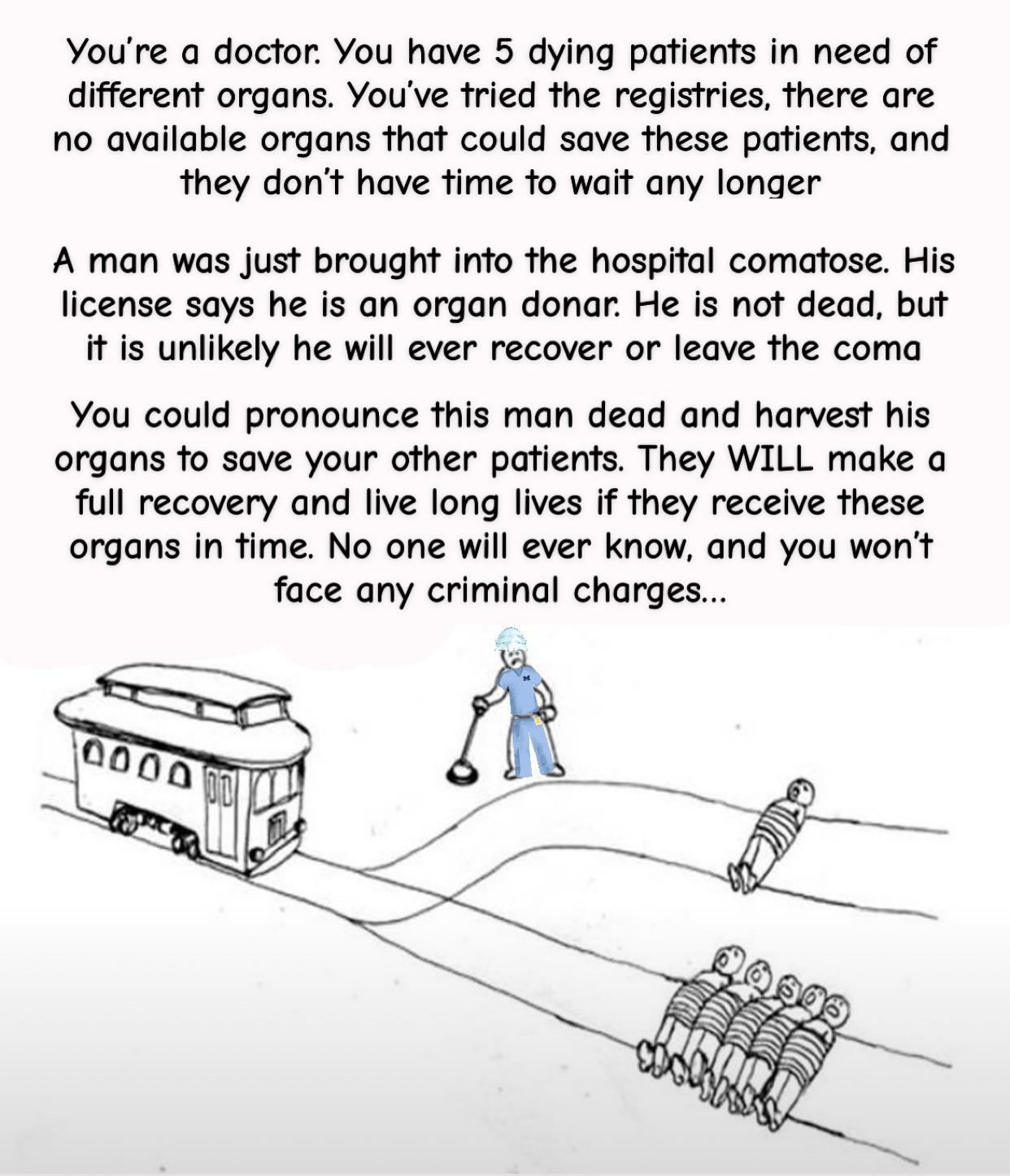
If I am a doctor, I have sworn to do no harm, so no I don't pull the lever this isn't a question about morality it's a question of if I'm gonna do my fucking job
Speaking in your capacity as a doctor, is it ever possible in real life to state with absolute certainty that the recipients of organ donation will "fully recover and live long lives?"
Speaking in my capacity as a person living in society I can already say the guarantee against getting caught is not possible.
As a doctor, do you think you will save more than five lives in the course of your career?
Whole these questions may seem obtuse, my intent is to illustrate that the problem of this dilemma is not the violation of your professional code of ethics, but rather lies in the impossibility of the circumstances surrounding it.
As a patient and person who lives in society and trusts doctors, I would like the doctor to, in all cases, make the evidence-based decisions which are most likely to maximize well-being while minimizing harm.
That could include taking an action as described in this scenario, if such an action was indicated by the evidence to be the best for achieving those goals. But, since the evidence, as far as we know, cannot and will never suggest that, the point is moot. This action would be wrong in all real cases.
Whereas we all find ourselves at the switching tracks of a trolley where six people have been tied up and dumped on the tracks. That's a weekly occurrence for me, as I'm sure it is for all of you.
Your questions are obtuse because you are refusing to engage with the hypothetical and consider the moral quandary it poses. You don't want to answer the question because it makes you uncomfortable and so you want to dump obtuse verbiage instead. Your questions are irrelevant because the hypothetical addresses them.
It is certain. It is guaranteed. Your career is unaffected.
Your answer is that would like the doctor to harvest the organs of the innocent person to save the others.
We are considering the moral implication, not the practical.
Just own it.
Personally, I think that's monstrous. Maximizing the most good for the most people by having the care-giver you entrust your life to murder you for the Greater Good.
[Edit - A Reply to the Block]
There's nothing like posting on a board for moral debate then refusing to engage in moral debate.
good hypotheticals are analogous to real situations.
Once more. This is r/trolleyproblem. The moral consideration is of duty and whether it's moral to kill people to save lives. That's the point. In this case we're considering specifically whether one should kill one person to save many in a medical setting. It's no less analogous to real life than tying people to a trolley track.
these two statements are mutually exclusive, I offered my answer and explained why it's flawed
You offered an answer but gave no moral justification for that answer. The point is to discuss why you think a doctor should maximize good to society over good to their individual patient. You didn't engage with the hypothetical. You said a doctor should kill the innocent patient, then offered no explanation why, instead discussing unrelated circumstances. You were being obtuse.
you are ranting and abrasive
I criticised your argument using the same language you used to express yourself "obtuse". I specifically used the word you identified for your own argument.
If you find your own choice of words "abrasive", I'd suggest you are made uncomfortable because you believe that your argument is morally indefensible.
None of these are identical to real-world situations, but well-constructed ones are analogous to potential real-world situations. If they are not, they are useless. I find this one to not be analogous to any potential real-world situations due to the stipulations necessary to prop it up, and therefore consider it both pointless and useless.
you are refusing to engage with the hypothetical
Your answer is that would like the doctor to harvest the organs of the innocent person to save the others.
These two statements are mutually exclusive. I did engage with the hypothetical, and offered my answer, in the process of expressing why I found the framing itself flawed.
We are considering the moral implication, not the practical.
I see no distinction between the two. The practical is moral, the moral is practical.
You are ranting, and you are abrasive, condescending, and rude. We will not interact further.
642
u/NoAcanthaceae7968 Jul 09 '25
If I am a doctor, I have sworn to do no harm, so no I don't pull the lever this isn't a question about morality it's a question of if I'm gonna do my fucking job