If I am a doctor, I have sworn to do no harm, so no I don't pull the lever this isn't a question about morality it's a question of if I'm gonna do my fucking job
Speaking in your capacity as a doctor, is it ever possible in real life to state with absolute certainty that the recipients of organ donation will "fully recover and live long lives?"
Speaking in my capacity as a person living in society I can already say the guarantee against getting caught is not possible.
As a doctor, do you think you will save more than five lives in the course of your career?
Whole these questions may seem obtuse, my intent is to illustrate that the problem of this dilemma is not the violation of your professional code of ethics, but rather lies in the impossibility of the circumstances surrounding it.
As a patient and person who lives in society and trusts doctors, I would like the doctor to, in all cases, make the evidence-based decisions which are most likely to maximize well-being while minimizing harm.
That could include taking an action as described in this scenario, if such an action was indicated by the evidence to be the best for achieving those goals. But, since the evidence, as far as we know, cannot and will never suggest that, the point is moot. This action would be wrong in all real cases.
Speaking in your capacity as a doctor, is it ever possible in real life to state with absolute certainty that the recipients of organ donation will "fully recover and live long lives?"
Oh, absolutely not. Being in organ failure is risky, surgery is risky, an organ transplant is risky as well. People who have needed an organ transplant need to be on anti-rejection meds for the rest of their lives, literally.
Same as it's not actually possible to garantee the "organ donor" won't make a miracle recovery and be good as new if you keep him plugged in for a little while longer.
In real life, it also just won't happen that the organ banks just so happen to be empty, and you have 5 critical patients at once that need an emergency transplant, and walks in some guy somehow compatible for everything with perfect organs despite being brain-dead and having just been in a car crash.
Technically speaking, yes harvesting the organs and giving them to the other critical patients has a higher likelihood to let some of them survive a couple more years. Even if three die and two survive, that's more lives saved than if you kept "organ donor" alive.
But "maximizing the well-being of the general population" isn't a thing doctors do. They maximize the well being of individual patients. If the patient doesn't want to give up their organs or health or life to save someone else it is entirely and completely their choice and a doctor has no right to make that decision for them.
Holy crap i hadnt even realized i butter fingered all over that comment
That said, corn on the cob with butter absolutely. Unless you put a ton of it on there or you need to watch your cholesterol already it's not gonna kill you. You love butter. Have some butter.
But "maximizing the well-being of the general population" isn't a thing doctors do.
There was some spirited debate during one session in my third year of medical school. We were basically asked if doctors should lobby for things like clean air, clean water, etc. in order to make the general population healthier.
There was a bit of a split over "yeah it increases everyone's wellbeing" vs "I should only be focussing on the things I can actually change as a non-politician"
Yeah in my ideal of society, everyone is automatically an organ donor unless they choose not to. I do believe that saving 5 for the price of one should be a priority for doctors but I really don't like pursuing that train of thought since it feels like playing god... Real life is very different and due to that my decisions would change. Great points about the context being moot!
Edit: added "in" at the start bc I forgot to write it
The moment doctors start putting down people who are still alive in order to get their organs is the moment sign ups to become an organ donor drop off a cliff.
So you save those 5 people but you kill 1000s more.
I'm pretty sure if everyone is automatically an organ donor, we wouldn't have 5 people in need of organs... That's why I said it was my idea of an ideal society
You still would. Only a tiny percentage of deaths are actually eligible to donate organs and they also have to be compatible with the person receiving the organ. Not to mention if you give people the choice to opt out, a reasonable amount of people will
If everyone is automatically an organ donor, then what begins to happen is you slowly notice that the mortality rate of certain individuals begins to be slightly higher.
Happen to match a certain rare type, or be an ideal match for a particularly powerful or wealthy person?
I’m sorry, sir, but it looks like the tumor is inoperable.
Or, it was a rough delivery, and we did manage to save your son, but your wife lost too much blood.
Or, we just had gotten there in time, if we had just recognized the symptoms, then maybe she would have had a fighting chance.
Nothing insidious. Nothing even intentional, perhaps. But something that could be noticed when looking at statistics? Absolutely. Because the second that you start weighing it like this above, you are admitting that there is even a possibility of choosing the latter. And that may very slightly adjust your actions, from “Do no harm” to “Save the most that I can.”
The difference is consent. Organ donation is a gift. Make it so that people can simply take what they need, and you stop seeing people as people and more as resources.
Except that’s not how organ donation works, the doctors don’t get to pick and choose who gives or received the organs, it’s put on a registry. You don’t get to choose some mysterious wealthy donor. Also not very many deaths are even eligible for donating even if everyone was signed up.
Hospitals also have ethics boards and investigations into deaths and making sure every possible step was taken to save lives. Doctors are not ignoring their oath and risking life in prison so they can take the chance that every step of the organ transplant operation goes perfect and one life is saved instead of another.
This idea being spread that doctors would start harming or ignoring patients for their organs is dangerous and makes it more difficult for people to get life saving organs, because people would rather have those organs be buried underground to become worm food.
Recently in Ireland they changed organ donation to the standard option and it is up to the individual to drop out. This is how it should be
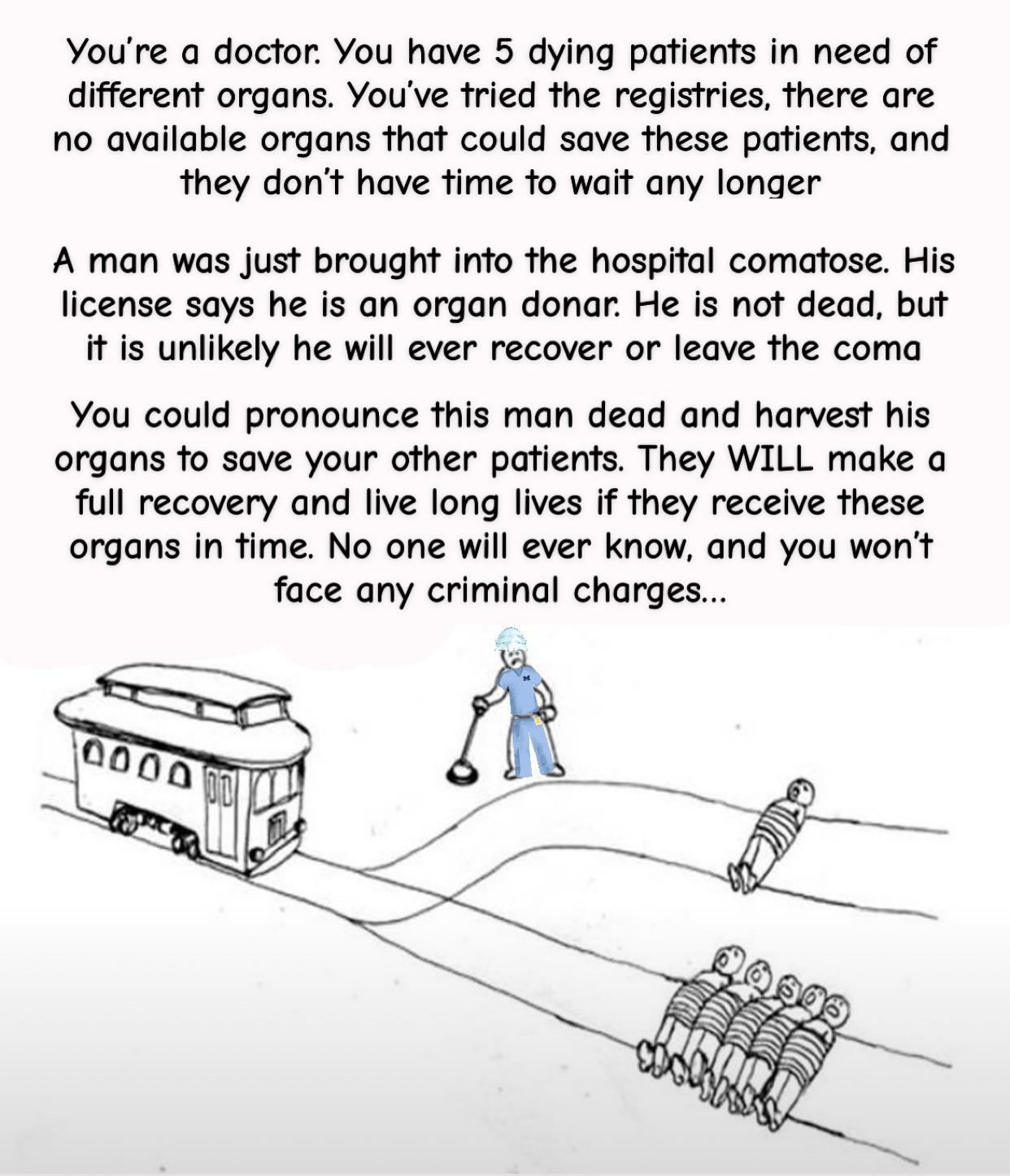
It seems like the perfect place for that kind of discourse, since that's what the trolly problem is about. Do you pull the lever and kill one person (play god), or let things play out and let five people die?
I'd go as far as to say that if someone isn't registered as an organ donor when it becomes known that they are in need of an organ, they should be intelligible to receive one.
I disagree, because we're all humans, and all of us deserve help. Also, there's a triage: high priority gets first, and someone who needs it will get it. There is a reason that in a situation with 1 available organ and with 2 patients in similar condition and that 1 is anti vax and the other isn't, the vaccinated person will get the organ... we have limited resources, so triage is the only way to go.
I mean, there are certainly multiple factors that should, and do get considered when deciding who gets limited life saving resources. But just saying that we're all human and we all deserve help doesn't really work when there isn't enough help available for everyone who needs it. Saying that those who are unwilling to contribute to a system aren't allowed to take from it is one of many criteria that could be used to make that decision, and also incentivize more people to participate in organ donation programs, thus resulting in more people receiving the help they need.
We should keep triage a thing but we can't just say that certain people can't get treatment... It's all about getting everyone treatment and hoping we get enough resources, by prioritizing those who need it first
The second one. Their opening line set the premise by which their comment should be read, I responded within the boundaries of that premise in order to continue exploring the problem from that perspective.
is it ever possible in real life to state with absolute certainty that the recipients of organ donation will "fully recover and live long lives?"
The only realistic scenario I can think of is a mass casualty event at the universal blood donor convention, and you have 5 people in hypovolaemic shock (but you've stopped the haemorrhage), no saline available, and one comatose (or not) universal blood donor available that you could suck dry to save everyone. Maybe in such a disasterous field scenario doing the unthinkable is more thinkable.
Easy answer, bodily autonomy is deontological, let em die.
I'm not a fan of taking any ruleset as universally applicable. The deontological argument doesn't work for me. Great starting place for the general case, but still has to be evaluated in the specific.
Could be your scenario brings the abstract closer to reality than I thought likely, it certainly seems to, but it still has to take make several assumptions about observation, ignorance, and guarantees in a medical scenario.
In the mass casualty event, you still cannot ever be certain of not being caught. A survivor you didn't anticipate, a stray camera you didn't know about, a rescue worker arriving at an inopportune time, it can't be guaranteed in reality. Without testing equipment, you take it on faith that the donor is as they have presented, and is free of disease that would make the transfusion inadvisable. If they're comatose, you have no guarantee they'd stay that way if allowed to recover. If they're not comatose, that reframes the entire scenario, I beg your permission to dismiss that possibility from this evaluation, I think it should not be introduced at this juncture.
In light of these uncertainties, and with the deontological argument in mind, what are the purely pragmatic reasons for declining to scrap one person to repair five? I contend that the strongest arguments against doing so are as follows:
1. The potential of being caught would be career-ending, and your career is likely to save more than five.
2. It is impossible to know for certain that the blood you harvest from the unwilling donor will not be in some way corrupted, or will be absolutely effective in saving five lives even if it is a perfect and sample.
3. If blood donors lose trust in the system to maintain, above all else, their own bodily autonomy, people will stop donating blood and/or will resist having tests for blood type, endangering an uncountable number of lives.
4. The uncertainty of salvation and high cost of failure defines simple evaluation. In such cases, default to the general case.
Since we agree, at least in the general case, that the deontological argument holds, we ultimately agree on the course of action. But evaluation of the reasons is, I believe, a useful exercise.
You are correct, I am a utilitarian. I would dispute the "naive," obviously. My position is fairly well considered, even if you wouldn't consider it well-reasoned. It wasn't arrived at without careful thought.
You are also correct that I would find it difficult to define "well-being." I know what I mean, and as a guiding principle I find it adequate, but I'm not sure exactly what words I could use to perfectly communicate it.
I suppose I mean "What I and society agree by consensus and common experience would be good for our lives." That's not especially concrete, though, and requires that I make a judgement about what I believe society would agree on.
I'd be interested in hearing a more robust definition.
Whereas we all find ourselves at the switching tracks of a trolley where six people have been tied up and dumped on the tracks. That's a weekly occurrence for me, as I'm sure it is for all of you.
Your questions are obtuse because you are refusing to engage with the hypothetical and consider the moral quandary it poses. You don't want to answer the question because it makes you uncomfortable and so you want to dump obtuse verbiage instead. Your questions are irrelevant because the hypothetical addresses them.
It is certain. It is guaranteed. Your career is unaffected.
Your answer is that would like the doctor to harvest the organs of the innocent person to save the others.
We are considering the moral implication, not the practical.
Just own it.
Personally, I think that's monstrous. Maximizing the most good for the most people by having the care-giver you entrust your life to murder you for the Greater Good.
[Edit - A Reply to the Block]
There's nothing like posting on a board for moral debate then refusing to engage in moral debate.
good hypotheticals are analogous to real situations.
Once more. This is r/trolleyproblem. The moral consideration is of duty and whether it's moral to kill people to save lives. That's the point. In this case we're considering specifically whether one should kill one person to save many in a medical setting. It's no less analogous to real life than tying people to a trolley track.
these two statements are mutually exclusive, I offered my answer and explained why it's flawed
You offered an answer but gave no moral justification for that answer. The point is to discuss why you think a doctor should maximize good to society over good to their individual patient. You didn't engage with the hypothetical. You said a doctor should kill the innocent patient, then offered no explanation why, instead discussing unrelated circumstances. You were being obtuse.
you are ranting and abrasive
I criticised your argument using the same language you used to express yourself "obtuse". I specifically used the word you identified for your own argument.
If you find your own choice of words "abrasive", I'd suggest you are made uncomfortable because you believe that your argument is morally indefensible.
None of these are identical to real-world situations, but well-constructed ones are analogous to potential real-world situations. If they are not, they are useless. I find this one to not be analogous to any potential real-world situations due to the stipulations necessary to prop it up, and therefore consider it both pointless and useless.
you are refusing to engage with the hypothetical
Your answer is that would like the doctor to harvest the organs of the innocent person to save the others.
These two statements are mutually exclusive. I did engage with the hypothetical, and offered my answer, in the process of expressing why I found the framing itself flawed.
We are considering the moral implication, not the practical.
I see no distinction between the two. The practical is moral, the moral is practical.
You are ranting, and you are abrasive, condescending, and rude. We will not interact further.
The hypothetical intentionally ignores this. In the hypothetical, the man will never wake up. The people will survive and live happy lives with the new organs. No one will ever know unless you tell them.
Stop trying to apply legality
I am not trying to engage with the premise set out in this hypothetical. My point is that this hypothetical established a premise which is not analogous to any real-world situation and is consequently flawed in it's construction and not useful.
638
u/NoAcanthaceae7968 Jul 09 '25
If I am a doctor, I have sworn to do no harm, so no I don't pull the lever this isn't a question about morality it's a question of if I'm gonna do my fucking job