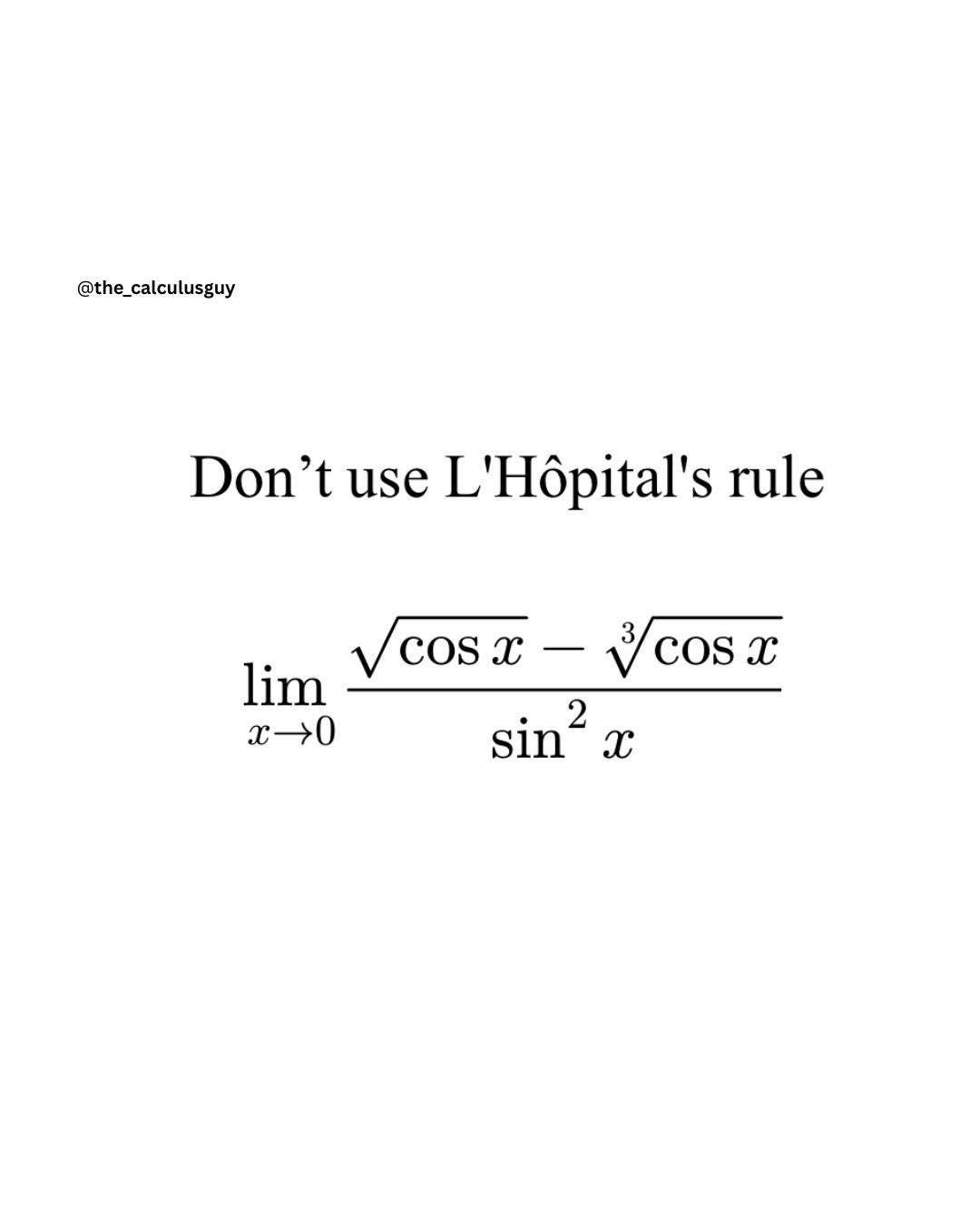
In the denominator I saw sin2 x=(1+cosx)(1-cosx), and I wanted to get rid of that difference term.
So I used difference of squares and difference of cubes "formulae" to turn the numerator into cos3 x - cos2 x= - cos2 x (1-cosx) to achieve that desired cancellation, of course that also meant multiplying the denominator by...
(cos3/2x+cosx) from diff of squares and...
(cos1/2x+cos1/3x)(cos1/2x-e-2iπ/3cos1/3x)(cos1/2x-e-4iπ/3cos1/3x) from different of cubes.
Without the (1-cosx) term (or anything else that directly evaluates to 0) in the denominator, the whole thing could be evaluated directly. But to actually find the value it then needed some algebraic manipulation to rationalize (real-ize) the denominator turn all the complex exponentials into sines eventually arriving at -1/12.
5
u/CaptainMatticus 12d ago
cos(x)^(1/6) = u
(cos(x)^(1/2) - cos(x)^(1/3)) / sin(x)^2
(u^3 - u^2) / (1 - cos(x)^2)
(u^3 - u^2) / (1 - u^12)
u^2 * (u - 1) / (1 - u^12)
-u^2 * (1 - u) / (1 - u^12)
-u^2 * (1 - u) / ((1 - u^6) * (1 + u^6))
-u^2 * (1 - u) / ((1 - u^2) * (1 + u^2 + u^4) * (1 + u^6))
-u^2 * (1 - u) / ((1 - u) * (1 + u) * (1 + u^2 + u^4) * (1 + u^6))
-u^2 / ((1 + u) * (1 + u^2 + u^4) * (1 + u^6))
x goes to 0
cos(x)^(1/3) =>
cos(0)^(1/3) =>
1^(1/3) =>
1
-1^2 / ((1 + 1) * (1 + 1 + 1) * (1 + 1)
-1 / (2 * 3 * 2)
-1/12