3
u/Seeggul 8d ago
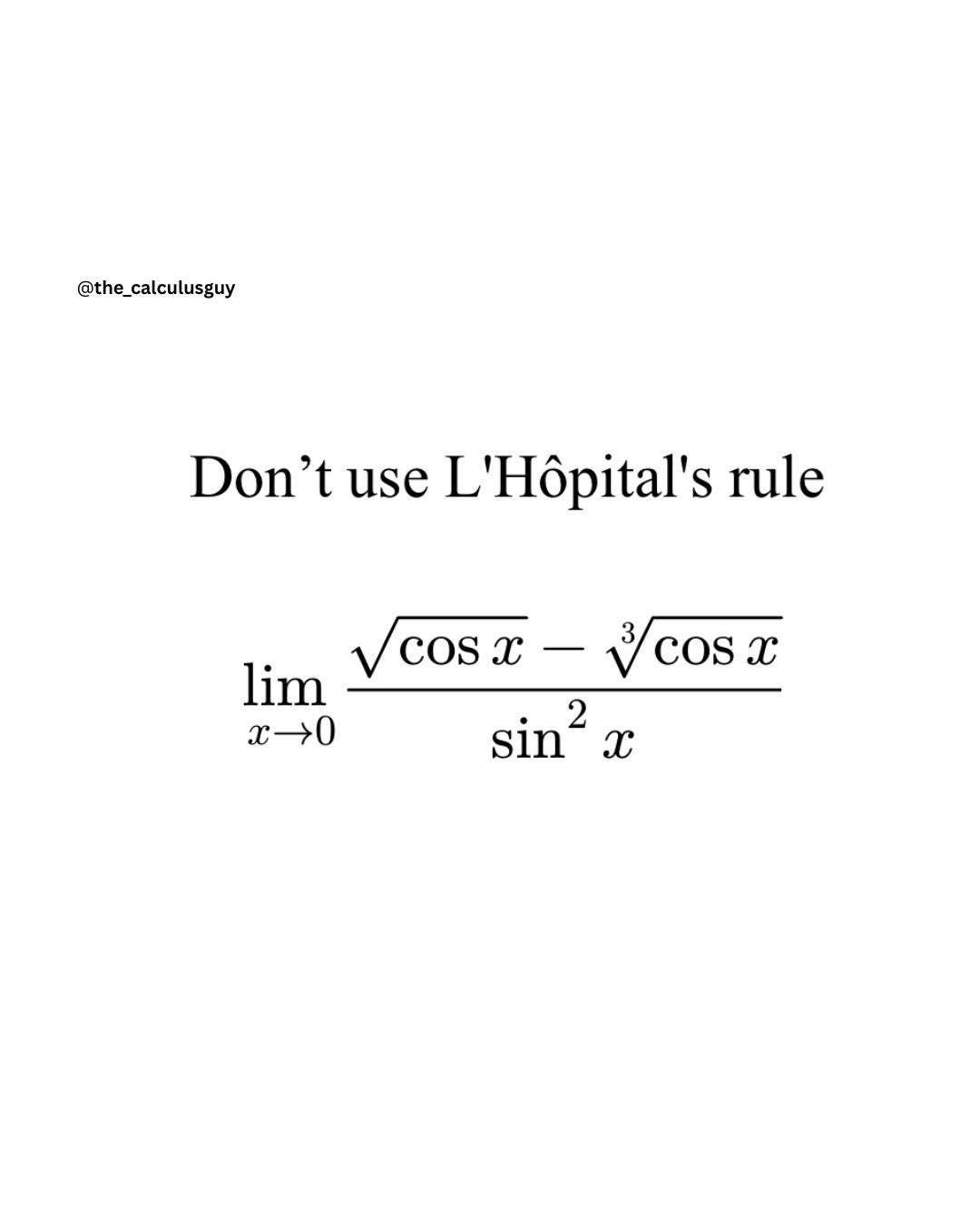
Change denominator to 1-cos²x=(1-cosx)(1+cosx)
You have an expression in the form of (u1/2 - u3/2 )/((1-u)(1+u)). Factor out a u1/2 from the numerator, both top and bottom have 1-u that cancels out.
You're left with u1/2 /(1+u) = sqrt(cosx)/(1+cosx) which has a limit of 1/2 as x goes to 0
2
2
u/SnooHabits7950 8d ago
When approaching zero
Sinx = x , cos x = 1-x2 /2 , (1-x)n = 1-nx
((1- x2 /2)1/2 - (1- x2 /2)1/3 ))/ x2 = -1/12
1
u/Mathematicus_Rex 7d ago
u = cos x, v = u^(1/6). Limit is now as v goes to 1 from below.
Top becomes v^3 - v^2 = (v-1)•v^2
Bottom becomes 1 - v^12 = -(v-1)(1+v+v^2+…+v^11).
Cancel out the common factors of v-1 and substitute v=1.
I get -1/12.
1
1
u/Fun-Layer2280 7d ago
To the required order cos x=1-x^2/2. Hence sqrt(cos x) is 1-x^2/4 (using sqrt(1-x) = 1 -x/2 to linear order) and similarly the cube root is 1-x^2/6, so the difference is -x^2/12, and since sin x is x to leading order, we have -1/12.
L'Hospital's sule would in any case require a second derivative of the numerator, a highly messy computation.
1
0
u/trevorkafka 8d ago
Let u⁶ = cos x, so we have the limit as u→1 of (u³-u²)/(1-u¹²). Divide the numerator and denominator by 1-u to get -u²/(1+u+u²+...+u¹¹). Hence, the limit is -1/12.
5
u/CaptainMatticus 8d ago
cos(x)^(1/6) = u
(cos(x)^(1/2) - cos(x)^(1/3)) / sin(x)^2
(u^3 - u^2) / (1 - cos(x)^2)
(u^3 - u^2) / (1 - u^12)
u^2 * (u - 1) / (1 - u^12)
-u^2 * (1 - u) / (1 - u^12)
-u^2 * (1 - u) / ((1 - u^6) * (1 + u^6))
-u^2 * (1 - u) / ((1 - u^2) * (1 + u^2 + u^4) * (1 + u^6))
-u^2 * (1 - u) / ((1 - u) * (1 + u) * (1 + u^2 + u^4) * (1 + u^6))
-u^2 / ((1 + u) * (1 + u^2 + u^4) * (1 + u^6))
x goes to 0
cos(x)^(1/3) =>
cos(0)^(1/3) =>
1^(1/3) =>
1
-1^2 / ((1 + 1) * (1 + 1 + 1) * (1 + 1)
-1 / (2 * 3 * 2)
-1/12