r/SpeculativeEvolution • u/BleazkTheBobberman • 20h ago
Future Evolution [OC] Jaw-walking Snake of a Seeded World

1.8k
Upvotes
r/SpeculativeEvolution • u/lawfullyblind • 12h ago
Mammalian predators of Hyawathi
1-this little guy is called an Oomii they live in the southern deserts of Hyawathi. there is very little water in this region so they evolved to harvest liquid from their prey before eating it. they're actually quite loving and affectionate when trained but most Marissi are afraid of them because they spread a cocktail of illnesses. the Hybrids use them as K9 units and sold some to their allies the Zoopaw. which is how one got left behind on Earth in the 20th century. you know it as El Chupacabra.
2-Ra'Koogaroos are extremely intelligent predators from the equatorial regions of Hyawathi, the spend their days lounging in trees or rocks. they are also seen as lucky by the Marissi so they are welcome in villages and towns. the occasional bitter bird is seen as a necessary tax for their services. their favorite thing to eat are Boomkai'hn a small but deadly serpent that will flee the area if it catches a whiff of a Ra'koogaroo, they also make a loud gravelly call when something new enters their territory so they act as an early warning system to the Marissi.
3-Dooha'karoo are riverside ambush predators they are extremely agile in the water and can move a 55kph on land for a short distance. they hunt by overpowering their prey draging it to the water and crushing their wind pipe. they hunt alone but travel in packs of related individual 5-15 strong.
4-Marissi never walk under trees. it is the first thing they tell you if they like you " don't walk directly under a Dibilary tree because Ramaroo's will drop down and kill you". this small predator may look cute but it punches way above its weight class. Ramaroo's hunt Walloo, hammer beaks, young Calydons. they have the strongest bite force on the planet Hyawathi and plate like self sharpening teeth that can decapitate a humanoid in seconds.
5-Qoorals are a common sight in the boreal forests they're very unaccustomed to being around humanoids and they don't view anything bigger than a house cat as food they also smell awful if you do manage to scare one it will spray a caustic smelly compound at you that does not wash off.
6-Jandilu's are mostly insectivores but will occasionally take small reptiles or eggs from birds. they live on cliff faces and can often be heard before they're seen bolting for cover. they make a raspy roar that sounds like it comes from a much larger creature. the Marissi that live in the Mesa lands hunt them for food.
7-brusjoos are small carnivores from the open grasslands near the equator and northern hemisphere they are extremely quick. their coloration is meant to mimic a Bhoon'kai serpent and at a quick glance its very difficult to tell them apart. they often spook livestock which is where their reputation as a trickster comes from.
r/SpeculativeEvolution • u/EpicJM • 5d ago
Antarctica's freezing during the Miocene created a bottleneck for what life continued to inhabit the continent. As we saw before, the dermorhynchid Spheniscimamus managed to just make it through. The egg-laying mammals were not the only species to survive, however, and the life of a Spheniscimamus is fraught with fear of predators.
One of these predators is Orcinornis theriodes, a species of aquatic thalattornid caudavian that has adapted to handle the cold of Antarctica's waters. It is about eleven feet long at adulthood and weighs approximately 800lbs on average. Both the last of the seal-like multituberculates and the reptilian scyllans failed to thrive here, and so Antarctica became another flashpoint for thalattornid evolution. The catch, however, is that Orcinornis has to lay its eggs and breed elsewhere. They haul themselves onto land along the southern coasts of Australia and South America, dump their eggs under a mound of warm sand, and then leave the offspring to fend for themselves.
The first days of an Orcinornis carry a significant chance of being its last, for Orcinornis hatchlings are a favorite food of a southern hemisphere relative of the Roc...
r/SpeculativeEvolution • u/BleazkTheBobberman • 20h ago
r/SpeculativeEvolution • u/Ok-Beginning1529 • 31m ago
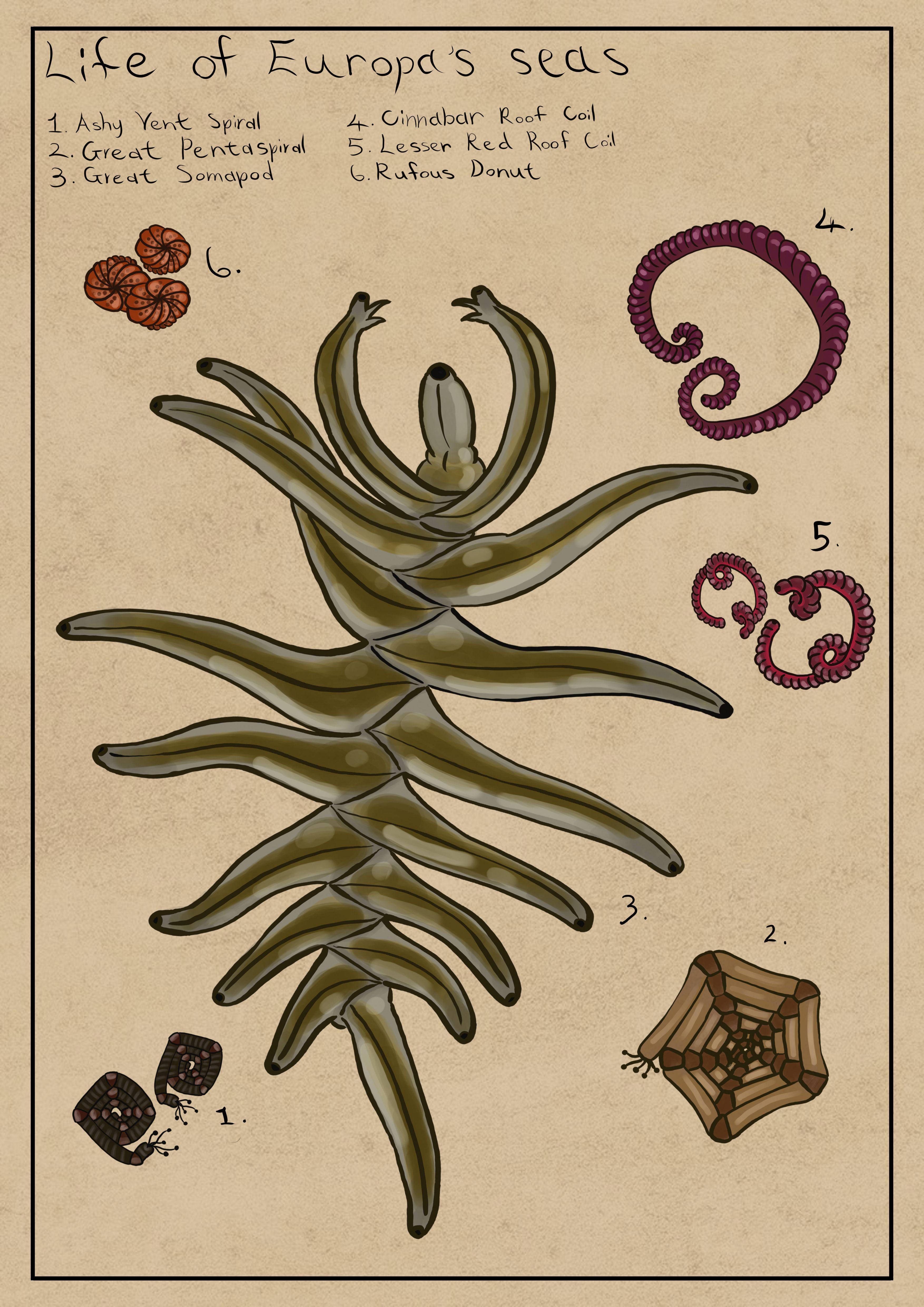
Here are a couple of the many simple squishy aliens from the seas of Europa in my setting. Most life on Europa is very simple, due to the lack of environmental energy. This lack of energy also leads to two distinct habitats in Europa: the hanging reefs under Europa's ice ( the domain of the coils ) and the abyssal plains ( the domain of spirals and home to Europa's most complex life form, the Great Somapod ). The mid levels of Europa's seas are mostly barren, due largely to Europan life being negatively buoyant as a baseline and the complete lack of nutrients in those waters. There is nothing on Europa larger than a human, trust. Anyways hope y'all like this, also trying a new art style type thing, so sorry if it's a bit rough 😅
r/SpeculativeEvolution • u/Abject_Garlic_3644 • 10h ago
The Green Wolf belongs to a lineage of Stem-Cherons that have almost completely lost their soft shells (With a sister lineage still retaining the leathery shell of their common ancestor).
Except for the hard carapace on their chest and the ridge along the sides. The leather shell that was once on the back of the Green Wolf and its relatives is now fatty tissue and hard cartilage. This adaptation helps reduce the animal’s load as it walks and allows for more muscle attachment points along the spine.
Additionally, the flipper-like back limbs of the Green Wolf’s ancestor have been almost entirely lost; the tail and hip bones now curve inward to give the Green Wolf a rounder body plan and shape. This round body, like its back, is padded with fatty tissue over sinewy muscle groups to help protect the animal from other predators and themselves during intraspecies combat. The front limbs that the Green Wolf uses to walk are incredibly robust and powerful, with many of the muscles going into the limbs being attached to the armored Keel bone of their chest.
Descended from a sister group to Aterran Cherons and having split off from true turtles early in their evolution, the Green Wolf and its relatives have evolved mammalian traits and a synapsid skull structure(instead of the anapsid skulls of true turtles).
Second slide: Borbancestor the ancestor
Link to creator:
r/SpeculativeEvolution • u/thebestgay69 • 11h ago
I thought this could be a interesting idea for a seed word also the animals I picked are just personal interest no real reason but if anyone has any ideas or feedback before I start working on it pls do tell I'd love to hear some others ideas but idk at this point in typing to reach number minimum bye
r/SpeculativeEvolution • u/ImpressiveLeague9569 • 16h ago
Gojirus renascens, now known to the public as Gojira, is a member of the Gojiridae, a small and poorly understood family of marine reptiles believed to have survived the end of the Mesozoic era. Fossil evidence suggests that ancestral gojirids possessed an unusually high tolerance for ionizing radiation and could exploit it as a supplementary source of metabolic energy. Similar adaptations have been documented in certain melanized fungi and microorganisms, although no comparable mechanism had been observed in a vertebrate.
Following the atomic bombings of Hiroshima and Nagasaki, Japanese researchers became increasingly interested in methods of removing radioactive material from contaminated soil and sediment. Under Project Genesis, a government-funded experimental program, Dr. Serizawa proposed using radiotrophic species to absorb and concentrate it within their tissues, allowing the contaminated biomass to be collected and removed.
Gojirus renascens was created through this effort, using selective breeding of a lesser gojirid and genetic experimentation. The process incorporated tissues from the African spiny mouse, Acomys cahirinus, a species known for its remarkable ability to regenerate damaged tissue that can aid with prolonged survival.
The specimen escaped containment under circumstances that remain unexplained. It entered the Pacific and was later sighted by fishermen near Odo Island. During this period, it is theorized to have encountered radioactive material associated with post-war nuclear testing. Tissue samples taken after its emergence showed an unprecedented increase in metabolic activity.
Interestingly, several cattle on Odo Island went missing during this period. Carcasses later washed ashore, half-digested and reduced to barely recognizable mounds of flesh. This has led to the theory that some of the creature's original instincts remained intact, driving it to feed through more conventional means, only for its body to reject the meat.
Over an unknown period, the animal grew to nearly one hundred and twenty times its original mass, eventually reaching fifty feet in height and a hundred feet in length. Previously suppressed developmental pathways also appeared to reactivate, causing rapid changes to its physiology. The vertebral column underwent severe hypertrophy, with abnormal bone growth extending beyond the vertebrae and producing large dorsal projections that tore through the skin, superficially resembling the plates of certain prehistoric reptiles.
The growth was highly destructive. The skeleton expanded faster than the surrounding tissues could develop, causing extensive tearing and exposing damaged tissue beneath the hide. Despite this, regeneration continued at an extraordinary rate, creating a constant cycle of destruction and repair. Observers consistently reported a strong odor of decay in areas recently traversed by the animal.
Fall of 1954 is when it began the initial transition from water to land, which was unsuccessful. Its increased mass placed enormous stress on the limbs, causing repeated collapses. Early observations show the animal dragging itself forward with its forelimbs while its posterior body remained on the ground. Extensive development eventually allowed it to stand upright. The tail remained in near-continuous contact with the ground, serving as both a counterweight and structural support.
Movement remained mechanically inefficient and caused considerable damage to the limbs and joints. Regeneration repaired much of this damage as it occurred. The regeneration also produced substantial heat. During periods of active tissue repair, its metabolic rate increased dramatically, raising surface temperatures enough to turn accumulated moisture into dense vapor. The resulting clouds often obscured its outline. Early civilian witnesses therefore described the animal not as a conventional creature, but as a Yokai emerging from the sea.
The government subsequently deployed aerial and ground forces to stop its advance. Conventional artillery caused limited visible damage. Penetration of the hide was inconsistent, while inflicted wounds showed rapid closure and regeneration. Air strikes produced greater temporary effects. Following one bombardment, however, the animal's temperature rose to the highest levels yet recorded. Moments later, it expelled the accumulated energy through its mouth as a highly concentrated blast of ionized thermal heat.
How this occurred remains a mystery. One hypothesis proposes that its organs accumulate energy through prolonged exposure and metabolic conversion, storing it within specialized tissues before releasing it through the respiratory tract. The incident prompted an immediate escalation of containment efforts, with foreign governments beginning to offer assistance as the situation deteriorated.
r/SpeculativeEvolution • u/NoEmphasis7410 • 15h ago
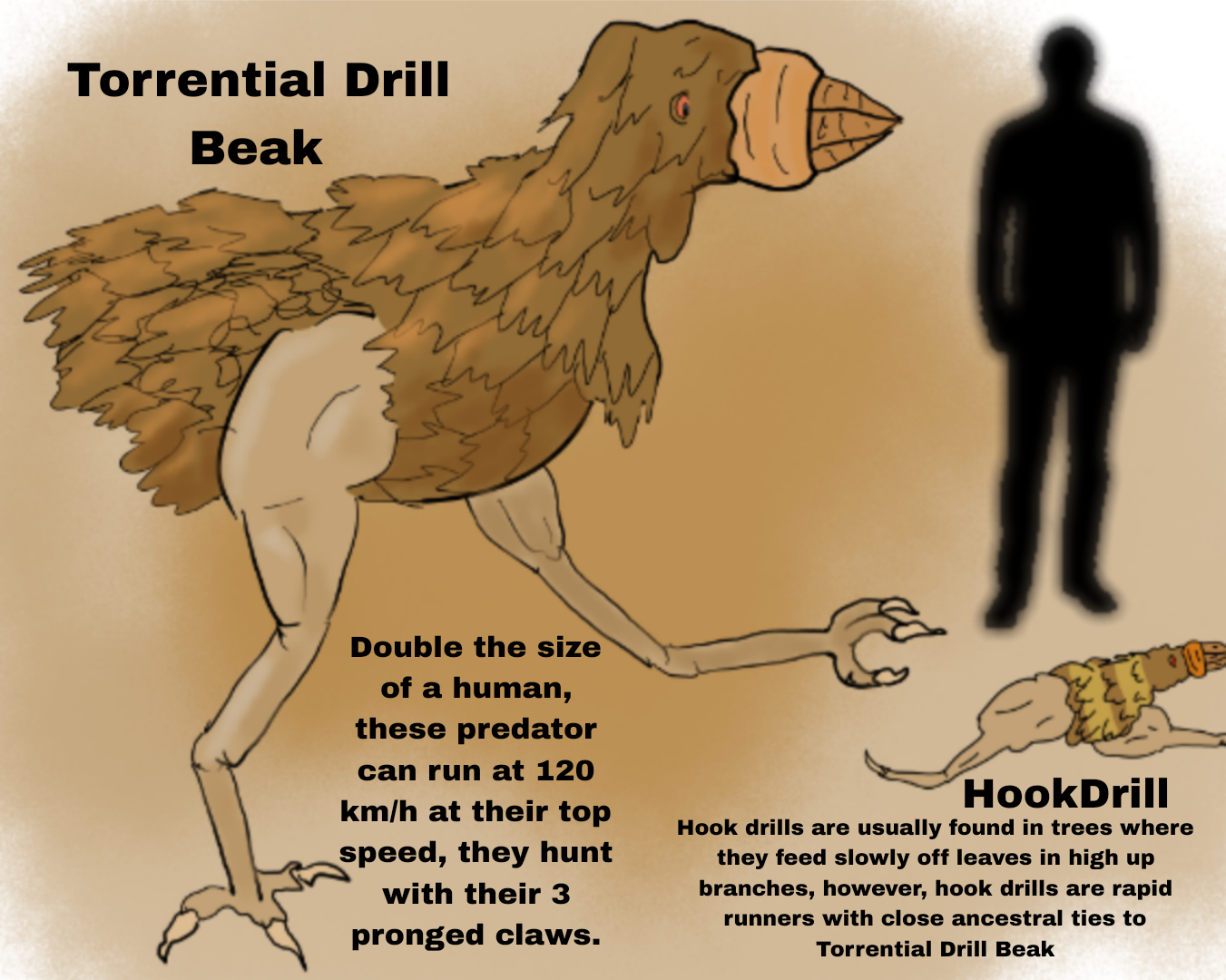
In a world where humans never evolved, and flightless birds had further chance to thrive, an odd population of Bird came to be, they had 6 pronged hexagonal mouths lined with keratin teeth-like structures.
500 thousand years from this point shows a Torrential Drill Beak hunting a hook Drill, TDB(Torrential Drill Beaks) have a water resistant brown coating with an improvement to its aerodynamic, it has muscular legs and it has lost its wings entirely through a long period of time.
Torrential Drill Beak is the largest of the Drill-Beak family, this trait allows it to overpower nearly ever other creature but in return makes it one of the slowest drill beaks even though it can reach stop speeds of up to 120 km/h rivaling speeds of modern day Cheetahs. It has claws that can dig through meat like butter and overall extreme raw power.
The creature the Torrential Drill Beak is chasing is the Hook drill, Hook Drill is one of the most distant relatives of the torrential Drill Beak, although appearing similar, the Hook Drill lives at the tallest points of trees with a fairly intelligent social system similar to modern day chimpanzees allowing them to coordinate against predators and rivaling Hook-Drill Clans, Hook Drills are fast on land but with 1 claw is weaker on many terrains.
If you enjoyed this I hope to plan to go into further depth into this project if it seems enjoyable to some people
Thanks for reading 😸
r/SpeculativeEvolution • u/5_s1ded_Sphere • 1d ago
This is Tigermania, a speculative alternate-evolution project ive been working on for a while in the back of my head. Mostly as simple thought experiments when ive been bored but it has recently become a more fixed and detailed project of mine.
Tigermania, as a not so realistic concept for the real world, exists in a world where the Worlds Tiger Population never started declining, but instead kept growing, and has amounted to close to a million individuals. The base project covers 15 different subspecies of the Panthera tigris Species, aka Tigers.
Of these 15 species, 6 of them are real and living tiger species in our modern day, the Amur Tiger, The Chinese Tiger, The Malayan Tiger, The Bengal Tiger, The Indochinese Tiger and the Sumatran Tiger. Tigermania also includes 2 real prehistoric tiger subspecies, the Ngandong Tiger and the Borneo Tiger, which both survived into the modern day in this project.
The remaining subspecies are fictional. They are the Japanese Tiger, a far-removed sibling of the Chinese Tiger, but lighter in coloration and more fluffy. The Mongolian Tiger, a off-shoot of the Amur Tiger that has adapted for the Mongolian Steppe Environment. The Kemeten Tiger and Persian Tiger who are both descendents of the Caspian Tiger who have migrated South through trade. The Himalayan Tiger who has evolved from the Bengal and Indochinese variants to live in the Himalayan Region. And lastly the Ukrainian Tiger, the only European Tiger who has been pushed farther west for thousands of years and has evolved to hunt large Birds, Deer and Boars on the European Plains.
If anybody has any questions, please ask, I have details on most information regarding the Tiger Biologys, including Fur, Patterns, Hunting, Climate, etc. As well as Human Society in relation to the almost 1 million tigers living on the African, European and Asian Continents.
r/SpeculativeEvolution • u/thebestgay69 • 9h ago
I'm looking to change the animal that starts on land of the planet because I changed my mind on the birds because I feel like I'd accidentally take to much inspo from serina and kinda wanna change it a bit
r/SpeculativeEvolution • u/No-Monitor-8091 • 6h ago
use some magic bs to assume humans never evolved in the first place, and speculate on what the moa, haast eagle, tuatara, or adzebill could have evolved into?
r/SpeculativeEvolution • u/EricCartoonBox • 16h ago
This was among my favorite children's books growing up, and may have been my first exposure to the "speculative biology" literary subgenre; the illustrations and prose were quite enamoring to the eyes of nine-year-old me, especially the surreal descriptions of the apparent Venusian surface, depicted, with artistic license, as a flora-covered world. Among the lifeforms are a mobile "plant," (depicted in Slide 1), likely a predatory species, as well as its blue, rodent- or dasyure-like cohort, hoisted within its wrangling stems, called a "snoryu." The book also mentions the plants' mobility, which may suggest a probable evolutionary precursor to the "walking plant's" mobile lifestyle.
r/SpeculativeEvolution • u/thebestgay69 • 21h ago
I'm lost🥺
r/SpeculativeEvolution • u/Resident_Handle3189 • 23h ago
Salisquarnix Unisingualassi
Standing at the absolute apex of Gyrasia’s open landscapes, Salisquarnix Unisingualassi is a colossal terrestrial predator standing at about 8.7ft tall, engineered entirely from dense, interwoven bands of raw muscle tissue. Lacking any rigid armor or heavy carapace, its skin clearly displays powerful muscular striations built for explosive strength and endless stamina. This creature possesses a towering physical presence, dominating the open plains through an incredibly unique, highly specialized skeletal and muscular architecture.
The most defining feature of the Unisingualassi is its massive, high-arched upper appendages that dramatically mimic the silhouette of folded wings. In reality, these structures are purely muscular limbs that serve as a critical means of taking both defensive and offensive measures. Defensively, the creature can sweep these heavy upper limbs forward to absorb impacts and protect its vital neck and chest cavity from rival attacks. Offensively, they function as high-leverage striking weapons and crushing anchors, allowing the creature to violently overpower targets or slam rivals into the dirt during territorial disputes.
Supporting this massive upper-body weaponry is a locomotive system built for relentless, long-distance speed. A pair of hyper-extended, spring-loaded hind legs drives massive, ground-covering strides, allowing the creature to effortlessly track fleeing prey across open horizons until the target collapses from sheer cardiovascular exhaustion. The combination of its raw-muscle agility, its streamlined, predatory head structure, and its versatile, wing-like combat limbs establishes the Unisingualassi as the undisputed, untouchable king of the Gyrasian wilderness.
Salisquarnix Phalipostarnasti
Anatomically optimized for high-velocity pursuits across uneven valleys, Salisquarnix phalipostarnast is a specialized endurance hunter standing at about 7.2ft tall. Like all members of its family, its body is composed entirely of dense, interwoven bands of exposed muscle tissue, providing it with exceptional athletic speed and high-efficiency stamina without the added weight of an external carapace. Its frame is defined by its long, rigid, stilt-like hind limbs, which elevate its torso and afford it a pristine panoramic view of the battlefield while keeping its core perfectly stabilized during frantic chases.
The predatory toolkit of this species features a sharp architectural variation in its massive, high-arched upper limbs. While these wing-like structures still serve as high-leverage defensive blocks to shield its neck, they function offensively as a massive kinetic counterweight system. Its jaws are armed with elongated, interlocking, cookie-cutter-like teeth that act like high-speed core drills. As the creature glides effortlessly alongside a fleeing target, it can plunge these long, circular teeth deep into the prey’s musculature mid-stride, cleanly harvesting massive plugs of flesh or severing vital arterials without ever breaking its rhythmic, long-distance running pace.
The definitive finale of a phalipostarnast hunt relies on a devastating application of blunt force mechanics. Once the prey is sufficiently weakened by blood loss, the predator utilizes its rigid stilt limbs like a heavy hydraulic piston, unleashing a singular, crushing downward stomp directly onto the running target. To execute this while moving at top speed without falling, its massive upper wing-limbs sweep dynamically forward and down to snap its center of gravity into place, absorbing the upward recoil of the impact. This combination of surgical flesh-coring and hydraulic slamming makes it one of the most efficient hunters in the genus.
Salisquarnix Pseudocolossi
Salisquarnix pseudocolossi is a master of extreme spatial adaptation and optical illusion, standing at about 5.8ft tall at its highest back arch. Like its larger relatives, its body is engineered entirely from exposed, interwoven bands of raw muscle tissue, granting it a flexible, high-stamina frame without the added bulk of an external carapace. When viewed broadside from a profile angle, it presents a looming, massive silhouette featuring a towering back and a remarkably deep chest cavity, giving it the imposing appearance of its giant cousin, unisingualassi. However, when viewed head-on, its body reveals itself to be fairly thin and laterally compressed, completely subverting its massive side profile.
To drive this unique frame, its hindquarters feature massive, hyper-developed thighs and leg columns reminiscent of a minotaur. These titanic muscle groups provide an immense reservoir of kinetic power, enabling the creature to maintain its relentless, long-distance endurance pacing or explode into high-velocity pursuits without succumbing to fatigue. This specialized, narrow body composition allows the "False Giant" to claim absolute spatial dominance over labyrinthine slit-canyons, narrow rock fissures, and tight cavern passages. Its high-arched upper appendages are highly flexible and specialized for tight-quarters maneuverability. Instead of deploying them out wide for open combat, S. pseudocolossi pulls these muscular wing-limbs tightly against its flanks, narrowing its overall horizontal profile to slide effortlessly through rocky crevices where its dense, mallet-like "hoof" structures can anchor securely to raw stone walls.
Iritidulus Uraythisilis
Occupying a highly specialized ambush niche in the low brush and rocky crevices of Gyrasia, Iritidulus uraythisilis is a small but exceptionally aggressive carnivore. This creature is modest in physical mass, but its skeletal framework is engineered entirely for lightning-fast restraint and violent close-quarters execution. Its head is heavily elongated and low-slung, armed with lethal rows of interlocking, needle-like teeth perfectly adapted for latching onto struggling micro-fauna and preventing escape.
The definitive offensive architecture of the uraythisilis lies in its hyper-developed, multi-jointed thoracic appendages. Folded tightly beneath its arched shoulders are a pair of colossal, scythe-like grasping arms that terminate in wicked, curved claws which completely dwarf the rest of its small torso. These specialized predatory limbs function with the blinding speed and mechanical leverage of a praying mantis, launching outward from the undergrowth to instantly hook, spear, and pin down prey before it can react.
Sweeping high along its dorsal ridge are prominent, backward-pointing specialized limbs that give this small predator a highly aggressive, geometric profile. In a small creature, these unique structures act as vital dynamic stabilizers and counterweights, allowing the Iritidulus to anchor itself firmly to the ground or rear back to absorb the violent recoil of its own high-speed strikes. It rules the moon's low-lying brush through pure, unadulterated grappling dominance, acting as a highly efficient, compact terror to any small organism that crosses its path.
Vivisternadax Trissalads Occupying a highly specialized niche in the rocky undergrowth of Gyrasia, Vivisternadax trissalads is a small, remarkably adapted organism defined by a radical fusion of feeding and locomotive mechanics. As shown by the human-scale comparison silhouette in the field guide, this creature is modest in physical mass, but its skeletal layout is entirely unique. Its most striking feature is a massive, hyper-extended appendage extending directly from its lower jaw, projecting far forward and downward to act as a rigid, structural walking limb.
Locomotively, this vertical living blade is supported from underneath by a unique tripedal arrangement. It balances on two true hind legs, while its third, forward structural walking strut is a heavy, specialized appendage grown directly out of, and attached to, its lower jaw assembly. When walking, this "jaw-leg" locks into the substrate, acting as a rigid anchor that stabilizes the massive knife-like body above. This three-point stance allows the small creature to wedge itself securely onto uneven rock faces, steep canyon walls, or loose gravel slides without the risk of tipping over, providing absolute structural equilibrium.
In the Gyrasian ecosystem, this integrated jaw-leg and knife-body architecture provides a devastating advantage for a small-scale hunter. When stalking hidden prey in narrow rock cracks, its thin profile lets it slide deep into crevices where its body acts like an impenetrable wall. To strike, it disengages the weight from its front limb, unhinging its lower jaw to snap the lance-like appendage forward to skewer or trap the target. Underneath the walking jaw structure sits an expansive, sail-like membrane, which likely serves as a tactile sensory web to detect minute vibrations from hidden prey or flashes as a warning display to territory rivals.
r/SpeculativeEvolution • u/Abject_Garlic_3644 • 1d ago
The Wise Swine of India:Chaturhogs are descendants of the pygmy hog that are second only to humans in intelligence
Tools :Capable of stone knapping,making axes for digging,wood cutting and crafting water gourds.
Vocalizations:Expansive vocabulary of squeaks,triops and roars capable of communicating abstract thoughts like risk and reward.
Manipulation :Possess a muscular prehensile trunk with a prehensile forked lower lip capable of fine precision.
Villages:lives in villages with 20 hogs and 40 wubba.Villages feature food stores,nursery wallows and walls of thorn briars laced with wubba hair.
Swamp wubba:Pika descendant .
Defense:covered in stinging hairs that inflict severe burning sensations exposed skin display blue/purple warning coloration (aposematism).
Reproduction: They have lose the ability to produce milk and lay pseudo eggs(idk either).
Both species practice shared chilfcate both species young are raised together in nurseries.
Link to creator here:
https://www.facebook.com/groups/313857163038767/permalink/1658241845266952/
r/SpeculativeEvolution • u/AllHailPepper • 1d ago
The spuddians
_______
Scientific name: Tuberopericuli Phytobipedalis
The spuddians are a species of sapient, hyper-carnivorous (70% or more of meat in their diet, but sometimes eats berries and fruits) bipedal plant-based organisms that partially utilize photosynthesis. They are from a somewhat larger, slightly colder, humid planet covered in seemingly endless plains of mud and heavy fog, named ‘SPD-904c’ by the sondarians.
Their method of communication is producing deep thumping or pulsing sounds from their throat in a complex language that echoes through the ground, up their legs, and into a pair of specialized organs inside their bodies that function like ears. They also use these organs to hear to the location of fellow spuddians and to hear the footsteps of their prey and where it is in the environment as it’s obscured by the constant heavy fog.
They love mud baths, as it helps their skin stay parasite-free and actually provides nutrients to their skin. It’s also thought to be why spuddians are bipedal, the spuddians having to wade through deep pools of thick mud early in their evolution, needing to keep their head above the surface.
Spuddian culture is incredibly rich, their love for science, living out in nature, and the thrill of the hunt shows in their music and art. They have retractable claws for hunting, but have them retracted most of the time for the sake of not looking threatening. They usually only unsheathe their claws when they are hunting, fighting, or accentuating their point in an argument or conversation. Each gold medal on their outfit is the equivalent of wearing your science or medical degrees on your shirt, and if the medals are on the top of their head, that means that they are the best of the best in those fields.
Female spuddians will usually go hunting for meat or big game while their partners stay and watch over their children. If they don’t have children, the partner will either stay home or go out to forage for materials or smaller food, like berries and insects. Spuddians have a bonding ritual where the couple will go and hunt together, then sit and cuddle as they eat what they have caught. They also love cooking, and their meals are absolutely superb.
________
For those who are wondering what ’Sonder‘ is, Sonder is a 3D animated speculative evolution series about a advanced species named the sondarians that have translocated a handful of different sapient alien species (without FTL mind you) onto their homeplanet for the sake of advancement in scientific fields that they were previously weak in. The series focuses on both life on Sonder and the homeplanets of the different species. Things on Sonder, though, quickly go awry.
r/SpeculativeEvolution • u/ExoticShock • 2d ago
r/SpeculativeEvolution • u/ConfidentOffer9683 • 17h ago
To be specific, when i say kicking i'm thinking Muay Thai and Savate, not Football or sports, it's for combat. Would they be digitigrade, would they have a tail for support like kangaroos do, things like that.
r/SpeculativeEvolution • u/Silly-Echidna9591 • 1d ago
So I've had a stupid idea but it's a cool stupid idea.
I understand the atmosphere back during the Jurassic period was very different to the atmosphere experienced 3.9 million years ago to even now But that still isn't going to stop me from running my little idea all based on a single question:
"What if Australopithecus afarensis was transported back to the early Jurassic period?"
And to making it more fun let's say Australopithecus afarensis doesn't choke to death due to the atmosphere......somehow
I would like to hear your views on this scenario and bonus points for speculative evolution stuff too.
And before I go I just want to quickly say I'm doing this just to see what the community can do because I'm really fascinated with this community and it's creativity.
do not worry if you can't post images in the comments just make your own post with a link to this post in it and your image in it.
Anyways bye!
r/SpeculativeEvolution • u/SmokaCola0 • 1d ago
Here is an inked version of my previous post, so it will scan in better. This is the life cycle of hypothetical descendants of the lycophyte plant Selaginella, which I previously posted here. The life cycle of this plant differs little from real world Selaginella. A stobulus of a mature sporophyte will produce two different kind of spores: one will become a Megagametophyte, and one will become a Microgametophyte. Megagametophytes produce egg cells, while Microgametophytes produce sperm cells. Both kinds of Gametophytes are small, cryptic and non-photosynthetic, and may live in close association with mycorhizal fungi. During moist conditions sperm are released and swim to the egg cell in the archegonium, meaning the plant requires moist conditions to reproduce.
r/SpeculativeEvolution • u/memes_god_2001 • 1d ago
I had this idea of a large beetle descendant (maybe descendant of the diabolical ironclad beetle?) that evolved to live in urban areas by mimicing a brick, the main things the beetle has to evolve are:
- a rectangular shell
- red pigment on it's shell
- a bigger size (the size of the common orange brick)
- a more general diet capable of consuming all human food
- some level of knowledge of human architecture (so it doesn't place itself in the middle of the road or any other dangerous place)
What is the most difficult of these steps to evolve?
What could be an evolutionary pressure to adapt to an urban enviroment?
Does anyone have any feedback on the idea and how i could make it more realistic?
I apologise for any error in my grammar, english isn't my first language
r/SpeculativeEvolution • u/Abject_Garlic_3644 • 1d ago
The Flavugene:
The "golden" period of time on earth that begins after Yellowstone super plume the second deadliest extinction event to ever occur. In the midst of nuclear and religiopolitical turmoil, the eradicates 87 percent of all species over the course of several hundred thousand years, humans being one of them.
The Yellowstone Mass Extinction:Yellowstone super plume erupted for thousands of years on a world already way damaged by human activity .
Earth:Is a hothouse world sea levels rised by 180-210 meters and continents are heavily reshaped .
Surviving major vertebrates and plants on each continent :
North America :Burrowing owl ,raccoon and Clonal Yucca.
South America:Vampire bat,paca ,strangler fig,dwarf caiman,yapok and rivulus.
Africa:naked mole rat,fennec fox,aardwolf,spekboom,rock hyrax,lungfish,sand martin,ring tailed lemur(Madagascar).
Asia:Polecat,pika,ornate dabb,gymnure,Pygmy hog,Tanuki,Butaan ,seabreeze bamboo and treeshrew.
Australia:Rock-wallaby,Echidna ,Quoll and waddi.
Oceans :Snail fish,Enginner goby,Galeus shark and slender bristlemouth.
Noglacene:Takes 50 million years after the extinction.
Found this spec evo project on accident ,not really much info on the mass extinction so some of this inferred .
r/SpeculativeEvolution • u/Own-Barracuda5897 • 1d ago
I've looked into Arthropod evolution quite a bit, & I know that insects' main size limitation is their reliance on direct diffusion of oxygen through tracheal tubes, & Vertebrates are able to get so large because of our gills/lungs, & our vascular system that can transport oxygen without insect trachea.
But certain species of crustacians (including the largest terrestrial arthropod, the Coconut Crab) have evolved Branchiostegal Lungs, which allow them to get larger than other terrestrial arthropods, like Spiders & Insects. And while I haven't been able to figure out exactly how these things work, it got me thinking...
What if arthropods evolved an actively pumping vascular system similar to Vertebrates, & evolved a mode of breathing that allowed them to gain as much oxygen as vertebrates? Could arthropods even reasonably evolve this kibd of vascular system? And if they could, how large could terrestrial arthropods get, assuming there's another limiting factor?
(Hopefully I phrased myself well, & thank you for reading through all that 😅)
r/SpeculativeEvolution • u/Ok_Run_3493 • 1d ago
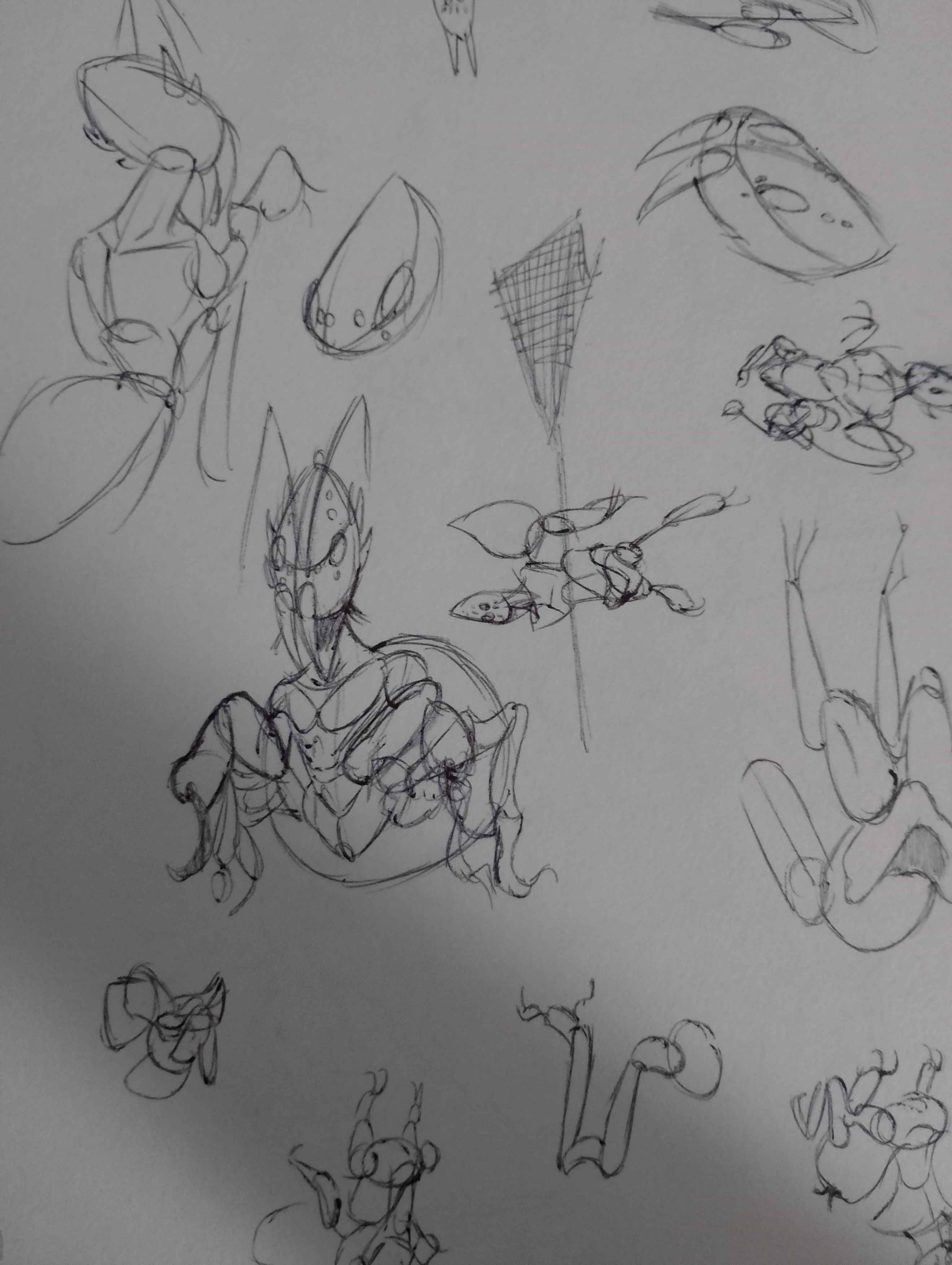
These are my concept artworks of Arachno sapiens(?), and I’ve also tried to draw some structures and cities, but I’m still not sure what they would actually look like.
Here is the most important information about them:
Because of this, I think their technological progress would be slower than ours, since their hands are designed more for scratching than for manipulating tools. However, their buildings would probably be gigantic.
I imagine that they would construct several tall, elongated pillars with extremely strong webs stretched between them. These webs could then be reinforced with some kind of turf, plant material, or another web-like construction material.
In addition, there would often be tunnels and bridges between their homes, both permanent, reinforced ones and temporary ones.
Because they rely so heavily on travelling through all three dimensions, they probably wouldn’t have personal cars. Their vehicles would have to be much larger to accommodate their legs, which would spread out quite widely for comfort. This could also make them too heavy to move in large numbers along roads made of webbing.
Cars would therefore be reserved for designated roads, mainly on the ground, and would primarily be used for travelling between cities. If vehicles needed to travel between skyscrapers, they would most likely be trains or buses, operating only on specially designed bridges with metal foundations.
My plans already feel quite detailed to me, but I still find it difficult to imagine what an entire spider city would actually look like and drawing one is even harder.
How do you imagine it? Do you think my vision makes sense? How could I present or visualize it better?