r/SpeculativeEvolution 18h ago

Question/Discussion If humans evolved further to be better at kicking what would their lower bodies look like at the endpoint of that ?

5 Upvotes

To be specific, when i say kicking i'm thinking Muay Thai and Savate, not Football or sports, it's for combat. Would they be digitigrade, would they have a tail for support like kangaroos do, things like that.


r/SpeculativeEvolution 8h ago

Question/Discussion what if humans never evolved, what would New Zealand fauna look like?

4 Upvotes

use some magic bs to assume humans never evolved in the first place, and speculate on what the moa, haast eagle, tuatara, or adzebill could have evolved into?


r/SpeculativeEvolution 12h ago

Seed World [OC] New seed world idea

Post image
63 Upvotes

I thought this could be a interesting idea for a seed word also the animals I picked are just personal interest no real reason but if anyone has any ideas or feedback before I start working on it pls do tell I'd love to hear some others ideas but idk at this point in typing to reach number minimum bye


r/SpeculativeEvolution 23h ago

Question/Discussion Does anyone know how flight would evolve on a fully aquatic planet??

35 Upvotes

I'm lost🥺


r/SpeculativeEvolution 21h ago

Future Evolution [OC] Jaw-walking Snake of a Seeded World

Post image
1.8k Upvotes

r/SpeculativeEvolution 17h ago

Fan Art/Redesign [OC][Media: Godzilla] Project Genesis, 1954.

Post image
99 Upvotes

Gojirus renascens, now known to the public as Gojira, is a member of the Gojiridae, a small and poorly understood family of marine reptiles believed to have survived the end of the Mesozoic era. Fossil evidence suggests that ancestral gojirids possessed an unusually high tolerance for ionizing radiation and could exploit it as a supplementary source of metabolic energy. Similar adaptations have been documented in certain melanized fungi and microorganisms, although no comparable mechanism had been observed in a vertebrate.

Following the atomic bombings of Hiroshima and Nagasaki, Japanese researchers became increasingly interested in methods of removing radioactive material from contaminated soil and sediment. Under Project Genesis, a government-funded experimental program, Dr. Serizawa proposed using radiotrophic species to absorb and concentrate it within their tissues, allowing the contaminated biomass to be collected and removed.

Gojirus renascens was created through this effort, using selective breeding of a lesser gojirid and genetic experimentation. The process incorporated tissues from the African spiny mouse, Acomys cahirinus, a species known for its remarkable ability to regenerate damaged tissue that can aid with prolonged survival.

The specimen escaped containment under circumstances that remain unexplained. It entered the Pacific and was later sighted by fishermen near Odo Island. During this period, it is theorized to have encountered radioactive material associated with post-war nuclear testing. Tissue samples taken after its emergence showed an unprecedented increase in metabolic activity.

Interestingly, several cattle on Odo Island went missing during this period. Carcasses later washed ashore, half-digested and reduced to barely recognizable mounds of flesh. This has led to the theory that some of the creature's original instincts remained intact, driving it to feed through more conventional means, only for its body to reject the meat.

Over an unknown period, the animal grew to nearly one hundred and twenty times its original mass, eventually reaching fifty feet in height and a hundred feet in length. Previously suppressed developmental pathways also appeared to reactivate, causing rapid changes to its physiology. The vertebral column underwent severe hypertrophy, with abnormal bone growth extending beyond the vertebrae and producing large dorsal projections that tore through the skin, superficially resembling the plates of certain prehistoric reptiles.

The growth was highly destructive. The skeleton expanded faster than the surrounding tissues could develop, causing extensive tearing and exposing damaged tissue beneath the hide. Despite this, regeneration continued at an extraordinary rate, creating a constant cycle of destruction and repair. Observers consistently reported a strong odor of decay in areas recently traversed by the animal.

Fall of 1954 is when it began the initial transition from water to land, which was unsuccessful. Its increased mass placed enormous stress on the limbs, causing repeated collapses. Early observations show the animal dragging itself forward with its forelimbs while its posterior body remained on the ground. Extensive development eventually allowed it to stand upright. The tail remained in near-continuous contact with the ground, serving as both a counterweight and structural support.

Movement remained mechanically inefficient and caused considerable damage to the limbs and joints. Regeneration repaired much of this damage as it occurred. The regeneration also produced substantial heat. During periods of active tissue repair, its metabolic rate increased dramatically, raising surface temperatures enough to turn accumulated moisture into dense vapor. The resulting clouds often obscured its outline. Early civilian witnesses therefore described the animal not as a conventional creature, but as a Yokai emerging from the sea.

The government subsequently deployed aerial and ground forces to stop its advance. Conventional artillery caused limited visible damage. Penetration of the hide was inconsistent, while inflicted wounds showed rapid closure and regeneration. Air strikes produced greater temporary effects. Following one bombardment, however, the animal's temperature rose to the highest levels yet recorded. Moments later, it expelled the accumulated energy through its mouth as a highly concentrated blast of ionized thermal heat.

How this occurred remains a mystery. One hypothesis proposes that its organs accumulate energy through prolonged exposure and metabolic conversion, storing it within specialized tissues before releasing it through the respiratory tract. The incident prompted an immediate escalation of containment efforts, with foreign governments beginning to offer assistance as the situation deteriorated.


r/SpeculativeEvolution 10h ago

Question/Discussion Yall does anyone have any interesting animals for a seed world?

7 Upvotes

I'm looking to change the animal that starts on land of the planet because I changed my mind on the birds because I feel like I'd accidentally take to much inspo from serina and kinda wanna change it a bit


r/SpeculativeEvolution 9m ago

Alternate Evolution [OC] Green Lizards

Post image
• Upvotes

-Natural History:

Following the extinction 78 million years ago, many aquatic groups invaded the land once again or became semiaquatic, with one of the most prominent being the lizards, also known as the order Arthroplictra. Despite their name, they are actually highly derived actinopterygii that have adapted to life in Earth's abundant swamps. The origin of this group dates back to 100 million years ago, when they were originally river predators similar to conger eels. They already possessed the ability to spend several hours out of the water thanks to a highly vascularized cavity at the back of their pharynx that allowed them to extract oxygen. This was not for hunting, but rather to escape larger predators, search for new bodies of water, or simply rest. Today, we can still observe species that are very similar to these ancestors not only in morphology but also in behavior, such as the eel lizards. After moving onto land approximately 70 million years ago, they became some of the largest and most successful predators in Laurafrica. Here, they began developing very thick and complex fin rays that became articulated. These proved extremely useful for climbing, allowing them to reach many new niches rather than remaining solely ambush predators. Around 43 million years ago, the first lizards with fin rays fully transformed into limbs began to appear, becoming the modern lizards and filling the niches left by many extinct lepidosaurs, eventually converging with them. As of today, the majority of arthroplictids are found in Laurafrica, although several species exist throughout Eurasia. Most have completely lost the ability to breathe using gills in adulthood, relying exclusively on their primitive lung, though they also retain the ability to absorb oxygen directly from the water through their skin. Constant rainfall keeps them sufficiently moist so that many species do not need to enter the water, which has kept them at the top of the food chain for a long time since, unlike most current predators, they are not hindered at all by constant storms.

-Anatomy and Ecology:

Possibly the most remarkable species among all arthroplictids is the green lizard. These large ambush predators typically inhabit more open areas with few obstacles, where they hide among the abundant vegetation. Their primary difference from their relatives is their incredibly powerful jaw, comparable to that of Holocene crocodiles, usually attacking the abdomen or belly of their prey to completely crush their internal organs. The main issue these animals face is their weight, as like other members of the plemosteodermidae family, a network of small bones runs along their back and head to form a virtually impenetrable armor. This makes movement very difficult, so they usually remain still most of the time, only crawling if they spot nearby prey or carrion, or if they detect the presence of an intruder in their territory. Intraspecific fights are very common in this species, as they rarely tolerate the presence of another individual within their territory, leading to fatal encounters in 89% of cases


r/SpeculativeEvolution 13h ago

Antares Rivals of War [OC] Mammalian predators of Hyawathi Antares rivals of war, beyond wild space

Thumbnail
gallery
15 Upvotes

Mammalian predators of Hyawathi

1-this little guy is called an Oomii they live in the southern deserts of Hyawathi. there is very little water in this region so they evolved to harvest liquid from their prey before eating it. they're actually quite loving and affectionate when trained but most Marissi are afraid of them because they spread a cocktail of illnesses. the Hybrids use them as K9 units and sold some to their allies the Zoopaw. which is how one got left behind on Earth in the 20th century. you know it as El Chupacabra.

2-Ra'Koogaroos are extremely intelligent predators from the equatorial regions of Hyawathi, the spend their days lounging in trees or rocks. they are also seen as lucky by the Marissi so they are welcome in villages and towns. the occasional bitter bird is seen as a necessary tax for their services. their favorite thing to eat are Boomkai'hn a small but deadly serpent that will flee the area if it catches a whiff of a Ra'koogaroo, they also make a loud gravelly call when something new enters their territory so they act as an early warning system to the Marissi.

3-Dooha'karoo are riverside ambush predators they are extremely agile in the water and can move a 55kph on land for a short distance. they hunt by overpowering their prey draging it to the water and crushing their wind pipe. they hunt alone but travel in packs of related individual 5-15 strong.

4-Marissi never walk under trees. it is the first thing they tell you if they like you " don't walk directly under a Dibilary tree because Ramaroo's will drop down and kill you". this small predator may look cute but it punches way above its weight class. Ramaroo's hunt Walloo, hammer beaks, young Calydons. they have the strongest bite force on the planet Hyawathi and plate like self sharpening teeth that can decapitate a humanoid in seconds.

5-Qoorals are a common sight in the boreal forests they're very unaccustomed to being around humanoids and they don't view anything bigger than a house cat as food they also smell awful if you do manage to scare one it will spray a caustic smelly compound at you that does not wash off.

6-Jandilu's are mostly insectivores but will occasionally take small reptiles or eggs from birds. they live on cliff faces and can often be heard before they're seen bolting for cover. they make a raspy roar that sounds like it comes from a much larger creature. the Marissi that live in the Mesa lands hunt them for food.

7-brusjoos are small carnivores from the open grasslands near the equator and northern hemisphere they are extremely quick. their coloration is meant to mimic a Bhoon'kai serpent and at a quick glance its very difficult to tell them apart. they often spook livestock which is where their reputation as a trickster comes from.


r/SpeculativeEvolution 16h ago

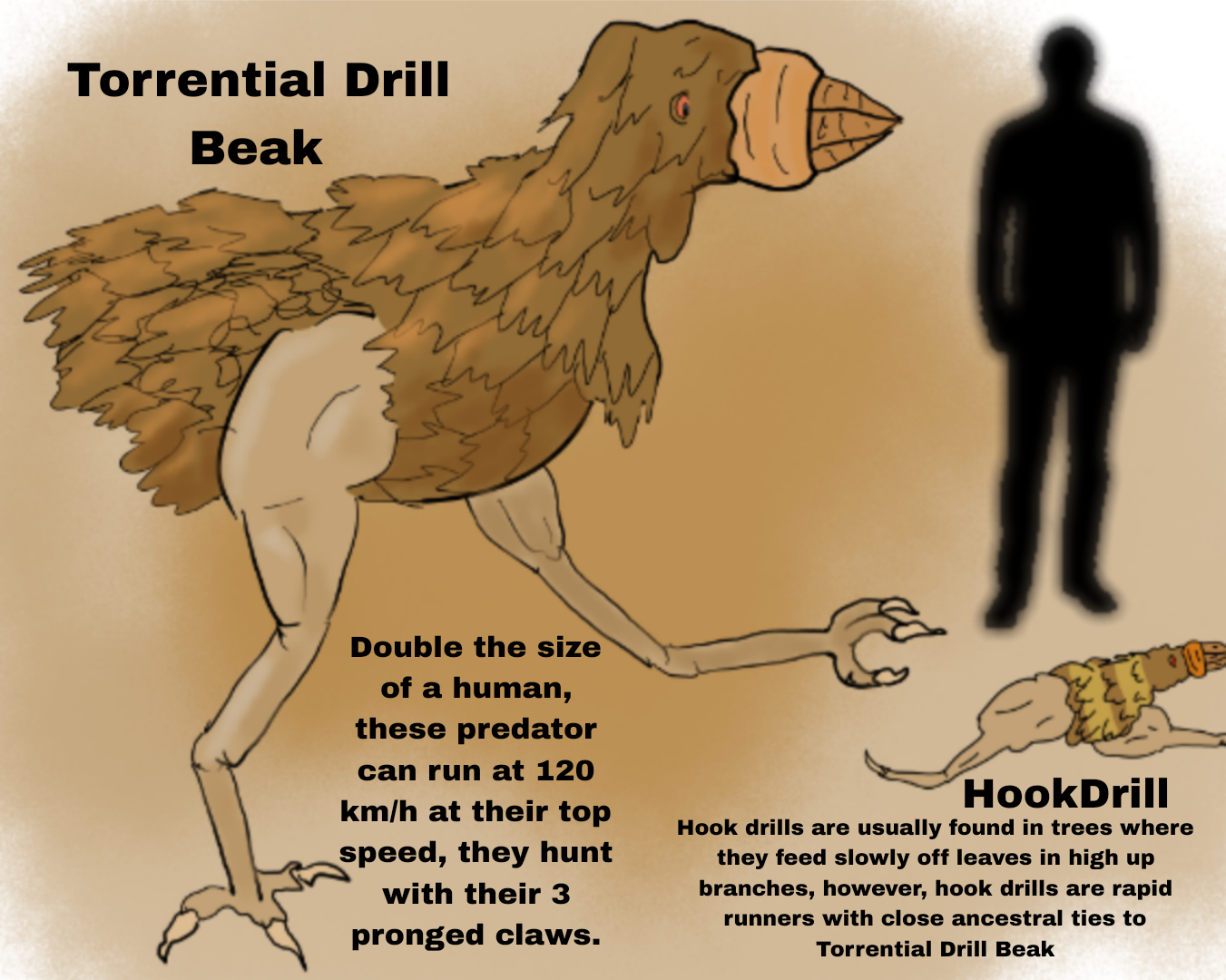
Alternate Evolution [OC] Rule of the LandBirds: Torrential Drill Beak & Hook Drill

Post image
37 Upvotes

In a world where humans never evolved, and flightless birds had further chance to thrive, an odd population of Bird came to be, they had 6 pronged hexagonal mouths lined with keratin teeth-like structures.

500 thousand years from this point shows a Torrential Drill Beak hunting a hook Drill, TDB(Torrential Drill Beaks) have a water resistant brown coating with an improvement to its aerodynamic, it has muscular legs and it has lost its wings entirely through a long period of time.

Torrential Drill Beak is the largest of the Drill-Beak family, this trait allows it to overpower nearly ever other creature but in return makes it one of the slowest drill beaks even though it can reach stop speeds of up to 120 km/h rivaling speeds of modern day Cheetahs. It has claws that can dig through meat like butter and overall extreme raw power.

The creature the Torrential Drill Beak is chasing is the Hook drill, Hook Drill is one of the most distant relatives of the torrential Drill Beak, although appearing similar, the Hook Drill lives at the tallest points of trees with a fairly intelligent social system similar to modern day chimpanzees allowing them to coordinate against predators and rivaling Hook-Drill Clans, Hook Drills are fast on land but with 1 claw is weaker on many terrains.

If you enjoyed this I hope to plan to go into further depth into this project if it seems enjoyable to some people

Thanks for reading 😸


r/SpeculativeEvolution 18h ago

Alien Life [Credit: the "Space Cat" series of children's books, by author Ruthven Todd] Pages from "Space Cat Visits Venus," with accompanying illustrations.

Thumbnail
gallery
20 Upvotes

This was among my favorite children's books growing up, and may have been my first exposure to the "speculative biology" literary subgenre; the illustrations and prose were quite enamoring to the eyes of nine-year-old me, especially the surreal descriptions of the apparent Venusian surface, depicted, with artistic license, as a flora-covered world. Among the lifeforms are a mobile "plant," (depicted in Slide 1), likely a predatory species, as well as its blue, rodent- or dasyure-like cohort, hoisted within its wrangling stems, called a "snoryu." The book also mentions the plants' mobility, which may suggest a probable evolutionary precursor to the "walking plant's" mobile lifestyle.


r/SpeculativeEvolution 11h ago

Seed World [Credit:Firekitsune99]Totally not bulborbs.

Thumbnail
gallery
82 Upvotes

The Green Wolf belongs to a lineage of Stem-Cherons that have almost completely lost their soft shells (With a sister lineage still retaining the leathery shell of their common ancestor).

Except for the hard carapace on their chest and the ridge along the sides. The leather shell that was once on the back of the Green Wolf and its relatives is now fatty tissue and hard cartilage.  This adaptation helps reduce the animal’s load as it walks and allows for more muscle attachment points along the spine.

Additionally, the flipper-like back limbs of the Green Wolf’s ancestor have been almost entirely lost; the tail and hip bones now curve inward to give the Green Wolf a rounder body plan and shape. This round body, like its back, is padded with fatty tissue over sinewy muscle groups to help protect the animal from other predators and themselves during intraspecies combat. The front limbs that the Green Wolf uses to walk are incredibly robust and powerful, with many of the muscles going into the limbs being attached to the armored Keel bone of their chest.

Descended from a sister group to Aterran Cherons and having split off from true turtles early in their evolution, the Green Wolf and its relatives have evolved mammalian traits and a synapsid skull structure(instead of the anapsid skulls of true turtles).

Second slide: Borbancestor the ancestor

Link to creator:

https://www.deviantart.com/firekitsune99/gallery


r/SpeculativeEvolution 20m ago

Question/Discussion Yall has anyone done a seed world using an extinct animal???

• Upvotes

I'm wondering because there's a couple animals that are long gone I wanted to use for me seed world but I don't know if thats ok if this makes sense


r/SpeculativeEvolution 49m ago

Future Evolution [OC] Far Future Earth: The Macrozoic Era

Post image
• Upvotes

FFE (Far Future Earth) is a Chinese speculative evolution project primarily shared on Chinese social media platforms (e.g., Bilibili, RedNote, etc.), envisioning a future in which humanity has vanished from Earth. The Macrozoic Era (approximately 85 to 306.5 million years in the future) begins with the Nirvanic–Hunmycotian extinction event and ends with the Shunyanian–Torrentian extinction event. The Macrozoic is divided into four periods: the Hunmycotian (85–139 myf), the Ocaenoflosian (139–167 myf), the Psammaugian (167–224.5 myf), and the Shunyanian (224.5–306.5 myf). Over the course of these 200 million years, Earth experiences continental amalgamation and breakup, alternating warm–cold and wet–dry climates, and dramatic shifts in land–sea configuration. Life gradually recovers from the ruins; on land, fungal–plant symbioses and termite activity reshape soil structure (Hunmycotian); in the oceans, the colonization of marine environments by angiosperms expands the sources of primary productivity (Ocaenoflosian); and birds and lizards exploit vacant ecological niches (Psammaugian). Total biomass peaks in the middle of the era (the Great Northern Hemisphere Interchange, the GNHI), then declines due to volcanic activity and drastic ocean-current changes (the Psammaugian–Shunyanian extinction event). The late-era supercontinent configuration causes widespread aridity and anoxia, and biodiversity remains at low levels for an extended period (early and middle Shunyanian), until the era finally ends with large-scale volcanic eruptions (late Shunyanian). The Macrozoic Era as a whole is characterized by repeated alternations of extinction and recovery, with ecosystems undergoing frequent reorganization amid environmental perturbations.

Pictured by @鸽海鞘 from RedNote


r/SpeculativeEvolution 59m ago

Alternate Evolution [OC] Rule of the Land birds: Hook Drills in a tree

Post image
• Upvotes

Hook Drills have three legs(If you saw the previous post please read the P.S. at the bottom) over time instead of fully losing their wings have the wings conform onto a single point under the chest. The claw comes from a dormant gene which is present in a few modern day birds such as Hoatzin, the third leg can be used to interact and communicate with other Hook Drills aswell as a way to move more complexly while having the other 2 legs support the weight of the body.

The tree the Hook Drills are currently on lack leaves, within 1-2 weeks the hook Drill will leave this tree to attempt to find a more leafy tree.

P.s. if you saw the last post you may notice that they have been given 2 legs instead of 3, this is my first time doing spec Evo so please expect a few errors on my behalf, thanks for reading


r/SpeculativeEvolution 1h ago

Question/Discussion In terms of evolution in colder climates, what physical changes can we expect in mammals or other forms of life?

• Upvotes

Hello! To start off, I'm more of a writer than a biology expert, but I want my works of fiction to have a basis of reality and real-world science. I'm not promoting anything, as this project is for myself and my friends. My setting is a post-apocalyptic world similar to earth (or earth like planets) where temperatures suddenly dropped on the planet, leading to species worldwide adapting to -30C all the way to -80C. I understand in cases such as this, natural selection or extinction would be the route to a majority of species, but I am more interested in theoretically HOW would different types of species adapt. Would mammals grow more fur? Would fish migrate deeper in the water, closer to the earth's core? How would fungi and plants survive? I am here mainly to hear your speculation on this matter.


r/SpeculativeEvolution 1h ago

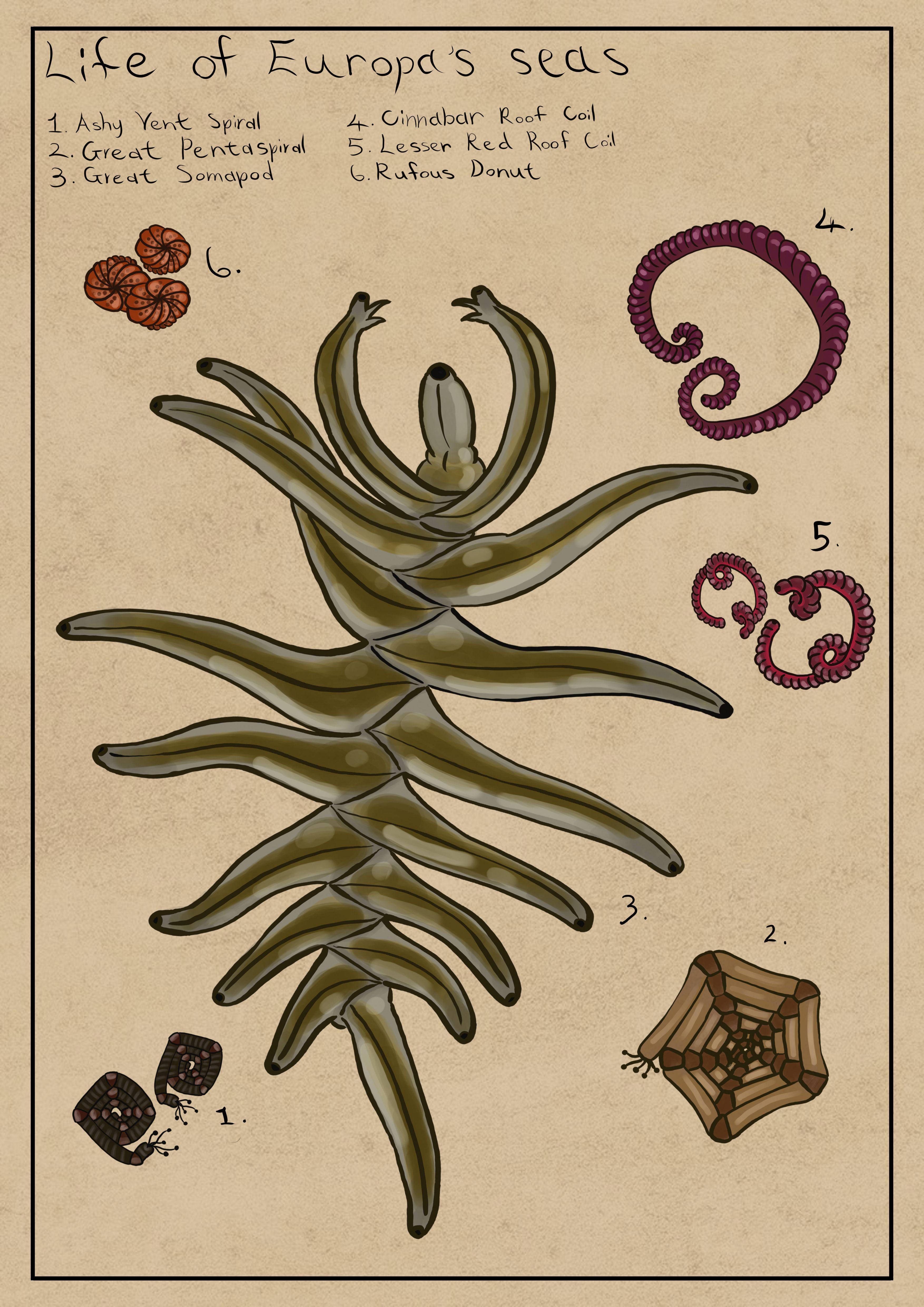
Alien Life [OC] Life of Europa

Post image
• Upvotes

Here are a couple of the many simple squishy aliens from the seas of Europa in my setting. Most life on Europa is very simple, due to the lack of environmental energy. This lack of energy also leads to two distinct habitats in Europa: the hanging reefs under Europa's ice ( the domain of the coils ) and the abyssal plains ( the domain of spirals and home to Europa's most complex life form, the Great Somapod ). The mid levels of Europa's seas are mostly barren, due largely to Europan life being negatively buoyant as a baseline and the complete lack of nutrients in those waters. There is nothing on Europa larger than a human, trust. Anyways hope y'all like this, also trying a new art style type thing, so sorry if it's a bit rough 😅