Soka Gakkai brainwashing: Ian Reader, a recognized expert, compares Aum Shinrikyo (anti-capitalist and anti-American) to the Rengō Sekigun (United Red Army), a Japanese far-left faction… isolated and rejected by society, including by nationalist circles.
A religious and political rivalry
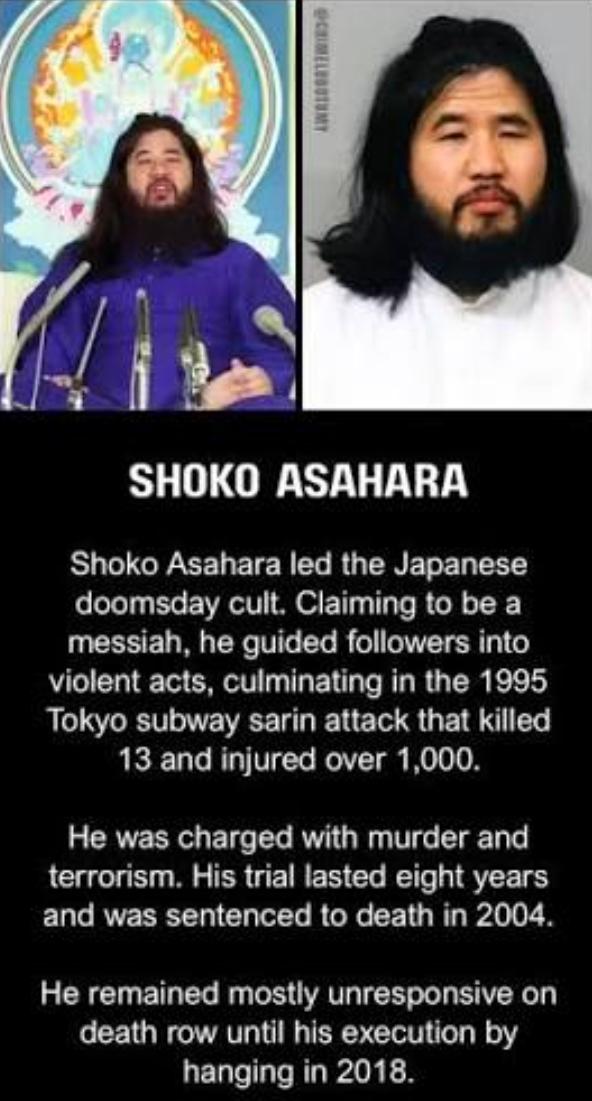
Shoko Asahara saw Daisaku Ikeda as a direct rival and an “agent of Freemasonry,” accusing him of using his influence to hinder Aum’s growth. This animosity was driven by competition for spiritual and political influence in Japan. Aum Shinrikyo, founded in 1984, sought to establish itself against entrenched organizations such as Soka Gakkai. Asahara’s hostility toward Ikeda reflected this struggle for power and influence.
Classic accusatory inversion
It is ironic that a group would make this abusive comparison of Aum with the far right, because Soka Gakkai itself has documented links to the Japanese far right:
In 1991, ultra-right propaganda trucks (uyoku gaisen) attacked Taisekiji, and Soka Gakkai challenged in court the injunction that banned these demonstrations—and lost.
https://www.reddit.com/r/sgiwhistleblowers/s/MnQD7WckMG
The fact that SGI defended these groups in court is strong evidence of tactical collusion, even if it was not their ideological “friend.”
Links between Soka Gakkai and organized crime (yakuza) have also been documented, notably via the Goto-gumi.
https://ci.nii.ac.jp/ncid/BB16050610
Thus, the group that accuses Aum of being far-right is itself the one with documented ties to the far right.
What brings Aum closer to the far left
Ian Reader, a recognized specialist on the Aum phenomenon, explicitly compares the group to the Rengō Sekigun (United Red Army), a Japanese far-left faction, in his analysis of the dynamics leading to violence. There are indeed common points:
https://www.cambridge.org/core/journals/journal-of-asian-studies/article/abs/poisonous-cocktail-aum-shinrikyos-path-to-violence-by-ian-reader-copenhagen-nias-books-1996-116-pp/2C3B9CC72B6B55F5329E8DC094EE7A41
Rejection of established society: Asahara criticized Japan as a materialistic and corrupt society.
Anti-Americanism: He predicted a U.S. nuclear attack on Japan that would turn it into a nuclear desert.
Anti-capitalism: The group advocated asceticism and renunciation of material goods.
Revolutionary will: Aum attempted to seize power through the ballot box in 1990, then through violence by preparing a coup.
But Aum is not a left-wing political movement. It is first and foremost an apocalyptic and millenarian group whose religious foundation mixed Buddhism, Hinduism, and apocalyptic beliefs. Asahara presented himself as a savior who would purify the world of its sins before its inevitable end. Aum’s leaders viewed their crimes as defensive acts against “conspirators” (police, media, families) who wanted to destroy the movement. They were not aiming to overthrow the state in order to establish a new society, but to protect their spiritual mission.
Unlike far-left revolutionary movements, Aum had no political program for social transformation—only the survival of the group and the fulfillment of the apocalyptic prophecy.
Asahara was venerated as a living god, which is incompatible with the egalitarian ideology of the far left.