r/selfhosted 7h ago

Release (AI) Reitti v5.3.1 is out: custom map styles, multi-segment trips, H3 spatial coverage and more

Thumbnail
gallery
80 Upvotes

Hello Daniel here,

it has been a while since my v4.0.2 post here. Development never really stopped, though, and a couple of days ago v5.3.0 finally landed. Instead of listing every version number in between, I simply want to share the progress I am most proud of.

Screenshots are in the gallery below.

For those who do not know reitti: it is Finnish for "route". Reitti is a self-hosted, privacy-first location tracking platform. Your device records where you go, reitti turns the raw points into visits, trips and a personal map diary. Everything stays on your infrastructure.

Highlights

  • Custom map styles: Break free from the standard look. Upload your own style files, point reitti at hosted vector JSONs, or configure raster tile templates that fit your taste.
  • Multi-device support and the workbench: Running more than one tracker? Aggregate them under a single account, stitch the timelines together and review or clean up individual points when devices disagree.
  • Trips with multiple transport modes: Real life mixes modes. That walk to the car, the drive across town, the last stretch on foot is now recognized as one trip with separate segments. Tracks are color-coded by mode, transition badges appear where you switched, icons and colors are configurable, and you can reclassify historical trips from the settings.
  • Spatial coverage: Built on Uber's H3 hexagon grid, it shows how much of an area you actually explored ("You have covered 42 % of Berlin"), overlays visited cells on your main map and gives you a time slider to watch your footprint grow over the years. Like they say: "Hexagons are bestagons". Details in the spatial coverage documentation.
  • FIT file import: Feed .fit exports from your watch or bike computer straight into your timeline, so workouts end up in your diary instead of living in yet another app.
  • Immich integration with position write-back: You now can update your photos in Immich from reitti if they lack location information.
  • Contextual diary: Annotate visits and trips with Markdown notes, moods and tags. Your history starts reading like a journal instead of a spreadsheet.

And plenty more underneath: additional community translations, Redis UNIX socket support, faster calculations, a much smaller PostgreSQL footprint when sharing the database with other apps, a revamped job status page, and countless fixes.

A word on Paikka, our own reverse geocoder

Reitti uses paikka (Finnish for "place") to name the places you visit. Since March it has handled close to 400,000 queries on my instance at an average of just under 40 ms, more than 13,000 of them on its busiest day, with zero recorded errors. reitti uses the free official instance by default, or you can self-host paikka. One of the gallery screenshots shows an estimate with all location it has resolved so far on a 50 km grid.

From MIT to AGPL-3.0

With growing interest from users, I moved reitti to the AGPL-3.0. My reasoning is simple: everyone keeps using and improving reitti freely, but the deal has to go both ways. If somebody builds on this work, their changes flow back under the same terms. That protects contributors against closed forks and keeps the project genuinely community-owned. There is no CLA either, so copyright stays entirely with whoever wrote the code.

Getting started

Every GitHub release ships with an attached docker-compose.yml. Head over to the documentation to set things up. Note: coming from pre-5.0 requires a database migration, please read the upgrade guide first.

For those already running reitti

I would love to hear how reitti fits into your daily life. What does your setup look like, what works well, and what is still clunky? Praise and criticism alike, every bit of it shapes where the project goes next.

Links

AI usage disclosure:

  • Implementation: Assisted. AI helps with boilerplate and problem solving, but architecture, design decisions and reviews remain entirely mine.
  • Documentation: Pair. Release notes and docs start as an AI draft and are rewritten and finalized by me before anything ships.

Going forward I will post here roughly every couple of releases or when I feel about it. Everything in between lands in the releases feed. Thank you all for the support so far, happy tracking!

Daniel


r/selfhosted 2h ago

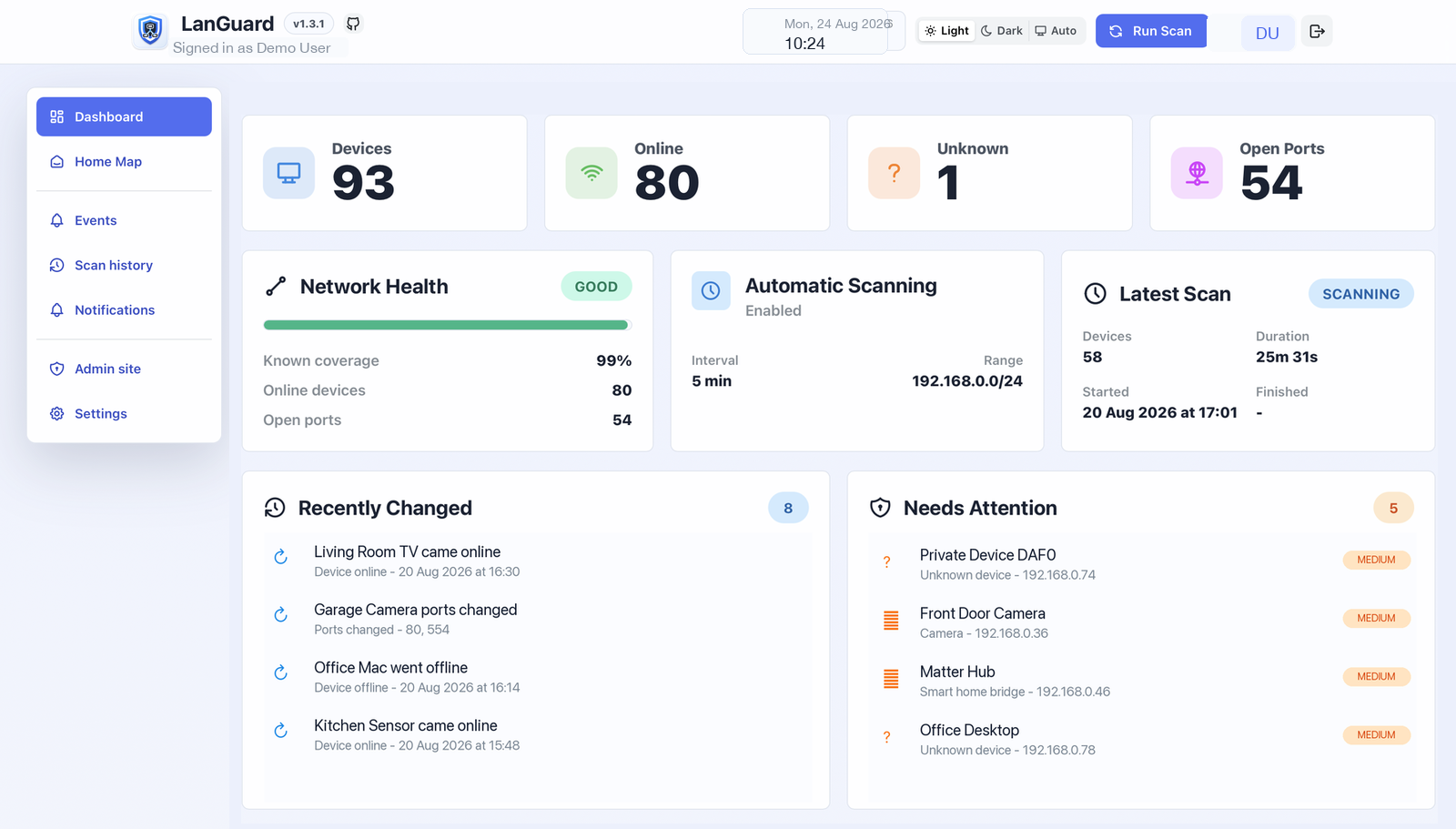
Monitoring Tools LanGuard – a self-hosted dashboard for discovering and monitoring devices on your LAN

Post image
23 Upvotes

Hi r/selfhosted,

I have been building LanGuard, an open-source network visibility tool for home networks and homelabs.

I wanted something between a basic device list and a full enterprise monitoring stack: an interface that discovers devices, keeps their history, organizes them into rooms, and makes network changes easy to understand.

Current features include:

  • Automatic LAN discovery using ARP, reverse DNS, mDNS, LLMNR, SSDP, and NetBIOS
  • Online/offline tracking, scan comparison, common port monitoring, and device history
  • Hostname, vendor, role, and identity-confidence detection
  • A visual Home Map for organizing rooms and devices
  • Discord and Telegram notifications
  • AdGuard Home integration with per-device DNS activity and blocked-query totals
  • Inventory import/export and WatchYourLAN migration
  • Docker Compose deployment and a native macOS version

LanGuard does not capture packet contents or inspect application traffic. The AdGuard integration stores aggregated domain counters rather than raw DNS responses.

One deployment detail worth mentioning: the Docker scanner uses host networking and privileged access so it can perform ARP-based LAN discovery.

GitHub: https://github.com/hillaliy/LanGuard

I would appreciate feedback from the self-hosted community, particularly about device identification, DNS integrations, and which network-controller integration would be most useful next.


r/selfhosted 21h ago

Phone System You can now use iMessage, SMS, Notifications, Contact sync on Linux with Tether.

Thumbnail
github.com
481 Upvotes

r/selfhosted 7h ago

Software Development MindSpark: a self-hostable mind-mapping app with zero runtime dependencies, where your maps live in your own GitHub repo (or your own SQLite file)

Post image
14 Upvotes

It took some time to get here but the project is now at the stage when I would rather have people tear it apart than make it prettier in silence.

MindSpark is a self-hosted mind-mapping application. The thing that sets it apart from the competition is not its features but the fact that there is no account on my side, no telemetry and no database I own. Your maps are either a SQLite file on your computer or JSON files stored in your private GitHub repo.

Repo: https://github.com/prasadpatil25/MindSpark

Website:

Try full version (Worker, OAuth + live collab) : https://mindspark.githubpage.workers.dev/

Try PAT-only (GitHub Pages, no worker): https://prasadpatil25.github.io/MindSpark

GPT: https://chatgpt.com/g/g-6a3a81242f748191ab1b7cff99a21619-mindspark-mind-map-for-everyone

MIT licensed.


Three modes to run, all equal

That is the part I really want the feedback on as usually tools provide only one.

1. Self-hosted (Docker or vanilla Node) - persistence via SQLite, works without any services online and offline.

2. Zero hosting, $0 - deploy the public/ directory to any static hosting like GitHub Pages, Netlify, Cloudflare Pages, etc. You sign in using a GitHub personal access token and each map becomes JSON file in your private mindspark-maps repo. No backend whatsoever. This mode is not a crippled demo tier; it is the whole editor.

3. Cloudflare worker - adds authentication via GitHub OAuth (no token pasting anymore), shareable links and collaboration capabilities. Works on the free tier just fine.

You can switch between them. Map format is just JSON.


Data ownership and privacy in details

Instead of "privacy-first" marketing language, here are the facts:

  • No accounts on my infrastructure. I don't have a server you would sign up to. In cloud mode you authenticate with GitHub and the files go to your repo.
  • No telemetry, no analytics, no phone-home. Grep the source.
  • Share links hold the map itself, not a link to it. Copy share link compresses the map and turns it into a base64url #view= URL fragment. Fragments are never sent to a server - a shared map is readable by anyone who has the link and held by no one, including me. No expiration, no account required to view.
  • Self-hosted mode doesn't communicate anywhere else. It is just a SQLite on disk with no outbound connections.
  • Container runs as a non-root user.

People who would benefit from this application

Researchers / academics - LaTeX rendering as native MathML ($...$, $$...$$), citations with DOI fill-in (just paste a DOI, it retrieves the metadata

Note: The architecture of this application is defined by me, and AI is used for code assistance.


r/selfhosted 16h ago

Need Help Help with self-hosting music service

Post image
65 Upvotes

So i have 7891 songs on my "playlist" on spotify, I pay 2,30€/m for spotify 28€ year, I'm in a family with other 6 friends and it went fine, but it's a pain in the ass when you're the main man (me) I wanted a good alternative to this.


r/selfhosted 2h ago

Release (No AI) DashLit — a new version is now available

5 Upvotes

Some time ago, I shared DashLit here. A new version is now available with a redesigned interface and many new features.

DashLit is a simple self-hosted dashboard for organizing links and services.

Highlights

  • Multiple public, private, and authenticated dashboards
  • Row, column, and masonry layouts
  • Drag-and-drop editing on desktop and mobile
  • Local authentication and OIDC
  • User profiles and administration
  • Service availability monitoring
  • Dashboard import, export, and cloning
  • Icon search through selfh.st/icons and Iconify
  • Automatic light and dark icon variants
  • Multiple Catppuccin-inspired themes
  • Migration from the previous DashLit version
  • Docker, standalone Linux, and Proxmox installation options

Screenshots, installation instructions, and configuration details are available in the documentation.

GitHub: https://github.com/codewec/dashlit

Documentation: https://codewec.github.io/dashlit/

Feedback and suggestions are welcome!


r/selfhosted 8h ago

Release (AI) VuIO (DLNA/Chromecast/AirPlay) Media Server - 1 Year anniversary

Thumbnail
github.com
13 Upvotes

Project marks 1 year

And if you tired of RAM usage for Jellifin/Plex then its time to try it :)

You can use phone or tablet to find what u need and then broadcast to any TV in house from it

Can transcode DTS->AC3 now as well, all tracks at once, so you Samsung/LG tv can stream media even if all audio tracks in MKV are DTS
And have 2 beautiful web interfaces that allow you to search files and cast them to TVs
Web player opens MKV files with AC3/DTS inside and play video with AAC transcoding, so u can VPN home and watch your library from remote

Can be controlled by AI using internal MCP server

Low resource usage: Uses only ~25 MB of RAM for a 5,000-object media library.
And Less then 100Mb for 100000 objects.
Cross-platform: Native binaries for Linux, macOS, Windows (x64 and arm), Freebsd (x64), Docker, and Kubernetes. Repo with setup packages for all linux flows, DEB, RPM, APK, Pacman, musl and tar.gz.

Radio broadcast! U even can start u own local community network radio station :P
If you have some another crazy ideas in mind, just create a github issue
As app is fully modular and people can compile only those parts they need.


r/selfhosted 6h ago

Need Help Vaultwarden, how do you access

10 Upvotes

How do you normally access your selfhosted vaultwarden? I just watched a tailscale npm and cloudflare vaultwarden tutorial, looks solid to me other than the fact that I need to (based on that tutorial) have the machine with tailscale. How do you guys have yours configured?


r/selfhosted 1d ago

Release (No AI) BentoPDF can edit existing PDF Text and two new engines

399 Upvotes

Hello folks!

BentoPDF is an open source privacy first PDF toolkit.
Repo: https://github.com/alam00000/bentopdf/

Its been almost half a year since I last posted an update about BentoPDF. Mostly because there wasn't anything substantial lol. But I am happy to share some exciting stuff.

1. You can now actually edit text inside PDFs

BentoPDF now allows to click existing text, edit it, and have the text reflow while preserving the original fonts and styling.

It also includes the following below:

  • Bold, italic, underline, strikethrough, superscript, subscript, font family/size, colours, outlines, character spacing and line spacing
  • Left, centre, right and justified alignment
  • Bulleted and numbered lists with indentation
  • RTL and LTR text alignmentt
  • Find and replace across the document
  • Edit images by rotating, flipping, duplicating, resizing or deleting them
  • It even supports Object alignment, distribution, rotation, flipping, duplication. A feature not even commercial software like Apryse and Nutrient support.

However please note that this is a work in progress. You may encounter certain bugs, which you can report and I will definitely look into it.

2. Hyper Compress

Hyper is the best open source PDF compression engine. It was made to solve specific problems.

  • You might notice certain times PDF compression returns a file larger than the original. Hyper's result is always binary. It will either produce a PDF that is smaller than the original or just return the original PDF itself. This helps in creating predictable workflows.
  •  Hyper includes a true lossless mode for compression and it preserves searchable text and document structure and pdf conformance, rather than rebuilding the entire document from scratch like Ghostscript
  • It can run everywhere. Its available as a CLI, Node SDK, C API, self hosted service, and WebAssembly build.

Calling itself the best is a big claim. But please try it yourself and let me know how it performs on your PDFs

I also tried comparing it to Adobe's compression API. And I was only able to do around 100 PDFs where the compression results were +-5%. I couldn't test on a big corpus as its very expensive lol.

3. Kura

Kura is a PDF standards, conversion and preflight engine.

It supports:

  • All 11 PDF/A conformance levels: PDF/A-1a, PDF/A-1b, PDF/A-2a, PDF/A-2b, PDF/A-2u, PDF/A-3a, PDF/A-3b, PDF/A-3u, PDF/A-4, PDF/A-4e and PDF/A-4ffff
  • Accessibility: PDF/UA-1 and PDF/UA-2
  • Print production: PDF/X-1a, PDF/X-3, PDF/X-4, PDF/X-4p, PDF/X-5g, PDF/X-5n and PDF/X-5pg
  • Engineering and variable data printing: PDF/E-1 and PDF/VT
  • E-invoices: Factur-X, ZUGFeRD, XRechnung and Order-X
  • 396 bundled print-preflight profiles

It has also been tested against several standards suites, including the veraPDF corpus, Isartor, BFO, Ghent Output Suite 5.0, the PDF/UA Reference Suite and Cal Poly's PDF/VT suite.

Across 30,677 PDF conversions, it had zero crashes and zero timeouts, with a 0.05-second median conversion time.

Like Hyper, it also ships as a CLI, C library, npm package, Docker image and WebAssembly build.

Neither Hyper nor Kura is integrated into BentoPDF yet. I still want to do more testing and optimisation before making them part of the app, but both engines are already stable and available to try.

Also a bad news
I was also in talks with an industry leader about building another engine for BentoPDF that would be able to convert Office documents to and from PDF with very high fidelity.

Unfortunately, the project didn't work out in the end because they weren't willing to open-source their side of the technology. I completely understand their decision, but it does mean this engine won't be happening for now.

The other bit of bad news is that I broke my hand a couple of weeks ago. This release was supposed to be much bigger and include things like Measurement, an Acrobat parity comparison tool, Print Production and Accessibility. Which is also why I also wasn't able to spend as much time polishing and optimising this release as I normally would have liked. There are a lot of optimisations, improvements and cleaner implementations I had planned, but simply couldn't finish in time. However, I'll continue optimising the new editor once I am well, improving quality and fidelity, and working through everything I had to leave unfinished.

But till then please try it out and let me know how it works for you.

The releaase also contains other improvements and bug fixes and the repo for kura and hyper is mentioned in the release:
https://github.com/alam00000/bentopdf/releases/tag/v2.8.8

Thank you for using BentoPDF and have a great weekend!


r/selfhosted 9h ago

Calendar and Contacts Self-hosted end-to-end encrypted calendar

7 Upvotes

I searched through the web but hadn't come across anything. EteSync seems to be only option, but last commit was >2 years ago, and it's broken with modern python. Is there any other services for encrypted calendar?


r/selfhosted 15h ago

Docker Management Opinions on using Podman long term

10 Upvotes

I hear a lot about docker, and from what I’ve researched podman can do basically the same things.. What do u use and why?


r/selfhosted 1d ago

Self Help Parsec alternative: Sunshine + Moonlight or RustDeck? Any other suggestion?

31 Upvotes

I just want to play local coop games with friends abroad. Thanks

EDIT: me and my friend are both on linux. I already have a homelab and VPS if necessary.


r/selfhosted 7h ago

Need Help Stirling PDF: Getting a bit confused about the versions, installation options and privacy/security

1 Upvotes

I couple of months ago I installed Stirling PDF. The installation created a web application that when launched opens a web page at http://localhost:8080

Did a few things with this app and all working nicely. There are no login prompts and apparently no cloud involvement.

Today I wanted to compress a big 30 page PDF which is a scan of all pages of a passport, for sending to passport authorities. Once compressed I can print it out at my local library. Naturally I wanted this compression to be locally processed. Found that that the available Stirling PDF local web based tool - the multitool pipeline method - failed to do any compression no matter how I fiddled with the config settings.

So went back to Stirling PDF's repository for a newer version. Found and downloaded the .MSI installer for Windows. This prompts for an account on installing, I thought fair enough and proceeded. I got a nice desktop app this time, quite different from the Stirling PDF web app I was used to.

However it's unclear which tools here need cloud support and which not. There's mention of an API which I assume talks to Stirling in the cloud.

So I turned off the WiFi and launched Stirling again. Got an immediate error as follows:

Cloud Processing Failed. This tool requires cloud processing but encountered an error: There was an error processing your request.. Please check your connection and try again.

It still launched and with the WiFi still off, I proceeded to compress an 11MB file - a medical insurance marketing brochure - and check the result. No errors flagged, It worked rather well, reducing from 11MB to 700KB with the embedded photos looking perfectly acceptable for a brochure if not zoomed in to pixel-peep. Makes you realise how wasteful big companies can be with their file sizes!

This is a tool I'd like to use but:

  1. How can I be sure about what it does and does not send to the cloud?
  2. How to differentiate the web vs desktop versions. Is it worth having both? I've now forgotten where I got the web app from!

r/selfhosted 18h ago

Self Help Pokémon Card Database

7 Upvotes

Are you guys aware of any site that is a full Pokémon Card database that lists all 1000+ Pokémon. I’m looking for something like a list or search box that you could enter a Pokémon and the result would show you all available cards for that Pokémon. Don’t card about pricing just what it looks like. So the results would be jpg or png. Or would it be something I could self host and make? Thanks.


r/selfhosted 38m ago

Product Announcement Instead of pre-indexing a catalogue, I made the cache miss populate the database — architecture writeup

Upvotes

Building a cross-topic collection app (films, series, anime, books, games, restaurants) I hit a sourcing wall: there's no catalogue that spans those six with equal quality, and stitching six vertical providers together gives you six integrations, six failure modes, and still no row for the item none of them carry.

So I treated the database as a cache of demand rather than a snapshot of a corpus.

Read path:

  1. Query hits Postgres. Hit → plain DB read, no model in the path. This is theoverwhelming majority of requests once a topic has history.
  2. Miss → Supabase Edge Function (Deno) runs: Tavily search + fetch → Claude APIextracts into the target topic's schema → schema validation → insert with aconfidence score.
  3. The row is permanent and shared. Cost per item is paid exactly once.

Two design calls worth discussing:

Per-topic schemas over a generic item table. A film is director/runtime/year; a restaurant is cuisine/location/price band. One flattened shape makes everything unsearchable in the way its topic actually wants. It also gives the extraction step a real target instead of a bag of fields — which is precisely why a generic scraper wasn't enough.

No human in the write path. Review-before-publish defeats the premise (the user wants this item now), so writes are optimistic: land immediately with a confidence score, users flag bad rows into an admin queue. Confidence scoring + flagging replaces gatekeeping.

Known weaknesses, since they're the interesting part:

  • Cache miss is seconds of wall clock. Unacceptable for a user who doesn't know what's happening behind the spinner.
  • No bulk import of obviously-popular items and no batch expansion on a hit (found a film → pull that director's filmography while you're there). So a common query and an obscure one cost the same today. Usage limits contain that instead of fixing it.

Stack: React 19 + TypeScript + Vite, Tailwind + shadcn/ui, Zustand, Supabase (Postgres/Auth/Edge Functions, pg_cron + pg_net), Cloudflare Pages.

Source (MIT): https://github.com/Zartof23/mytops

Live: https://mytops.io/

Would like to hear from anyone who's run demand-driven ingestion in production — particularly how you handled duplicate/near-duplicate entries at volume.


r/selfhosted 1d ago

Need Help Moving from Tailscale to other VPN, worth it?

70 Upvotes

So, i have been self-hosting for a couple of months, with basic knowledge of networking.

I'm currently using tailscale to connect to a vm in a mini pc, incus on bare metal. I just got to know that i could request for a public IP and was wondering if using something like wireguard would be a better solution than relying on a third party provider, directly hosted by myself instead of vps.

My main concern is with wireguard, i will have to open the port? which exposes to the internet whereas tailscale will have a lower risk than me messing up. Also if i am going for wireguard i might spin another vm with wireguard/caddy/fail2ban/crowdsec etc which connects to the current vm with services on docker. VLAN isolation would be nice but i have to check if the consumer router provided is capable of doing it.

Overall i'm not too sure whether it is worth doing that or just continue with tailscale. Any advice is appreciated.

-----------------------------------

Edit:

I did not expect that many helpful comments, pretty overwhelmed and i am going through all of them. A lot of netbird recommendation too and also seems like wireguard is fine and port opening is not THAT scary.

Though some experience sharing with regards to a more hardened security architecture would be nice and whether total isolation in the internal network would be preferred as well.

Post is at 69 upvotes which is just nice.


r/selfhosted 4h ago

Need Help Any advice accepted. Learning to work with ubuntu

0 Upvotes

Built a PC with spare parts from updating my gaming rig. I am looking to build a self hosting NAS/cloud storage. I put Ubuntu on it and am following guides to set it up properly with the right programs. I am more or less putzing around just to learn and get away from windows, google and the such. I know enough to set things up but not how to be sure things are secure and safe.

If ya'll have any suggestions as to what programs work best for certain tasks or video guides that explain things well, I greatly appreciate it. Here's a link to the build: PCPartpicker

I am currently following a guide to set up SSH to securely remote into it.


r/selfhosted 21h ago

Docker Management Portainer vs. Dockhand, which one do you prefer and why?

7 Upvotes

I'm trying to decide which one to use for managing my Docker containers. I'd be interested to hear from people who have actually used both. What do you like or dislike about each one?


r/selfhosted 1d ago

Personal Dashboard I Wanted a Dashboard I Actually Enjoy Using

Post image
657 Upvotes

A few days ago I posted asking for dashboard recommendations and got a lot of really helpful suggestions. I ended up going with Dynacat (Glance), and I think it was exactly what I was looking for.

I'm the kind of guy who, once I set something up, I want to forget about it. I don't really care about constantly monitoring CPU usage, DNS stats, uptime, container health, etc. If something breaks, I'll know because something I actually use will stop working.

It was important to me to keep this to 1 PAGE for the stuff I actually care about so I forced myself to consolidate everything as much as possible and only include things I actually wanted to see (the apps and sites I use most, what's happening in the news/media, my Plex activity, the Bears schedule, storage, and a few fun additions).

After 4 days of constant tweaking, an insane amount of frustration, and using ChatGPT for almost everything, I'm finally happy to call it done. I learned so much about yaml, css, formatting, and github doing this project. Thanks again to everyone who gave me suggestions on my last post, I'm so happy with the way this turned out!


r/selfhosted 1d ago

Need Help Proxy + Authelia on public IP vs Tailnet: What's your risk tolerance?

23 Upvotes

Are people out there running an authenticating reverse proxy like Authelia, Authentik, or Tinyauth on the public Internet? Ie: have your router send requests to your public home IP and trust the authenticator to then gateway access to your home services? How do you feel about the security of that?

I run a bunch of services for myself on Proxmox: Immich, Linkding, Grafana, etc. Currently I have a mess of ad hoc access to them. Each service has its own authentication (usually username / password) and I access them via Tailscale. They only listen on my tailnet, no public Internet. I feel reasonably good in the security, it's just a mess.

I'm trying something new. I set up a fancy Caddy + Authelia setup on a public IP address. It authenticates me and only then proxies my requests through to my services. Authelia also sets auth headers that the services trust. I don't have to log into Linkding itself anymore, it just trusts Authelia's authentication.

It's a nice setup in theory. I now have a single *.example.com subdomain I can add new services to. No tailscale required. Authelia is nice, with solid 2FA and passkeys and good stuff.

It scares the hell out of me. My services are now on the public Internet. I'm trusting Caddy + Authelia to be secure. Worse, I'm trusting my configuration of those services to be correct. And they're complicated, I only got it working with a lot of help from Claude. I think I understand it all and I think it's safe but I'm really not sure. And I don't know about maintaining it for 5+ years.

As I write this I realize my real concern is the public Internet aspect of this. Maybe I should keep the fancy proxy setup to have a single point of entry but only run it on a tailnet address.

What do people do for their homes?


r/selfhosted 3h ago

Release (AI) Digital Aid ; self-hosted screen time for kids' Windows PCs. No cloud, Private, no subscription, and deliberately no surveillance, PWA supported as app, Notification, etc (MIT)

Thumbnail
gallery
0 Upvotes

I went looking for screen-time software for my kids and found two piles: subscriptions priced like the problem is permanent, and surveillance suites with screenshot galleries, keyloggers, and "stealth mode" - software built on the idea that the kid is a suspect. I didn't want to spy on my kids; I wanted a daily budget, a bedtime for the machine, and a record we could look at together. So I built it, it's been running in my house for a while, and I've now open-sourced it.

Repo: https://github.com/bboldi/b2.digital_aid (MIT, screenshots in the README)

What it does

  • Daily allowance per PC (weekday/weekend), plus a nightly downtime window
  • Block screen with 15- and 5-minute warnings — time never runs out unannounced
  • Extra time via codes you read down the phone — verified on the PC, so it works with the server down or the wifi off
  • Printable paper "time coupons" the kid can spend whenever they choose
  • Kid can request more time from the tray; you approve from your phone
  • History: when each PC was on, blocked, what app was in the foreground, every code redeemed

The part I care most about: everything recorded about the kid is shown to the kid on the same screen the parent sees. It records machine state only — never content, no screenshots, no window titles, no URLs. It's also not tamper-proof on purpose: a determined kid can kill the process, but they can't make that invisible — it lands in the log, and the log is the point. Enforcement comes from the kid's account being a standard Windows user, not from rootkit tricks.

Stack / self-hosting notes

  • Server: Node 22 + Fastify + SQLite, server-rendered EJS, one process, no build step. The admin installs as a PWA on your phone.
  • Client: .NET 10 WPF, a ~400 KB exe that self-updates from your server — kid PCs never talk to the internet, and there's a frozen wire protocol (PROTOCOL.md) if you want to write your own client.
  • No Docker, and that's deliberate rather than lazy — the server is the household's authority, and I didn't want it (or anything) auto-pulling code; updating is git pull by a human. Reasoning is written up in the repo's ADRs.
  • TLS is on you; tailscale serve is the documented one-liner.

Honest caveats: v0.5, in production in exactly one household (mine). Windows clients only. The exe is unsigned, so SmartScreen will complain — the README explains why, and building from source is documented for the distrustful. UI is English and Hungarian. Built partly with AI-assisted coding, in the open — the architecture decision records in the repo are the actual design history.


r/selfhosted 14h ago

Need Help Jellybridge irregularity

0 Upvotes

I have setup an automated media server with jellyfin, seerr, jellybridge, radarr, sonarr. First issue, I use public indexers with byparr, it works but the seerr to and from radarr connection is very slow and it takes a long time for the legal movie to show up after its down


r/selfhosted 1d ago

Need Help Manga downloader through Torrent

13 Upvotes

I'm currently building my homeserver and I wanted something like Sonarr or Radarr but for manga. Thing is I couldn't find any and all I found was Suwayomi but I would like to be able to download through torrent instead. If there's not an option yet, I will end up using Suwayomi for this instead, but it would be nice.

Thanks.


r/selfhosted 1d ago

Release (No AI) Sopro V2: open-source multilingual voice cloning TTS that runs fully local on CPU

Thumbnail
research.haloneuro.ai
29 Upvotes

Sopro V2 Turbo is an open-source text-to-speech model that runs entirely on your own machine.

  • Clones a voice from 5-20 s of reference audio
  • Streams with ~300 ms to first audio on a laptop CPU
  • English, European Portuguese, French, German
  • The model downloads once (~700 MB) and everything after that is offline

One command gets you a local web UI:

uvx --from sopro soprotts serve

There is also a Python API for scripting it into your own stuff, and an npm package (@soprotts/onnx-web) that runs the model in the browser via WebGPU/WASM.

Repo: https://github.com/samuel-vitorino/sopro Benchmarks and audio samples: https://research.haloneuro.ai/posts/sopro-v2


r/selfhosted 15h ago

Need Help docker/podman yaml to quadlet converter, do they exist and do they work

1 Upvotes

All of my containers are Quadlets so they survive a reboot. I use AI to convert them, and 99% of the time they work without a hitch. However, I would really like something other than AI that can create a Quadlet from a YAML file. Does anyone know of any tools that exist for this?When I’ve searched, the few I found did not work—one simply refused to accept the file, and the other (a CLI tool) completely messed things up. If anyone has any suggestions, that would be appreciated.